CT-388 for Weight Loss: Results, Side Effects, and Current Status
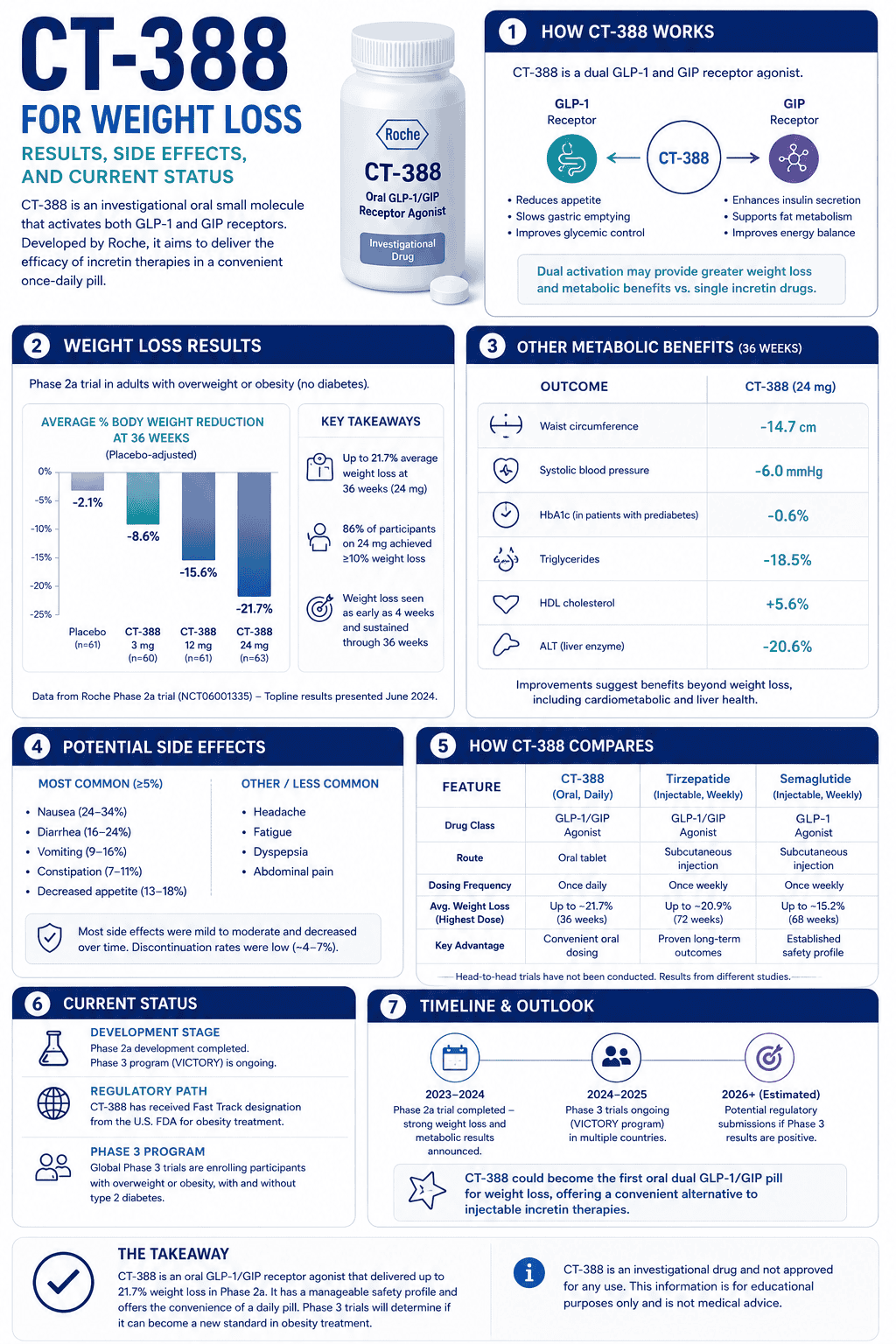
CT-388, also called enicepatide, is an investigational once-weekly injectable GLP-1/GIP receptor agonist being developed by Roche and Genentech for obesity, type 2 diabetes, and related metabolic conditions. Early clinical results are promising, but CT-388 is not approved and should not be used outside a regulated clinical trial.
In a Phase 2 obesity trial, Roche reported 22.5% placebo-adjusted weight loss at 48 weeks at the highest tested dose of 24 mg, without a reported weight-loss plateau. The main side effects reported so far are gastrointestinal and broadly consistent with the incretin drug class.
This article focuses on CT-388 for weight loss and current clinical development, not Roche’s separate oral GLP-1 candidate CT-996.
Who this is for: Readers tracking CT-388 trial results, side effects, dosing studied in research, and how close it may be to approval.
Who this is not for: Anyone trying to buy, compound, dose, or use CT-388 outside a regulated clinical trial.
Reviewed by VerifiedSupps Editorial Team • Last reviewed: May 18, 2026
The answer-first view: CT-388 looks like one of the more important obesity drug candidates in Roche’s pipeline. Its Phase 2 data showed large weight loss over 48 weeks, but the program still needs full Phase 3 results before anyone can judge durability, real-world tolerability, and regulatory approval odds with confidence.
The most important caution is that CT-388 is not a supplement and not an approved prescription medicine. It is a clinical-stage drug candidate. Any product sold online as “CT-388” or “research enicepatide” should be treated as unverified and unsafe for personal use.
For comparison context, see our separate article on CT-388 vs tirzepatide. If you are tracking the broader obesity-drug pipeline, you may also want to compare VK2735 for weight loss, retatrutide, and MariTide.
Key Takeaways
- CT-388 is an investigational once-weekly subcutaneous GLP-1/GIP receptor agonist.
- Roche reported 22.5% placebo-adjusted weight loss at 48 weeks at the highest tested 24 mg dose in a Phase 2 obesity trial.
- A more inclusive treatment-regimen analysis showed 18.3% placebo-adjusted weight loss.
- The main side effects reported so far are gastrointestinal, including nausea, vomiting, diarrhea, and reduced appetite.
- CT-388 has moved into Phase 3 development, including ENITH trials in people with and without type 2 diabetes.
- CT-388 is not approved, not commercially available, and should not be used outside clinical research.
Does CT-388 work for weight loss?
Early clinical data suggest CT-388 can produce substantial weight loss, but the evidence is not final. The strongest publicly available result so far is Roche’s 48-week Phase 2 obesity trial.
CT-388 is a dual GLP-1/GIP receptor agonist. That places it in the same broad drug class as tirzepatide, but CT-388 is a separate molecule with its own clinical development program, dosing research, and safety questions.
Mechanism
- GLP-1 activation: May reduce appetite, increase fullness, slow gastric emptying, and support glucose regulation.
- GIP activation: May add metabolic and appetite-related effects when paired with GLP-1 activity.
- Signal bias: CT-388 is described as a signal-biased dual agonist designed to favor cAMP signaling with limited beta-arrestin recruitment.
- Outcome gap: Mechanism does not prove superiority. Larger Phase 3 trials are needed to confirm long-term weight loss, safety, and adherence.
The practical meaning is simple: CT-388 is designed to influence appetite and metabolic signaling, not to “burn fat” directly. Weight loss with this type of drug is mainly expected through reduced energy intake, appetite control, and related metabolic effects.
For broader incretin-drug context, see our guides on retatrutide vs tirzepatide and how retatrutide works. Retatrutide uses a different triple-agonist strategy, while CT-388 is a dual GLP-1/GIP agonist.
How much weight did people lose on CT-388?
In Roche’s Phase 2 CT388-103 obesity trial, the highest tested CT-388 dose produced 22.5% placebo-adjusted weight loss at 48 weeks using the efficacy estimand. Roche also reported 18.3% placebo-adjusted weight loss using the treatment-regimen estimand.
That wording matters. “Placebo-adjusted” means the number reflects the difference between CT-388 and placebo, not necessarily the raw average weight loss from baseline. Different estimands also answer slightly different trial questions, especially around treatment adherence and discontinuation.
| Study or dataset | Population | Duration | Reported result |
|---|---|---|---|
| Phase 1 obesity cohort | Adults with obesity, without type 2 diabetes | 24 weeks | 18.8% mean placebo-adjusted weight loss |
| Phase 2 CT388-103 | 469 adults with obesity, or overweight with at least one weight-related comorbidity, without type 2 diabetes | 48 weeks | 22.5% placebo-adjusted weight loss at 24 mg using the efficacy estimand |
| Phase 2 treatment-regimen analysis | Same CT388-103 study | 48 weeks | 18.3% placebo-adjusted weight loss |
| Phase 2 CT388-104 | Adults with obesity or overweight and type 2 diabetes | 48 weeks | Ongoing or not fully reported as of this review |
Responder data were also notable in the 24 mg group at week 48. Roche reported that 95.7% of participants achieved at least 5% weight loss, 87% achieved at least 10%, 47.8% achieved at least 20%, and 26.1% achieved at least 30%.
Roche also reported that 54% of participants on the 24 mg dose achieved a BMI below 30 kg/m2, compared with 13% in the placebo group. Among participants who had prediabetes at baseline, 73% on CT-388 24 mg achieved normal blood glucose levels at week 48, compared with 7.5% in the placebo group.
These are strong Phase 2 signals, but they are still not the same as completed Phase 3 evidence. For another example of why early obesity-drug results need careful interpretation, see our articles on MariTide for weight loss, mazdutide for weight loss, and survodutide for weight loss.
What CT-388 dose was used in studies?
CT-388 has no approved dose. In clinical studies, it has been tested as a once-weekly subcutaneous injection with gradual dose escalation.
The Phase 2 CT388-103 trial evaluated low, middle, and high doses across five dosing cohorts, with 24 mg as the highest tested dose. The study used different up-titration schemes rather than starting participants immediately at the highest dose.
- Route: Subcutaneous injection.
- Frequency: Once weekly in clinical trials.
- Highest tested Phase 2 dose: 24 mg.
- Dose escalation: Used in research to improve tolerability and evaluate different regimens.
- Consumer dose: None. There is no approved dosing schedule for CT-388.
This is a critical safety point. Trial doses should not be copied from press releases, registry entries, or online forums. A dose used in a monitored clinical trial is not a safe do-it-yourself protocol.
If you are seeing CT-388 sold online as a “research peptide,” read our guide on whether peptides are safe. Unapproved peptide products can raise concerns around identity, sterility, dosing accuracy, contaminants, storage, and lack of medical monitoring.
What are the side effects of CT-388?
The most common CT-388 side effects reported so far are gastrointestinal. Roche described the Phase 2 safety profile as generally consistent with the incretin class, with no new or unexpected safety signals in the topline release.
In the Phase 2 obesity trial, Roche reported that most gastrointestinal adverse events were mild to moderate. Discontinuation due to adverse events was 5.9% across CT-388 arms compared with 1.3% in the placebo arm.
- Likely GI effects: Nausea, vomiting, diarrhea, constipation, abdominal discomfort, and reduced appetite may occur with GLP-1/GIP drugs.
- Injection-related effects: Bruising, discomfort, swelling, itching, or other local injection-site reactions are possible with subcutaneous injections.
- Discontinuation: The reported Phase 2 adverse-event discontinuation rate was relatively low, but full safety tables are still needed.
- Long-term unknowns: Larger studies are needed to better assess gallbladder events, pancreatitis signals, kidney complications, dehydration risk, and rare adverse events.
- Lean mass: Large weight loss can include lean mass loss if protein intake, resistance training, and clinical monitoring are not managed well.
The current safety picture is encouraging but incomplete. Topline trial summaries are useful, but they do not replace full published safety tables, longer follow-up, and regulatory review.
The lean-mass question matters for all strong weight-loss drugs. For more context, see our guide on retatrutide and muscle loss and our article on how much protein you actually need.
Who should avoid CT-388?
Outside a regulated clinical trial, everyone should avoid CT-388. It is not approved, does not have a final prescribing label, and has not completed the evidence package needed for routine medical use.
If CT-388 is eventually approved, the final label will determine contraindications, warnings, monitoring needs, and eligible populations. Until then, caution is especially important for groups that commonly require careful screening with incretin-based therapies.
- People who are pregnant, trying to become pregnant, or breastfeeding.
- People with a history of pancreatitis, gallbladder disease, or severe gastrointestinal motility problems.
- People using insulin, sulfonylureas, or other glucose-lowering medications where appetite and glucose changes could affect hypoglycemia risk.
- People with kidney disease or a history of dehydration from vomiting or diarrhea.
- People with active eating disorders or a high risk of under-eating.
- Anyone considering gray-market injections, research vials, or compounded products labeled as CT-388.
A basic rule applies: promising trial data do not make an investigational drug safe to self-administer. CT-388 belongs in clinical research until regulators review the full data.
What is the current status of CT-388?
As of May 18, 2026, CT-388 is not approved for weight loss or type 2 diabetes. Roche’s latest public pipeline materials list enicepatide, the name used for CT-388, as a Phase 3 obesity asset.
Roche has initiated Phase 3 ENITH trials for obesity with and without type 2 diabetes. CT-388 is also being studied in an additional Phase 2 trial in people with obesity or overweight and type 2 diabetes.
| Program | Population | Status | Why it matters |
|---|---|---|---|
| CT388-103 | Obesity or overweight with weight-related comorbidity, without type 2 diabetes | Phase 2 topline data reported | Supports the 48-week weight-loss signal |
| CT388-104 | Obesity or overweight with type 2 diabetes | Phase 2, active or not fully reported | Will help clarify weight and glucose effects in people with type 2 diabetes |
| ENITH-1 | Obesity or overweight without type 2 diabetes | Phase 3 initiated | Key confirmatory obesity trial |
| ENITH-2 | Obesity or overweight with type 2 diabetes | Phase 3 initiated | Important for diabetes-associated obesity use |
| CT-388 + petrelintide | Obesity pipeline combination research | Phase 2 initiation expected in 2026 | May test GLP-1/GIP plus amylin-pathway combination strategy |
No reliable approval date can be given yet. Phase 3 trials must complete, results must be analyzed, and regulators must review efficacy, safety, dosing, labeling, and manufacturing before CT-388 could be used commercially.
How does CT-388 compare with tirzepatide and other weight-loss drugs?
CT-388 is promising, but it should not be called better than tirzepatide or other approved obesity medications yet. The drugs have not been compared head-to-head in a completed obesity trial, and CT-388 has not completed Phase 3 development.
The cleanest comparison is by development stage. Tirzepatide is approved and has large Phase 3 data. CT-388 is investigational with strong Phase 2 data. Other pipeline drugs use different mechanisms and should not be ranked from headline numbers alone.
- CT-388 vs tirzepatide is the most direct comparison because both are GLP-1/GIP drugs.
- Retatrutide trial results matter because retatrutide uses a GLP-1/GIP/glucagon triple-agonist strategy.
- CagriSema for weight loss combines semaglutide with an amylin analog approach.
- Cagrilintide, petrelintide, and amycretin are examples of amylin-pathway obesity research.
- Pemvidutide is being studied for weight loss and fatty liver with a different receptor strategy.
The practical takeaway: CT-388 is one to watch, not one to use. Phase 3 results will determine whether its strong Phase 2 signal becomes a clinically useful, regulator-reviewed treatment option.
References
- Genentech. Positive Phase II Results for CT-388 in People Living With Obesity. January 26, 2026.
This source supports the 48-week Phase 2 CT388-103 topline results, including 22.5% placebo-adjusted weight loss, responder rates, BMI changes, prediabetes subgroup data, and discontinuation due to adverse events.
- Roche. Positive Phase II Results for Dual GLP-1/GIP Receptor Agonist CT-388. January 27, 2026.
This Roche release confirms CT-388’s investigational status, Phase 2 study design, 469-participant trial population, highest tested 24 mg dose, and planned Phase 3 development.
- Roche. First Quarter 2026 Update and Pipeline Materials. April 23, 2026.
This source supports the current pipeline status, including Phase 3 ENITH-1 and ENITH-2 initiation for enicepatide, Roche’s name for CT-388, and planned obesity-pipeline newsflow.
- Roche ForPatients. CT388-104 Study of Enicepatide in Participants With Obesity or Overweight and Type 2 Diabetes.
This registry-style Roche page supports the current type 2 diabetes trial context, once-weekly subcutaneous dosing, experimental status, eligibility details, and known unwanted effects listed for study participants.
- ClinicalTrials.gov. NCT06525935: CT388-103 Phase 2 Study of Enicepatide in Obesity or Overweight.
This trial registry supports the Phase 2 CT388-103 study design in adults with obesity or overweight with at least one weight-related comorbidity and without type 2 diabetes.
- ClinicalTrials.gov. NCT06628362: CT388-104 Phase 2 Study of Enicepatide in Obesity or Overweight With Type 2 Diabetes.
This trial registry supports the ongoing Phase 2 study in people with obesity or overweight and type 2 diabetes.
- ClinicalTrials.gov. NCT07351045: ENITH-1 Phase 3 Study of Enicepatide Without Type 2 Diabetes.
This source supports the Phase 3 ENITH-1 study in participants with obesity or overweight without type 2 diabetes.
- ClinicalTrials.gov. NCT07351058: ENITH-2 Phase 3 Study of Enicepatide With Type 2 Diabetes.
This source supports the Phase 3 ENITH-2 study in participants with obesity or overweight and type 2 diabetes.
- Chakravarthy MV, et al. Effects of CT-388, a once-weekly signaling-biased dual GLP-1/GIP receptor agonist, on weight loss and glycemic control. Molecular Metabolism. 2025.
This peer-reviewed source supports the mechanistic framing of CT-388 as a signal-biased dual GLP-1/GIP receptor agonist and provides early preclinical and clinical context.
- Ismaiel A, et al. Gastrointestinal adverse events associated with GLP-1 receptor agonists in adults with overweight or obesity. International Journal of Obesity. 2025.
This review supports the broader safety context that nausea, vomiting, diarrhea, and constipation are common adverse effects across GLP-1-based obesity therapies.
FAQ
Is CT-388 approved for weight loss?
No. CT-388 is investigational and is not approved for weight loss or type 2 diabetes as of May 18, 2026.
Is CT-388 the same as enicepatide?
Yes. Enicepatide is the name Roche uses for CT-388. It may also appear in research materials as RO7795068 or RG6640.
Is CT-388 an oral weight-loss drug?
No. CT-388 is being studied as a once-weekly subcutaneous injection. Roche has a separate oral obesity candidate called CT-996.
How much weight loss did CT-388 show?
Roche reported 22.5% placebo-adjusted weight loss at 48 weeks at the highest tested 24 mg dose in a Phase 2 obesity trial. A treatment-regimen analysis showed 18.3% placebo-adjusted weight loss.
What are the main CT-388 side effects?
The main side effects reported so far are gastrointestinal, including nausea, vomiting, diarrhea, and reduced appetite. Injection-site reactions may also occur with subcutaneous dosing.
Is CT-388 better than tirzepatide?
That cannot be concluded yet. CT-388 has promising Phase 2 data, but tirzepatide has completed large Phase 3 trials and has an approved prescribing label. Direct head-to-head data would be needed for a fair comparison.
Can you buy CT-388 online?
You should not buy or use CT-388 online. Products marketed as CT-388 outside clinical trials may be unverified, unregulated, mislabeled, contaminated, or unsafe.
Medical Disclaimer
This article is for educational purposes only and does not provide medical advice, diagnosis, or treatment. CT-388 is an investigational drug candidate and should not be purchased, compounded, prescribed, or used outside a regulated clinical trial unless it receives regulatory approval and is prescribed by a qualified clinician. People considering obesity treatment should speak with a licensed healthcare professional about approved options, contraindications, side effects, glucose monitoring, nutrition, muscle preservation, and long-term weight-management planning.