By VerifiedSupps Editorial Team
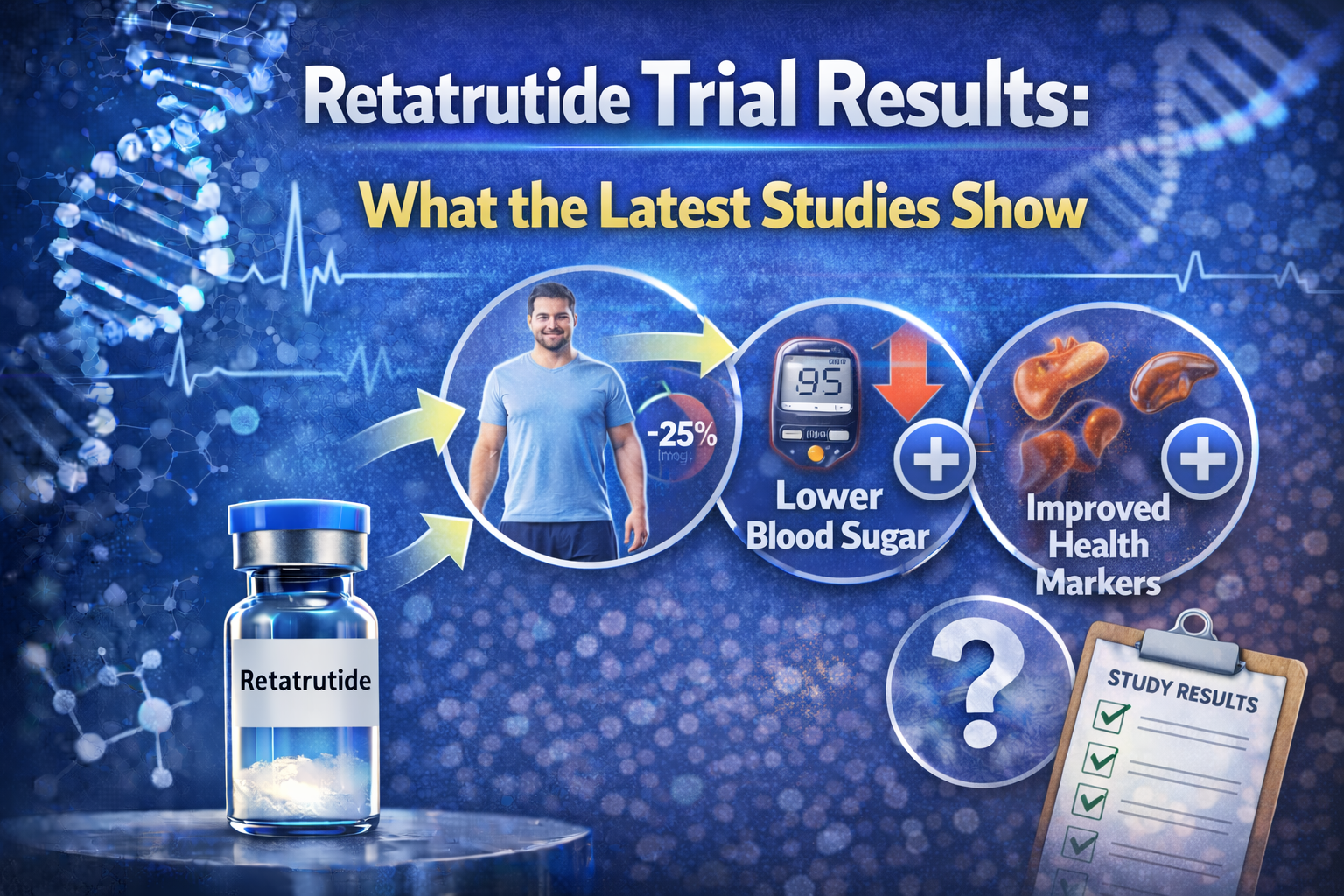
Retatrutide Trial Results: What the Latest Studies Show
The retatrutide story is now strong enough that it deserves serious attention. The most important published obesity dataset still comes from phase 2, where the highest dose reached 24.2% average weight loss at 48 weeks. Since then, newer phase 3 public readouts have pushed the excitement even higher.
That sounds impressive because it is. But the clean reading is still more disciplined than the hype. Some of the most dramatic newer results are still topline announcements, not yet full peer-reviewed publications, and retatrutide remains investigational rather than publicly approved.
This page is for the practical question: what the latest retatrutide studies actually show, which results are strongest, which are still preliminary, and what that means for how seriously you should take the drug right now.
Key terms: retatrutide, triple agonist, obesity trial, phase 2, phase 3, type 2 diabetes, MASLD, liver fat, trial-only status
Quick Take
The latest studies show retatrutide is one of the strongest obesity-drug candidates currently in development. The main caution is not whether it looks real. It is that the newest story still mixes published phase 2 evidence with phase 3 toplines and an unfinished approval timeline.
TL;DR decision
The latest retatrutide studies suggest a serious late-stage obesity and metabolic drug candidate, not a speculative rumor. But the cleanest interpretation still is “strong and getting stronger,” not “fully settled and ready for routine public use.”
Evidence standard: human trials, dose ranges, guideline-level sources when available
Who this is for: people trying to understand the newest retatrutide results without confusing published data, topline announcements, and pipeline status
Who this is not for: anyone looking for gray-market sourcing, fake trial shortcuts, or reassurance that anything sold online as retatrutide is legitimate
Reviewed by: VerifiedSupps Editorial Team
Last reviewed: April 17, 2026
Parent Hub
VerifiedSupps Articles
Use the main article hub if you want a calmer framework before treating every late-stage obesity headline like a finished answer.
Quick study table: what the latest retatrutide readouts actually are
This is the fastest way to separate the strongest published dataset from the most exciting newer toplines.
| Study / readout | Population | Key result | Evidence tier |
|---|---|---|---|
| Phase 2 obesity | Adults with obesity or overweight, without diabetes | Up to 24.2% mean weight loss at 48 weeks and waist reduction up to 19.6 cm | Published |
| TRIUMPH-4 | Obesity or overweight plus knee osteoarthritis, no diabetes | Up to 28.7% mean weight loss at 68 weeks, plus major pain and function improvement | Topline only |
| TRANSCEND-T2D-1 | Adults with type 2 diabetes | A1C reduction up to 2.0% and weight loss up to 16.8% at 40 weeks | Topline only |
| Phase 2a MASLD substudy | Adults with MASLD and at least 10% liver fat | Relative liver-fat reduction ranged from 42.9% to 82.4% at 24 weeks across active doses | Published |
Best next step (today): Treat the phase 2 obesity trial as the strongest published anchor, then layer the phase 3 headlines on top without pretending those toplines are already the final complete answer.
What do the latest retatrutide studies show overall?
The newest retatrutide picture is no longer just a mechanism story. The current studies show a very strong obesity signal, meaningful diabetes efficacy, and unusually strong liver-fat results in MASLD. The real caution is that the headline story is still built from mixed evidence layers.
Mechanism
- Retatrutide is a once-weekly triple agonist that activates GIP, GLP-1, and glucagon receptors.
- That broader receptor profile is one reason the obesity and metabolic results are so closely watched.
- The strongest current interpretation is “serious late-stage candidate,” not “fully settled public-use therapy.”
What would change my recommendation: fuller peer-reviewed phase 3 publications across obesity and diabetes, not just topline disclosures.
How much weight loss has retatrutide shown in obesity trials?
The cleanest answer is that the best fully published obesity number remains 24.2% average weight loss at 48 weeks. That result still matters most because it is the strongest peer-reviewed obesity dataset in hand.
Published phase 2
24.2%
Mean weight loss at 48 weeks
Latest obesity topline
28.7%
Mean weight loss at 68 weeks in TRIUMPH-4
Waist change
−19.6 cm
Largest mean waist reduction at 48 weeks in phase 2
The phase 2 obesity study also mattered because participants had not reached a weight plateau by the time the study ended. That helped explain why phase 3 expectations became so high.
The first successful phase 3 obesity readout suggests that the phase 2 signal was not a fluke. But because the 28.7% number is still a topline release, the cleanest current summary is “extremely strong and still maturing,” not “final answer achieved.”
What do the latest retatrutide diabetes and metabolic studies show?
The newest diabetes readout shows retatrutide is not only an obesity story. In TRANSCEND-T2D-1, Lilly reported A1C reductions of 1.7% to 2.0% at 40 weeks across dose groups, with weight loss up to 16.8% at the 12 mg dose.
That matters because weight loss in type 2 diabetes is usually harder to achieve than in obesity without diabetes. A signal this strong in diabetes makes the metabolic case much more serious.
The phase 2 obesity paper also helps here. It showed improvements in systolic and diastolic blood pressure, glycated hemoglobin, fasting glucose, insulin, and lipids except HDL cholesterol, and 72% of participants with prediabetes at baseline reverted to normoglycemia by week 48 versus 22% on placebo.
What do the latest retatrutide liver-fat studies show?
The liver-fat story is probably the most impressive specific metabolic result outside the core obesity trials. In the published phase 2a MASLD substudy, mean relative liver-fat reduction at 24 weeks ranged from 42.9% to 82.4% across active doses, while placebo rose slightly.
At 24 weeks, normal liver-fat levels below 5% were reached by 27%, 52%, 79%, and 86% of participants across ascending retatrutide doses, compared with 0% on placebo. By 48 weeks, the liver-fat effect stayed very large, with the highest-dose group reaching an 86.0% relative reduction from baseline.
That does not mean every metabolic-health question is already solved. But it does mean the liver-fat signal is much more than a side note. It is one of the strongest specific retatrutide findings currently published.
What do the latest retatrutide studies say about side effects?
The overall side-effect story still looks like what you would expect from a very potent incretin-style medicine: gastrointestinal effects dominate, especially during dose escalation.
| Study | Most useful side-effect takeaway |
|---|---|
| Phase 2 obesity | GI effects were the most common adverse events, usually mild to moderate, and mostly concentrated in escalation periods. |
| TRIUMPH-4 | At 12 mg, nausea was 43.2%, diarrhea 33.1%, constipation 25.0%, vomiting 20.9%, dysesthesia 20.9%, and discontinuation due to adverse events 18.2%. |
| TRANSCEND-T2D-1 | At 12 mg, nausea was 26.5%, diarrhea 22.8%, vomiting 17.6%, dysesthesia 4.4%, and discontinuation due to adverse events 5.1%. |
The cleanest summary is “very strong efficacy with a still meaningful tolerability burden.” That is one of the biggest reasons fuller phase 3 publications still matter.
What is retatrutide’s current trial and approval status?
Retatrutide is still investigational. Lilly says it is not available for public use, has not been approved by any regulatory agency, and is legally available only to participants in Lilly-sponsored clinical trials.
At the same time, this is not an early-phase curiosity anymore. Lilly’s March 2026 FAQ says retatrutide has successfully completed two phase 3 trials so far: TRIUMPH-4 in obesity or overweight plus knee osteoarthritis and TRANSCEND-T2D-1 in type 2 diabetes.
The broader phase 3 program is still active across obesity, type 2 diabetes, knee osteoarthritis pain, moderate-to-severe obstructive sleep apnea, chronic low back pain, cardiovascular and renal outcomes, and metabolic dysfunction-associated steatotic liver disease. So the current status is best described as “late-stage and serious, but still unfinished.”
How should you interpret new retatrutide headlines?
Treat every new result by asking two questions first: is it fully published or still topline, and which population was actually studied? Those two filters prevent most of the confusion.
Common mistakes
- Treating phase 3 toplines like the final complete answer.
- Blending obesity, diabetes, and liver-fat findings together as if they were all the same endpoint.
- Assuming anything sold online as retatrutide is real because the actual molecule is in late-stage development.
- Ignoring the fact that approval status still matters even when efficacy looks unusually strong.
Clean test protocol
| Inputs | A clear distinction between published data and toplines, a clear understanding of the studied population, and a clear read on approval status |
|---|---|
| Duration | Reassess when fuller phase 3 publications arrive or when approval status changes |
| 3 metrics | Evidence tier, population match, and whether the new result changes clinical certainty or mainly adds excitement |
| Stop conditions | Any blurred explanation of approval status, any fake-source product, or any decision based mainly on hype rather than actual trial level |
How to tell it’s working
Right now, the better test is whether your interpretation is getting cleaner. A good retatrutide trial-results page should leave you more precise about which outcomes are strongly published, which are still topline, and which questions remain open.
Red flags / seek care
If you are taking any unverified product claimed to be retatrutide and develop persistent vomiting, severe dehydration, chest pain, fainting, strong palpitations, trouble breathing, or a major allergic-type reaction, stop and seek medical care immediately. Fake-source risk is part of the safety story here.
Selected Professional References
These are the most useful sources for understanding the strongest published obesity data, the newest phase 3 readouts, the liver-fat findings, and the current official status.
What to Know About Retatrutide
The cleanest official source for current status, trial-only availability, and the broader phase 3 program.
Used for: approval status and phase 3 scope
Triple–Hormone-Receptor Agonist Retatrutide for Obesity
Still the anchor study because it is the strongest fully published obesity dataset.
Used for: 24.2% at 48 weeks, waist change, and cardiometabolic improvements
Lilly Phase 2 Results Published in NEJM
Useful because it summarizes the phase 2 obesity signal in plain language and notes there was no plateau yet.
Used for: practical phase 2 context
TRIUMPH-4 Results
The strongest public obesity topline so far, with the important caveat that it is still not a final full publication.
Used for: 28.7% at 68 weeks and current obesity-phase tolerability
TRANSCEND-T2D-1 Results
The key current source for how retatrutide is performing in type 2 diabetes.
Used for: A1C, weight loss, and diabetes-phase tolerability
Retatrutide for Metabolic Dysfunction-Associated Steatotic Liver Disease
Probably the strongest specific metabolic-health result outside the obesity trials.
Used for: liver-fat reduction and metabolic-hepatic context
Retatrutide in MASLD
Useful for the cleanest quick summary of the liver-fat reductions and current MASLD program context.
Used for: liver-fat numbers and current MASLD clinical direction
Go Deeper (VerifiedSupps Guides)
These are the best next reads if you want the retatrutide cluster to make more sense after the latest-trial picture is clear.
Retatrutide for Weight Loss
Best next read if you want the broader obesity-results story after this trial roundup.
How Retatrutide Works
Helpful if you want the receptor-level explanation behind the trial outcomes.
Retatrutide: Results, Side Effects, and Current Status
Useful if you want the cleaner status snapshot after this latest-studies page.
Retatrutide for Belly Fat and Metabolic Health
Helpful if your next question is what the latest trials really imply for abdominal fat and liver-fat change.
Final Takeaway
The latest retatrutide trial results are strong enough that the drug should be taken seriously. The best published obesity evidence is already unusually impressive. The newest phase 3 readouts look even stronger. The liver-fat data are some of the most striking specific metabolic findings in the whole program. The caution is simply that the newest story still mixes published trials, topline releases, and an unfinished approval process. The cleanest current read is “serious late-stage candidate, not finished public-use therapy.”
FAQ
What do the latest retatrutide studies show overall?
The latest studies show a very strong obesity signal, meaningful diabetes efficacy, and unusually strong liver-fat reductions in MASLD. The main caveat is that the newest phase 3 results are still partly topline rather than fully published.
What is the strongest published retatrutide obesity result?
The strongest fully published obesity result remains up to 24.2% average weight loss at 48 weeks in the phase 2 obesity trial.
What is the biggest public retatrutide obesity result so far?
The biggest public obesity result so far is 28.7% average weight loss at 68 weeks in the phase 3 TRIUMPH-4 topline release.
What do the latest retatrutide diabetes results show?
The first phase 3 diabetes readout, TRANSCEND-T2D-1, showed A1C reductions up to 2.0% and weight loss up to 16.8% at 40 weeks, with weight loss still continuing at the end of treatment.
What do the latest retatrutide liver-fat studies show?
The published phase 2a MASLD substudy showed very large liver-fat reductions, ranging from 42.9% to 82.4% at 24 weeks across active-dose groups, versus a slight increase with placebo.
What side effects matter most in the latest retatrutide studies?
The main side effects are still gastrointestinal, especially nausea, diarrhea, constipation, vomiting, and decreased appetite, mostly during dose escalation. Dysesthesia has also shown up in some phase 3 results.
Is retatrutide approved yet?
No. Retatrutide is investigational, not approved, and legally available only through Lilly-sponsored clinical trials.
How many phase 3 trials has retatrutide completed so far?
Lilly’s March 2026 FAQ says retatrutide has successfully completed two phase 3 trials so far: TRIUMPH-4 and TRANSCEND-T2D-1.
Why should readers separate published studies from topline releases?
Because published studies usually give fuller methodological detail and stronger context, while topline releases are useful early signals but are not the same thing as a final complete evidence package.
What is the safest way to think about retatrutide right now?
Treat it as a very promising late-stage obesity and metabolic drug candidate with real results, but not as a finished public-use therapy or something legitimate to buy outside a clinical trial.
VerifiedSupps Medical Disclaimer
This content is for educational purposes only and is not medical advice. Retatrutide is an investigational medicine, not an approved public-use therapy. Strong clinical results do not make gray-market or fake-source products safe, legitimate, or appropriate. Do not use unverified products sold as retatrutide as a substitute for medical care, evidence-based obesity treatment, or legitimate clinical-trial participation. Seek urgent medical care for persistent vomiting, severe dehydration, chest pain, fainting, trouble breathing, severe palpitations, or a strong allergic-type reaction after using any unverified injectable product.