Glutathione Supplements: Benefits, Absorption, and Whether They Actually Work
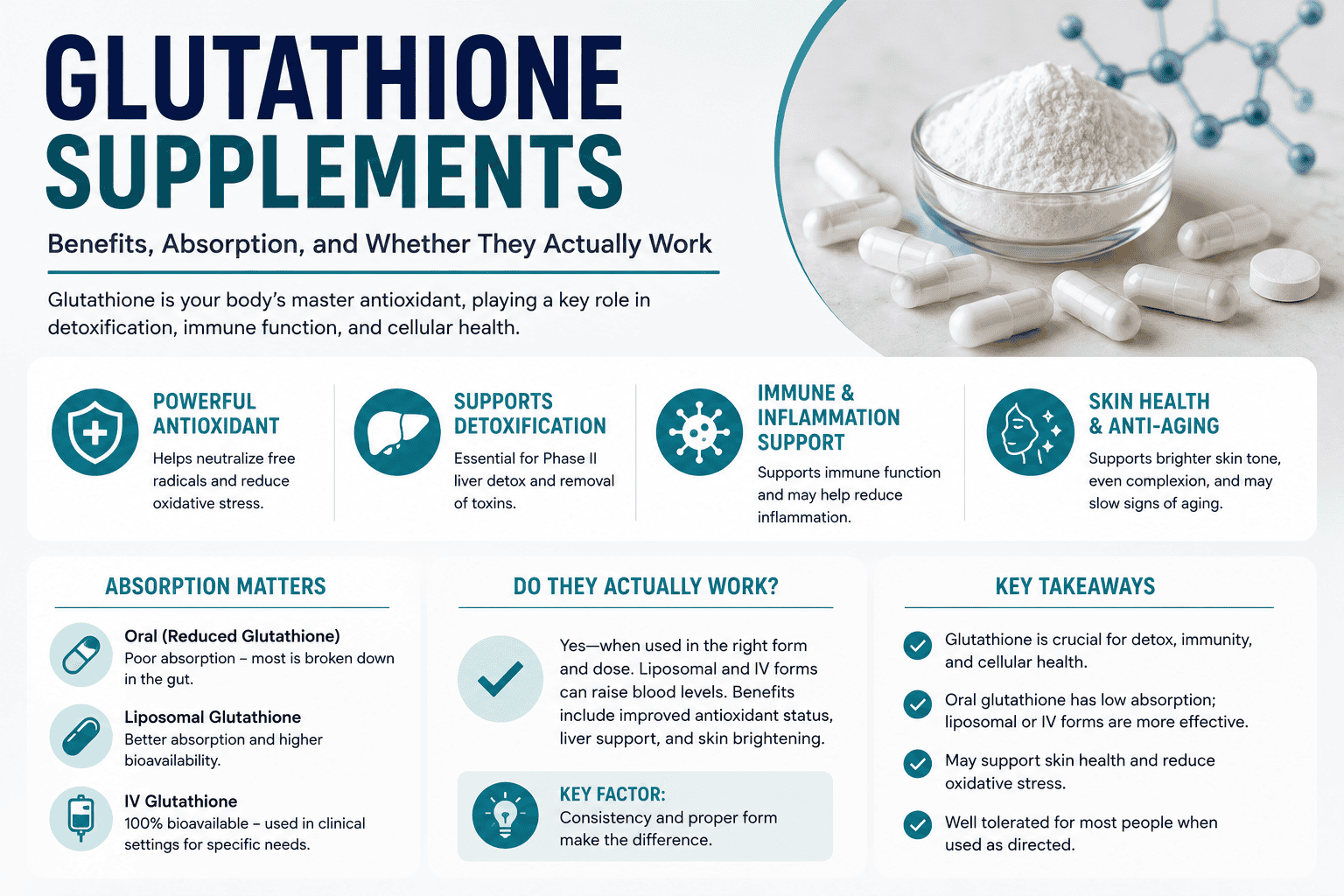
Glutathione is one of the body’s most important antioxidants, but that does not automatically mean taking glutathione capsules produces major health benefits. Your cells already manufacture glutathione from the amino acids cysteine, glycine, and glutamate, and conventional oral glutathione can be partially broken down before reaching the bloodstream.
The evidence is more encouraging than the old claim that oral glutathione is simply “not absorbed.” Longer-term human trials have shown that daily oral glutathione can increase glutathione stores, while liposomal, sublingual, micellar, and other delivery systems may improve absorption further. The bigger unanswered question is whether those higher levels translate into meaningful improvements in health for otherwise healthy people.
The short version: glutathione supplements can work biologically, but the clinical benefits are much less established than supplement marketing often suggests.
Who this is for: Adults considering glutathione for antioxidant support, skin health, healthy aging, liver support, or general wellness who want to know whether oral supplements are actually absorbed.
Who this is not for: Anyone looking for glutathione to treat liver disease, cancer, metabolic disease, or another medical condition without clinician guidance.
Reviewed by VerifiedSupps Editorial Team • Last reviewed: August 25, 2026
The answer-first view: yes, oral glutathione can increase glutathione levels—but results depend on the formulation, dose, and duration. A six-month randomized controlled trial found that 250 or 1,000 mg per day increased glutathione in several body compartments. On the other hand, an earlier four-week trial using 1,000 mg per day found no significant improvement in glutathione status or oxidative-stress markers.
That apparent contradiction is important. It suggests that duration, baseline glutathione status, measurement method, and formulation may all influence whether supplementation produces a detectable effect.
Newer delivery systems look promising. Small human studies suggest liposomal, sublingual, and micellar glutathione can increase systemic exposure more effectively than conventional formulations. But most of these studies measured glutathione levels rather than outcomes such as fewer diseases, improved longevity, or noticeably better energy.
If you are interested in other emerging supplements where the mechanism is promising but the clinical evidence requires careful interpretation, see our Akkermansia supplement guide. Our guide to choosing supplements without guesswork also covers how to separate biological plausibility from meaningful human outcomes.
Key Takeaways
- Glutathione is a naturally produced antioxidant made from cysteine, glycine, and glutamate.
- Standard oral glutathione has imperfect absorption, but saying it is completely useless or completely destroyed in the gut is too simplistic.
- A six-month randomized trial found that 250–1,000 mg per day increased glutathione stores in several tissues and blood compartments.
- Shorter studies have produced mixed results, including one four-week trial that found no significant increase.
- Liposomal, sublingual, and newer micellar formulations may improve absorption, but evidence that they produce better long-term health outcomes is still limited.
- Human evidence for skin-lightening effects exists, but results are modest, inconsistent, and not necessarily permanent.
- Evidence is not strong enough to recommend glutathione supplements as treatments for fatty liver disease, chronic illness, or aging.
- For most healthy adults, the main question is not whether glutathione can raise blood levels—it can—but whether the benefit is large enough to justify taking it.
What does glutathione actually do in the body?
Glutathione, commonly abbreviated GSH, is a small molecule made from three amino acids: glutamate, cysteine, and glycine. It is found throughout the body, with particularly important roles inside cells.
Calling glutathione the “master antioxidant” is common in supplement marketing, but the term is not especially useful scientifically. Glutathione is extremely important, but it works as part of a much larger antioxidant and redox-regulation system rather than acting alone.
Its major roles include:
- Neutralizing reactive molecules: Glutathione helps control reactive oxygen species before they damage proteins, lipids, and DNA.
- Regenerating antioxidants: It interacts with other antioxidant systems, including vitamins C and E.
- Cellular redox regulation: The balance between reduced glutathione (GSH) and oxidized glutathione (GSSG) helps regulate the cellular environment.
- Liver metabolism: Glutathione participates in enzyme systems that help process and eliminate certain reactive compounds and metabolites.
- Immune function: Immune cells rely on adequate glutathione availability for normal function.
- Protein and cellular protection: Glutathione helps protect important cellular components during oxidative stress.
The body continually makes, uses, oxidizes, and regenerates glutathione. That is why simply swallowing more of it is not necessarily equivalent to increasing intracellular glutathione everywhere in the body.
It is similar to other antioxidant-related supplements in that a strong biological mechanism does not automatically guarantee a noticeable benefit from supplementation. Our CoQ10 benefits guide discusses a comparable distinction between an important endogenous compound and the effects of supplementing it.
Are glutathione supplements actually absorbed?
Yes, but absorption is complicated. Conventional glutathione is a tripeptide, and some of it is broken down by enzymes in the gastrointestinal tract. Its amino acids can then be reused to make glutathione inside cells.
This is why older research often concluded that swallowing glutathione was an inefficient way to increase systemic glutathione. A well-controlled 2011 trial gave healthy adults 500 mg of glutathione twice daily for four weeks and found no significant changes in erythrocyte glutathione or systemic oxidative-stress markers.
But a larger and longer randomized study complicated that picture.
In that six-month study, 54 healthy nonsmoking adults received placebo, 250 mg per day, or 1,000 mg per day of oral glutathione. At six months, the 1,000 mg group showed approximately 30–35% increases in glutathione levels in red blood cells, plasma, and lymphocytes. Buccal-cell glutathione increased even more. The lower-dose group also showed increases in some compartments.
| Human study | Dose | Duration | Main finding |
|---|---|---|---|
| Allen & Bradley | 1,000 mg/day | 4 weeks | No significant improvement in glutathione or oxidative-stress markers |
| Richie et al. | 250 or 1,000 mg/day | 6 months | Glutathione increased in several blood and tissue compartments |
| Sinha et al. | 500 or 1,000 mg/day liposomal | 4 weeks | Glutathione stores increased, but study included only 12 adults |
| 2026 micellar study | 300 mg single-dose comparison | Pharmacokinetic crossover | Micellar formulation produced greater systemic exposure than standard glutathione |
Taken together, the evidence suggests conventional oral glutathione is not completely unabsorbable. But its effect may be slower, less predictable, and more formulation-dependent than supplement labels imply.
There is another important distinction: researchers can measure a rise in blood glutathione without proving that every organ received more intracellular glutathione or that the person became healthier as a result.
Is liposomal glutathione better than regular glutathione?
Liposomal glutathione is designed to protect glutathione inside microscopic lipid structures, potentially reducing degradation in the gastrointestinal tract and improving delivery.
The concept makes sense, and early human evidence is positive—but the evidence base is still small.
A 2018 pilot study followed 12 healthy adults taking either 500 or 1,000 mg of liposomal glutathione per day. Whole-blood glutathione increased by as much as 40%, plasma glutathione by 28%, and glutathione in peripheral blood mononuclear cells by up to 100% during the study. Markers of oxidative stress also improved.
Those results sound impressive, but there was no placebo group and only 12 participants. That makes it inappropriate to conclude that liposomal glutathione is definitively superior based on this study alone.
Other delivery systems have also been tested.
| Form | Absorption evidence | Evidence quality |
|---|---|---|
| Standard reduced glutathione | Can increase body stores with longer supplementation, but findings are inconsistent | Moderate |
| Liposomal glutathione | Small human studies show increased systemic glutathione | Promising but limited |
| Sublingual glutathione | A small crossover study showed higher plasma glutathione than conventional oral glutathione | Promising but limited |
| Micellar glutathione | A 2026 crossover study showed substantially greater systemic exposure than standard glutathione | Very early human evidence |
| S-acetyl glutathione | Marketed for stability and cellular delivery | Much less direct clinical evidence |
A small randomized crossover study in adults with metabolic syndrome also found that sublingual glutathione produced higher plasma total and reduced glutathione than conventional swallowed glutathione.
The newest evidence is a 2026 randomized crossover pharmacokinetic study involving 14 healthy adults. A 300 mg micellar glutathione formulation produced roughly 2.5 times greater baseline-adjusted systemic exposure than 500 mg of standard glutathione. When normalized for dose, the difference was larger.
That study is interesting but should not be treated as proof that micellar glutathione produces better health outcomes. It involved only 14 people, primarily examined pharmacokinetics, and the formulation tested is connected to intellectual property held by a company associated with several study investigators. The authors disclosed those relationships.
Practical takeaway
If maximizing absorption is the goal, liposomal or another validated enhanced-delivery formulation makes more sense than assuming every inexpensive glutathione capsule is equivalent. But paying significantly more for a premium formulation is harder to justify if the goal is vague “detox,” anti-aging, or disease prevention, because those clinical outcomes have not been established.
What benefits of glutathione supplements are actually supported?
The strongest evidence is that supplementation can increase glutathione status under some conditions. Evidence for specific health outcomes is considerably weaker.
1. Increasing glutathione levels
This is the most defensible benefit. Longer-term conventional oral supplementation and several enhanced-delivery formulations have increased glutathione levels in human studies.
Whether a healthy person with normal glutathione status gains a meaningful advantage from raising those levels is less certain.
2. Oxidative-stress support
Several studies report changes in glutathione redox status or oxidative-stress biomarkers. The six-month trial found a reduction in the oxidized-to-reduced glutathione ratio, while the liposomal pilot reported reductions in markers including plasma 8-isoprostane.
But not every study has replicated this. The four-week placebo-controlled trial found no significant reduction in urinary F2-isoprostanes or 8-OHdG.
For another supplement commonly marketed around oxidative stress and healthy aging, see our guide to NAD and longevity.
3. Skin pigmentation and skin appearance
Glutathione has become especially popular as an oral skin-lightening supplement. The proposed mechanism involves antioxidant activity and changes in melanin production.
Several randomized trials have found modest reductions in melanin measurements at some body sites using approximately 250–500 mg per day. However, results have not been consistent across all sites or all trials.
A 2025 systematic review identified multiple randomized trials reporting reductions in melanin index with oral glutathione, but it also found substantial variation in study quality and risk of bias. The authors concluded that oral and topical glutathione can produce some skin-lightening effects, but the results are variable and may not be sustainable.
That is very different from saying glutathione reliably or permanently changes skin tone.
4. Liver health
Glutathione is heavily involved in normal liver antioxidant and detoxification pathways, which is why “liver detox” is one of the most common supplement claims.
Human treatment evidence is limited. An open-label pilot study gave 300 mg per day to people with nonalcoholic fatty liver disease after a lifestyle intervention and reported lower ALT and several metabolic markers after four months. However, the study had no placebo group, meaning lifestyle changes, regression to the mean, and other factors cannot be excluded.
That is not strong enough evidence to recommend glutathione as a treatment for fatty liver disease.
5. Immune function
The six-month oral trial reported increased natural-killer-cell cytotoxicity at the higher dose, and the small liposomal study also found changes in immune-function markers.
These are laboratory measurements rather than evidence that healthy people taking glutathione get fewer infections or develop stronger clinically meaningful immunity.
| Claim | Current evidence | Verdict |
|---|---|---|
| Raises glutathione stores | Supported by several human studies | Reasonably supported |
| Reduces oxidative stress | Mixed human biomarker evidence | Promising |
| Lightens skin | Several small RCTs; inconsistent magnitude and durability | Possible modest effect |
| Treats fatty liver | Small uncontrolled clinical studies | Not established |
| Improves immunity | Changes in immune biomarkers | Clinical benefit uncertain |
| Slows aging | No convincing human longevity trials | Unproven |
| “Detoxes” healthy people | Normal glutathione biology is real; broad supplement detox claims are not clinically demonstrated | Mostly marketing |
Glutathione vs NAC: is it better to take a precursor?
Instead of swallowing glutathione directly, another strategy is to give the body more of the raw materials it uses to make glutathione.
Cysteine is often considered the limiting amino acid in glutathione synthesis. N-acetylcysteine, or NAC, supplies cysteine and has a much longer history of medical and research use than most premium glutathione formulations.
That does not mean NAC is automatically superior. The two approaches are different:
| Feature | Glutathione | NAC |
|---|---|---|
| What you take | Glutathione itself | A cysteine precursor |
| Main idea | Deliver more glutathione or its breakdown products | Give cells substrate to synthesize their own glutathione |
| Absorption concern | Conventional GSH can be degraded in the gut | Does not require intact glutathione absorption |
| Clinical history | Growing supplement evidence | Long medical and research history |
| Best choice | Depends on the goal and whether glutathione synthesis is actually substrate-limited | |
Interestingly, a small crossover study comparing conventional oral glutathione, NAC, and sublingual glutathione found the strongest short-term glutathione response with the sublingual formulation. That study involved only 20 people with metabolic syndrome, however, so it does not settle the question for healthy adults.
There is also growing interest in combinations such as glycine plus NAC because glutathione synthesis requires both cysteine and glycine. That is a separate strategy from direct glutathione supplementation and deserves its own evidence review rather than being treated as interchangeable with glutathione.
How much glutathione should you take?
There is no established daily requirement for supplemental glutathione and no universally accepted optimal dose for healthy adults.
Most oral human studies have used somewhere between 250 and 1,000 mg per day.
| Daily amount | Research context |
|---|---|
| 250 mg | Used in longer-term glutathione-store and skin studies |
| 500 mg | Common dose in skin and absorption studies |
| 1,000 mg | Used in several conventional and liposomal supplementation studies |
More is not necessarily better. In the six-month trial, both 250 mg and 1,000 mg increased glutathione in at least some body compartments. In the small liposomal study, researchers did not observe clear differences between the 500 mg and 1,000 mg groups, although the study was too small to establish dose equivalence.
Enhanced-delivery products may also require different amounts than conventional capsules, making milligram-to-milligram comparisons misleading.
When choosing a supplement, look for:
- Clearly disclosed glutathione amount: Avoid proprietary blends that hide the actual dose.
- Formulation: Reduced, liposomal, sublingual, micellar, and acetylated glutathione should not automatically be assumed equivalent.
- Third-party quality testing: Identity, potency, and contaminant testing matter more than elaborate antioxidant marketing.
- Reasonable claims: Be skeptical of products promising liver cleansing, major anti-aging effects, dramatic skin whitening, or disease prevention.
- Cost per effective dose: A premium delivery system may improve absorption without necessarily improving outcomes enough to justify a very large price difference.
What are the side effects of glutathione supplements?
Oral glutathione has generally been well tolerated in the short- and medium-term human trials published so far. Studies using 250–1,000 mg per day have not identified a consistent pattern of serious toxicity in healthy adults.
That does not mean every formulation is risk-free. Supplements may contain additional ingredients, and long-term safety data are much less extensive than the safety databases available for established medications.
Reasonable cautions include:
- Digestive symptoms: As with many oral supplements, gastrointestinal discomfort can occur in some users.
- Pregnancy and breastfeeding: There is insufficient supplementation evidence to assume routine high-dose use is safe.
- Chronic medical conditions: Do not use glutathione as a substitute for evidence-based treatment simply because oxidative stress is involved in the condition.
- Cancer treatment: People receiving chemotherapy, radiation, or other oncology treatment should discuss antioxidant supplements with their oncology team rather than self-prescribing them.
- Product quality: The safety of a studied glutathione ingredient does not guarantee the purity or label accuracy of every commercial supplement.
Intravenous glutathione deserves separate caution. IV glutathione used for cosmetic skin lightening is not equivalent to taking an oral dietary supplement. A 2025 systematic review found insufficient support for IV glutathione as a skin-lightening treatment and highlighted safety concerns.
For routine supplementation, oral products have a substantially more reassuring evidence base than unsupervised injections.
So, are glutathione supplements worth taking?
Glutathione supplements are more legitimate than the claim that oral glutathione “doesn’t absorb at all” would suggest. Multiple human studies now show that supplementation can increase glutathione availability, particularly with longer treatment or enhanced-delivery formulations.
But the opposite extreme is also wrong. Increasing a laboratory measurement of glutathione does not prove that a supplement detoxifies the body, prevents disease, slows aging, improves energy, protects the liver, or meaningfully extends lifespan.
Our take: Glutathione is a reasonable but optional supplement for someone specifically trying to increase glutathione status. A well-formulated liposomal or other evidence-backed delivery system may have an absorption advantage. For a healthy person simply looking for “general antioxidant protection,” however, the evidence does not make glutathione an essential supplement.
Sleep, exercise, adequate protein, sufficient micronutrients, not smoking, and a diet rich in minimally processed plant foods affect oxidative balance far more broadly than relying on a single antioxidant capsule.
And as with emerging microbiome products such as Akkermansia, the important distinction is between an interesting biological mechanism and a clinically meaningful effect. Glutathione clearly passes the first test. The second is still being worked out.
References
-
Richie JP Jr, et al. Randomized controlled trial of oral glutathione supplementation on body stores of glutathione. European Journal of Nutrition. 2015;54(2):251–263.
Six-month randomized, double-blind, placebo-controlled study of 250 and 1,000 mg per day in healthy adults showing increases in glutathione stores in multiple body compartments.
-
Allen J, Bradley RD. Effects of oral glutathione supplementation on systemic oxidative stress biomarkers in human volunteers. Journal of Alternative and Complementary Medicine. 2011.
Four-week randomized placebo-controlled trial finding no significant improvement in glutathione status or measured oxidative-stress biomarkers with 1,000 mg per day.
-
Sinha R, et al. Oral supplementation with liposomal glutathione elevates body stores of glutathione and markers of immune function. European Journal of Clinical Nutrition. 2018.
Small one-month pilot study evaluating 500 and 1,000 mg per day of liposomal glutathione.
-
Schmitt B, et al. Effects of N-acetylcysteine, oral glutathione and a novel sublingual form of glutathione on oxidative stress markers: a comparative crossover study. Redox Biology. 2015;6:198–205.
Small crossover study comparing sublingual glutathione with swallowed glutathione and NAC in adults with metabolic syndrome.
-
A Targeted Metabolomic Assessment of Oral Glutathione Bioavailability and Safety in Humans: A Randomized Crossover Clinical Trial. Antioxidants. 2026.
Recent small pharmacokinetic trial comparing a micellar glutathione formulation with standard and liposomal formulations. The study found greater systemic exposure with the micellar product but does not establish superior long-term clinical outcomes.
-
Arjinpathana N, Asawanonda P. Glutathione as an oral whitening agent: a randomized, double-blind, placebo-controlled study. Journal of Dermatological Treatment. 2012.
Randomized study of 500 mg per day showing modest changes in melanin measurements at some, but not all, body sites.
-
Sarkar R, et al. Glutathione as a skin-lightening agent and in melasma: a systematic review. International Journal of Dermatology. 2025;64(6):992–1004.
Recent systematic review evaluating oral, topical, and intravenous glutathione for pigmentation and melasma.
-
Honda Y, et al. Efficacy of glutathione for the treatment of nonalcoholic fatty liver disease: an open-label, single-arm, multicenter pilot study. BMC Gastroenterology. 2017.
Preliminary uncontrolled study of oral glutathione in NAFLD; useful as early evidence but insufficient to establish treatment efficacy.
-
Impact of Supplementary Amino Acids, Micronutrients, and Overall Diet on Glutathione Homeostasis. Nutrients. 2019.
Review of glutathione synthesis, intestinal degradation, amino-acid precursors, and nutritional strategies that influence glutathione status.
FAQ
Do oral glutathione supplements actually work?
They can. A six-month randomized trial found that 250 and 1,000 mg per day increased glutathione levels in several body compartments. However, shorter studies have produced mixed results, and increasing glutathione levels does not automatically mean a person will notice a health benefit.
Is glutathione absorbed when taken orally?
Some oral glutathione is broken down in the gastrointestinal tract, but human research shows that oral supplementation can still increase glutathione status, especially with longer use or enhanced-delivery formulations. The old claim that swallowed glutathione is completely unabsorbed is too absolute.
Is liposomal glutathione worth it?
Liposomal glutathione may improve delivery compared with conventional capsules, and small human studies show increased glutathione levels. There is not yet strong evidence that liposomal glutathione produces substantially better long-term health outcomes, so whether the higher cost is worthwhile depends on the goal.
What is the best form of glutathione?
Enhanced-delivery forms such as liposomal, sublingual, and micellar glutathione have encouraging absorption data. Pasteurization does not apply to glutathione, and terms such as “reduced glutathione” describe its chemical state rather than an inherently superior delivery method. No formulation has yet proven superior for long-term clinical outcomes.
How much glutathione should you take per day?
Human oral studies commonly use approximately 250–1,000 mg per day. There is no established optimal supplemental dose for healthy adults, and enhanced-delivery formulations may not require the same dose as conventional products.
Does glutathione detox the liver?
Glutathione is genuinely involved in normal liver detoxification and antioxidant systems, but that does not mean taking a glutathione supplement “cleanses” the liver. Clinical evidence is currently insufficient to recommend oral glutathione as a treatment for fatty liver or other liver disease.
Does glutathione lighten skin?
Some randomized trials show modest reductions in melanin measurements with oral glutathione, usually at 250–500 mg per day. Results vary between studies and body sites, and the effect may not be permanent. Evidence does not support expecting dramatic or predictable changes in skin tone.
Is glutathione better than NAC?
They work differently. Glutathione provides the molecule directly, while NAC provides cysteine that cells can use to synthesize glutathione. There is not enough evidence to say one is universally better for healthy adults.
How long does glutathione take to work?
Blood-level changes can occur relatively quickly with some enhanced-delivery formulations, but conventional oral supplementation may require weeks or months to produce consistent changes in body glutathione stores. The timeline depends on the formulation and what outcome is being measured.
Medical Disclaimer
This article is for educational purposes only and does not provide medical advice, diagnosis, or treatment. Glutathione supplements are not substitutes for medical treatment of liver disease, cancer, metabolic disorders, or other health conditions. Human studies generally suggest that oral glutathione is well tolerated, but evidence on long-term use, pregnancy, breastfeeding, and some medical populations remains limited. People receiving chemotherapy, radiation therapy, or other complex medical treatment should discuss antioxidant supplementation with their healthcare team before use. Supplement quality and absorption can differ substantially between products.