By VerifiedSupps Editorial Team
Cagrilintide for Weight Loss: The Amylin Peptide Behind CagriSema
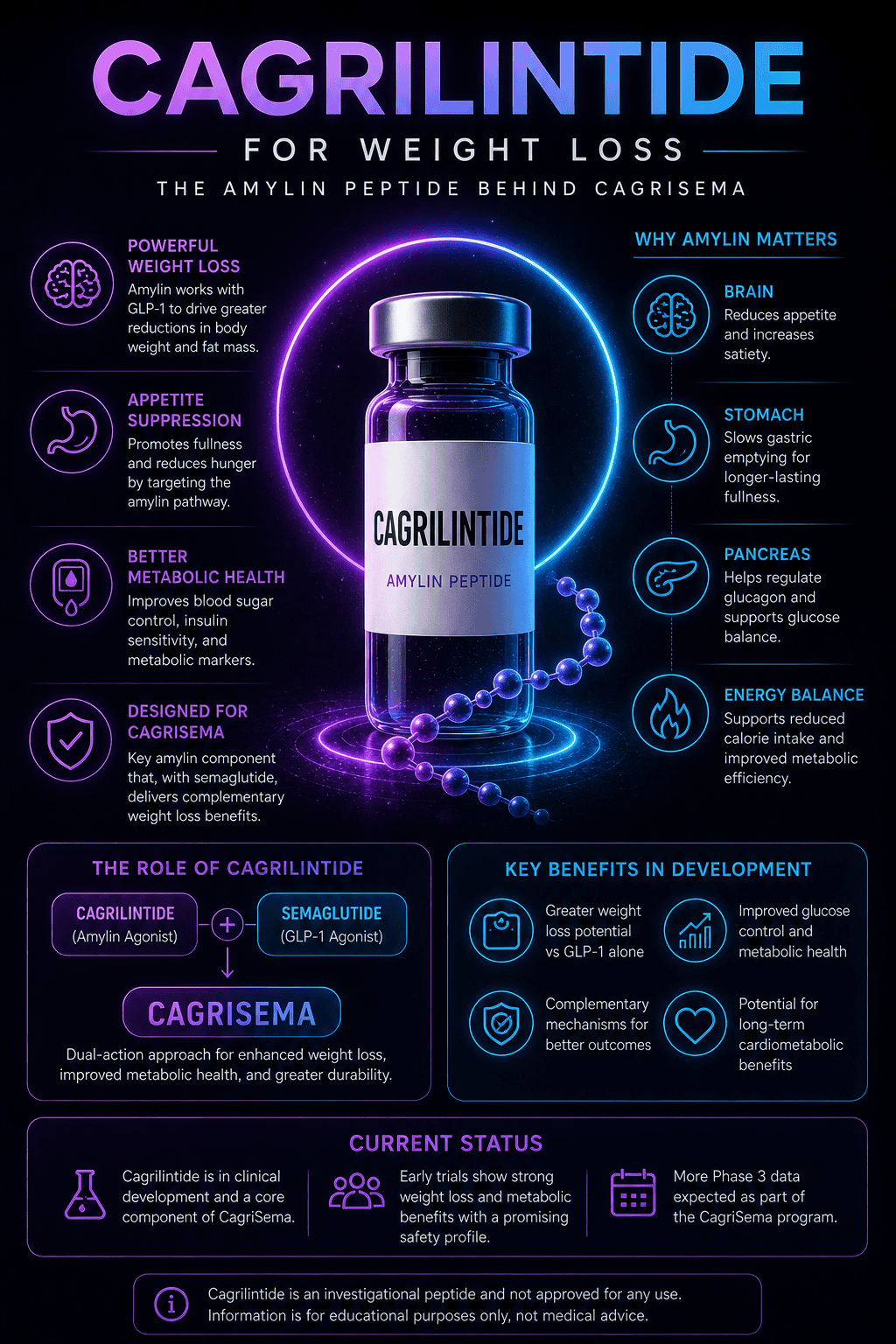
Cagrilintide is an investigational long-acting amylin analogue being studied for weight management. It matters because it is the amylin component inside CagriSema, Novo Nordisk’s once-weekly combination of cagrilintide and semaglutide.
The practical answer is balanced: cagrilintide has shown meaningful weight loss as monotherapy and stronger results when paired with semaglutide, but it is not approved as a standalone weight-loss medication.
This guide focuses on cagrilintide monotherapy, amylin biology, trial results, side effects, and its role inside CagriSema; it does not provide injection instructions, sourcing advice, or treatment recommendations.
Key terms: cagrilintide, amylin analogue, amylin receptor agonist, CagriSema, semaglutide, REDEFINE 1, RENEW programme, weight management
Quick Take
Cagrilintide is promising because it targets amylin, a satiety hormone pathway that differs from GLP-1. Monotherapy data show meaningful weight loss, while CagriSema data suggest the amylin plus GLP-1 combination may produce larger effects than either pathway alone.
TL;DR decision
Track cagrilintide if you are following next-generation obesity medications and amylin-based therapy. Do not treat it as an available supplement or approved standalone prescription option; for real treatment decisions, use clinician-guided, approved care while the cagrilintide evidence matures.
Evidence standard: human trials, dose ranges, guideline-level sources when available
Who this is for: readers trying to understand cagrilintide, amylin-based weight-loss research, and why CagriSema includes an amylin analogue
Who this is not for: anyone looking for self-injection instructions, research-vial sourcing, or a substitute for obesity care from a licensed clinician
Reviewed by: VerifiedSupps Editorial Team
Last reviewed: May 1, 2026
Parent Hub
CagriSema for Weight Loss: Results, Setbacks, and Current Status
Start here for the full combination-drug context: how cagrilintide pairs with semaglutide, what the Phase 3 results showed, and why the current status is still unsettled.
Does cagrilintide work for weight loss?
Cagrilintide has shown meaningful weight loss in human trials, including dose-dependent Phase 2 results and Phase 3 monotherapy data from a REDEFINE 1 sub-analysis. The important caution is that cagrilintide is still investigational and not approved as a standalone weight-loss medication.
Mechanism
- Cagrilintide is a long-acting amylin analogue designed to act on amylin-related receptor pathways involved in satiety and food intake.
- Amylin is normally co-secreted with insulin after meals and helps regulate fullness, gastric emptying, and post-meal glucagon signaling.
- The real-world outcome still depends on dose, escalation, tolerability, adherence, protein intake, resistance training, and long-term medical monitoring.
Cagrilintide decision decoder
Use this quick table to separate what cagrilintide shows today from what it still has to prove.
| What you want to know | Best read | What it means | Practical action |
|---|---|---|---|
| “Is cagrilintide effective by itself?” | Phase 3 monotherapy sub-analysis reported 11.8% weight loss at 68 weeks if participants adhered to treatment | Meaningful standalone signal, but not a finished approval story | Watch the dedicated RENEW Phase 3 programme |
| “Why is it inside CagriSema?” | CagriSema combines cagrilintide 2.4 mg with semaglutide 2.4 mg | The goal is to layer amylin and GLP-1 pathways | Compare combination outcomes separately from monotherapy outcomes |
| “Can I get cagrilintide now?” | No approved standalone product for routine use | This is clinical-trial and regulatory-review territory | Use approved treatment options with a clinician |
| “What side effects matter most?” | Gastrointestinal symptoms are the clearest pattern | Tolerability may shape dose escalation and long-term use | Avoid unsupervised use and take persistent symptoms seriously |
Best next step (today): treat cagrilintide as a promising investigational amylin medication to monitor, not as something to buy, dose, or stack on your own.
What were the cagrilintide trial results?
Cagrilintide’s evidence has two layers: earlier dose-finding monotherapy data and newer Phase 3 monotherapy data from REDEFINE 1. The combination story is stronger, but it belongs to CagriSema, not cagrilintide alone.
| Evidence layer | Population | Result signal | Clean interpretation |
|---|---|---|---|
| Phase 2 dose-finding monotherapy | Adults with overweight or obesity without type 2 diabetes | Dose-dependent weight loss over 26 weeks, roughly 6% to 10.6% across studied weekly doses | Strong early signal, mainly useful for dose-response and tolerability |
| REDEFINE 1 cagrilintide monotherapy sub-analysis | Adults with obesity or overweight and weight-related comorbidity, without diabetes | 11.8% average loss with cagrilintide 2.4 mg versus 2.3% with placebo after 68 weeks if all adhered to treatment | Clinically meaningful monotherapy result; still needs dedicated Phase 3 confirmation |
| REDEFINE 1 treatment-policy analysis | Same general population | 11.5% average loss with cagrilintide versus 3.0% with placebo regardless of adherence | Useful because it reflects a less idealized treatment effect |
| CagriSema Phase 3 programme | Adults with overweight or obesity, with and without type 2 diabetes depending on trial | Cagrilintide 2.4 mg plus semaglutide 2.4 mg produced larger weight-loss results than placebo and component comparisons in key trials | Supports the combination rationale, but should not be credited to cagrilintide alone |
The fair conclusion: cagrilintide looks meaningful as an amylin monotherapy, but its biggest clinical impact may come from combination strategies unless standalone Phase 3 data show a clear use case.
What dose of cagrilintide is being studied?
There is no approved cagrilintide dose for weight loss. Trials have studied once-weekly subcutaneous dosing, with cagrilintide 2.4 mg being the key dose used in CagriSema and in the newer monotherapy signal from REDEFINE 1.
| Context | Dose pattern | Why it matters |
|---|---|---|
| Phase 2 monotherapy dose-finding | Weekly doses included 0.3 mg, 0.6 mg, 1.2 mg, 2.4 mg, and 4.5 mg | Helped establish dose-response and tolerability patterns |
| REDEFINE 1 monotherapy sub-analysis | Cagrilintide 2.4 mg once weekly | Key late-stage monotherapy dose signal |
| CagriSema combination | Cagrilintide 2.4 mg plus semaglutide 2.4 mg once weekly | Combination dosing is not the same as standalone cagrilintide use |
| RENEW Phase 3 programme | Dedicated cagrilintide monotherapy development is being studied in larger populations | This is the evidence layer that may define a future standalone role |
Trial doses are not self-use instructions. With peptide-based obesity medications, escalation, formulation, monitoring, missed doses, side effects, and medication interactions can change the safety picture quickly.
How long does cagrilintide take to work?
Cagrilintide should be read as a long-term weight-management therapy, not a short-term fat-loss product. Earlier dose-finding data were assessed around 26 weeks, while the later REDEFINE 1 monotherapy analysis reported results at 68 weeks.
Some appetite or fullness changes may happen earlier than major scale movement, but the useful clinical question is the trend: body weight, waist, side effects, nutrition quality, hydration, and whether strength and lean-mass habits are being protected.
Useful timing frame
A fair assessment needs weeks to months, stable nutrition habits, enough protein, resistance training, and medical monitoring if a person has diabetes, cardiovascular disease, kidney disease, liver disease, or active gastrointestinal symptoms.
What side effects can cagrilintide cause?
The clearest side-effect pattern is gastrointestinal. Nausea, vomiting, diarrhea, and constipation are the most relevant symptoms to understand, because they can affect hydration, protein intake, quality of life, and whether someone can continue treatment.
| Side-effect theme | What the evidence suggests | Practical interpretation |
|---|---|---|
| Nausea | Common in amylin-based therapy; REDEFINE 1 monotherapy reporting noted nausea-related discontinuation in 1.0% versus 0.1% with placebo | Usually a tolerability issue, but persistent nausea can become clinically important |
| Vomiting, diarrhea, constipation | Reported as gastrointestinal adverse events in the cagrilintide and CagriSema evidence base | Can disrupt hydration, electrolytes, medications, and food tolerance |
| Appetite suppression | Part of the intended effect, but it can make under-eating easier | Protein, fluids, and micronutrient-dense meals still matter |
| Medication and medical-condition context | Amylin-related therapies can interact with broader diabetes, GI, and metabolic care decisions | Diabetes medication changes, severe GI symptoms, pregnancy, and complex comorbidities are clinician territory |
Common does not mean harmless. Severe, persistent, or unusual symptoms should not be managed through online dosing guesses or unregulated peptide use.
Cagrilintide troubleshooting: what if results or side effects do not make sense?
Because cagrilintide is investigational, troubleshooting should not mean adjusting dose on your own. The safer frame is to protect the evidence signal, avoid noisy comparisons, and use a clinical trial team or licensed clinician to interpret symptoms and trends.
Common mistakes
- Treating cagrilintide monotherapy results as if they were CagriSema combination results.
- Comparing weight-loss percentages without matching trial duration, population, dose, adherence analysis, and background lifestyle intervention.
- Ignoring muscle-preserving basics during appetite suppression: protein, resistance training, sleep, hydration, and enough nutrient-dense food.
Clean test protocol
| Inputs | Formal trial protocol or clinician-supervised plan, baseline weight, waist, blood pressure, medication list, relevant labs, side-effect history, protein target, hydration plan, and resistance-training baseline. |
|---|---|
| Duration | Use the study protocol if enrolled in a trial. For obesity medications in general, meaningful interpretation usually takes weeks to months, not a few daily weigh-ins. |
| 3 metrics | Weekly average weight trend, waist circumference trend, and side-effect burden with food tolerance and hydration notes. |
| Stop conditions | Stop self-adjusting and contact a clinician or study team for severe nausea, persistent vomiting, dehydration, fainting, severe abdominal pain, allergic symptoms, jaundice, chest pain, severe low-blood-sugar symptoms, or any symptom that feels unsafe. |
How to tell it’s working
A good response is not just a lower scale number. Better signs include steadier appetite, gradual waist reduction, manageable side effects, preserved strength where possible, adequate protein intake, and improving metabolic markers if those are being tracked.
Red flags / seek care
Seek medical help for persistent vomiting, severe or persistent abdominal pain, signs of dehydration, fainting, chest pain, yellowing skin or eyes, severe allergic symptoms, confusion, severe low-blood-sugar symptoms, or thoughts of self-harm.
Is cagrilintide approved or still in trials?
Cagrilintide is still investigational for weight management and is not approved as a standalone weight-loss medication. Novo Nordisk has advanced cagrilintide into a dedicated Phase 3 RENEW programme after monotherapy data showed meaningful weight loss.
CagriSema, the combination of cagrilintide 2.4 mg and semaglutide 2.4 mg, has been submitted to the US FDA for weight management, but that submission is for the combination product, not standalone cagrilintide.
Decision rule
Cagrilintide belongs in the “watch the evidence” category until dedicated Phase 3 data, regulatory decisions, final labeling, contraindications, and access rules are clear.
How is cagrilintide different from CagriSema and GLP-1 drugs?
Cagrilintide is the amylin analogue. CagriSema is the fixed-dose combination that pairs cagrilintide with semaglutide. GLP-1 drugs like semaglutide work mainly through GLP-1 receptor signaling, while cagrilintide is designed around amylin-related satiety signaling.
| Term | What it is | Why readers confuse it |
|---|---|---|
| Cagrilintide | Investigational long-acting amylin analogue | It is discussed both as monotherapy and as part of CagriSema |
| CagriSema | Investigational fixed-dose cagrilintide plus semaglutide combination | Its results are sometimes mistakenly attributed to cagrilintide alone |
| Semaglutide | GLP-1 receptor agonist used in approved obesity and diabetes medications depending on product and indication | It is the GLP-1 half of CagriSema |
| Amylin-based therapy | A research pathway focused on satiety and meal-related signaling | It may complement GLP-1 therapy, but mechanism does not automatically prove superiority |
The cleanest takeaway: cagrilintide helps explain why amylin is becoming important in obesity research, while CagriSema shows how that pathway may be combined with GLP-1 therapy.
Selected Professional References
These sources support the cagrilintide monotherapy results, CagriSema context, mechanism framing, side-effect discussion, and current development status used in this guide.
Novo Nordisk: Cagrilintide Phase 3 Data and RENEW Programme
Supports the 11.8% cagrilintide monotherapy result, placebo comparison, gastrointestinal side-effect pattern, and dedicated RENEW programme status.
Used for: monotherapy results and current development direction
The Lancet: Once-Weekly Cagrilintide for Weight Management
Supports the early Phase 2 dose-response evidence, weekly dose ranges, and the conclusion that cagrilintide produced clinically relevant weight loss.
Used for: early human efficacy and dose-response context
New England Journal of Medicine: Cagrilintide and Semaglutide in Adults With Overweight or Obesity
Supports the REDEFINE 1 CagriSema context, including why cagrilintide is studied as the amylin component of a GLP-1 plus amylin combination.
Used for: CagriSema and component-comparison context
Novo Nordisk: CagriSema FDA Submission Announcement
Supports the fixed-dose combination description, CagriSema submission status, and the statement that the combination is not approved in the US or EU.
Used for: CagriSema status and cagrilintide role
ClinicalTrials.gov: Cagrilintide in Adults With Overweight or Obesity
Supports the current dedicated monotherapy research context in adults with overweight or obesity.
Used for: ongoing standalone trial status
ClinicalTrials.gov: Cagrilintide in Adults With Overweight or Obesity and Type 2 Diabetes
Supports the broader RENEW-style development context in people with excess body weight and type 2 diabetes.
Used for: population and trial-program context
Novo Nordisk Science Hub: Development of Cagrilintide
Supports the long-acting amylin analogue framing and the rationale for studying cagrilintide alone and with semaglutide.
Used for: mechanism and development framing
ScienceDirect: Cagrilintide Phase 2 Trial Record
Provides an additional primary-source route for the Lancet cagrilintide dose-finding trial and its implications.
Used for: primary trial verification
Go Deeper (VerifiedSupps Guides)
Use these related guides to compare cagrilintide with other amylin, peptide, and next-generation weight-loss medication topics without mixing up mechanisms, results, and approval status.
Eloralintide for Weight Loss
Compare another investigational amylin receptor agonist and why amylin matters for future obesity care.
Petrelintide for Weight Loss
A companion guide for understanding another amylin-focused weight-loss candidate and its current evidence.
Amycretin for Weight Loss
Understand another amylin-linked obesity therapy and how early results should be interpreted.
Are Peptides Safe?
A broader safety guide for separating regulated clinical use from unapproved peptide sourcing.
Final Takeaway
Cagrilintide is a serious amylin-based weight-loss candidate, not a finished consumer option. Its standalone results are meaningful, its role inside CagriSema is strategically important, and the best decision today is to watch the dedicated Phase 3 evidence while relying on approved, clinician-guided options for treatment.
FAQ
Is cagrilintide approved for weight loss?
No. Cagrilintide is investigational and is not approved as a standalone weight-loss medication. It is being studied in dedicated Phase 3 development.
How much weight loss did cagrilintide show?
In a REDEFINE 1 monotherapy sub-analysis, cagrilintide 2.4 mg showed 11.8% average weight loss versus 2.3% with placebo after 68 weeks if participants adhered to treatment.
Is cagrilintide the same as CagriSema?
No. Cagrilintide is the amylin analogue component. CagriSema is the combination of cagrilintide 2.4 mg and semaglutide 2.4 mg.
Is cagrilintide a GLP-1 drug?
No. Cagrilintide is an amylin analogue, not a GLP-1 receptor agonist. Semaglutide is the GLP-1 component inside CagriSema.
What does amylin do for weight loss?
Amylin is involved in fullness, meal-size regulation, gastric emptying, and post-meal metabolic signaling. That makes it a relevant pathway for weight-management research.
What dose of cagrilintide was studied?
Phase 2 studied weekly doses up to 4.5 mg, while the key REDEFINE 1 monotherapy signal used cagrilintide 2.4 mg once weekly. These are study doses, not approved dosing instructions.
What are the main cagrilintide side effects?
The main side-effect pattern is gastrointestinal, including nausea, vomiting, diarrhea, and constipation. Persistent or severe symptoms should be handled by a clinician.
How long does cagrilintide take to work?
Trial results were assessed over months. Phase 2 data were measured around 26 weeks, while the later monotherapy sub-analysis reported 68-week results.
Can you buy cagrilintide online?
There is no approved standalone cagrilintide product for routine weight-loss use. Online research-vial listings are not the same as regulated clinical medication.
Why is cagrilintide important if CagriSema already exists?
Cagrilintide helps explain the amylin side of CagriSema and may also become a standalone amylin-based option if dedicated Phase 3 trials and regulatory review support that role.
VerifiedSupps Medical Disclaimer
Cagrilintide is an investigational medication, not a dietary supplement. This article is for educational purposes only and does not provide medical advice, diagnosis, prescribing guidance, dosing instructions, or a recommendation to purchase unapproved products. Weight-loss medications and investigational peptide therapies can cause meaningful side effects and may be unsafe with certain medical conditions or medications, especially diabetes medications, pregnancy considerations, gallbladder disease, pancreatitis history, kidney disease, liver disease, or severe gastrointestinal symptoms. Speak with a licensed clinician before considering any obesity medication, and seek urgent care for severe abdominal pain, persistent vomiting, dehydration, fainting, chest pain, jaundice, severe allergic symptoms, severe low-blood-sugar symptoms, or thoughts of self-harm.