By VerifiedSupps Editorial Team
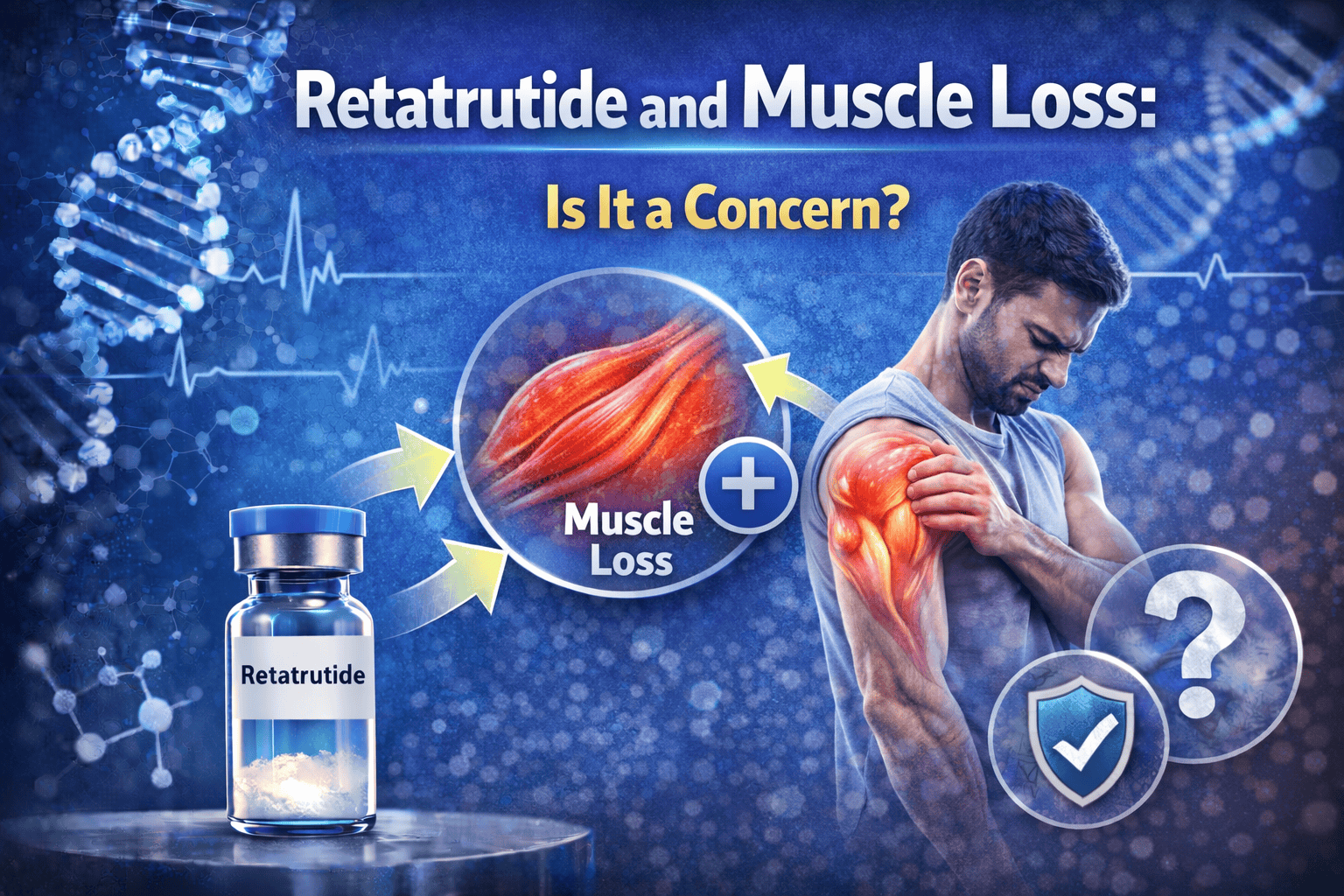
Retatrutide and Muscle Loss: Is It a Concern?
Yes, it is a real concern — but not in the lazy way people often talk about it. The best current retatrutide body-composition data suggest that lean mass does go down as body weight falls. The more important question is whether that loss looks unusually bad compared with other obesity treatments. Right now, the answer appears to be no.
That does not make the issue small. When total weight loss is very large, even a “normal” proportion of lean-mass loss can still mean a meaningful drop in absolute lean tissue. The cleanest current reading is: retatrutide does not yet look uniquely muscle-toxic, but muscle preservation should be taken seriously if this drug eventually becomes widely used.
This page is specifically about body-composition and muscle-preservation concerns with retatrutide, not a general overview of its total weight-loss results or approval timeline.
Key terms: retatrutide, lean mass, muscle loss, body composition, DXA, fat mass, semaglutide comparison, sarcopenia risk, protein intake, resistance training
Quick Take
Retatrutide should be treated like a powerful weight-loss drug where lean-mass preservation matters on purpose, not like a molecule that has already been proven to uniquely waste muscle. The current concern is real, but the fairest frame is “watch body composition closely,” not “assume direct muscle damage.”
TL;DR decision
Muscle-loss concern with retatrutide is real enough to respect, but the best current data suggest the proportion of lean-mass loss is similar to other major weight-loss treatments. The bigger issue is protecting muscle on purpose during very large weight loss, not proving that retatrutide is uniquely harmful to muscle tissue.
Evidence standard: human trials, dose ranges, guideline-level sources when available
Who this is for: anyone worried that rapid retatrutide-related weight loss might come with too much lean-mass or muscle loss
Who this is not for: anyone looking for gray-market peptide use, underground dosing advice, or reassurance that “lean mass loss doesn’t matter at all”
Reviewed by: VerifiedSupps Editorial Team
Last reviewed: April 17, 2026
Parent Hub
VerifiedSupps Articles
Use the main article hub if you want a calmer framework before treating any new metabolic drug like a complete answer to every body-composition problem.
Quick decision table: how worried should you be about muscle loss with retatrutide?
This is the fastest way to separate “real concern” from “overread panic.”
| If you are worried about… | Best current answer | Why | Best next move |
|---|---|---|---|
| Whether retatrutide can lower lean mass | Yes | The published body-composition substudy showed real lean-mass loss alongside fat-mass loss | Take preservation seriously |
| Whether that proves unique muscle toxicity | No | Investigators said the lean-mass share looked similar to other obesity treatments | Do not overread the signal |
| Whether lean mass automatically equals skeletal muscle | No | DXA-style lean-mass measures include more than contractile muscle tissue | Use more nuance |
| Whether muscle preservation still matters | Absolutely | Large weight loss can still mean meaningful absolute lean-tissue loss | Protein + resistance training matter |
Best next step (today): Think less in terms of “Does retatrutide destroy muscle?” and more in terms of “How do I preserve muscle quality and lean tissue during very large weight loss?”
Does retatrutide cause muscle loss?
The cleanest answer is that retatrutide appears to cause some lean-mass loss during weight loss, which is not surprising. The more careful answer is that current evidence does not show it causes a clearly disproportionate share of lean-mass loss compared with other major obesity treatments.
That distinction matters. During large weight loss, some lean tissue usually goes down along with fat mass. The key question is whether the quality of weight loss still favors fat loss. The retatrutide body-composition substudy says yes: the investigators concluded that the proportion of lean-mass loss to total weight loss was similar to other obesity treatments, not obviously worse.
So yes, concern is warranted. But the concern is better framed as a preservation problem during large weight loss rather than as proof that retatrutide has a unique direct muscle-wasting effect.
How much lean mass has retatrutide reduced so far?
The best direct body-composition data so far come from a phase 2 substudy in adults with type 2 diabetes, not from the big obesity-only phase 3 trials. That is important because it means the muscle-loss story is still based on a narrower dataset than the overall retatrutide weight-loss story.
Fat mass
26.1%
Greatest mean percent reduction in total fat mass at week 36
Lean mass
6.5 kg
Largest lean-mass loss reported in the week-36 body-composition analyses
Best honest read
Roughly one-third to two-fifths
of total mass lost in the highest-loss subgroup, by simple arithmetic from the abstracted kg changes
That last number is an inference, not a directly published endpoint. But it lines up with the paper’s own conclusion that the proportion of lean-mass loss looked similar to other obesity treatments. So the current worry is less “retatrutide uniquely strips muscle” and more “retatrutide can drive enough total weight loss that the absolute lean-tissue drop may become meaningful.”
Is retatrutide worse than semaglutide for muscle loss?
There is not enough direct evidence to say that yet. The current retatrutide body-composition paper itself says the lean-mass share appears similar to other obesity treatments. Semaglutide’s own body-composition data also show real lean-mass loss during substantial weight reduction.
In the STEP 1 DXA substudy, semaglutide 2.4 mg reduced total fat mass by 19.3%, regional visceral fat mass by 27.4%, and total lean body mass by 9.7% over 68 weeks. At the same time, the proportion of lean body mass relative to total body mass actually increased by 3.0 percentage points, which is one reason “lean mass went down” is not the whole story.
So the cleanest current comparison is this: retatrutide does not yet look uniquely worse than semaglutide for lean-mass share, but retatrutide may still demand more attention simply because its total weight-loss effect may become larger in absolute terms.
Does lean mass loss mean actual muscle loss?
Not automatically. This is one of the most important distinctions in the whole conversation. Lean mass or fat-free mass is not the same thing as pure skeletal muscle mass.
The 2024 body-composition principles review points out that people often conflate fat-free mass, lean body mass, and skeletal muscle mass when they should not. In these body-composition models, the nonfat side of the body includes more than just contractile muscle. That is one reason a drop in lean mass should not instantly be translated into “the drug is wasting muscle.”
Lean mass includes more than muscle
It is a broader nonfat compartment, not a clean skeletal-muscle readout.
Muscle quality may matter more than mass alone
A 2025 review argues muscle quality may be more meaningful than absolute lean mass by itself.
That does not make lean-mass loss irrelevant. It makes it harder to interpret lazily. The best read is that body composition needs context, not that the issue should be ignored.
What increases muscle loss risk on retatrutide?
The biggest practical risk factors are not mysterious. They are the same things that make lean tissue more vulnerable during most major weight loss: very fast total weight loss, low protein intake, low resistance-training stimulus, and starting out with less muscle reserve or worse function.
Low protein intake
A major appetite-suppressing drug can accidentally turn into a low-protein diet if you are not careful.
No resistance training
Without a mechanical reason to keep muscle, the body has less incentive to preserve it.
Lower starting reserve
Older adults, frailer people, and anyone with lower strength or muscle reserve have less room for sloppy weight loss.
This is why the same amount of lean-mass loss can be a minor issue in one person and a serious issue in another. The concern is highest when muscle and function were already at risk before the drug entered the picture.
What should you do if you are worried about losing muscle on retatrutide?
Treat muscle preservation as part of the treatment plan, not as something you check after the fact. The main mistake is waiting until strength, performance, or body composition obviously decline before taking it seriously.
Common mistakes
- Using scale weight as the only success metric.
- Letting appetite fall so much that protein intake quietly collapses.
- Doing little or no resistance training during major weight loss.
- Assuming lean-mass loss automatically means muscle damage or, on the opposite extreme, that it does not matter at all.
Clean test protocol
| Inputs | Resistance training, a protein-forward meal pattern, and baseline markers like body composition, waist, strength, or performance that can actually be rechecked |
|---|---|
| Duration | Build preservation habits from the start and reassess over the first few months of major weight loss rather than waiting until the end |
| 3 metrics | Protein adequacy, consistency of resistance training, and whether strength or function is holding up as weight falls |
| Stop conditions | Rapid worsening weakness, repeated falls, inability to maintain basic training or daily function, severe vomiting or dehydration, or any use of unverified “retatrutide” products outside legitimate trials |
How to tell it’s working
The best sign is not just “the scale is down.” It is that body weight is decreasing while protein intake, training quality, strength, and day-to-day function are staying relatively stable.
Red flags / seek care
Get medical help quickly for persistent vomiting, dehydration, chest pain, fainting, severe palpitations, or if weakness and functional decline are becoming clinically meaningful rather than just annoying.
Who should be more cautious about retatrutide and muscle loss?
The higher-risk group is not “everyone who wants to lose weight.” It is the people who already have less margin for lean-tissue loss: older adults, people with low baseline strength or lower muscle reserve, anyone already close to frailty or sarcopenia, and people who struggle to eat enough protein or maintain training while weight is dropping.
This also is where current status matters. Retatrutide is still investigational and legally available only in Lilly-sponsored trials. That means there is no approved public-use framework yet for carefully navigating these higher-risk body-composition questions in routine practice.
So if someone is already vulnerable to weakness, falls, or functional decline, the threshold for casual enthusiasm should be much higher. The more muscle matters to your safety and independence, the less acceptable sloppy weight loss becomes.
Selected Professional References
These are the most useful sources for understanding what the current retatrutide body-composition data do and do not show, how that compares with semaglutide, and why “lean mass” is not the same thing as skeletal muscle.
Effects of Retatrutide on Body Composition in Type 2 Diabetes
The single most important source for the current retatrutide lean-mass discussion.
Used for: fat-mass loss, lean-mass loss, and “similar proportion to other obesity treatments” conclusion
Triple–Hormone-Receptor Agonist Retatrutide for Obesity
Important for the larger weight-loss context behind why absolute lean-tissue loss could matter so much with this drug.
Used for: strongest published obesity efficacy context
What to Know About Retatrutide
The key official source for current legal and clinical status.
Used for: investigational status and trial-only availability
Impact of Semaglutide on Body Composition in STEP 1
Useful because it gives the best current approved-drug comparison for how major weight loss shifts fat and lean tissue.
Used for: fat, visceral-fat, and lean-mass changes with semaglutide
Wegovy Prescribing Information
The label itself already acknowledges greater fat-mass loss than lean-mass loss, which is an important comparator point.
Used for: official pharmacodynamic framing of semaglutide body-composition change
Fundamental Body Composition Principles Provide Context for Lean-Mass Loss
One of the best sources for why lean mass is not the same as skeletal muscle and how to preserve more of it during weight loss.
Used for: interpretation, resistance training, and protein targets
Are We Giving Too Much Weight to Lean Mass Loss?
Helpful for a more nuanced read on why muscle quality and function can matter more than raw lean-mass numbers alone.
Used for: nuance around muscle quality vs absolute lean mass
Go Deeper (VerifiedSupps Guides)
These are the best next reads if your real concern is body composition, lean-mass protection, and making better retatrutide decisions with more context.
Retatrutide for Weight Loss
Best next read if you want the broader obesity-results story after the lean-mass concern is clear.
Retatrutide: Results, Side Effects, and Current Status
Helpful if you want the cleaner retatrutide status snapshot after this body-composition-focused page.
How Much Protein Do You Actually Need?
Useful if your real goal is protecting lean mass while body weight is falling.
Creatine Monohydrate Benefits, Science, and Dosage
Helpful if you are thinking more seriously about strength, training quality, and muscle support during fat loss.
Final Takeaway
Retatrutide and muscle loss should be taken seriously, but the current evidence does not support the lazy version of the fear story. The better reading is that large weight loss can bring meaningful lean-mass loss, and retatrutide is powerful enough that this deserves active prevention. What the current data do not show is clear proof that retatrutide is uniquely worse than other major obesity treatments on lean-mass share. The right response is not panic. It is muscle-preservation strategy.
FAQ
Does retatrutide cause muscle loss?
Current evidence suggests retatrutide causes some lean-mass loss during weight loss, but the available study says the proportion appears similar to other obesity treatments rather than clearly worse.
How much lean mass has retatrutide reduced so far?
In the phase 2 body-composition substudy in type 2 diabetes, retatrutide produced up to 6.5 kg of lean-mass loss alongside much larger fat-mass reductions. The study did not conclude that lean-mass loss was disproportionately high versus other obesity therapies.
Is lean mass loss the same as muscle loss?
No. Lean mass or fat-free mass is broader than skeletal muscle alone, which is why body-composition changes need interpretation and not just alarm.
Is retatrutide worse than semaglutide for muscle loss?
That is not proven. Semaglutide also causes lean-mass decline during substantial weight loss, and the retatrutide body-composition paper says its lean-loss proportion appears similar to other obesity treatments.
Why does rapid weight loss reduce lean mass at all?
Because major weight loss usually reduces both fat mass and some lean tissue. The key issue is whether fat loss still clearly outweighs lean-tissue loss and whether muscle-preserving strategies are being used.
Can resistance training help preserve muscle on retatrutide?
Yes. Resistance training is one of the most practical countermeasures for preserving more lean tissue and muscle during major weight loss.
How much protein matters during major weight loss?
A practical target during weight loss is often around 1.2 g/kg or greater, or at least 20% of total energy, depending on the clinical context and tolerability.
Who should be more cautious about retatrutide and muscle loss?
Older adults, people with low baseline strength or muscle reserve, frailty or sarcopenia risk, and anyone struggling to eat enough protein or train consistently should be more careful.
Is retatrutide approved right now?
No. Retatrutide is still investigational and legally available only in Lilly-sponsored clinical trials.
What is the safest mindset about retatrutide and muscle loss?
Treat lean-mass preservation as an active part of the plan. The current data support concern and vigilance, but not a lazy conclusion that retatrutide is uniquely muscle-toxic.
VerifiedSupps Medical Disclaimer
This content is for educational purposes only and is not medical advice. Retatrutide is an investigational medicine, not an approved public-use therapy. Current discussions of lean mass and muscle loss with obesity drugs should not be treated as proof of direct muscle toxicity, but they also should not be ignored when weight loss becomes very large. If strength, function, nutrition, or hydration are deteriorating during weight loss, get medical guidance. Seek urgent medical care for persistent vomiting, dehydration, chest pain, fainting, trouble breathing, severe palpitations, or strong reactions after using any unverified injectable product.