By VerifiedSupps Editorial Team
Amycretin for Weight Loss: Results, Side Effects, and Current Status
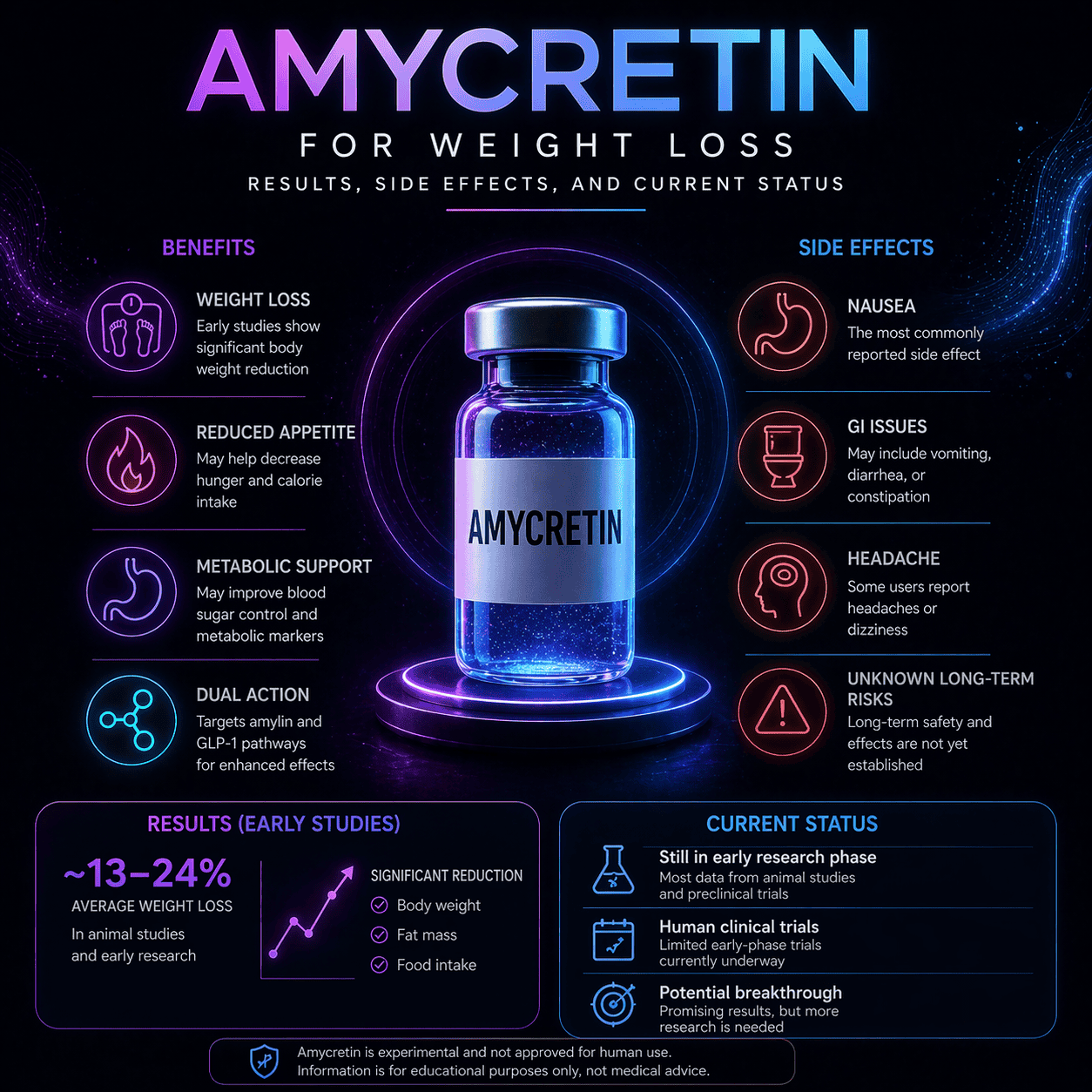
Amycretin is one of Novo Nordisk’s most closely watched next-generation obesity drugs because it combines GLP-1 and amylin receptor activity in one molecule. The early weight-loss results are strong: published and publicly reported studies show up to 24.3% mean weight loss with weekly injections over 36 weeks and up to 13.1% with a daily oral version over 12 weeks.
That does not make amycretin a finished treatment yet. It is still investigational, not approved for routine use, and the biggest open questions are exactly the ones that matter most in real care: long-term tolerability, maintenance, cardiovascular and metabolic outcomes, and how it performs against already approved obesity medicines.
This page focuses on amycretin’s weight-loss results, side effects, oral versus injectable data, diabetes findings, and current development status without treating early promise like final proof.
Key terms: amycretin, GLP-1, amylin, Novo Nordisk, oral amycretin, subcutaneous amycretin, phase 1, phase 2, phase 3, obesity, type 2 diabetes
Highest reported SC result
24.3%
at 36 weeks
Highest oral result
13.1%
at 12 weeks
Current status
Phase 3 development
not approved
Quick Take
Amycretin looks like a serious obesity-drug candidate because it is producing large early weight-loss signals in both injectable and oral forms. The main caution is that early and mid-stage results are not the same as approved, long-term, real-world treatment evidence.
TL;DR decision
Amycretin is one of the most promising next-wave obesity drugs, especially because an oral version may be possible. But for now, it belongs in the “watch closely” category, not the “use now” category.
Evidence standard: human trials, dose ranges, guideline-level sources when available
Who this is for: people trying to understand whether amycretin may be a real next-generation weight-loss treatment and how strong the early data actually are
Who this is not for: anyone looking for access outside clinical development, off-label sourcing, or reassurance that amycretin is already an approved public-use therapy
Reviewed by: VerifiedSupps Editorial Team
Last reviewed: April 20, 2026
Parent Hub
VerifiedSupps Articles
Use the broader article hub if you want a calmer framework for comparing new obesity therapies without getting pulled around by headlines alone.
Amycretin quick answer table: what should you believe right now?
This is the fastest way to keep the major claims attached to the right evidence tier.
| If you want to know… | Best current answer | Strongest evidence so far | What it means |
|---|---|---|---|
| Does amycretin cause meaningful weight loss? | Yes, in early trials | Up to 24.3% at 36 weeks with subcutaneous dosing; up to 13.1% at 12 weeks with oral dosing | Strong signal, but not final approval-grade proof |
| Is oral amycretin interesting? | Very | Daily oral dosing reached double-digit weight loss in 12 weeks | Could matter if longer trials confirm efficacy and tolerability |
| What are the main side effects? | Mostly GI | Nausea, vomiting, diarrhea, decreased appetite, and other incretin-like effects | Tolerability during dose escalation remains important |
| Can you get amycretin now? | No routine public use | Phase 3 development has been advanced, but approval has not happened | This is a pipeline drug, not a current prescription option |
Best next step (today): Treat amycretin as a serious late-stage candidate, but wait for phase 3 outcomes before comparing it confidently with approved obesity medicines.
Does amycretin actually work for weight loss?
Yes, amycretin has shown meaningful weight loss in early and mid-stage human studies. The signal is strong enough that Novo Nordisk has advanced both injectable and oral forms into phase 3 development.
The most important qualifier is that amycretin is still not approved. Early and mid-stage weight loss can look excellent and still require larger, longer studies before clinicians know the real balance of efficacy, tolerability, durability, and outcomes.
Mechanism
- GLP-1 receptor activity helps explain appetite, fullness, glucose, and gut-motility effects familiar from drugs like semaglutide.
- Amylin receptor activity may add satiety and appetite control through a different hormonal pathway.
- Amycretin is designed as one molecule with both activities, rather than a two-drug combination.
What would change my recommendation: full phase 3 obesity data showing durable weight loss, acceptable tolerability, strong maintenance results, and meaningful cardiometabolic outcomes.
How much weight loss has amycretin shown so far?
The largest reported amycretin weight-loss result so far is 24.3% mean body-weight reduction over 36 weeks with a 60 mg weekly subcutaneous dose. In a separate oral study, the highest daily oral dose reached 13.1% mean weight loss over 12 weeks.
Weekly injection
24.3%
Highest reported weight loss at 36 weeks
Oral daily version
13.1%
Highest reported weight loss at 12 weeks
Type 2 diabetes study
14.5%
Highest reported weight loss at 36 weeks in diabetes
The comparison that matters is not just “which number is biggest.” Trial duration, dose escalation, diabetes status, baseline weight, study design, and discontinuation all matter. The safest summary is that amycretin’s early weight-loss signal is strong, but its final place in therapy is still unknown.
One encouraging detail is that several reports noted no clear early weight-loss plateau, which suggests longer treatment could potentially produce additional loss. That still needs to be confirmed in larger and longer trials.
Is oral amycretin as promising as the injection?
Oral amycretin is one of the most interesting parts of the program because double-digit weight loss over 12 weeks is a strong early signal for a pill. But the injectable data are still larger in absolute weight-loss percentage and longer in duration.
Oral amycretin
The oral version reached 10.4% weight loss at 50 mg and 13.1% at the highest daily dose over 12 weeks, with mostly mild-to-moderate gastrointestinal side effects.
Subcutaneous amycretin
The weekly injectable version has the largest published and publicly reported weight-loss signal so far, including results above 20% over 36 weeks.
The practical question is not whether the oral form looks exciting. It does. The real question is whether phase 3 can confirm meaningful, durable weight loss with a tolerability and manufacturing profile that works at scale.
What side effects does amycretin have?
The main side effects so far are gastrointestinal, which is consistent with incretin and amylin-based obesity therapies. Nausea, vomiting, diarrhea, decreased appetite, and similar symptoms are the pattern to watch.
| Safety topic | What current studies suggest |
|---|---|
| Most common adverse events | Mostly gastrointestinal events such as nausea, vomiting, diarrhea, and decreased appetite |
| Severity | Most reported events were mild to moderate and occurred more often at higher doses or during escalation |
| Serious events | A serious recurrent gallstone-related pancreatitis event was reported in the subcutaneous trial literature, so pancreatic and gallbladder safety remain worth watching |
| Main open question | Whether tolerability remains acceptable when many more people use the drug for longer periods in phase 3 and real-world care |
The short version is that amycretin’s side effects look familiar for this drug class, not shocking. But “familiar” does not mean trivial, especially for higher-dose, long-duration obesity treatment.
How does amycretin compare with Wegovy, Zepbound, and retatrutide?
Amycretin looks competitive on early weight-loss numbers, but direct comparison is not settled. Comparing a 36-week phase 1b/2a amycretin result against approved phase 3 programs for semaglutide or tirzepatide is not a clean head-to-head test.
What makes amycretin distinct is the GLP-1 plus amylin design. Semaglutide is primarily a GLP-1 receptor agonist. Tirzepatide targets GIP and GLP-1. Retatrutide targets GIP, GLP-1, and glucagon. Amycretin’s bet is that adding amylin biology can strengthen appetite and weight control while potentially supporting both injectable and oral development.
The calm comparison is this: amycretin is a very strong pipeline candidate, but approved medicines still win on availability, labeling, outcomes experience, and real-world clinical use.
What is amycretin’s current approval status?
Amycretin is still investigational. It has advanced into phase 3 development for weight management, and Novo Nordisk has also reported promising data in type 2 diabetes, but it is not approved for routine treatment.
Novo Nordisk said it would advance both subcutaneous and oral amycretin into phase 3 development for weight management after regulatory feedback. The phase 3 program is expected to take time before any regulatory review can happen.
The current status is best described as: strong pipeline candidate, phase 3 development underway or starting, no public approval yet, and no routine clinical access outside research pathways.
What should you do if you are waiting for amycretin?
Do not build your weight-loss plan around a drug that is not approved yet. Amycretin is worth watching, but current care decisions should still be based on available treatments, medical evaluation, nutrition, activity, sleep, and long-term adherence.
Common mistakes
- Comparing early amycretin results directly with approved drugs as if the studies were identical.
- Assuming oral amycretin will be easier, cheaper, or better before phase 3 confirms the full profile.
- Treating “no plateau yet” as proof of unlimited or guaranteed additional weight loss.
- Ignoring current approved obesity treatments while waiting for a pipeline drug.
Clean test protocol
| Inputs | Your current obesity or diabetes context, available approved options, cardiometabolic risk, tolerability history with GLP-1 medicines, and whether the information you are reading is phase 1, phase 2, or phase 3 |
|---|---|
| Duration | Reassess when full phase 3 obesity and diabetes results are published, and again if a regulatory filing or approval decision occurs |
| 3 metrics | Durable weight loss, discontinuation and GI tolerability, and outcome data beyond the scale |
| Stop conditions | Any seller claiming public access before approval, any blurred explanation of trial status, or any decision to delay necessary care because a pipeline drug looks exciting |
How to tell it’s working
For amycretin as a development program, “working” means phase 3 confirms strong, durable weight loss with acceptable tolerability and useful metabolic outcomes. For you as a patient, it means your current plan is improving health now rather than waiting passively for future drugs.
Red flags / seek care
Seek medical care for severe vomiting, dehydration, severe abdominal pain, chest pain, fainting, trouble breathing, or symptoms that could suggest pancreatitis, gallbladder disease, or a serious allergic reaction. Do not use any product sold as amycretin outside legitimate clinical development or approved medical channels.
Selected Professional References
These are the most useful sources for understanding amycretin’s mechanism, injectable and oral trial results, diabetes findings, tolerability profile, and current development status.
Subcutaneous Amycretin Phase 1b/2a Results
Official source for the once-weekly injection proof-of-concept data and the 1.25 mg, 5 mg, and 20 mg weight-loss results.
Used for: 22.0% at 36 weeks, placebo comparison, and GI tolerability pattern
Amycretin Administered Subcutaneously
The peer-reviewed study behind the subcutaneous efficacy and tolerability discussion in people with overweight or obesity.
Used for: 36-week study design, safety profile, discontinuation context, and highest reported subcutaneous result
First-in-Human Oral Amycretin Trial
Key source for the oral version’s safety, tolerability, pharmacology, and early weight-loss signal.
Used for: oral amycretin adverse events and 12-week early trial context
Up to 24.3% Weight Loss and Oral Results
Useful for the publicly reported ADA and Lancet-era results across both injection and oral forms.
Used for: 24.3% at 36 weeks, 13.1% oral result, and no early plateau context
Novo Plans Late-Stage Amycretin Trials
Helpful for the current status line: both oral and injectable forms advancing into phase 3 development.
Used for: phase 3 timing, regulatory feedback, and investigational status
Amycretin in Type 2 Diabetes
Important because it shows amycretin’s relevance beyond obesity-only populations.
Used for: 14.5% subcutaneous weight loss, 10.1% oral weight loss, HbA1c improvement, and late-stage plan
GLP-1 and Amylin Multiagonism with Amycretin
Useful for keeping the side-effect and outcomes discussion more cautious and clinically grounded.
Used for: serious event context and why comorbidity outcomes still matter
Amylin in Obesity and Metabolic Disease
A broader source for why amylin-based obesity therapy is scientifically interesting.
Used for: amylin mechanism and future clinical potential context
Go Deeper (VerifiedSupps Guides)
These are the best next reads if you want to compare amycretin with the broader next-generation obesity-drug landscape.
Retatrutide for Weight Loss
Best next read if you want to compare amycretin with another major next-generation obesity candidate.
Retatrutide Trial Results
Useful if your next question is how to read early, topline, and published obesity-drug results without overreacting.
Retatrutide vs Semaglutide
Helpful if you want a clean comparison between pipeline drugs and approved GLP-1 therapy.
Retatrutide for Belly Fat and Metabolic Health
Useful if you care about metabolic outcomes beyond the headline weight-loss number.
Final Takeaway
Amycretin looks like one of the most important next-generation obesity medicines to watch. The injectable results are strong, the oral results are unusually interesting, and the type 2 diabetes data suggest metabolic relevance beyond weight loss alone. But the current recommendation stays conservative: amycretin is promising, not approved; impressive, not settled; and worth following closely while phase 3 determines whether the early signal survives in larger, longer, more clinically meaningful studies.
FAQ
What is amycretin?
Amycretin is an investigational Novo Nordisk medicine designed as a unimolecular GLP-1 and amylin receptor agonist for weight management and type 2 diabetes research.
Does amycretin work for weight loss?
Early and mid-stage human studies suggest meaningful weight loss, including more than 20% mean body-weight reduction in some subcutaneous trial results. Amycretin is still investigational and not approved.
How much weight loss has amycretin shown?
The largest reported subcutaneous result is 24.3% mean weight loss at 36 weeks, while oral amycretin reached up to 13.1% at 12 weeks in an early trial.
Is oral amycretin available?
No. Oral amycretin is still investigational. It has shown promising early weight-loss results, but it is not an approved public-use medicine.
What are amycretin’s main side effects?
The most common reported side effects are gastrointestinal, including nausea, vomiting, diarrhea, decreased appetite, and related incretin-like symptoms.
Is amycretin better than Wegovy or Zepbound?
That is not proven. Amycretin looks promising, but direct comparison with approved drugs requires larger, longer phase 3 and head-to-head evidence.
Is amycretin approved?
No. Amycretin is still investigational and has advanced into phase 3 development, but it is not approved for routine obesity or diabetes treatment.
When could amycretin become available?
Amycretin would need successful phase 3 trials and regulatory review before availability. Novo Nordisk has said late-stage development is expected to take time before regulatory review can begin.
Does amycretin help diabetes?
Mid-stage data in type 2 diabetes suggest amycretin can reduce body weight and improve HbA1c, but the diabetes program still requires further late-stage confirmation.
What is the safest way to think about amycretin right now?
Treat amycretin as a serious and promising pipeline obesity drug, not as an approved treatment or something to seek outside legitimate clinical development.
VerifiedSupps Medical Disclaimer
This content is for educational purposes only and is not medical advice. Amycretin is an investigational medicine and is not approved for routine weight-loss or diabetes treatment. Do not use unverified products claiming to contain amycretin, and do not delay evidence-based obesity or diabetes care while waiting for a pipeline drug. Seek urgent medical care for severe vomiting, dehydration, severe abdominal pain, chest pain, fainting, trouble breathing, or symptoms that may suggest pancreatitis, gallbladder disease, or a serious allergic reaction.