Ribupatide for Weight Loss: Oral and Injectable GLP-1/GIP Results
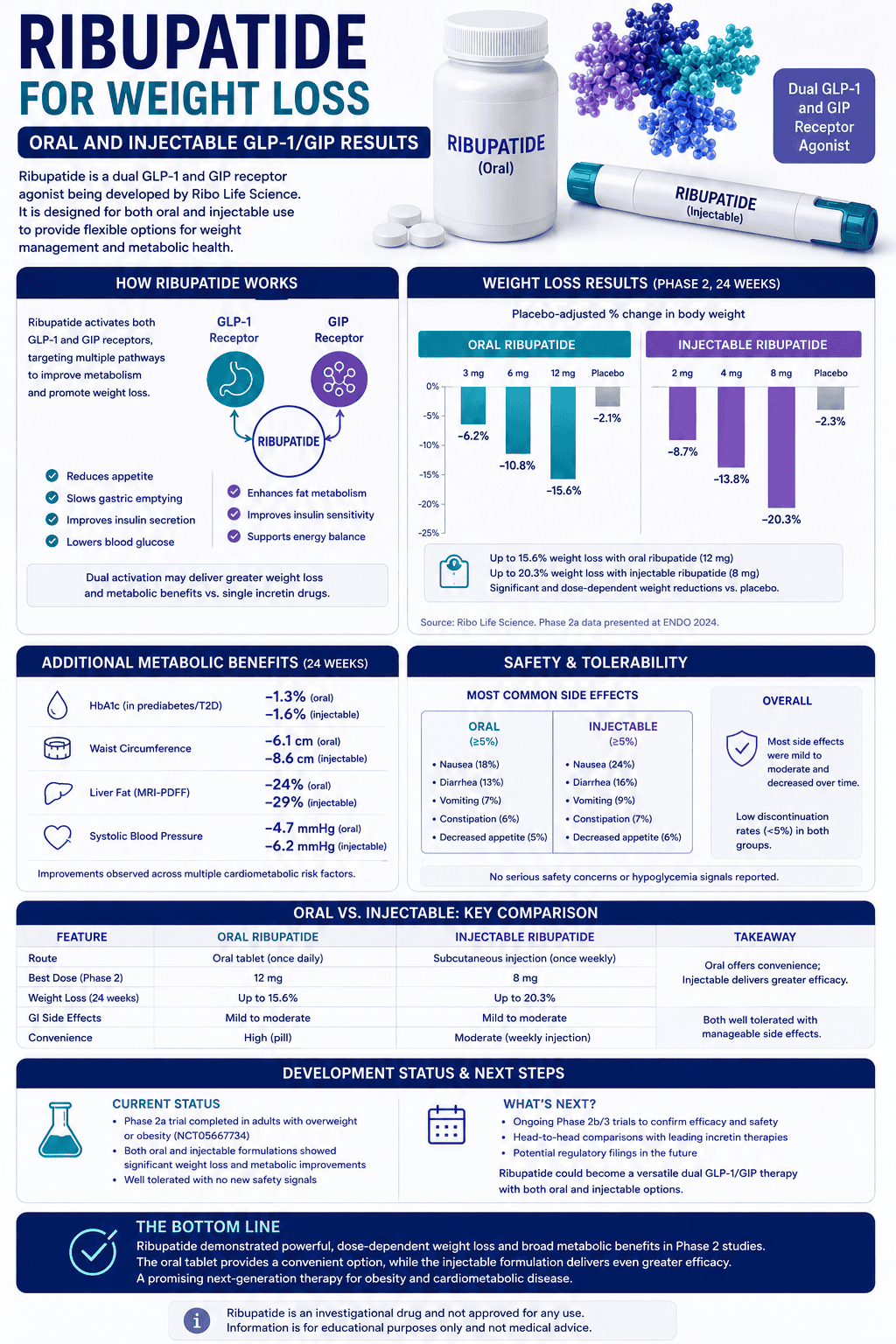
Ribupatide is an investigational dual GLP-1/GIP receptor agonist being developed in both once-weekly injectable and once-daily oral forms for obesity and overweight. The injectable version is further along in global Phase 3 development, while oral ribupatide has early Phase 2 data from China.
The strongest injectable data reported so far include up to 19.2% mean weight loss at 48 weeks in a Phase 3 China trial and up to 23.6% mean weight loss at 36 weeks in a separate higher-dose Phase 2 analysis. Oral ribupatide showed up to 12.1% mean weight loss at 26 weeks in a Phase 2 trial.
This article focuses on ribupatide results, side effects, dosing studied in trials, and current development status. It does not provide dosing instructions or support gray-market peptide use.
Who this is for: Readers tracking oral and injectable ribupatide trial results, GLP-1/GIP drug development, and emerging weight-loss medications.
Who this is not for: Anyone trying to buy, compound, inject, or self-dose ribupatide outside a regulated clinical trial.
Reviewed by VerifiedSupps Editorial Team • Last reviewed: June 1, 2026
The answer-first view: ribupatide is one of the more interesting GLP-1/GIP drug candidates because it has both injectable and oral development paths. The injectable form has stronger and longer clinical data, while the oral form is earlier but notable because it reached double-digit weight loss over 26 weeks.
The careful interpretation is that ribupatide is still investigational. It is not FDA-approved, it is not available as a normal prescription medicine in the U.S., and trial results should not be treated like consumer dosing guidance.
Ribupatide is also not the same as tirzepatide. Both target GLP-1 and GIP pathways, but they are different molecules with different evidence packages, regulatory timelines, and dosing programs. For a direct approved-drug comparison, see our article on CT-388 vs tirzepatide.
If you are following the broader obesity-drug pipeline, ribupatide sits alongside candidates such as VK2735 for weight loss, CT-388 for weight loss, retatrutide, and MariTide.
Key Takeaways
- Ribupatide is a dual GLP-1/GIP receptor agonist being developed by Kailera outside Greater China and by Hengrui as HRS9531 in Greater China.
- Injectable ribupatide is being studied as a once-weekly subcutaneous injection in the global Phase 3 KaiNETIC program.
- In a completed Phase 3 China obesity trial, injectable HRS9531 produced up to 17.7% mean weight loss using the treatment-policy estimand and 19.2% using a supplementary hypothetical estimand at 48 weeks.
- In a separate Phase 2 China trial, an 8 mg injectable dose produced 22.8% mean weight loss at 36 weeks in the primary analysis and 23.6% in a supplementary analysis.
- Oral ribupatide showed up to 12.1% mean weight loss at 26 weeks in a 166-person Phase 2 China trial, with no observed plateau at the topline readout.
- Ribupatide is not FDA-approved and should not be used outside clinical research.
Does ribupatide work for weight loss?
Early and mid-to-late-stage data suggest ribupatide can produce clinically meaningful weight loss, especially as a weekly injection. The oral version also has promising Phase 2 data, but it is earlier and needs more confirmation.
Ribupatide, also called KAI-9531 by Kailera and HRS9531 by Hengrui in Greater China, targets both GLP-1 and GIP receptors. That puts it in the same broad dual-incretin category as tirzepatide and CT-388, though cross-drug comparisons should be made carefully.
Mechanism
- GLP-1 receptor activation: May reduce appetite, increase fullness, slow gastric emptying, and improve glucose regulation.
- GIP receptor activation: May add appetite and metabolic effects when paired with GLP-1 activity.
- Energy intake: Weight loss is expected mainly through reduced appetite and lower calorie intake, not direct “fat burning.”
- Evidence gap: Mechanism does not prove long-term safety, durability, or superiority over approved medicines.
The key point is that ribupatide’s biology is plausible, and the weight-loss results are notable, but it still needs large global data before it can be judged like an approved medication. For a related mechanism discussion, see how retatrutide works and retatrutide vs tirzepatide.
What were the injectable ribupatide weight-loss results?
Injectable ribupatide has produced the strongest results so far, including up to 19.2% mean weight loss at 48 weeks in a Phase 3 China trial and up to 23.6% at 36 weeks in a separate higher-dose Phase 2 analysis. These are strong signals, but they are not yet the same as completed U.S. or global approval data.
The injectable program is important because it is the version now being tested in Kailera’s global Phase 3 KaiNETIC trials.
| Injectable ribupatide study | Population | Duration | Key weight-loss result |
|---|---|---|---|
| HRS9531-201 Phase 2 | Chinese adults with obesity, without diabetes | 24 weeks | 6 mg group showed about 16.8% mean weight loss from baseline. |
| HRS9531-203 Phase 2, 8 mg dose | Chinese adults with overweight or obesity, without diabetes | 36 weeks | 22.8% mean weight loss in the primary analysis; 23.6% in a supplementary analysis; placebo was about 1.8%. |
| HRS9531-301 Phase 3 China trial | 567 Chinese adults with overweight or obesity, without diabetes | 48 weeks | Up to 17.7% mean weight loss using the treatment-policy estimand and 19.2% using the supplementary hypothetical estimand at 6 mg. |
| KaiNETIC global Phase 3 program | Adults with obesity or overweight, including studies with and without type 2 diabetes | 76-week treatment design | Ongoing; topline results expected in 2028. |
The Phase 3 China result is useful because it tested ribupatide in a larger late-stage setting. The 8 mg Phase 2 result is also important because it suggests higher doses may produce larger weight loss, which is why Kailera is studying doses up to 10 mg in Phase 3 and up to 20 mg in a separate Phase 2b high-dose trial.
A cautious reader should avoid one common mistake: do not compare ribupatide’s 36-week, 48-week, and future 76-week results as if they came from the same study design. Dose, duration, population, estimand, and trial conduct all matter.
What were the oral ribupatide weight-loss results?
Oral ribupatide showed up to 12.1% mean weight loss at 26 weeks in a Phase 2 China trial. That is notable for an oral GLP-1/GIP peptide candidate, but it is still early compared with the injectable program.
The oral version is also known as HRS9531 tablet or KAI-9531-T. It is being developed as a once-daily tablet, while injectable ribupatide is being developed as a once-weekly shot.
| Oral ribupatide dose | Mean weight loss at 26 weeks | Responder data | Main interpretation |
|---|---|---|---|
| Placebo | 2.3% using the efficacy estimand | Reference group | Used for comparison. |
| 10 mg | 6.9% using the efficacy estimand | Less robust than higher doses | Shows dose response but lower effect. |
| 25 mg | 12.1% using the efficacy estimand | 59.1% achieved at least 10% loss; 38.6% achieved at least 15% loss | Strongest responder signal reported. |
| 50 mg | 12.1% using the efficacy estimand | 52.5% achieved at least 10% loss; 37.5% achieved at least 15% loss | Similar mean loss to 25 mg in topline data. |
The treatment-policy estimand showed similar but slightly different results: 6.7% at 10 mg, 11.9% at 25 mg, and 11.4% at 50 mg, compared with 2.1% for placebo. That matters because estimands answer different trial questions, especially when discontinuation or nonadherence occurs.
Oral ribupatide should also be separated from other oral weight-loss candidates. For example, oral VK2735 is another dual GLP-1/GIP candidate, while oral GLP-1-only drugs follow a different approach. The oral obesity-drug space is promising, but still highly competitive and fast-moving.
What ribupatide dose was used in trials?
Ribupatide has no approved dose. Trial doses include once-weekly injectable doses studied at 2, 4, 6, 8, and higher planned doses, while oral ribupatide has been studied as once-daily 10, 25, and 50 mg tablets.
These are research doses, not consumer instructions. Dose escalation and medical monitoring are central to the clinical trial design.
- Injectable ribupatide: Studied as a once-weekly subcutaneous injection.
- China Phase 3 injection: Tested 2 mg, 4 mg, and 6 mg over 48 weeks.
- Higher-dose injectable data: An 8 mg dose showed larger 36-week weight loss in Phase 2.
- Global Phase 3 KaiNETIC: Designed to evaluate weekly doses up to 10 mg over 76 weeks.
- High-dose Phase 2b: Designed to evaluate injectable doses up to 20 mg over 48 weeks.
- Oral ribupatide: Studied as once-daily 10 mg, 25 mg, and 50 mg tablets in Phase 2.
The oral Phase 2 study used a simple titration schedule, reaching 10 mg and 25 mg by week 4 and 50 mg by week 8. That does not mean those doses are appropriate outside a trial; it only describes how the study was conducted.
If you are seeing ribupatide vials, tablets, or “research use only” products online, treat that as a major safety red flag. For the bigger framework, read Are Peptides Safe?.
What are the side effects of ribupatide?
The main ribupatide side effects reported so far are gastrointestinal, broadly consistent with GLP-1-based obesity drugs. Nausea, vomiting, diarrhea, constipation, decreased appetite, and abdominal symptoms are the key issues to watch.
So far, sponsor-reported trial summaries have described most adverse events as mild to moderate. That is encouraging, but full peer-reviewed data and larger global datasets are still needed before the safety profile is clear.
| Safety area | What has been reported | Why it matters |
|---|---|---|
| Oral nausea | 11.9% at 10 mg, 22.7% at 25 mg, and 20.0% at 50 mg in the Phase 2 oral trial | Nausea is one of the most common tolerability issues with incretin drugs. |
| Oral vomiting | 2.4% at 10 mg, 11.4% at 25 mg, and 7.5% at 50 mg | Vomiting can affect adherence and dehydration risk. |
| Oral GI discontinuations | No permanent discontinuations or down-titrations due to nausea, vomiting, diarrhea, or constipation were reported in the Phase 2 oral trial | Encouraging, but confirmation in larger trials is needed. |
| Injectable adverse events | Most reported events were mild to moderate and gastrointestinal-related in sponsor summaries | The global Phase 3 program will better define tolerability at scale. |
| Long-term unknowns | Rare adverse events, durability, adherence, gallbladder events, pancreatitis signals, kidney complications, and post-discontinuation weight regain need more data | These questions matter before broad clinical use. |
Large weight loss can also include lean mass loss if nutrition and resistance training are not managed. That issue is not unique to ribupatide. For more context, see our guides on muscle loss with incretin-based weight loss and how much protein you actually need.
Is ribupatide approved or available yet?
No. Ribupatide is not FDA-approved and is not available as a normal prescription weight-loss medicine in the United States. Current legitimate access should be limited to regulated clinical trials.
The current status depends on the region and formulation. Hengrui has advanced HRS9531 in China, while Kailera is developing ribupatide outside Greater China.
- Injectable ribupatide outside Greater China: Global Phase 3 KaiNETIC program is underway.
- Injectable HRS9531 in China: Hengrui submitted a marketing authorization application to China’s NMPA for long-term weight management in adults.
- Oral ribupatide in China: Hengrui plans to advance oral ribupatide into Phase 3 for obesity.
- Oral ribupatide globally: Kailera plans to initiate a global Phase 2 trial.
- Global injectable data timing: Kailera has indicated KaiNETIC topline results are anticipated in 2028, while a high-dose Phase 2b trial is expected to report topline results in 2027.
A realistic U.S. timeline cannot be stated yet. FDA approval would require successful global trials, a regulatory submission, FDA review, manufacturing review, labeling decisions, and post-approval launch planning.
The conservative takeaway: ribupatide is one to watch, not one to use. Products marketed online as ribupatide, HRS9531, KAI-9531, or “research GLP-1/GIP” should not be treated as safe, verified, or legitimate for personal use.
How does ribupatide compare with other GLP-1/GIP weight-loss drugs?
Ribupatide belongs in the same broad dual-incretin conversation as tirzepatide, CT-388, and VK2735, but it is not approved and should not be ranked from headline percentages alone. The most useful comparison is by evidence maturity, route, and trial duration.
Compared with approved drugs, ribupatide has less regulatory certainty. Compared with pipeline drugs, its injectable data are relatively advanced, and its oral data are interesting but earlier.
| Drug or candidate | Main route | Mechanism | Current interpretation |
|---|---|---|---|
| Tirzepatide | Weekly injection | GIP/GLP-1 receptor agonist | Approved drug with mature Phase 3 and real-world use data. |
| Ribupatide | Weekly injection and daily oral tablet in development | GLP-1/GIP receptor agonist | Investigational; global Phase 3 injectable program underway. |
| CT-388 | Weekly injection | GLP-1/GIP receptor agonist | Investigational; strong Phase 2 data and Phase 3 development. |
| VK2735 | Oral and injectable in development | GLP-1/GIP receptor agonist | Investigational; oral tablet data make it a key comparison point. |
| Retatrutide | Weekly injection | GIP/GLP-1/glucagon triple agonist | Investigational; strong Phase 3 results reported, but not approved. |
For other pipeline strategies, see CagriSema for weight loss, petrelintide for weight loss, amycretin for weight loss, and pemvidutide for weight loss and fatty liver. These drugs use different receptor strategies, so direct comparisons need caution.
References
- Kailera Therapeutics and Hengrui Pharma. Positive Topline Data from Phase 2 Obesity Trial of Oral Ribupatide. February 10, 2026.
This source supports the oral ribupatide Phase 2 results, including 10 mg, 25 mg, and 50 mg weight-loss data, responder rates, nausea and vomiting rates, study design, and planned oral development pathway.
- Jiangsu Hengrui Pharmaceuticals and Kailera Therapeutics. Positive Topline Data from 8 mg Dose of Phase 2 Obesity Trial of HRS9531. January 13, 2025.
This source supports the injectable 8 mg Phase 2 data, including 22.8% mean weight loss in the primary analysis, 23.6% in a supplementary analysis, no observed plateau, and the statement that most adverse events were mild and consistent with GLP-1/GIP class effects.
- Hengrui Pharma and Kailera Therapeutics. Positive Topline Data from Phase 3 Obesity Trial in China of HRS9531. July 15, 2025.
This source supports the 48-week Phase 3 China trial results, including 17.7% mean weight loss using the treatment-policy estimand, 19.2% using the supplementary hypothetical estimand, 44.4% achieving at least 20% weight loss, and Hengrui’s plan to seek regulatory review in China.
- Li X, et al. Efficacy and Safety of HRS9531, a Dual GLP-1/GIP Receptor Agonist, in Chinese Adults Living With Overweight or Obesity Without Diabetes. ObesityWeek 2025 Presentation.
This scientific presentation supports the Phase 3 HRS9531-301 study design, 2 mg, 4 mg, and 6 mg dose groups, baseline characteristics, weight-loss endpoints, cardiometabolic markers, and safety overview.
- Kailera Therapeutics. First Participants Randomized in KaiNETIC Global Phase 3 Program of Ribupatide. January 12, 2026.
This source supports the current global Phase 3 status, KaiNETIC-1, KaiNETIC-2, and KaiNETIC-3 trial structure, doses up to 10 mg, 76-week treatment period, and the relationship between KAI-9531 and HRS9531.
- Kailera Therapeutics. First Quarter 2026 Financial Results and Clinical Data Updates. May 26, 2026.
This source supports the most recent corporate status update, including KaiNETIC Phase 3 initiation, anticipated 2028 data timing, the high-dose Phase 2b study, and oral ribupatide development plans.
- Kailera Therapeutics. Ribupatide Program Overview.
This source supports the general description of ribupatide as a once-weekly injectable GLP-1/GIP receptor dual agonist being evaluated in a Phase 3 clinical program for obesity.
- U.S. Food and Drug Administration. FDA’s Concerns With Unapproved GLP-1 Drugs Used for Weight Loss. Content current as of February 4, 2026.
This FDA source supports the safety caution around unapproved GLP-1 products sold online, including products marketed as research-use-only or not-for-human-consumption while being sold for human use.
FAQ
Is ribupatide approved for weight loss?
No. Ribupatide is not FDA-approved for weight loss as of June 1, 2026. It remains investigational outside clinical trials.
Is ribupatide oral or injectable?
Both forms are in development. Injectable ribupatide is a once-weekly shot in global Phase 3 development, while oral ribupatide is a once-daily tablet with Phase 2 data from China.
How much weight loss did oral ribupatide show?
In a Phase 2 China trial, oral ribupatide produced up to 12.1% mean weight loss at 26 weeks using the efficacy estimand, compared with 2.3% for placebo.
How much weight loss did injectable ribupatide show?
Injectable ribupatide produced up to 19.2% mean weight loss at 48 weeks in a Phase 3 China trial and up to 23.6% at 36 weeks in a separate higher-dose Phase 2 analysis. These studies used different designs and should not be compared as identical evidence.
Is ribupatide the same as tirzepatide?
No. Ribupatide and tirzepatide both target GLP-1 and GIP pathways, but they are different drugs. Tirzepatide is approved under specific labels, while ribupatide is still investigational.
What are the main ribupatide side effects?
The main side effects reported so far are gastrointestinal, including nausea, vomiting, diarrhea, constipation, decreased appetite, and related digestive symptoms. Larger global studies are needed to define the full safety profile.
Can you buy ribupatide online?
You should not buy ribupatide online. Products marketed as ribupatide, HRS9531, KAI-9531, or research GLP-1/GIP may be unverified, mislabeled, contaminated, incorrectly dosed, or unsafe.
When could ribupatide be available?
There is no confirmed U.S. approval or launch date. Kailera’s global Phase 3 injectable program is expected to report topline results in 2028, so broad U.S. availability would depend on successful trial completion, regulatory submission, FDA review, and approval.
Medical Disclaimer
This article is for educational purposes only and does not provide medical advice, diagnosis, or treatment. Ribupatide is an investigational drug candidate and is not FDA-approved as of this review date. Do not buy, compound, inject, or use products labeled as ribupatide, KAI-9531, HRS9531, or oral ribupatide outside a regulated clinical trial unless the drug receives regulatory approval and is prescribed by a qualified clinician. People considering obesity treatment should speak with a licensed healthcare professional about approved options, contraindications, side effects, glucose monitoring, nutrition, muscle preservation, and long-term weight-management planning.