Magnesium Side Effects & Safety — What to Know Before You Take It

Magnesium · Safety · Dosage · Digestion · Nervous System
Safety Guide

Magnesium Side Effects & Safety: What to Know Before You Take It

Magnesium is one of the safest, most consistently well-tolerated supplements available. Most people use it daily for sleep, calm, recovery, or stress support without any issues. Still, like any nutrient, magnesium has specific forms, doses, and situations where it’s wise to pay attention. This guide keeps it simple: what’s normal, what isn’t, and how to use magnesium comfortably and confidently.

Quick Take
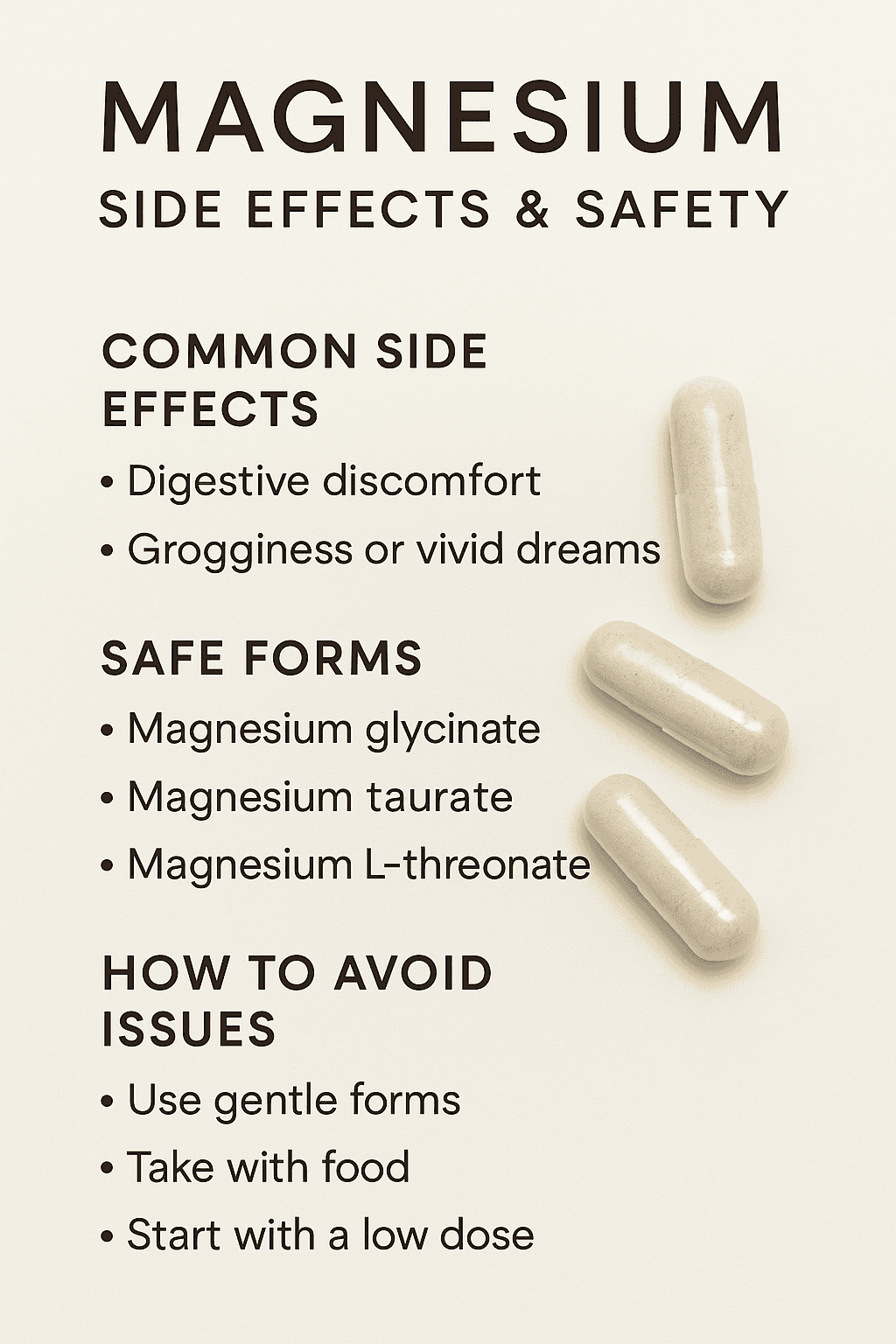
Magnesium is safe for most people. The most common side effect is digestive discomfort — especially from forms like magnesium citrate (and oxide). Gentler forms such as glycinate, threonate, and taurate are usually well-tolerated. People with kidney disease should avoid magnesium supplements unless cleared by a clinician.
Most “side effects” are solvable. The fix is usually dose, form, timing, or taking it with food.
🧭
The Complete Magnesium Guide
Benefits, dosage, timing, forms, safety, cramps, sleep, anxiety — everything magnesium, clearly organized.
Open the master guide

1) Why magnesium is considered very safe

Your body uses it constantly — and regulates it well

Magnesium supports muscle relaxation, nerve signaling, blood pressure regulation, energy production, and sleep-related neurotransmitters. When you supplement magnesium, your body generally absorbs what it needs and clears the rest — primarily through the kidneys.

Most side effects happen when:
  • You take too high a dose too quickly
  • You choose a form that’s too gut-active for you
  • You take it on an empty stomach when sensitive

2) Common magnesium side effects (and how to avoid them)

Most are digestive — and usually easy to fix
🚽
Loose stools / digestive upset
The #1 side effect — especially with citrate (and oxide). These forms can pull water into the intestines and feel too stimulating for some people.
Fix: switch to glycinate/taurate/threonate, take with food, or split AM + PM.
🍽️
Mild nausea
Usually from taking minerals on an empty stomach — especially if you’re sensitive.
Fix: take with a small meal or snack.
😴
Grogginess (if taken too early)
Calming forms like glycinate or threonate can feel “too relaxing” in the morning for some people.
Fix: move to evening or switch to taurate for daytime use.
🌙
Vivid dreams / deeper sleep
Not harmful — just a sign your sleep architecture may be shifting (often reported with threonate).
Fix: usually none needed. If it feels “too much,” lower the dose or take earlier.

3) Who should be more careful with magnesium?

A small group — but important
  • Kidney disease / reduced kidney function — magnesium may not clear as efficiently.
  • Very low blood pressure tendencies — magnesium can mildly relax blood vessels.
  • Certain heart-rhythm medications — interactions are uncommon but worth checking.
  • Frequent loose stools — citrate/oxide may worsen this.
If any apply, use gentler forms and lower doses unless medically advised otherwise.

4) Is magnesium safe to take long-term?

For most people, yes

With healthy kidney function, magnesium does not typically build to harmful levels when used responsibly. Long-term use is common for sleep, stress support, recovery, and overall wellness.

Two long-term essentials:
  • Choose the right form for your goal
  • Stay within a typical 100–400 mg elemental range unless medically advised

5) What happens if you take too much?

Your body usually signals it early
  • Loose stools
  • Stomach discomfort
  • Occasional lightheadedness (rare)
These effects usually happen long before magnesium becomes unsafe. The body tends to limit excess through the gut or kidneys.

6) The gentlest magnesium forms

Best tolerated options
  • Magnesium glycinate — top choice for calm, sleep, and sensitive digestion
  • Magnesium taurate — excellent for daytime calm and a clean feel
  • Magnesium L-threonate — best for brain-focused wind-down and sleep depth
If you’ve had stomach issues with magnesium before, start with glycinate, take it with food, and begin low.

7) Options with the best tolerability (optional)

Clean examples that match the “gentle” forms
Clean & Gentle · Daily Calm
Nootropics Depot Magnesium Glycinate
A reliably gentle form ideal for sleep, tension, and evening routines.
View at Nootropics Depot
Daytime Calm
Magnesium Taurate
Steady calm without drowsiness. Often helpful for caffeine sensitivity.
View on Amazon
Brain & Sleep Depth
Magnesium L-Threonate
Supports deeper sleep cycles, evening clarity, and cognitive restoration.
View on Amazon

Final takeaway

Magnesium is safe — when you respect the basics

For most people, magnesium side effects are mild and fixable: choose a gentler form, take it with food, start low, and increase slowly. If you have kidney disease or complex medical conditions, get medical guidance first.
Frequently Asked Questions

What is the most common magnesium side effect?
Digestive upset (especially loose stools), most often from citrate or oxide. Switching to glycinate or taurate usually resolves it.
Is magnesium safe to take every day?
Yes, for most healthy adults. With normal kidney function, magnesium does not usually accumulate to harmful levels at typical doses.
Can magnesium make you sleepy?
Calming forms can promote evening relaxation. If taken early, they may feel too relaxing for some people.
Is magnesium safe with other supplements?
Often yes. If you use prescription medications, it’s smart to check with a clinician for any specific interactions.
Is magnesium safe for long-term use?
For most people, yes — especially within typical ranges (often 100–400 mg elemental/day) and with healthy kidney function.
VerifiedSupps Medical Disclaimer
This guide is for educational purposes only and is not medical advice. It is not intended to diagnose, treat, cure, or prevent any disease. Always consult your healthcare provider before starting magnesium if you have kidney issues, take heart-rhythm medications, are pregnant or nursing, or have chronic health conditions.

Related Articles

Health

Magnesium and Antidepressants: Interactions, Timing, and Safety

Magnesium · Antidepressants · Timing · Risks Can You Take Magnesium With Antidepressants? Timing, Interactions, and Risks Direct answer: In most people, yes. Magnesium doesn’t usually “interact” directly with SSRIs the way some drugs do. Most concerns are about side effects overlap (sedation, GI effects) and timing/spacing—often because of other medications you take alongside an

Read More »
Health

Magnesium Not Helping Sleep? Causes + Fixes (Form, Dose, Timing)

Magnesium · Sleep · Insomnia Logic Magnesium Not Helping Sleep: Why It Happens and What To Do Direct answer: it’s common for magnesium to “do nothing” for sleep. Magnesium helps sleep indirectly by lowering arousal and tension—not like a sedative. If your insomnia is driven by circadian timing, sleep-disordered breathing, stimulants, pain/reflux, or an anxiety

Read More »
Calm & Focus

Can Magnesium Cause Panic Attacks? Causes, Fixes, and When to Stop

Magnesium · Panic Attacks · Anxiety Can Magnesium Cause Panic Attacks? Why It Happens + What to Do Direct answer: It can in some people, usually due to dose, timing, form, or stacking—not toxicity. It can feel like panic even if it’s just a body signal (GI discomfort, lightheadedness, “heart feels loud”) that your brain

Read More »