Magnesium Timing: Morning vs Night
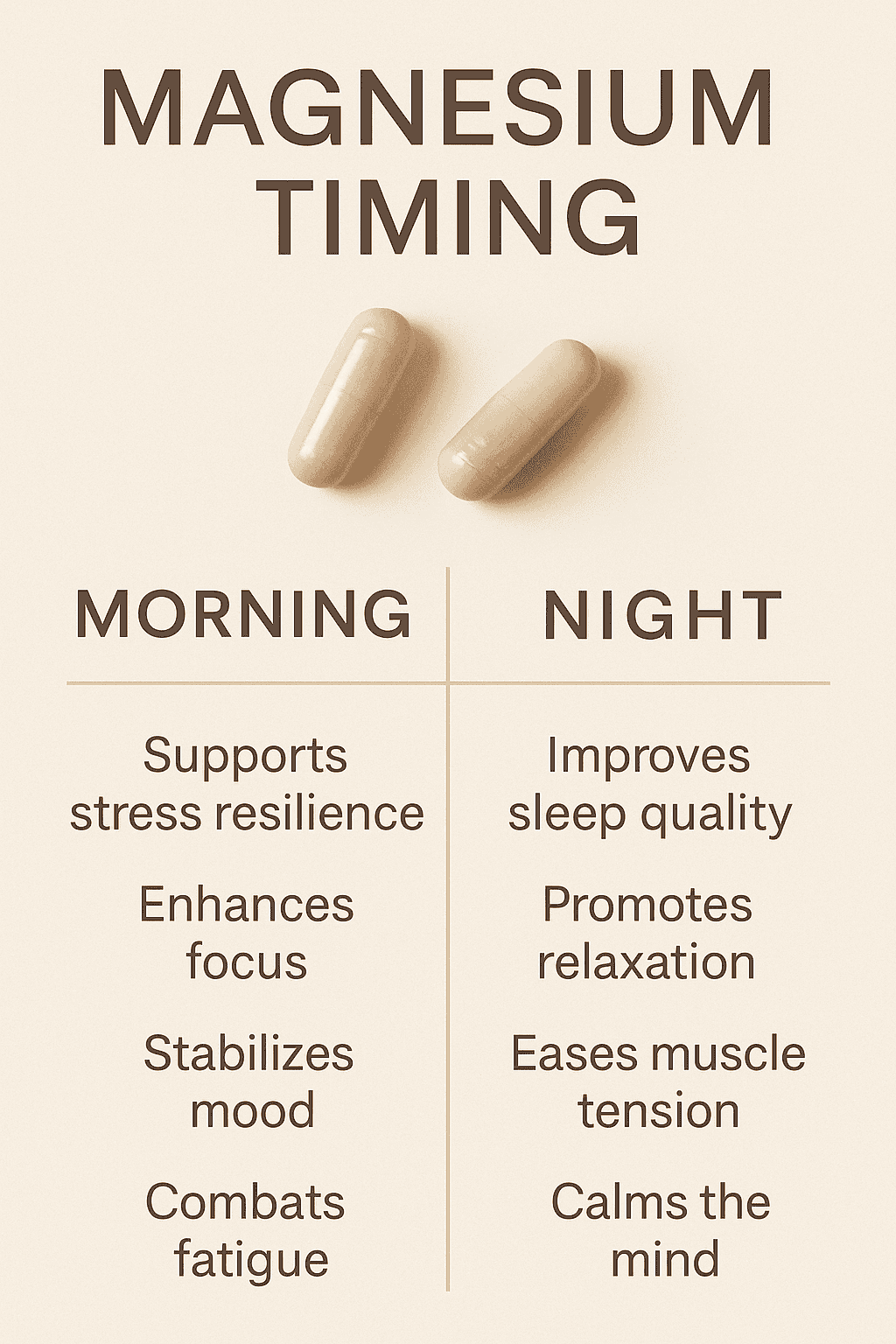
Direct answer: take magnesium at night if your goal is sleep, muscle relaxation, or winding down; take it earlier if your goal is steadier daytime calm (and it doesn’t make you sleepy). If you want both, split dosing is usually the cleanest option.
Scope note: this page is about timing (when to take magnesium). If your real problem is choosing the right form or your dose is causing GI issues, timing alone won’t fix it.
Quick Take
TL;DR decision: Night (sleep/tension) • Morning (daytime steadiness) • Split (both, or higher doses).
Best next step (today): choose one timing from the table below and run it consistently for 10–14 days before you judge it.
Parent Hub: Magnesium Complete Guide
Forms, dosage, timing, safety, and symptom matching—if timing isn’t the real bottleneck, start here.
Is it better to take magnesium in the morning or at night?
Night is usually better for sleep and muscle release. Morning (or early afternoon) is usually better for steady daytime calm—if it doesn’t make you feel sleepy. If you want both, split dosing is the cleanest solution.
- Nervous system tone: magnesium can feel “smoother” when your day is winding down.
- GI tolerance: timing + food can change whether magnesium feels comfortable.
- Sleep architecture: the same dose can feel different depending on bedtime routines and stress load.
- Kidney disease or reduced kidney function (timing becomes clinician territory).
- Low blood pressure symptoms (lightheadedness) that worsen with magnesium.
- Medications that require spacing from minerals (e.g., some antibiotics, thyroid meds).
- GI sensitivity (timing must be paired with food/splitting or a gentler form).
Cannibalization guardrail: this page is about timing. If you’re deciding between forms (glycinate vs threonate vs citrate), the forms guide is the better match.
Best time to take magnesium for your goal
Pick one row, run it consistently, and judge results on trends—not on one night.
| Intent | Timing | Best next step (today) | What to track |
|---|---|---|---|
| For sleep / winding down | Evening (with dinner or 1–2 hours pre-bed) | Pick a consistent evening cue (dinner) and take it there | Sleep onset + night cramps + next-day tension |
| For daytime calm / stress tolerance | Morning or early afternoon | Start lower than you think; increase only if you’re not sleepy | Caffeine edge + irritability + “wired” baseline |
| For both day + night | Split (AM + PM) | Put the larger portion in the evening if sleep is priority | Day steadiness + night relaxation (both) |
| If you get GI discomfort | With food (any time) | Take with a real meal; split doses before switching products | Stool changes + stomach comfort |
What is the best time to take magnesium for sleep?
Evening is usually best: either with dinner (best for habit + stomach comfort) or 1–2 hours before bed (best for a clear wind-down cue).
- If you get restless sleep: earlier evening dosing often feels smoother than right-before-bed.
- If you wake up at night: split dosing (dinner + later) can feel steadier for some people.
- If your stomach is sensitive: take it with food before changing timing again.
Can I take magnesium in the morning for anxiety or stress?
You can—especially if your goal is steadier daytime calm and you don’t feel sedated. If you do feel “flat,” the fix is usually lower dose or move it later, not abandoning magnesium.
- If caffeine makes you edgy: morning or early afternoon magnesium can feel stabilizing for some people.
- If you’re groggy: reduce dose or shift timing toward evening.
- If stress shows up as muscle tension: you may still prefer evening as the anchor dose.
Should I take magnesium with food or on an empty stomach?
Most people do best with food. It’s a high-yield move for tolerance and consistency—especially if you’ve ever had nausea or loose stools from magnesium.
- With meals: usually improves GI comfort and reduces “weird” sensations.
- Empty stomach: fine for some people, but more likely to trigger nausea in others.
- If you get loose stools: lowering/splitting dose usually helps more than timing changes alone.
How long before bed should I take magnesium?
A reliable window is 1–2 hours before bed. But if dinner is your most consistent habit, taking magnesium with dinner often wins in the real world.
- If you feel groggy: take it earlier in the evening or reduce dose.
- If you feel nothing: verify elemental dose and keep timing stable for 10–14 nights.
- If sleep is still rough: magnesium can help, but caffeine, stress, and sleep schedule can outweigh timing.
Can I split magnesium into morning and night doses?
Yes—split dosing is often the smoothest approach if you want daytime steadiness and nighttime wind-down, or if higher doses feel heavy on your stomach.
- AM portion: steadier baseline and stress tolerance.
- PM portion: smoother relaxation and sleep transition.
- GI benefit: smaller doses are usually easier to tolerate.
Why does magnesium timing not work for me?
Most “timing problems” are actually dose, form, or tolerance problems. Fix those first—then timing becomes obvious.
- Morning dose too large → “flat” or sleepy.
- Gut-active form at night → GI disruption → worse sleep.
- Inconsistent days/times → no clear signal.
- Judging after 2–3 days instead of 10–14.
- Label confusion: dosing by “compound mg” instead of elemental magnesium.
- Sleep timing: less friction at wind-down and fewer “tight” nights within 7–14 days.
- Day timing: a steadier baseline (less edge) without sedation within 3–10 days.
- What not to expect: a stimulant-like “kick.” Magnesium usually feels like fewer problems, not a dramatic feeling.
Selected Professional References
External sources used for dose ranges, safety, and mechanism framing.
Go Deeper (VerifiedSupps Guides)
Four next reads that pair naturally with timing decisions.
Final Takeaway
Night is usually the best default for sleep and muscle wind-down. Morning can work well for daytime steadiness if it doesn’t sedate you. If you want both, split dosing is the smoothest. Choose one plan, run it for 10–14 days, and judge by sleep onset, muscle tension, and next-day calm—not by “feeling a kick.”
FAQ
Can I take magnesium in the morning?
Yes. Morning magnesium can support steadier days, as long as it doesn’t make you feel sleepy. If it does, lower the dose or move it later.
Is magnesium better at night for sleep?
For most people, yes. Evening dosing is the most common and often the most comfortable sleep routine.
Should I take magnesium with food?
Most people tolerate magnesium better with meals. It’s one of the simplest ways to reduce GI discomfort and stay consistent.
How long before bed should I take magnesium?
A common window is 1–2 hours before bed, but dinner is often the most consistent (and stomach-friendly) choice.
Is it okay to take magnesium twice a day?
Yes. Split dosing can be smoother for digestion and can support both daytime calm and nighttime wind-down.
Why does magnesium cause diarrhea for some people?
Most often it’s dose-related or form-related. Lower the dose, split it, take with food, or switch away from gut-active forms.
How long should I test a timing change?
Run one timing for 10–14 days before judging, then compare if needed. Trends matter more than single nights.
Who should be cautious with magnesium supplements?
People with kidney disease or significant medication use (especially affecting electrolytes/heart rhythm) should consult a clinician before higher-dose use.