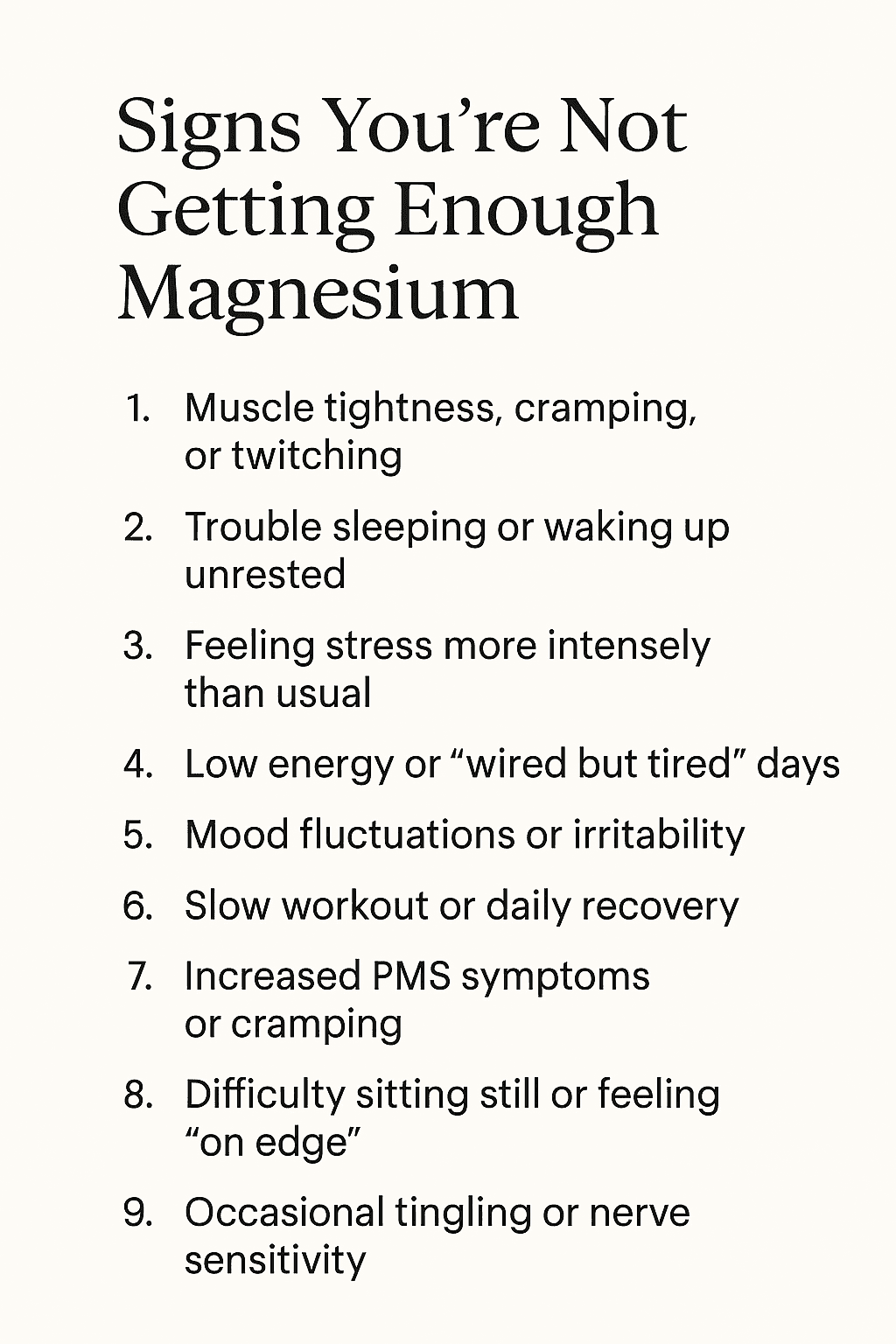
Signs You’re Not Getting Enough Magnesium
Direct answer: the most common “low magnesium” pattern is a cluster—twitchy/tight muscles, lighter or more restless sleep, higher stress sensitivity, and slower recovery—especially when your diet is low in magnesium-rich foods.
Intent/scope: this page helps you decide whether your symptoms look like a magnesium intake problem (and what to try first). It’s not a diagnosis for chest pain, fainting, severe weakness, or persistent palpitations—those need medical evaluation.
Quick Take
Treat this like a pattern test: if you have 2–4 signals plus a low-magnesium diet, a consistent 10–14 day intake upgrade is a calm, reasonable experiment.
| Signal | How it shows up | If this is you… | Best next step (today) |
|---|---|---|---|
| Twitching / tight calves / jaw tension | Eyelid twitch, tight neck/shoulders, frequent “grabby” muscles | Common when stress + low mineral intake stack up | Start a gentle magnesium routine (low dose, consistent) |
| Restless sleep / hard wind-down | Can’t switch off, light/fragmented sleep | More likely when caffeine + stress are high | Evening magnesium + stable bedtime for 10–14 nights |
| Stress sensitivity / irritability | “On edge,” short fuse, overwhelmed by small things | Often overlaps low sleep quality | Keep caffeine timing stable; consider split dosing |
| Low magnesium food pattern | Few greens/beans/nuts/seeds; lots of refined foods | This is the highest-signal “risk factor” | Add 1 magnesium-rich food daily (or a supplement routine) |
What are the signs of magnesium deficiency?
The most common signs are tension/twitching, restless sleep, stress sensitivity, fatigue, and slower recovery. The most reliable “signal” is multiple symptoms showing up together over time.
- Neuromuscular stability: magnesium influences how easily muscles and nerves “overreact”
- Relaxation threshold: supports the “release” side of muscle function
- Energy reactions: magnesium participates in many ATP-related processes (fatigue can overlap)
- Kidney disease or reduced kidney function
- Persistent palpitations, fainting/near-fainting, chest symptoms
- Severe diarrhea/vomiting or dehydration
- Pregnancy/breastfeeding
- Complex medications (especially diuretics/thyroid meds—spacing guidance needed)
Can low magnesium cause muscle cramps, twitching, or tightness?
It can contribute—especially when the pattern is tension + twitching + stress + poor sleep. If cramps are mainly happening during heat/sweat, the bigger driver may be sodium/potassium and fluid balance.
- Twitches and tight calves at rest
- Night cramps with restless sleep
- Jaw/neck tension and “can’t fully relax”
Can low magnesium affect sleep quality?
It can. Many people with low intake describe restless wind-down and lighter sleep. Magnesium is not a sleep medication; it often helps by lowering baseline “friction” rather than forcing sedation.
- Keep bedtime and caffeine timing stable
- Use a gentle form consistently (evening is common)
- Track sleep quality for 10–14 nights
Who is most likely to be low in magnesium?
Low intake is more likely when magnesium-rich foods are inconsistent and demand is high. Stress, poor sleep, and high training volume often make the “gap” feel bigger.
- Low intake pattern (few nuts/beans/greens/whole grains)
- High caffeine + high stress
- Athletes / frequent training
- Digestive issues that affect absorption
- Certain medications (ask your clinician/pharmacist)
How much magnesium should I take if I think I’m low?
A common supplemental range is 100–350 mg elemental magnesium per day, adjusted to tolerance and goal. Start low, then increase slowly if needed.
- Start: 100–150 mg elemental/day with food
- Common landing zone: 200–300 mg elemental/day (sleep/tension goals)
- GI guardrail: loose stools = reduce dose, split dose, or switch form
Why magnesium isn’t helping your symptoms
Most misses are: inconsistent intake, wrong form for the goal, underdosing elemental magnesium, or symptoms driven by something else (sleep apnea, thyroid issues, iron/B12 deficiency, hydration/electrolyte loss).
- Using citrate/oxide, getting diarrhea, and quitting
- Not dosing by elemental magnesium
- Taking magnesium sporadically (no clean signal)
- Ignoring hydration/electrolytes when symptoms track with heat/sweat
- Changing multiple variables (caffeine, training, supplements) at once
- Fainting/near-fainting, confusion, severe weakness
- New/persistent palpitations, chest pain, shortness of breath
- Severe diarrhea/vomiting or dehydration
- Known kidney disease or reduced kidney function
- Symptoms that feel dangerous or rapidly worsening
- Inputs: stable water intake, stable caffeine timing, stable bedtime
- Duration: 10–14 days
- 3 metrics: sleep quality (0–10), twitch/cramp count, stress reactivity (0–10)
- Stop conditions: severe palpitations, fainting/near-fainting, confusion, severe weakness
- Fewer twitches/tension episodes; smoother wind-down
- Sleep becomes less “fragile” over 10–14 nights
- You feel less reactive to small stressors
- What not to expect: a dramatic stimulant-like effect
Selected Professional References
Go Deeper (VerifiedSupps Guides)
Final Takeaway
The best “sign” you’re low in magnesium is a repeatable cluster: twitchy/tight muscles + restless sleep + higher stress sensitivity—especially with a low-magnesium diet. Run a clean 10–14 day intake upgrade (food-first or a gentle supplement routine), track sleep and muscle feel, and adjust calmly.