Can Magnesium Cause Panic Attacks? Why It Happens and What to Do
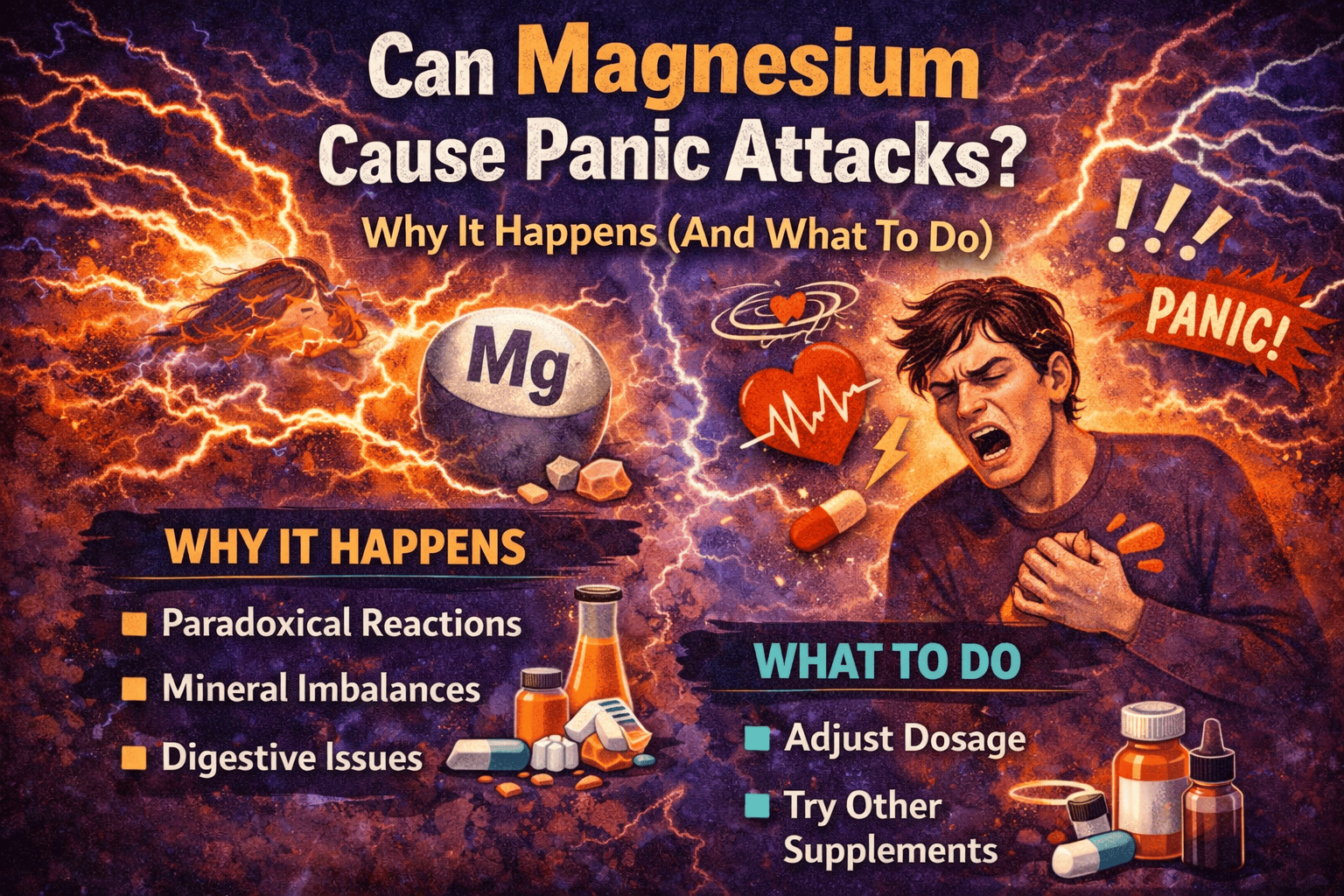
Sometimes, yes—but usually not because magnesium is “toxic.” What’s happening is more practical: dose, timing, form, or stacking creates a strong body sensation (GI discomfort, lightheadedness, “heart feels loud”), and your nervous system interprets it as threat.
Quick take
- Most “magnesium panic” is a trigger-sensation problem: GI discomfort, dizziness, sleep disruption, or palpitations.
- Fastest fix: pause 48–72 hours, then retry lower dose earlier with food (clean trial).
- True risk is uncommon: toxicity is mainly a kidney-function problem or extreme intake issue.
Evidence standard: human trials, dose ranges, guideline-level sources when available
For: panic-prone or anxiety-sensitive people who noticed panic-like symptoms after magnesium
Not for: chest pain, fainting, severe shortness of breath, or sustained irregular rhythm (treat as medical first)
Last reviewed: March 3, 2026
Parent Hub
Magnesium Side Effects & Safety: red flags, tolerance, and who should be cautious
If you’re unsure whether symptoms are “panic” vs a safety issue, use this hub first.
Can magnesium cause panic attacks?
It can in some people, but usually through trigger sensations (GI discomfort, dizziness, sleep disruption, “heart feels loud”) rather than “magnesium causing panic disorder.” This page is specifically about panic-like symptoms after magnesium; if your main issue is ongoing anxiety independent of dosing, that’s a different intent.
| If this is your pattern… | Most likely driver | Fastest fix to try first |
|---|---|---|
| Panic starts with nausea / urgency | GI stimulation or dose too high | Take with food, lower dose, hold steady 7 nights |
| Panic at night (waking 2–4am) | Timing too late, sleep disruption, stacking | Move magnesium to dinner; pause other sleep aids briefly |
| Dizzy / weak then panic | Dose intolerance, dehydration, low food intake | Pause 48–72 hours; restart low-dose with a meal |
| “Heart feels loud” / palpitations | Normal sensation + anxiety amplification, caffeine, stacking | Stabilize caffeine, lower dose, avoid bedtime dosing |
| Repeatable within 1–3 hours of dosing | Timing/dose/form sensitivity is likely | Do the clean test (pause → low restart → one change at a time) |
What would change my recommendation?
- You have kidney disease or reduced kidney function.
- You had chest pain, fainting/near-fainting, severe shortness of breath, or a sustained irregular rhythm.
- You’re using high-dose magnesium laxatives/antacids or combining multiple magnesium products.
- You changed caffeine, alcohol/THC, melatonin, or antidepressant dose around the same time.
- You’re getting repeated nighttime choking/gasping or severe daytime sleepiness (sleep-disordered breathing can mimic panic).
Can magnesium make anxiety worse?
Yes, in a subset of people. Most of the time it’s not “magnesium causes anxiety” directly—it’s magnesium creating a body signal (GI discomfort, dizziness, sleep disruption) that your nervous system labels as danger.
- GI discomfort → anxiety: nausea, cramps, or urgency can trigger panic loops.
- Sleep disruption → anxiety: vivid dreams or 2–4am awakenings can spike adrenaline.
- Stacking → anxiety: late caffeine + melatonin + antihistamines + alcohol/THC creates noisy physiology.
How much magnesium is too much for anxiety or panic?
There isn’t one number that fits everyone. “Too much” usually means too much for your tolerance—enough to cause GI upset, dizziness, or weakness that triggers panic. The safest approach for panic-prone people is to start low and increase only after stable, symptom-free days.
If you reacted strongly
Pause 48–72 hours, then restart at a low dose with food. Treat it like a sensitivity trial, not a “push through it” supplement.
If you feel nothing
Don’t jump straight to large doses. Increase gradually and keep timing stable so you can interpret the outcome.
Magnesium panic attacks at night: why it happens
Night panic after magnesium is most often a timing problem: dosing too close to bed can amplify dreams, trigger GI movement at night, or increase awakenings—then the body sensation becomes the panic trigger.
- Move magnesium earlier: dinner or early evening is a common “first fix.”
- Avoid stacking: hold melatonin, antihistamines, alcohol/THC constant during the test window.
- Track the wake-up pattern: consistent 2–4am awakenings often point to physiology (GI/reflux/stimulants) more than “supplement chemistry.”
Magnesium glycinate panic attacks: what to do
Treat this like a clean, cautious trial. The goal is not to prove glycinate is “bad”—it’s to remove the trigger sensation and see what remains.
- Pause 48–72 hours and see if symptoms resolve.
- Restart low and take with food (avoid fasted dosing).
- Move earlier (dinner / early evening) before changing forms.
- If it repeats twice in a similar window after dosing, stop and pivot (different form, lower dose, or food-first approach).
Is magnesium toxicity causing my panic symptoms?
In typical supplement use, true magnesium toxicity is uncommon. When it happens, it’s usually tied to kidney impairment or very high intake from multiple sources (supplements plus magnesium-containing medications). Panic-like symptoms are more commonly from tolerance issues and anxiety amplification.
More likely “panic trigger” signals
- GI upset, nausea, urgency
- Lightheadedness that resolves with food/rest
- Symptoms that track closely to timing or stacking
Treat as medical-first signals
- Chest pain, fainting/near-fainting
- Severe weakness, confusion, severe shortness of breath
- Sustained irregular heartbeat
Panic after magnesium: troubleshooting and how to tell it’s working
The goal is not “toughing it out.” The goal is a clean test that reduces trigger sensations so you can see whether magnesium can be tolerated in your routine.
Common mistakes
- Starting high: large dose on day one, then panic symptoms get blamed on “toxicity.”
- Fasted dosing: nausea and dizziness become the trigger.
- Bedtime dosing: sleep disruption and night awakenings amplify panic risk.
- Stacking: changing caffeine, melatonin, alcohol/THC, and magnesium together.
Clean test protocol (7–14 days)
- Pause 48–72 hours to reset the pattern.
- Restart low with a meal at a consistent time (dinner is a good default).
- Hold the stack constant (no new sleep aids; stable caffeine cutoff).
- One change only after 7 days (timing OR dose), then hold again.
- If symptoms recur twice in a similar timing window after dosing, stop and pivot.
How to tell it’s working
- Track: “panic intensity” (0–10), GI comfort, dizziness, and sleep awakenings.
- Time window: tolerance effects usually declare themselves within days; pattern stability is best judged over 7–14 days.
- What not to expect: a dramatic mood shift or “instant calm” if panic is driven by bigger lifestyle/medical drivers.
- Success definition: the trigger sensations stop appearing after dosing (or become mild enough that they no longer trigger panic).
Selected Professional References
NIMH: Panic disorder (symptoms and overview)
High-trust overview of panic attacks and how bodily sensations can be interpreted as threat.
nimh.nih.gov
MedlinePlus: Panic disorder
Clear symptom list and basics that help distinguish panic sensations from medical emergencies.
medlineplus.gov
NIH ODS: Magnesium (Health Professional)
Upper limit context (GI effects), safety notes, and medication categories that affect magnesium status.
ods.od.nih.gov
PMC: Magnesium supplementation and anxiety (systematic review)
Context: magnesium is more often studied as supportive for anxiety symptoms; evidence quality varies.
pmc.ncbi.nlm.nih.gov
NCBI Bookshelf: Hypermagnesemia (clinical overview)
Safety context: toxicity is rare and usually tied to kidney function or extreme intake.
ncbi.nlm.nih.gov
NCCIH: Magnesium supplements (side effects and safety)
Notes on common GI side effects and why very high intakes can be dangerous.
nccih.nih.gov
Go Deeper (VerifiedSupps Guides)
Magnesium made my anxiety worse
Mechanisms, overlap effects, and fixes when magnesium feels activating.
Magnesium makes me feel weird
Common sensations, what they mean, and how to adjust dose and timing.
Magnesium heart palpitations
How to tell “heart sensations” from anxiety loops and when to seek care.
Magnesium dosage guide
Elemental dose math, starting points, and safer titration strategies.
Final takeaway
Magnesium can trigger panic-like symptoms in some people, usually through body sensations (GI discomfort, dizziness, sleep disruption) plus timing/dose/stacking. The highest-yield move is a clean test: pause, restart low with food, move earlier, and change one variable at a time. Treat chest pain, fainting, severe shortness of breath, or sustained irregular rhythm as medical-first.
FAQ
Can magnesium cause panic attacks?
It can in some people, usually by triggering bodily sensations (GI, dizziness, sleep disruption) that escalate into panic.
Can magnesium make anxiety worse?
Yes for a subset. The usual driver is intolerance (GI effects, dizziness) or stacking other stimulants/sleep aids that increases body “noise.”
How long does anxiety from magnesium last?
If magnesium is the trigger, many people feel better within 24–72 hours after stopping. If symptoms persist, another driver is likely involved.
Can magnesium cause panic attacks at night?
It can if you take it too close to bed, disrupt sleep, or trigger GI movement at night. Dinner timing is a common fix.
Why does magnesium glycinate cause panic attacks for me?
Most often it’s dose too high, timing too late, or stacking. Pause, restart low with food, move earlier, and retest cleanly.
How much magnesium is too much if I’m panic-prone?
“Too much” usually means too much for your tolerance. Start low, take with food, and increase slowly only if stable and symptom-free.
Is magnesium toxicity causing my panic symptoms?
Usually no. Toxicity is uncommon with typical supplement use and is more likely with kidney impairment or extreme intake.
When should I seek urgent care?
Chest pain, fainting/near-fainting, severe shortness of breath, new neurological symptoms, or sustained irregular heartbeat should be treated as urgent medical concerns.
VerifiedSupps Medical Disclaimer
This content is for educational purposes only and is not medical advice. Supplements can interact with medications and health conditions. Consult a qualified clinician before starting, stopping, or changing magnesium if you have kidney disease, cardiovascular disease, low blood pressure, electrolyte disorders, or take medications that affect electrolytes. Seek urgent medical care for chest pain, fainting/near-fainting, severe shortness of breath, new neurological symptoms, sustained irregular heartbeat, or if you feel unsafe.