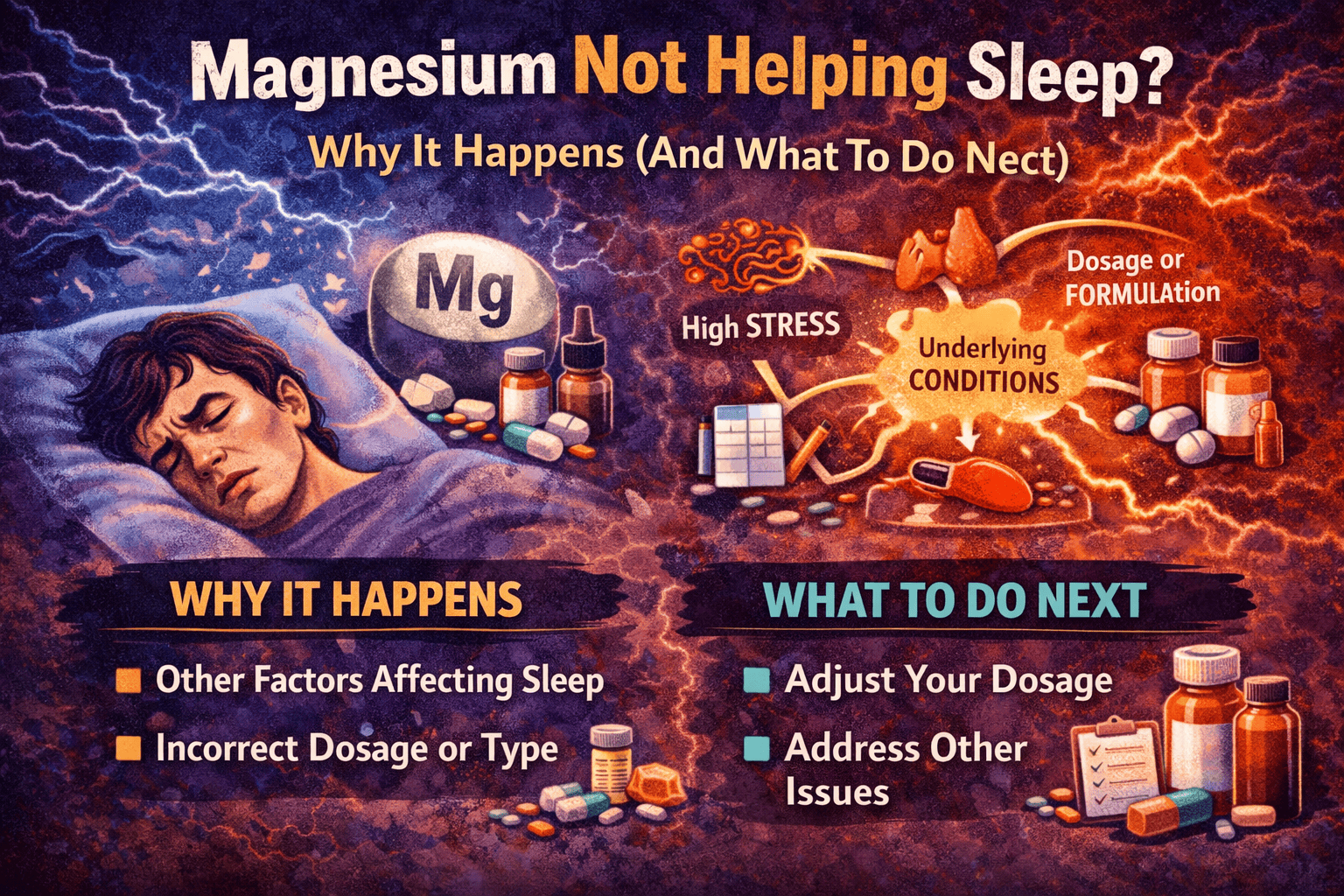
Magnesium Not Helping Sleep: Why It Happens and What To Do
It’s common for magnesium to “do nothing” for sleep. Magnesium typically helps indirectly (lower arousal, less tension), not like a sedative that forces sleep onset. If your insomnia is driven by circadian timing, sleep apnea risk, stimulants, pain/reflux, or an anxiety loop, magnesium alone may not move the needle.
Quick take
- If magnesium isn’t helping: change timing and dose before changing forms.
- If magnesium makes sleep worse: suspect late dosing, dose too high, GI activity, or stacking first.
- Fair test window: 7–14 nights with stable timing (not a one-night verdict).
Evidence standard: human trials, dose ranges, guideline-level sources when available
For: people using magnesium for sleep readiness (tension, winding down) who want a clean troubleshooting path
Not for: suspected sleep apnea or severe insomnia with safety concerns without clinician support
Last reviewed: March 3, 2026
Parent Hub
Magnesium for Sleep Handbook: mechanism, forms, dosing tiers, and decision trees
If you want the big picture (not just troubleshooting), start here.
Why is magnesium not helping me sleep?
Most of the time, magnesium isn’t “failing.” It’s just not the limiting factor. This page is for people who tried magnesium and didn’t notice sleep improvement; it’s not a “best magnesium for sleep” roundup. If your insomnia driver is circadian mismatch, apnea risk, stimulants, pain/reflux, or an anxiety loop, magnesium may be too small a lever by itself.
Decision table: match your pattern to the most likely fix
| Your sleep pattern | Most likely reason magnesium “does nothing” | Highest-yield next move |
|---|---|---|
| Trouble falling asleep (mind racing) | Arousal loop or late stimulants dominate | Move magnesium to dinner, reduce caffeine cutoff, run a clean 7–14 night trial |
| Waking at 2–4am | GI activity, reflux, alcohol/THC, or circadian timing | Take magnesium earlier with food; remove late stack; address reflux triggers |
| Restless / “wired” at night | Dose too high, late timing, or stack interactions | Lower dose, move earlier, simplify (one change at a time) |
| Vivid dreams / weird sleep | Timing too close to bed or dose too high | Move to dinner or early evening; step down dose |
| Loud snoring / choking / daytime sleepiness | Sleep-disordered breathing is the bottleneck | Treat this as medical evaluation territory; supplements won’t override apnea |
Most “magnesium not working” situations improve when you fix timing + dose and remove stack noise. If you have apnea signs, prioritize evaluation.
What would change my recommendation?
- You have kidney disease or reduced kidney function (magnesium can accumulate at high supplemental intakes).
- You have strong sleep apnea signs (loud snoring, choking/gasping, severe daytime sleepiness).
- You’re using multiple sleep aids (melatonin, antihistamines, alcohol/THC) or changing them frequently.
- Your insomnia includes safety red flags (severe mood symptoms, suicidal thoughts, fainting, chest pain).
- You’re taking medications that can affect electrolytes (diuretics, PPIs) and symptoms feel new or severe.
How long does magnesium take to work for sleep?
Some people notice a subtle shift within a few nights. Many don’t. A fair test window is long enough to stabilize timing and tolerance, because night-to-night sleep is noisy even when you change nothing.
Realistic expectation curve
- Nights 1–3: tolerance read (GI, grogginess, dreams).
- Nights 4–7: timing and dose tweaks (one change at a time).
- Nights 7–14: best window to judge baseline change.
What is the best time to take magnesium for sleep?
For many people, the best time is dinner or early evening—early enough to avoid late GI stimulation and dream intensity, but close enough to bedtime to support “downshift.”
If you feel nothing
Don’t chase bedtime timing first. Anchor magnesium to a consistent meal for 7–14 nights and adjust dose gradually.
If magnesium makes sleep worse
Move it earlier (dinner), reduce dose, and remove other sleep aids temporarily to isolate the cause.
How much magnesium should I take for sleep?
More isn’t automatically better for sleep. The goal is the smallest dose that improves sleep readiness without GI disruption, next-day grogginess, or restlessness.
Practical dosing logic (sleep-focused)
- Start low: if you’re sensitive, a smaller starting dose reduces “false interaction” symptoms.
- Increase slowly: adjust in small steps and hold for several nights.
- Stop increasing if sleep worsens: that’s a signal you crossed your tolerance line.
If your main goal is constipation relief rather than sleep readiness, the dose/form conversation changes (and side effects become more likely).
Why does magnesium glycinate not help me sleep?
Glycinate is often chosen for sleep because many people tolerate it well—but it still won’t override a strong insomnia driver. If glycinate “does nothing,” the most common reasons are timing too late, dose mismatch, stacking, or the sleep problem itself being non-magnesium-responsive.
Try this before switching forms
- Move dose to dinner or early evening.
- Hold timing steady for 7 nights.
- Change only dose (small steps), not multiple supplements.
If glycinate makes sleep worse
Assume late timing or dose too high first. Step down dose and move earlier before deciding you’re a “non-responder.”
Can magnesium keep you awake or make insomnia worse?
Yes—sometimes. When magnesium makes sleep worse, it’s usually not “magnesium is stimulating,” it’s the downstream effects: late GI movement, dose too high, timing too close to bed, or stacking multiple sleep aids that creates restless sleep.
If magnesium keeps you awake, start here
- Move earlier: dinner or early evening.
- Lower dose: stop chasing “more calming.”
- Remove stack noise: hold melatonin/antihistamines/alcohol/THC constant (or pause them briefly if safe).
- Re-test for 3 nights: don’t change anything else.
Magnesium not helping sleep: troubleshooting and how to tell it’s working
If you want a clear yes/no answer, you need a clean test. Most people accidentally run a “messy trial” (changing timing, dose, and other sleep aids at the same time) and then conclude magnesium doesn’t work.
Common mistakes
- Bedtime-only dosing: then blaming “restlessness” on magnesium instead of timing.
- Starting too high: GI changes and grogginess ruin sleep quality.
- Stacking: magnesium + melatonin + antihistamine + alcohol/THC makes interpretation impossible.
- Judging by one night: sleep variability masks subtle changes.
Clean test protocol (7–14 nights)
- Pick one timing: dinner or early evening is a good default.
- Pick one dose: start conservatively and hold for 7 nights.
- Hold the stack: don’t introduce new sleep aids or change caffeine/alcohol patterns during the test.
- If side effects appear: step down dose and restart the 7-night hold.
- Only one change: after 7 nights, change either timing or dose—then hold again.
How to tell it’s working
- Track: sleep onset latency, number of awakenings, and “next-day tension” rating (0–10).
- Realistic window: you might see tolerance changes in 1–3 nights; sleep pattern changes are best judged over 7–14 nights.
- What not to expect: a sedative “knockout” feeling or dramatic overnight insomnia cure.
- If nothing changes: magnesium may not be your bottleneck—shift focus to circadian timing, apnea screening, reflux/pain, or structured insomnia treatment.
Selected Professional References
NIH ODS: Magnesium (Health Professional)
Safety limits, deficiency context, side effects, and medication interactions (diuretics, PPIs, antibiotics).
ods.od.nih.gov
ACP Guideline: CBT-I as first-line for chronic insomnia
Clinical guidance emphasizing behavioral treatment for insomnia when supplements don’t move the needle.
acpjournals.org
MedlinePlus: Insomnia overview
High-trust patient overview of causes, evaluation, and treatment directions when supplements aren’t enough.
medlineplus.gov
NHLBI: Sleep apnea (why supplements can’t override it)
Useful for recognizing apnea patterns (snoring, choking, daytime sleepiness) when insomnia persists.
nhlbi.nih.gov
PubMed: Magnesium and insomnia trials (search)
A quick way to find the key randomized trials in older adults and compare outcomes across studies.
pubmed.ncbi.nlm.nih.gov
PubMed: Magnesium and sleep meta-analyses (search)
Useful for calibrating expectations: average effects are usually modest, and results vary by population.
pubmed.ncbi.nlm.nih.gov
Go Deeper (VerifiedSupps Guides)
Best magnesium for sleep
Form selection by sleep pattern and tolerance.
Magnesium timing: morning vs night
Who should take it earlier, and why bedtime dosing backfires for some.
Magnesium forms explained
Glycinate vs threonate vs taurate vs citrate: what changes in real life.
Magnesium vivid dreams
Dream intensity troubleshooting: timing, dose, and stacking factors.
Final takeaway
If magnesium isn’t helping sleep, assume it’s the setup: timing, dose, GI tolerance, or stacking. Run a clean 7–14 night trial with one change at a time. If there’s still no signal, magnesium probably isn’t your bottleneck—shift focus to circadian timing, apnea screening, stimulants, pain/reflux, or structured insomnia treatment.
FAQ
Why is magnesium not helping me sleep?
Usually the insomnia driver isn’t magnesium-responsive, or timing/dose/stacking is masking any subtle benefit.
How long does magnesium take to work for sleep?
Tolerance effects show up within days, but sleep pattern changes are best judged over 7–14 nights with stable timing.
What’s the best time to take magnesium for sleep?
Often dinner or early evening. If bedtime dosing makes you restless or gives vivid dreams, move it earlier.
Can magnesium keep you awake?
Yes—usually from late timing, dose too high, GI activity, or stacking other sleep aids.
Why is magnesium glycinate not working for sleep?
Common reasons are timing too late, dose mismatch, stacking, or your insomnia driver not being tension/arousal-based.
How many nights should I try magnesium for sleep?
Give it 7–14 nights with stable timing and dose. If you keep changing variables, you’ll never get a clear read.
Should I take magnesium with food for sleep?
If you’re GI-sensitive or waking at night, taking it with dinner often improves tolerance.
When should I stop magnesium and talk to a clinician?
If you have kidney disease, severe symptoms, chest pain, fainting/near-fainting, significant shortness of breath, or insomnia with safety concerns.
VerifiedSupps Medical Disclaimer
This content is for educational purposes only and is not medical advice. Supplements can interact with medications and health conditions. Consult a qualified clinician before starting, stopping, or changing magnesium if you have kidney disease, cardiovascular disease, low blood pressure, electrolyte disorders, or take medications that affect electrolytes. Seek medical evaluation for chest pain, fainting/near-fainting, severe shortness of breath, severe confusion/agitation, or insomnia associated with significant mental health or safety concerns. If you have loud snoring with choking/gasping or severe daytime sleepiness, consider evaluation for sleep-disordered breathing.