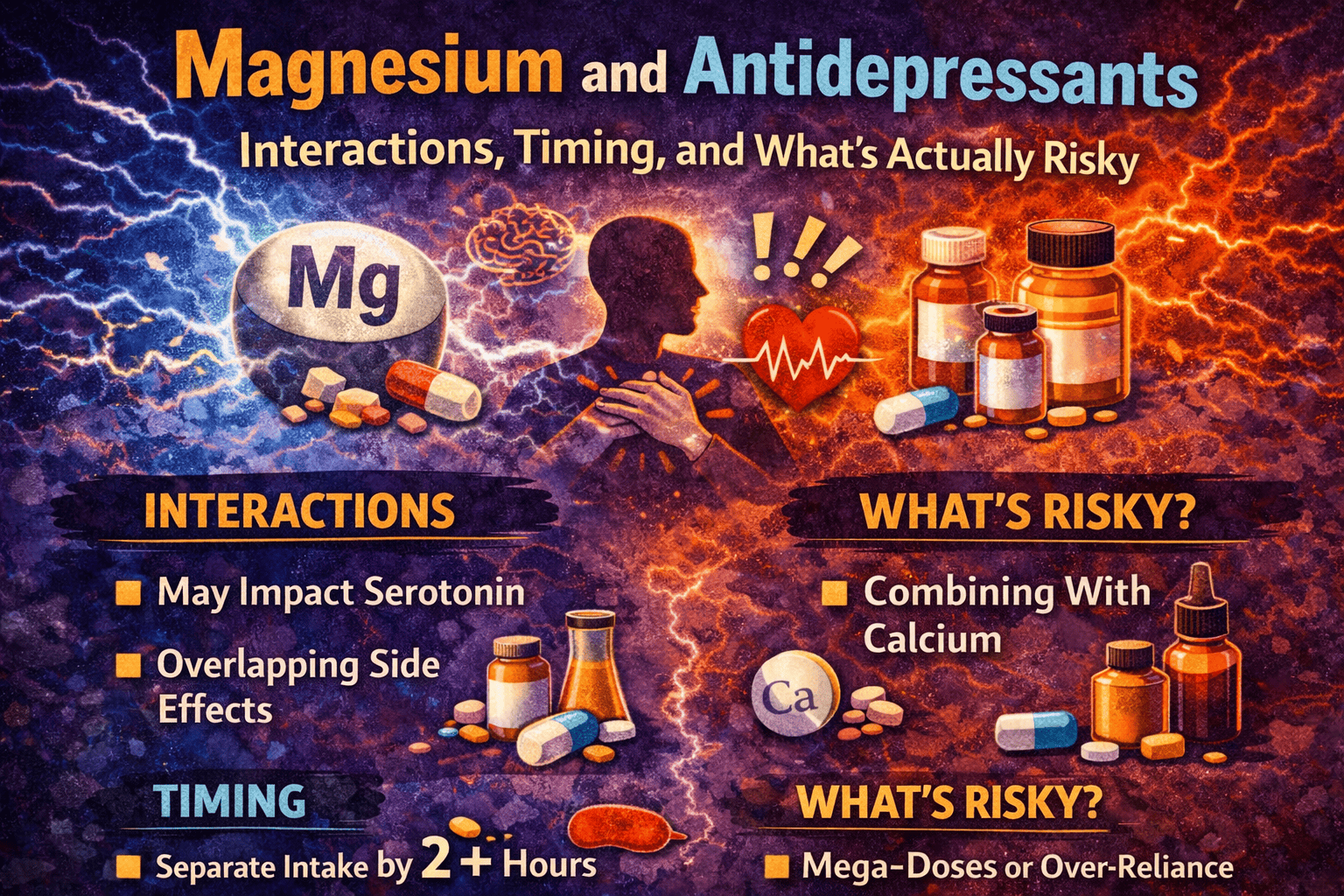
Can You Take Magnesium With Antidepressants? Timing, Interactions, and Risks
In most people, yes—magnesium is commonly used alongside antidepressants. The main issues are usually side-effect overlap (sleepiness, dizziness, GI changes) and spacing from other medications that bind minerals (not usually the antidepressant itself).
Quick take
- Most common “problem” isn’t an interaction: it’s GI upset or sedation that gets misread as one.
- Most reliable strategy: start low, keep timing consistent, and separate from mineral-binding meds.
- Biggest true risk group: reduced kidney function (magnesium can accumulate at high supplemental intakes).
Evidence standard: human trials, dose ranges, guideline-level sources when available
For: people on SSRIs/SNRIs/Wellbutrin who want magnesium for sleep, cramps, or deficiency support
Not for: advanced kidney disease or anyone with severe symptoms after starting (pause and get clinician guidance)
Last reviewed: March 3, 2026
Parent Hub
Magnesium Side Effects & Safety: red flags, tolerance, and who should be cautious
If your main concern is diarrhea, weird feelings, palpitations, or safety limits, use the hub.
Can you take magnesium with antidepressants?
For most people, yes. The “real-world” friction is usually tolerance (GI effects, sleepiness) and clean spacing from other meds—not a direct dangerous interaction with SSRIs/SNRIs/Wellbutrin. This page is specifically about compatibility + timing + risk triage, not magnesium benefits in general.
| If you’re taking magnesium for… | Often easiest timing | Best “tolerance move” | What to watch |
|---|---|---|---|
| Sleep / tension | With dinner or evening | Start low; take with food | Additive grogginess or vivid dreams |
| Constipation | Earlier in the day (so you can judge effects) | Don’t jump dose; increase slowly | Diarrhea can mimic “anxiety” sensations |
| Cramps / training recovery | With a meal you never skip | Consistency beats “perfect timing” | If cramps persist, electrolytes may be the real issue |
| Deficiency support | Any consistent time with food | Split dose if GI sensitivity | Kidney disease changes the safety equation |
What would change my recommendation?
- You have kidney disease or reduced kidney function.
- You take levothyroxine, certain antibiotics (tetracyclines/quinolones), or bisphosphonates (spacing is non-negotiable).
- You get new palpitations, near-fainting, or severe dizziness after starting magnesium.
- You’re in a med titration window (changing antidepressant dose): keep supplement changes minimal.
- You’re using magnesium as a laxative at high doses (different risk profile than supplementation).
What magnesium form is best if you’re on antidepressants?
The “best” form is the one you tolerate and can take consistently. For many people on antidepressants, the priority is avoiding GI noise and sedation confusion.
| Your goal | Often a good fit | What to watch |
|---|---|---|
| Sleep / winding down | Glycinate is a common choice | Additive grogginess (especially with sedating meds) |
| GI-sensitive | Lower dose + split dosing | Loose stool can amplify “anxiety sensations” |
| Constipation | Some forms are more laxative for some people | Diarrhea, dehydration, electrolyte imbalance if you overdo it |
If you’re already experiencing antidepressant-related nausea or diarrhea, keep magnesium dosing conservative and meal-anchored until your baseline settles.
Does magnesium interact with SSRIs?
Usually, SSRIs (like sertraline, escitalopram, fluoxetine, citalopram) don’t have a classic “mineral binding” interaction with magnesium. Most reports that feel like interactions are overlap: GI changes, dizziness, or sleepiness.
- If you feel more sedated: reduce magnesium dose or move it earlier.
- If GI worsens: take with food, split dose, and avoid aggressive laxative-style dosing.
- If symptoms are severe or new: pause magnesium and treat it as a medical question, not a supplement puzzle.
Is magnesium safe with SNRIs like Cymbalta or Effexor?
In most cases, yes. The same themes apply: side-effect overlap and keeping changes clean during dose adjustments. If you’re prone to dizziness or feel “off” during SNRI changes, don’t introduce multiple new supplements at once.
- During titration: keep magnesium dose steady for at least 1–2 weeks before making changes.
- If you’re lightheaded: consider moving magnesium earlier or lowering the dose.
- If you’re taking other spacing-sensitive meds: follow the spacing rules even if the SNRI itself isn’t the issue.
Can you take magnesium with Wellbutrin (bupropion)?
Usually, yes. The common confusion here is that bupropion can feel more activating for some people, while magnesium can feel more calming or sometimes GI-disruptive. If magnesium causes stomach discomfort, that sensation can be misread as anxiety.
- If you feel “wired”: don’t assume magnesium is the culprit—check caffeine, sleep, and GI tolerance first.
- If magnesium makes you feel weird: step dose down and take with food, then re-test.
- Best practice: avoid adding magnesium during bupropion dose changes if you’re troubleshooting activation.
How many hours apart should magnesium and antidepressants be taken?
There isn’t one universal rule because magnesium doesn’t typically bind most antidepressants in the gut. But spacing can still be useful for a clean trial and to avoid stacking side effects.
Simple rule that works well in practice
- If you’re just reducing confusion: separate magnesium and your antidepressant by 2–4 hours.
- If you take mineral-binding meds: follow their spacing instructions (often tighter and more important).
- If you’re sensitive: change one variable at a time (dose or timing) and hold it for a week.
Can magnesium cause serotonin syndrome?
Magnesium is not considered a serotonergic drug and is not a typical driver of serotonin syndrome. The real risk is misattributing serious symptoms to supplements and delaying care.
If you’re worried about serotonin syndrome
- Treat severe agitation/confusion, fever, rigidity, or rapidly worsening symptoms as urgent.
- Look at medication combinations (multiple serotonergic agents), not magnesium as the primary cause.
- When in doubt, get medical evaluation—this is not a “wait it out” scenario.
Magnesium feels like it’s making things worse: troubleshooting and how to tell it’s helping
If magnesium makes you feel “off,” assume a simple explanation first: too much too fast, GI intolerance, or timing that stacks sedation. Then run a clean test so you can stop guessing.
Common mistakes
- Starting too high: jumping straight to a large dose.
- Fasted dosing: then blaming nausea on “interactions.”
- Changing multiple things: new supplement + antidepressant timing change in the same week.
- Expecting a feeling: not every benefit is “felt” acutely.
Clean test protocol (7–14 days)
- Pick one goal: sleep quality, cramps, or GI tolerance (not all at once).
- Start low: choose a conservative dose that doesn’t trigger GI symptoms.
- Meal anchor: take it with the same meal daily for consistency.
- Hold steady: no changes for at least 7 days unless side effects force a step-down.
- Only one adjustment: either timing or dose—then hold again.
How to tell it’s working
- Track one metric: sleep latency, nighttime awakenings, muscle cramp frequency, or “next-day tension” rating.
- Time window: tolerance changes show up in days; sleep/cramps often need 1–2 weeks to see a pattern.
- What not to expect: a dramatic mood shift overnight or a stimulant-like effect.
- If you’re worse: step down or stop, and treat severe symptoms (palpitations, near-fainting, confusion) as medical—not “supplement tweaking.”
Selected Professional References
NIH ODS: Magnesium (Health Professional)
High-quality safety notes, dose context, upper limits, and medication interaction categories (antibiotics, bisphosphonates, diuretics, PPIs).
ods.od.nih.gov
NCCIH: Magnesium supplements (safety + side effects)
Clear government summary: common GI side effects, upper limit guidance, and what excessive intakes can look like.
nccih.nih.gov
MedlinePlus: Magnesium oxide (uses + precautions)
Clinician-style medication page that helps separate “supplement dosing” from laxative/antacid use and highlights safety cautions.
medlineplus.gov
NCBI Bookshelf: Serotonin syndrome (clinical overview)
Useful for symptom triage and understanding what actually drives serotonin syndrome (med combinations), versus supplement confusion.
ncbi.nlm.nih.gov
Go Deeper (VerifiedSupps Guides)
Magnesium dosage guide
Elemental dose ranges, common mistakes, and safer starting points.
Magnesium timing: morning vs night
How timing changes sleep, dreams, and next-day grogginess.
Magnesium forms explained
Glycinate vs threonate vs taurate vs citrate: what changes in real life.
Who should not take magnesium?
The red-flag groups and when magnesium needs clinician-level caution.
Final takeaway
Most people can take magnesium with antidepressants. Get three things right: tolerance (start low, take with food if needed), clean timing (2–4 hours apart if you want clarity), and the true risk flags (especially kidney disease and severe new symptoms). If you feel worse, run a 7–14 day clean test instead of stacking changes.
FAQ
Can I take magnesium and an SSRI together?
Most people can. If you notice changes, they’re usually GI effects or sedation overlap rather than a direct interaction.
Does magnesium affect antidepressant absorption?
Not typically for SSRIs/SNRIs, but magnesium can reduce absorption of some other medications. Spacing is the practical solution.
How many hours apart should I take magnesium and my antidepressant?
A common, practical approach is 2–4 hours apart if you want a clean trial and fewer stacked side effects.
Is magnesium glycinate safe with antidepressants?
Often yes. If you’re sensitive to sedation, start low and consider moving it earlier in the evening.
Can magnesium make anxiety worse while on antidepressants?
It can feel that way if magnesium causes GI discomfort, dizziness, or sleep disruption. A lower dose with food often resolves it.
Can magnesium cause serotonin syndrome?
Magnesium is not a typical driver of serotonin syndrome. If you suspect serotonin syndrome symptoms, treat it as urgent medical care.
When should I stop magnesium and call a doctor?
Stop and seek help for chest pain, fainting/near-fainting, sustained irregular heartbeat, severe weakness, severe confusion/agitation, or any symptom that feels dangerous.
VerifiedSupps Medical Disclaimer
This content is for educational purposes only and is not medical advice. Do not stop, start, or change prescription antidepressants without clinician guidance. Supplements can interact with medications and health conditions. If you have kidney disease, cardiovascular disease, low blood pressure, electrolyte disorders, a history of arrhythmia, or take multiple medications with strict timing rules (including thyroid medication, certain antibiotics, or bisphosphonates), consult a qualified clinician before supplementing. Seek urgent medical care for chest pain, fainting/near-fainting, severe shortness of breath, severe confusion/agitation, fever/rigidity, or safety concerns including suicidal thoughts.