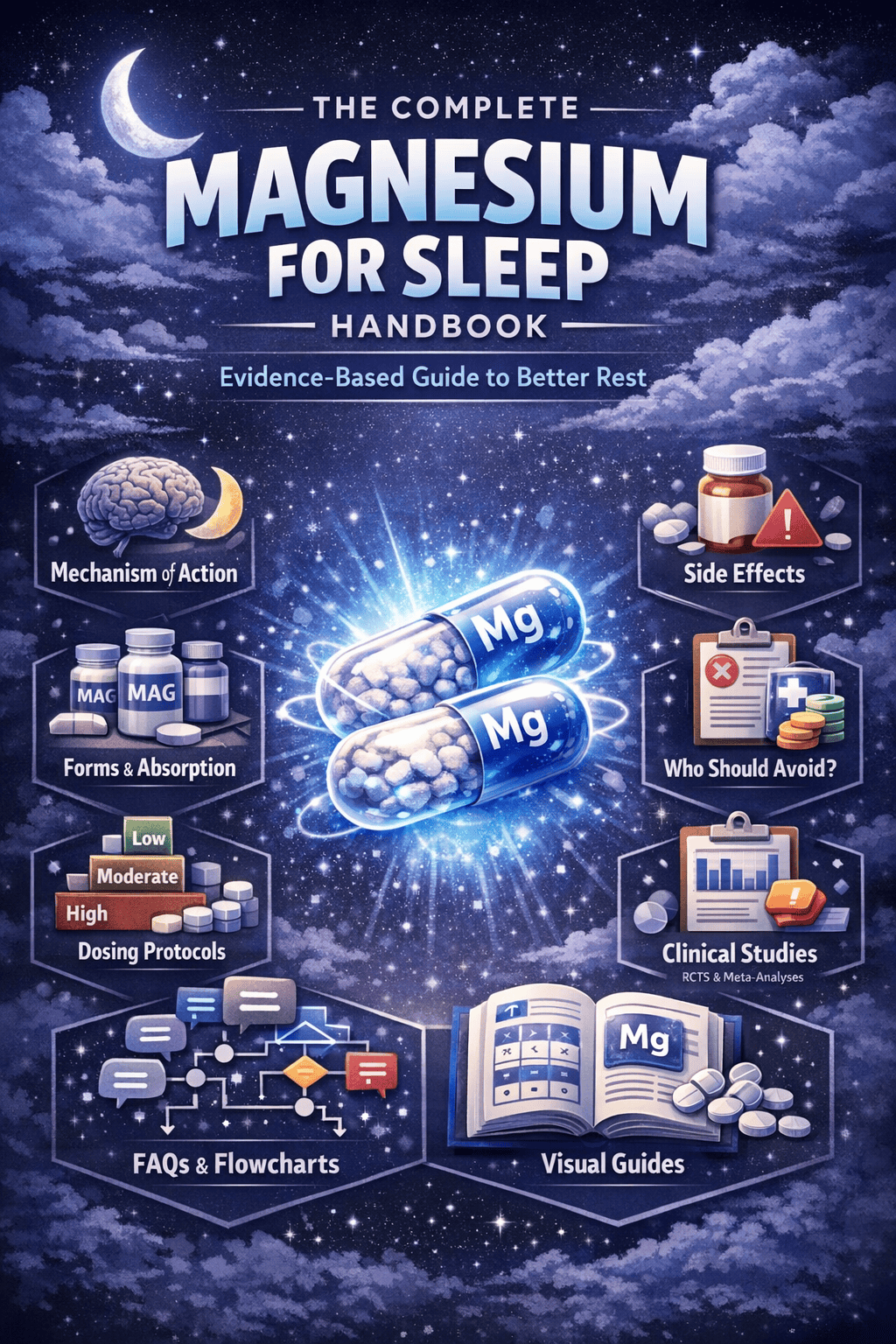
The Complete Magnesium for Sleep Handbook
Magnesium is not a sedative. It doesn’t “knock you out.” Its real value is more clinical: magnesium can support the physiology that makes sleep easier when your baseline intake is low, your nervous system is running hot, or your sleep is fragile.
This handbook is built to be a reference: mechanism, forms, dosing tiers, safety, who should avoid it, the clinical evidence, and clear decision trees.
Mechanism: How Magnesium Can Support Sleep
Magnesium influences sleep indirectly through systems that set your “sleep readiness.” Think of it as supporting stability rather than causing sedation.
- Neural quieting: magnesium helps regulate excitatory signaling (including NMDA-related activity), which can matter when the nervous system feels overactive.
- Stress physiology: magnesium status is linked with stress reactivity; improving low intake may reduce “wired but tired” patterns in some people.
- Muscle relaxation: magnesium supports normal neuromuscular function; for some, this reduces nighttime tension or cramping.
- Circadian support: in some clinical trials, magnesium supplementation is associated with changes in sleep-relevant hormones and markers (not a guarantee, but a plausible pathway).
Clinical framing: magnesium tends to help most when baseline magnesium intake is low, when sleep is disrupted by stress or discomfort, or in certain older-adult insomnia contexts.
Forms Comparison: Which Magnesium for Sleep?
Most people choose the wrong form because they’re thinking “strongest” instead of “best tolerated.” A clinically useful default is the form you can take consistently without GI side effects.
| Form | Best for | GI risk | Clinical notes |
|---|---|---|---|
| Glycinate (bisglycinate) | Sleep support + sensitive stomach | Low | Common “default” choice for bedtime use because it’s typically gentler. |
| Citrate | Sleep support when constipation is part of the picture | Moderate to high | Often better absorbed than oxide in comparative research; can be a “digestive lever.” |
| Threonate | People prioritizing cognitive/brain-focused claims | Low to moderate | Some recent sleep-quality findings exist, but interpret as emerging evidence rather than settled. |
| Taurate | Nighttime calm + cardiovascular-sensitive users | Low | Often chosen for “calm” profiles; hard outcome sleep data is limited. |
| Oxide | Budget-only scenarios | Moderate | Generally lower bioavailability vs many organic salts; more GI complaints at higher doses. |
Bioavailability varies by salt type and formulation; comparative work often shows higher bioavailability for organic salts (for example citrate) than oxide in controlled settings. External: PMC review
Dosing Tiers (Clinical, Not Influencer)
Below is a conservative dosing framework. It focuses on elemental magnesium (the amount that matters physiologically), not the raw compound weight on a label.
| Tier | Elemental magnesium | Who it fits | How to take |
|---|---|---|---|
| Starter | 100–150 mg nightly | Sensitive stomach, low tolerance, first-time users | 1–3 hours before bed; stay here 7–10 nights before adjusting |
| Standard | 150–250 mg nightly | Most people testing magnesium for sleep support | Single dose or split (dinner + bedtime) if GI sensitivity |
| Upper conservative | 250–350 mg nightly | Those who respond but need more; tolerate well | Avoid citrate here if diarrhea-prone |
| Clinician territory | Above 350 mg/day from supplements | Special cases under medical guidance | Higher doses increase GI risk and require better safety screening |
Safety anchor: The NIH Office of Dietary Supplements lists a tolerable upper intake level of 350 mg/day for magnesium from supplements (adults), primarily due to diarrhea risk. External: NIH ODS (Health Professional)
Side Effects (What’s Common vs What’s Concerning)
- Loose stools or diarrhea (especially citrate/oxide)
- Stomach discomfort
- Morning grogginess in some users (often from too high a dose)
- Persistent diarrhea or dehydration
- Low blood pressure symptoms (lightheadedness, faintness)
- Worsening kidney function symptoms or known kidney disease
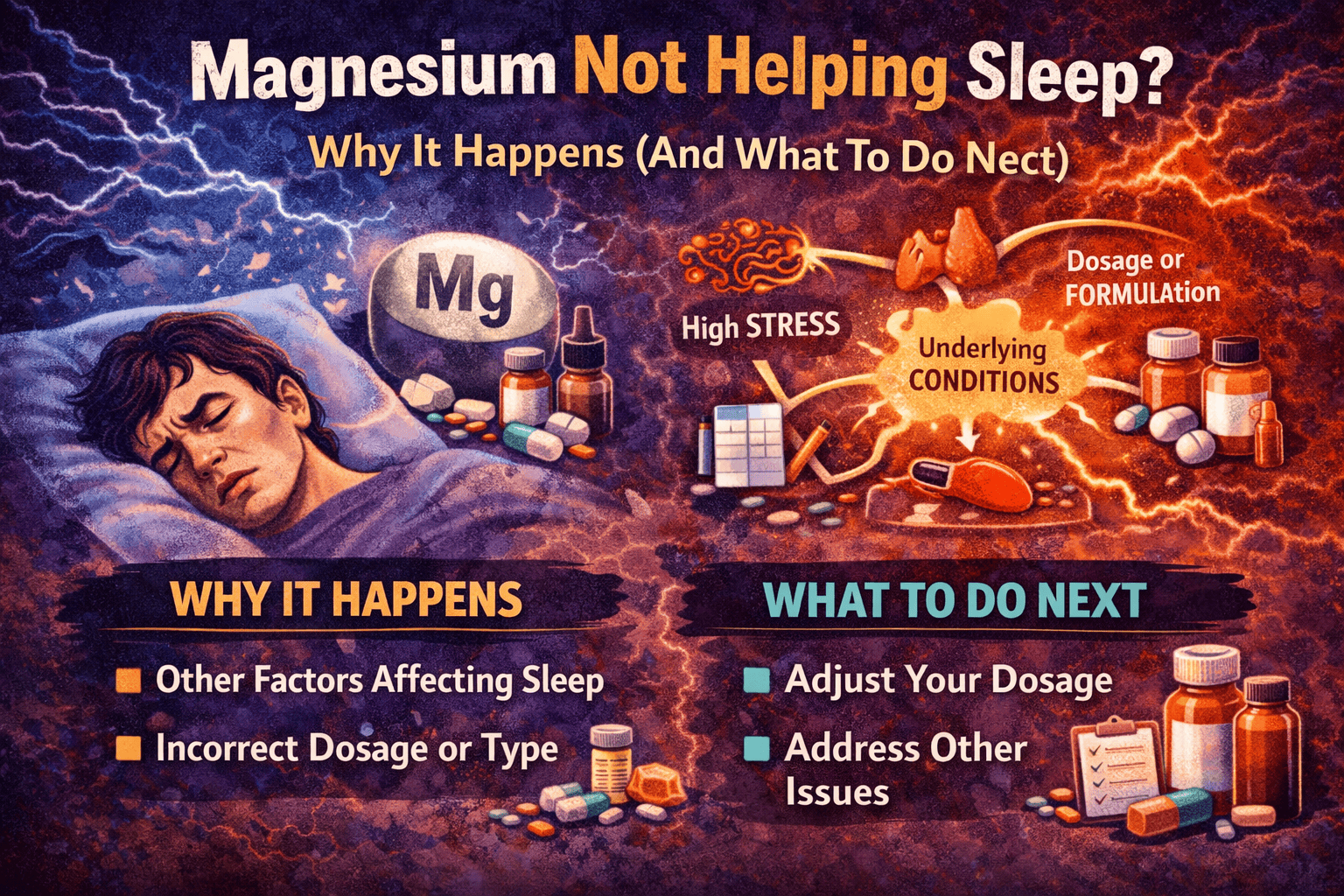
If magnesium “works” but causes GI issues, the usual clinical moves are: reduce dose, split dosing, or switch from citrate/oxide to glycinate.
Who Shouldn’t Take Magnesium for Sleep
This is where magnesium becomes clinical. The main risk is not “toxicity” in healthy people — it’s inappropriate use in contexts where magnesium clearance is impaired or interactions matter.
- Kidney disease or reduced kidney function (clearance is impaired; risk rises).
- Significant hypotension (low blood pressure) or frequent lightheadedness.
- Medication interactions: magnesium can interfere with absorption of certain antibiotics and thyroid medication; spacing strategies may be required.
- Complex cardiac conditions where electrolyte management is clinician-directed.
If any of these apply, magnesium may still be appropriate — but it becomes a clinician decision rather than a casual sleep experiment.
Clinical Studies Breakdown (What We Can Actually Say)
Magnesium for sleep has a consistent pattern in the literature: some signals of benefit, but study quality and population differences limit certainty.
Practical interpretation: magnesium is most rational as a “foundational support” when intake is low or sleep is stress-tension driven. If you have severe insomnia, treat magnesium as an adjunct, not a primary therapy.
Decision Trees (Use These Like a Clinician)
- Constipation present? Consider citrate (start low).
- GI sensitivity? Choose glycinate.
- Primary goal is calm + tension? Glycinate or taurate.
- Brain-focused experiment? Threonate (emerging data).
- Start at 100–150 mg elemental nightly.
- No effect after 7–10 nights? Increase by 50–100 mg.
- Loose stools? Reduce dose or switch form (often citrate → glycinate).
- Morning grogginess? Reduce dose or take earlier.
- Persistent diarrhea or dehydration → stop and reassess.
- Lightheadedness or low BP symptoms → stop and consult.
- No meaningful benefit after 3–4 weeks at tolerated dose → discontinue.
- Kidney disease or reduced kidney function
- Complex heart rhythm conditions
- Multiple interacting medications
- Pregnancy with medical complexity
Go Deeper (VerifiedSupps Guides)
Final Takeaway
If you want a “reference-grade” way to use magnesium for sleep: pick a well-tolerated form, start low, adjust slowly, and treat GI symptoms as a dosing signal — not a personal failure.
The strongest evidence lives in insomnia contexts (especially older adults). In healthy adults without deficiency, benefits are less predictable. Clinically, magnesium is best viewed as a foundational support that can improve sleep readiness — not a replacement for core insomnia treatment.