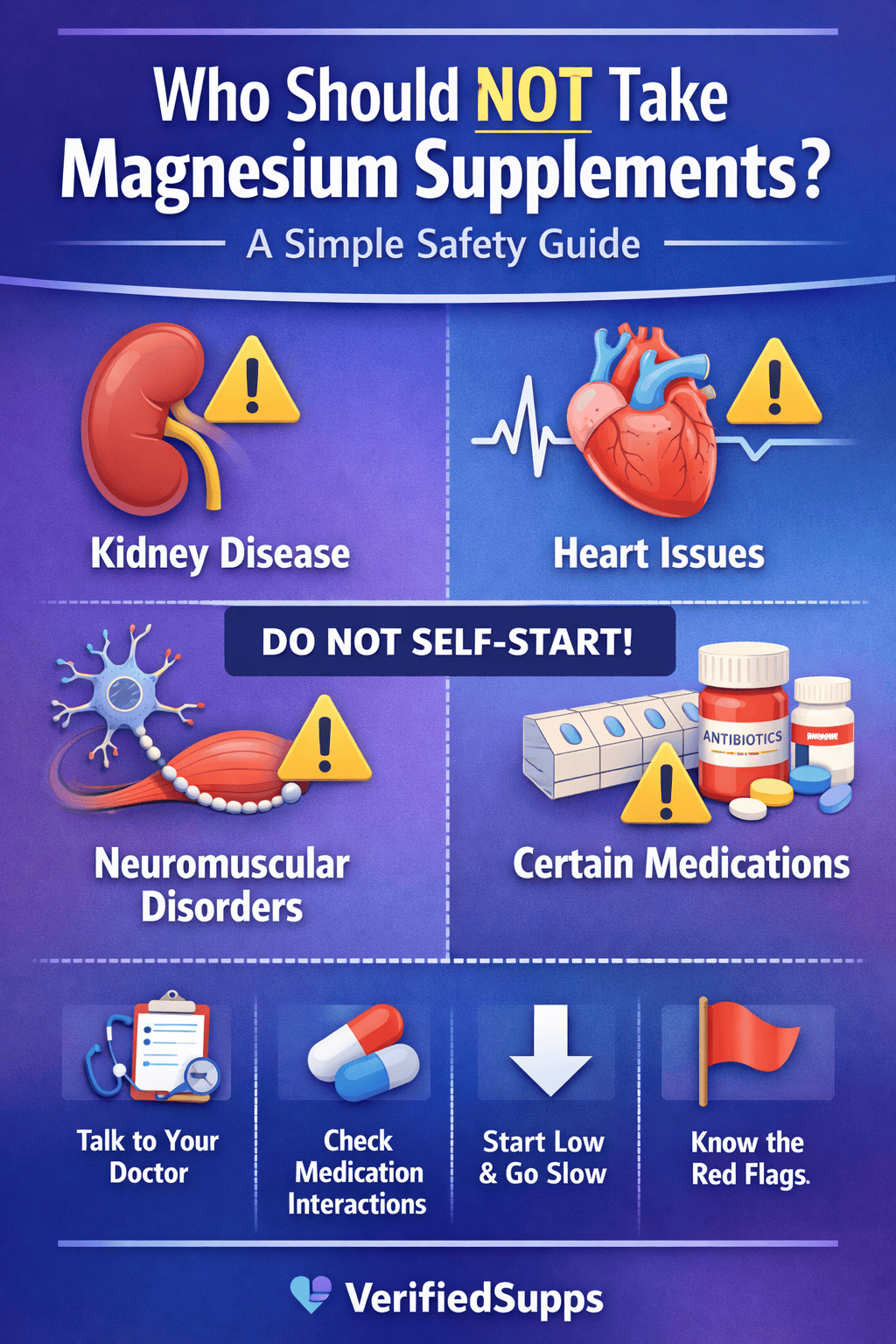
Who Should NOT Take Magnesium Supplements? A Simple Safety Guide
Magnesium is genuinely low-risk for many healthy adults. But there are a few situations where it isn’t a casual add-on — it’s something to pause and confirm with a clinician first.
This page “owns” one intent: who should not self-start magnesium supplements (and how to use them safely if you’re not in a high-risk group).
Who should not take magnesium supplements?
If you’re in a high-risk group, the safest move is not “pick the perfect form.” It’s don’t self-start. Magnesium from food is generally safer and self-limiting, but supplements can deliver concentrated doses that matter more clinically.
| Situation | Why it matters | Best next step |
|---|---|---|
| Kidney disease / reduced kidney function | Magnesium is cleared by kidneys; impaired clearance raises accumulation risk. | Clinician-guided dosing only. |
| Myasthenia gravis / significant neuromuscular disorders | Magnesium affects neuromuscular signaling; extra magnesium can worsen weakness. | Avoid self-start; discuss with clinician. |
| Heart conduction disease (e.g., heart block) or complex rhythm management | Electrolytes influence conduction and rhythm stability. | Don’t experiment; clinician guidance. |
| Using magnesium laxatives/antacids regularly | Unintentional dose stacking is common and can trigger GI loss and dehydration. | Count total magnesium sources before adding more. |
| High-risk meds or complex regimens | Spacing errors can reduce absorption of certain drugs; interactions are often timing-dependent. | Get a pharmacist spacing plan. |
What would change my recommendation: if you have any red-flag symptoms (fainting, severe weakness, confusion, chest pain/pressure, severe shortness of breath), treat it as medical first — not supplement troubleshooting.
Is magnesium safe if you have kidney disease?
This is the #1 safety divider. Healthy kidneys clear excess magnesium. With impaired kidney function, magnesium can accumulate and shift from “helpful” to “not safe” more quickly than people expect.
- Practical rule: kidney disease = clinician territory for supplements.
- Hidden trap: combining “sleep magnesium” + magnesium antacids/laxatives.
- If unsure: don’t guess — confirm kidney status and medication list with a clinician.
Can magnesium interact with medications?
Often, yes — but the common “interaction” is about absorption and timing, not a dangerous drug reaction. Magnesium can bind certain medications in the gut and reduce how much you absorb.
| Medication category | Why spacing matters | Safer rule of thumb |
|---|---|---|
| Tetracyclines / fluoroquinolones | Minerals can bind and reduce antibiotic absorption. | Separate doses; follow pharmacist instructions. |
| Levothyroxine | Minerals can interfere with thyroid hormone absorption. | Separate doses consistently; don’t “wing it.” |
| Bisphosphonates | Highly timing-sensitive medications. | Get a strict spacing plan. |
| Complex cardiac/kidney regimens | Electrolyte shifts may matter; meds may alter clearance. | Treat magnesium like a real intervention; clinician review. |
If you’re unsure, the best move is simple: ask a pharmacist, “How many hours should I separate magnesium from this medication?”
How much magnesium is safe to take?
Most safety issues show up as GI effects first (loose stools). If you’re healthy and magnesium is appropriate for you, the low-risk strategy is: start low, increase slowly, and treat diarrhea as a dosing ceiling.
- Start low: a modest elemental dose for 7–10 days before changing anything.
- Split dosing: two smaller doses are often better tolerated than one large dose.
- Take with food: this often reduces GI upset and “weird” sensations.
Which magnesium form is safest?
“Safest” usually means “most tolerated at a modest dose.” Different forms have different GI profiles. The form that causes diarrhea for you is not “stronger” — it’s simply too GI-active for your system at that dose.
- If you’re GI-sensitive: prioritize the gentlest option and take with food.
- If constipation is part of your sleep problem: a more GI-active form can help, but start low.
- If you get “weird” sensations: reduce dose and move timing earlier before switching forms.
What are signs magnesium is not safe for you?
Most side effects are mild and GI-related. The safety concern rises when symptoms suggest low blood pressure, neuromuscular weakness, mental status changes, or rhythm issues — especially in people with impaired kidney clearance.
- New or worsening muscle weakness (heavy limbs, unusual fatigue).
- Lightheadedness, fainting/near-fainting, or unusually low blood pressure symptoms.
- Confusion, severe lethargy, difficulty staying alert.
- Concerning palpitations or slow heartbeat symptoms.
- Persistent diarrhea with dehydration signs (dry mouth, dizziness, very dark urine).
Troubleshooting: how to tell you’re tolerating magnesium and when to stop
If you’re not in a “do not self-start” group, the goal is a clean, low-noise test: tolerate it well, avoid dose stacking, and learn what it actually changes for you.
Common mistakes
- Starting too high (then blaming magnesium for predictable GI effects).
- Bedtime mega-dose (more likely to cause vivid dreams, grogginess, and “weird” sensations).
- Stacking sources (multivitamin + laxative + “calm” powder + magnesium caps).
- Mixing changes (dose + form + timing all in one week).
Clean test protocol (7–14 days)
- Choose one magnesium product (no stacking) and one consistent daily time.
- Start low and keep the same dose for 7 days.
- Use food as a buffer if you’re GI-sensitive.
- If diarrhea occurs, reduce dose or stop; don’t push through.
- After day 7, change only one variable (dose OR timing OR form), then hold again.
How to tell it’s working
- Track: stool tolerance, morning grogginess, cramps/tension, sleep quality, and any dizziness/palpitations.
- Realistic window: tolerance signals show up in days; “sleep readiness” trends are best judged over 7–14 days.
- What not to expect: a sedative knockout effect. If you want that, magnesium isn’t the right tool.
Selected Professional References
Go Deeper (VerifiedSupps Guides)
Final Takeaway
Magnesium supplements are low-risk for many healthy adults — but not for everyone. If you have kidney disease, myasthenia gravis, or heart conduction problems, don’t self-start. If you take timing-sensitive medications, don’t guess: spacing matters. And if you’re healthy, most problems are preventable with the boring plan that works: start low, split doses, take with food, and avoid stacking products.