Magnesium Side Effects and Safety
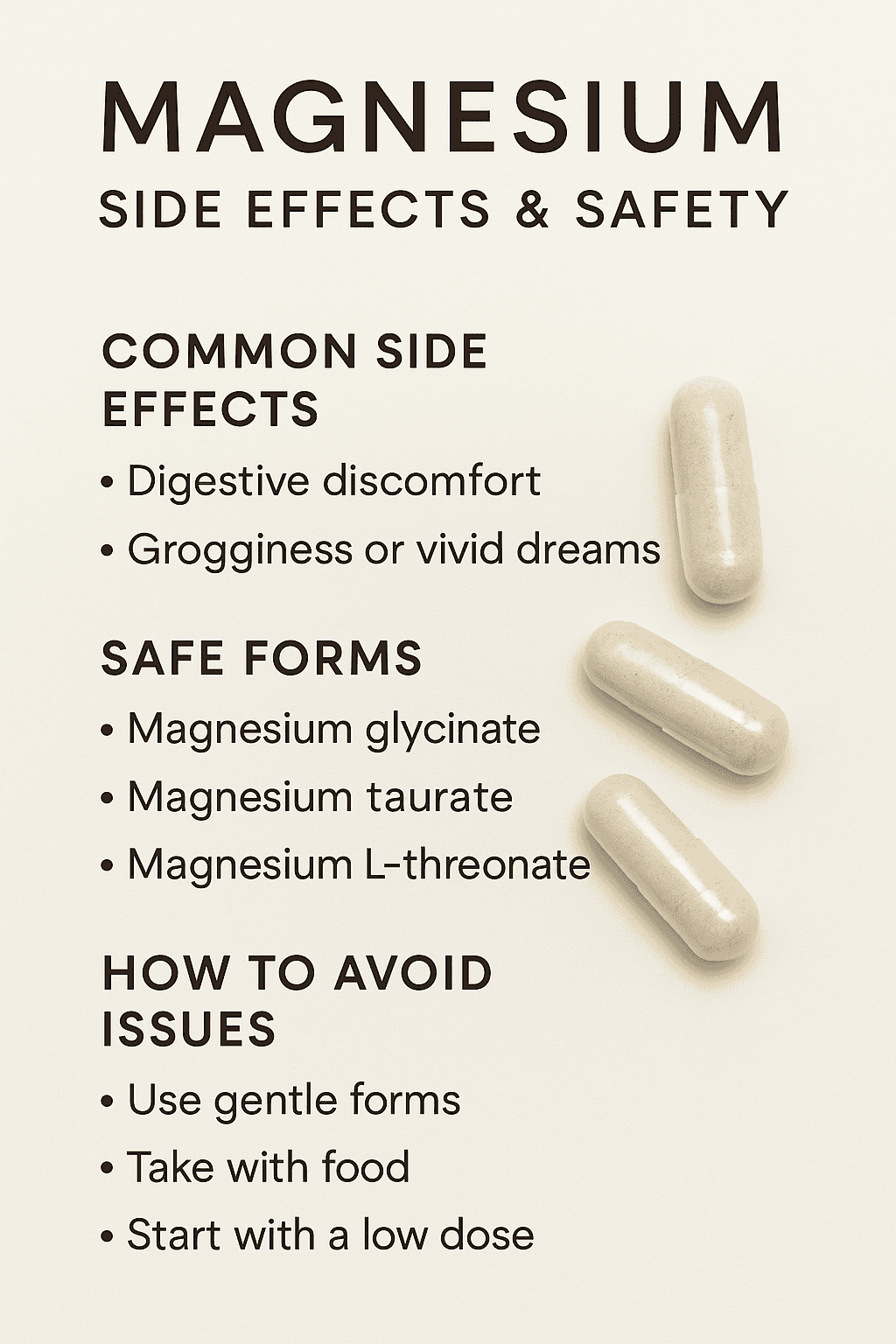
Direct answer: for most healthy adults, magnesium is safe and the most common “side effect” is digestive upset (loose stools, cramping, nausea)—usually driven by form (often citrate/oxide), elemental dose, or taking it on an empty stomach.
Intent/scope: this page covers typical magnesium supplement side effects, how to fix them, and the main safety exceptions. It does not replace clinician guidance for kidney disease, arrhythmias, pregnancy, or complex medication regimens.
What are the side effects of magnesium supplements?
For most people, magnesium side effects are mainly GI-related (diarrhea, abdominal cramping, nausea). “Too much” typically shows up as tolerance issues long before anything serious—unless kidney function is impaired.
- GI effects: unabsorbed magnesium can draw water into the gut (osmotic effect)
- Timing effects: calming forms + daytime dosing can feel sedating for some
- High-risk pathway: reduced kidney clearance can allow magnesium to accumulate
| If this happens | Most likely reason | Best fix | Gentler form |
|---|---|---|---|
| Diarrhea / stomach cramping | Dose too high or citrate/oxide (gut-active) | Lower dose, split dose, take with food | Glycinate |
| Nausea | Minerals on an empty stomach | Take with a meal/snack | Taurate |
| Too sleepy in daytime | Timing or calming form | Move to evening or reduce dose | Glycinate |
| No benefit | Underdose or inconsistency | Confirm elemental dose and run 10–14 days | Glycinate |
- Kidney disease or reduced kidney function (highest caution)
- Electrolyte-altering medications (diuretics, some BP meds) or complex regimens
- Persistent palpitations, fainting/near-fainting, chest symptoms
- Severe ongoing diarrhea/dehydration
- Pregnancy/breastfeeding (clinician guidance)
Can magnesium cause diarrhea or stomach cramps?
Yes—this is the most common side effect. It’s usually driven by form (more gut-active options) or a single large elemental dose. The fix is almost always practical: lower dose, take with food, split dosing, switch forms.
- Reduce the single dose
- Take with food
- Split AM + PM
- Switch to glycinate/taurate
Which magnesium forms cause the most side effects?
In real-world use, people most often report GI issues with more gut-active forms, especially when dosing is high or taken on an empty stomach. Individual tolerance varies, but pattern trends are consistent.
| Form | Typical tolerance | Common issue | Better use case |
|---|---|---|---|
| Citrate | More gut-active | Loose stools | Constipation/regularity context |
| Oxide | Often less tolerated | GI upset/diarrhea | Not ideal for sensitive digestion |
| Glycinate / Taurate / Threonate | Often better tolerated | Occasional sedation/timing mismatch | Daily use for calm/sleep/cognition |
How much magnesium is safe to take per day?
For most healthy adults, the practical guardrail is GI tolerance. Many authorities cite a tolerable upper limit for supplemental magnesium of 350 mg/day for adults—mainly because higher supplemental doses often cause diarrhea.
- Start: 100–150 mg elemental/day with food
- Adjust: increase slowly if needed (often 200–300 mg)
- If GI symptoms: lower or split dose and switch forms
Does magnesium interact with medications?
It can—most commonly by reducing absorption of certain medications if taken together. The practical fix is spacing: take magnesium at a different time of day than the affected medication.
- Oral bisphosphonates
- Tetracycline antibiotics
- Quinolone antibiotics
- Thyroid medication (ask your clinician/pharmacist about spacing)
- Diuretics/PPIs (can affect magnesium status over time)
Why does magnesium make me feel weird?
Most “weird” feelings come from a form/timing mismatch, dosing too high, or taking magnesium on an empty stomach. Fix the inputs first before deciding magnesium isn’t for you.
- Starting too high (GI symptoms) and stopping abruptly
- Using citrate/oxide for sleep/calm goals
- Taking minerals on an empty stomach
- Not checking elemental dose
- Changing multiple supplements at once
- Severe weakness, confusion, fainting/near-fainting
- New/persistent palpitations, chest pain, shortness of breath
- Severe dehydration from diarrhea/vomiting
- Known kidney disease or reduced kidney function
- Symptoms that feel dangerous or rapidly worsening
- Inputs: stable caffeine timing, stable water intake, stable bedtime
- Duration: 10–14 days
- 3 metrics: GI tolerance (0–10), sleep quality (0–10), tension/twitches frequency
- Stop conditions: severe palpitations, fainting/near-fainting, confusion, severe weakness
- Less twitching/tension and smoother wind-down
- Sleep feels easier (often subtle)
- GI symptoms are minimal or improving
- What not to expect: a stimulant-like “feel it” sensation
Selected Professional References
Go Deeper (VerifiedSupps Guides)
Final Takeaway
Magnesium is safe for most healthy adults. If side effects happen, they’re usually GI—and usually fixable by changing form, lowering elemental dose, taking with food, and splitting doses. The biggest exception is kidney disease: treat magnesium supplementation as clinician-guided.