How to Tell If Your Fish Oil Is Actually Working and When to Adjust It
If you’ve been taking fish oil and can’t tell if it’s doing anything, that’s normal. Omega-3s are not a “feel it in 30 minutes” supplement. They work by gradually increasing EPA and DHA inside cell membranes—so the best question is: what would “working” look like for your goal?
Quick take
- Most “working” signals are subtle: steadier mood baseline, less joint crankiness, better recovery, less dry skin—often over 3–8 weeks.
- Cleanest proof is labs: triglycerides (common) and omega-3 index (more direct) over 8–12 weeks.
- If nothing changes after 8–12 weeks: reassess dose (EPA+DHA), form/absorption, and whether your diet already covers the gap.
Evidence standard: human trials, dose ranges, guideline-level sources when available
For: people who want a practical way to verify fish oil is doing something (subjective + lab signals)
Not for: anyone with bleeding disorders or on anticoagulants without clinician guidance
Last reviewed: March 4, 2026
Parent Hub
Benefits of Omega-3: the big-picture framework (EPA vs DHA, outcomes, and expectations)
This page is the “is it working?” checker; the hub is the full omega-3 map.
How do I know if fish oil is working?
You’ll know by matching the right signal to the right goal. Fish oil rarely produces a dramatic “moment.” It’s more like: recovery is smoother, joints complain less, mood baseline is steadier, skin is less reactive, or labs move in the expected direction.
Decision table: what “working” looks like by intent
| Intent | Best early signal | Best objective signal | Honest timeline |
|---|---|---|---|
| Joints / stiffness | Less “cranky” warm-up, fewer flare days | None perfect; track symptom trend | 4–8+ weeks |
| Recovery / soreness | Soreness fades faster; steadier training | Performance consistency | 3–8 weeks |
| Mood / stress | Steadier baseline, quicker “bounce back” | Validated scales (if used consistently) | 4–12 weeks |
| Skin / dryness | Less flaking/irritation trend | Photos (same light) if needed | 2–6 weeks |
| Triglycerides | You won’t feel it | Fasting triglycerides | 8–12 weeks |
| “Is it absorbing?” | Tolerance improves with food | Omega-3 index (if available) | 8–12 weeks |
Pick one lane, track one signal, and hold everything steady long enough to judge.
What would change my recommendation?
- You take anticoagulants/antiplatelets, have a bleeding disorder, or have surgery scheduled soon.
- You’re using very high doses (pharmacologic omega-3) or mixing multiple omega-3 products.
- You’re pregnant/breastfeeding and unsure about dose and contaminants.
- Your goal is a medical condition requiring clinician dosing (very high triglycerides, inflammatory disease management).
- You already eat fatty fish frequently—your “gap” may be smaller than you think.
How long does fish oil take to work?
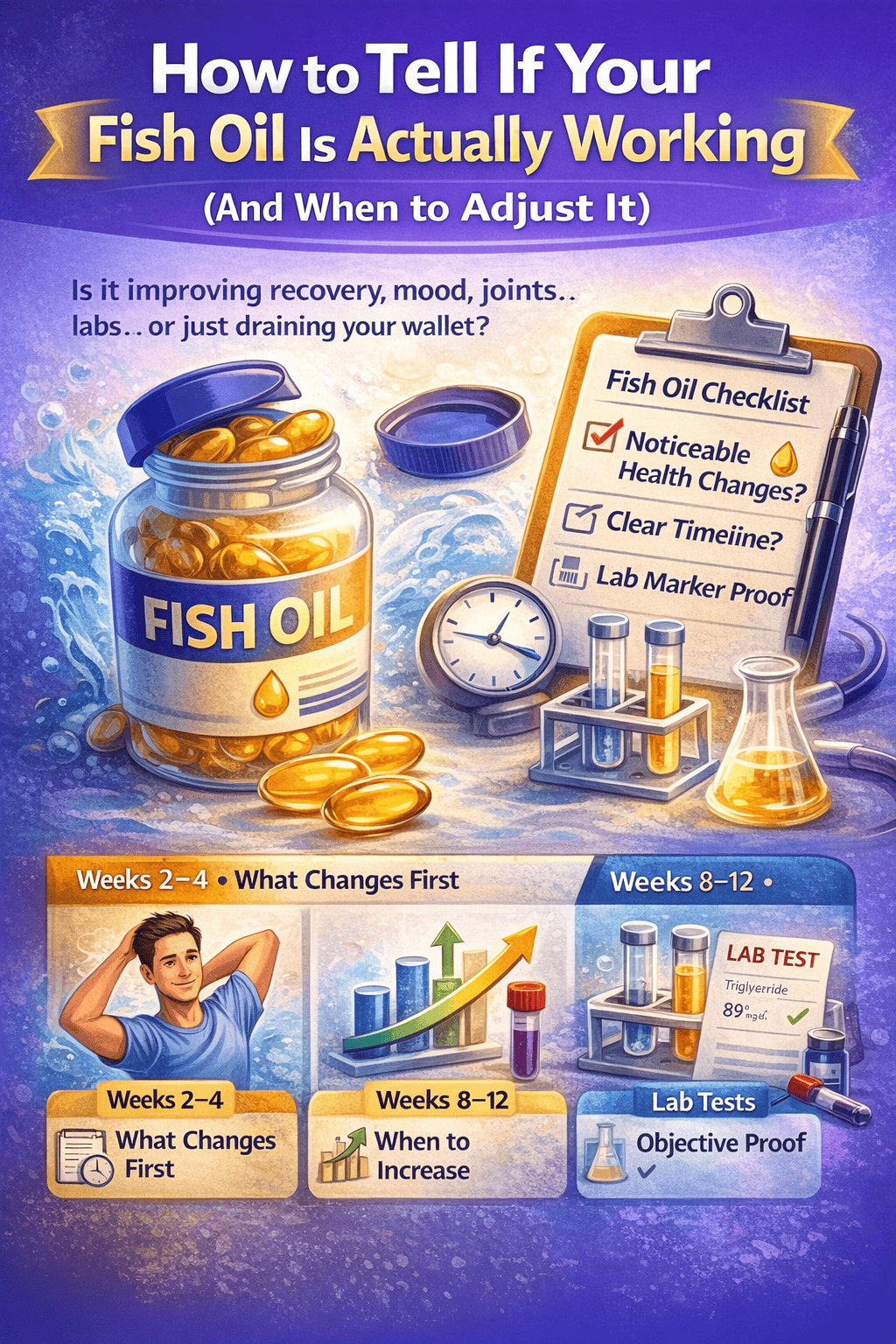
Most people are early when they decide it’s “not working.” A realistic timeline is: digestion/tolerance changes in the first week, subtle trend signals in weeks 2–4, clearer signals in weeks 4–8, and a clean decision at weeks 8–12.
Honest framing: omega-3s change the background over time. If you’re looking for an acute “kick,” you’ll miss the real signal.
What should I feel when fish oil is working?
Usually nothing dramatic. The most common “felt” signs are small: less morning stiffness, soreness resolves faster, skin feels less dry, and mood feels steadier under stress.
- Recovery lane: fewer “wrecked” days after hard sessions.
- Joint lane: less cranky warm-up, fewer flare days.
- Mood lane: less emotional whiplash, quicker return to baseline.
- Skin lane: dryness/irritation trends down.
What dose of EPA and DHA is enough to work?
The label “1000 mg fish oil” is not the real dose. What matters is the combined EPA + DHA. Many people underdose without realizing it, especially if they take one capsule that contains only a few hundred milligrams of EPA+DHA.
Practical dose logic
- If you want “baseline support”: a meaningful daily EPA+DHA intake maintained consistently.
- If you want lab movement (like triglycerides): clinician-guided dosing is often used in studies and medical products.
- If you can’t tell: you may be underdosed, taking it without food, or your baseline diet already covers the need.
Should I get an omega-3 index test?
If you want objective proof that you’re absorbing enough EPA+DHA to shift biology, omega-3 index testing is one of the cleanest options (availability varies by region). If that’s not available, fasting triglycerides are a more common lab signal for some people.
How to use labs without overthinking
- Test baseline → maintain a stable plan → re-test at 8–12 weeks.
- Don’t change dose every week; you’ll never know what caused what.
- Use labs to confirm exposure; use symptoms to confirm relevance.
Why am I not noticing any benefits from fish oil?
If you’re 8–12 weeks in and honestly can’t point to a single signal, it’s usually one of three things: dose mismatch (too little EPA+DHA), absorption mismatch (not taken with meals or poor tolerance), or need mismatch (your diet already covers it).
- Dose mismatch: “fish oil mg” isn’t EPA+DHA.
- Absorption mismatch: taking it without food, frequent fishy burps, or inconsistent use.
- Need mismatch: you already eat fatty fish regularly and your baseline is already solid.
How to tell it’s working and when to adjust
The cleanest way to avoid guesswork is to run a stable trial and track one marker. Fish oil rewards patience and punishes chaos.
Common mistakes
- Underdosing: taking “one softgel” with low EPA+DHA.
- Not taking with food: worse tolerance and often worse adherence.
- Changing three variables: dose, brand, and diet all at once.
- Expecting a dramatic feeling: fish oil is often subtle even when it’s working.
Clean test protocol (8–12 weeks)
- Pick one goal lane: joints, recovery, mood, skin, or labs.
- Hold one plan steady: same product, same daily EPA+DHA, taken with a real meal.
- Track one marker weekly: (0–10 scale) plus one objective if relevant (triglycerides or omega-3 index).
- At week 6: decide if there’s a trend. If yes, keep going. If no, consider one adjustment only (dose or timing).
- At week 12: decide: keep, adjust again, or stop because it’s unnecessary for your baseline.
How to tell it’s working
- What to track: your chosen lane marker plus tolerance (burps, GI comfort) and adherence.
- Realistic window: 3–8 weeks for subjective trends; 8–12 weeks for lab confirmation.
- What not to expect: an immediate mood “lift” or a dramatic anti-inflammatory feeling in days.
- Success definition: a stable trend in the direction you actually care about, without side effects.
Selected Professional References
NIH ODS: Omega-3 Fatty Acids (Health Professional)
Dose ranges, safety considerations, triglyceride effects, and what outcomes have the strongest evidence.
ods.od.nih.gov
American Heart Association: Omega-3 fats overview
Practical guidance on dietary omega-3s, supplements, and cardio-relevant expectations.
heart.org
PubMed: Omega-3 Index concept and clinical context
Background on omega-3 index as an exposure marker and why it can confirm absorption.
pubmed.ncbi.nlm.nih.gov
PubMed: Omega-3s and depression outcomes (meta-analysis context)
Helps set expectations for mood “steadiness” claims and why response varies by population and formulation.
pubmed.ncbi.nlm.nih.gov
PubMed: Omega-3s and triglycerides (dose-response context)
Supports the “labs change more than feelings” framing for triglyceride-focused goals.
pubmed.ncbi.nlm.nih.gov
Go Deeper (VerifiedSupps Guides)
How much omega-3 per day?
Dose ranges by goal, using EPA+DHA (not “fish oil mg”).
Best time of day to take omega-3
How to take it for best tolerance and adherence.
EPA vs DHA: what matters most
Pick the balance that matches your intent.
Triglyceride vs ethyl ester fish oil
Absorption differences and why “form” can matter.
Final takeaway
Fish oil “working” usually looks like a quieter baseline: steadier recovery, calmer joints, smoother mood, or labs moving in the expected direction. Give it time, judge it by one clear goal, and use labs if you want clean proof. If there’s no signal after a fair 8–12 week test, adjust intelligently—or stop without regret.
FAQ
How long does fish oil take to work?
Many people notice subtle trend signals in 3–8 weeks. A fair decision window is 8–12 weeks.
What’s the most reliable sign fish oil is working?
Labs are the cleanest proof (triglycerides and omega-3 index). Subjective signals are usually recovery, joints, skin, or mood steadiness.
Should I take fish oil with food?
Often yes. It usually improves tolerance and helps people stay consistent.
What if I get fishy burps?
Take with a larger meal, split the dose, or reassess product freshness and form.
How do I know if I’m taking enough EPA and DHA?
Check the supplement facts: EPA + DHA is the meaningful number, not “fish oil mg.”
Should I get an omega-3 index?
If you want objective confirmation of exposure/absorption, yes—if it’s available where you live.
When should I adjust my fish oil?
If you have mild benefits and want more, adjust once and wait 4–6 weeks. If you have no signal by 8–12 weeks, reassess dose and need.
Who should talk to a clinician before increasing dose?
Anyone on anticoagulants/antiplatelets, with a bleeding disorder, or with upcoming surgery or complex medical conditions.
VerifiedSupps Medical Disclaimer
This content is for educational purposes only and is not medical advice. Consult a qualified healthcare professional before starting, stopping, or changing omega-3 supplements, especially if you are pregnant or breastfeeding, have cardiovascular disease, liver or kidney conditions, a bleeding disorder, or take medications (including anticoagulants/antiplatelets). Seek urgent medical care for severe or concerning symptoms.