Triglyceride vs Ethyl Ester Fish Oil: Which Absorbs Better?
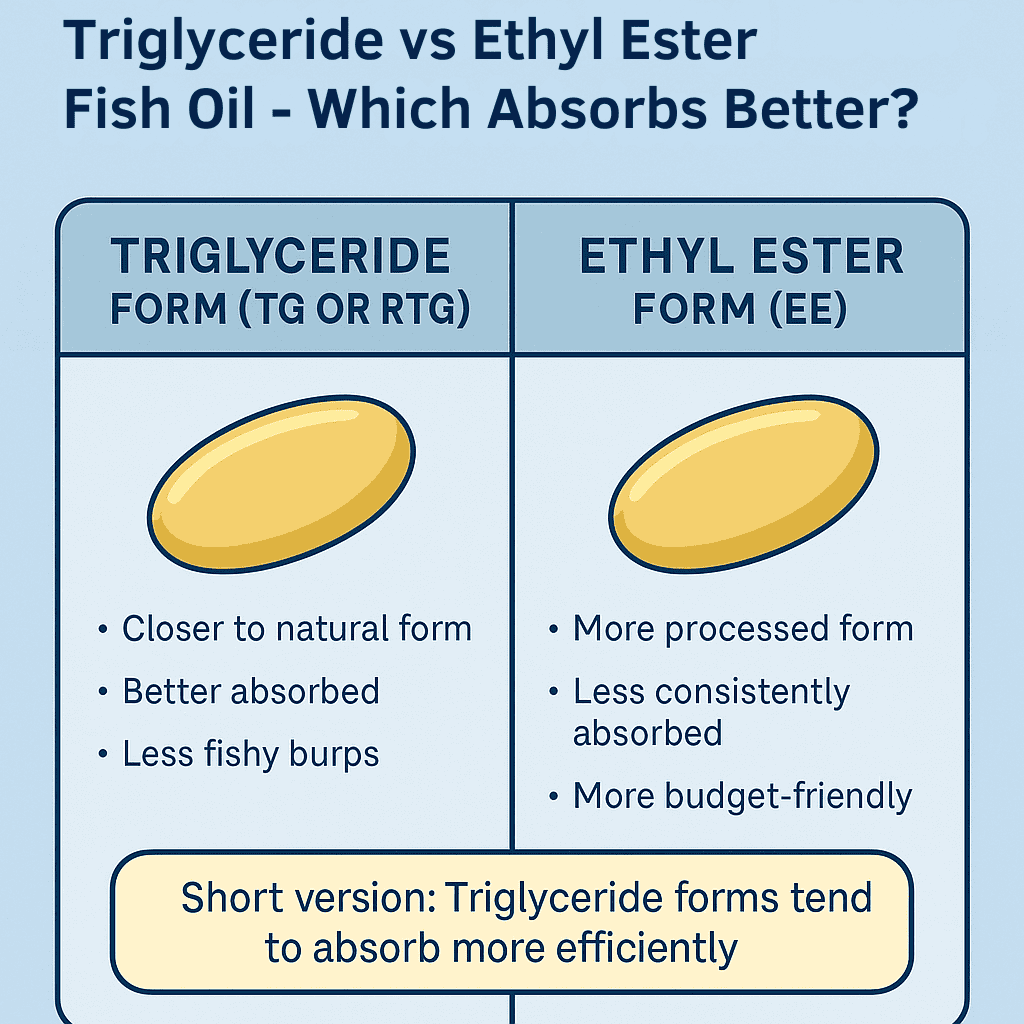
In most real-world use, triglyceride (TG) and re-esterified triglyceride (rTG) fish oils tend to have more consistent absorption than ethyl ester (EE)—especially when meals are inconsistent. EE can still work well, but it’s usually more dependent on taking it with a real meal (fat helps).
This guide turns “TG vs rTG vs EE” into a clean decision: what to buy, how to take it, and what actually changes your results.
Quick Take
- Best absorption odds: rTG/TG, taken with meals.
- Budget option that still works: EE—just be strict about taking it with a fat-containing meal.
- Most common “it did nothing” reason: underdosing EPA+DHA or taking EE without food.
- Fishy burps: freshness + timing with meals usually matter more than form alone.
Evidence standard: human studies on omega-3 bioavailability, absorption with meals, and clinical safety sources.
This is for you if: you want a simple buy/take rule and fewer “why does this bottle feel different?” moments.
Not for you if: you’re using blood thinners or have bleeding risk and want to self-increase omega-3 dosing without clinician input.
Last reviewed: March 2, 2026
Parent Hub: Want the complete omega-3 map (benefits, dosing, timing, forms, safety)?
Open: Omega-3 Complete Guide (VerifiedSupps)
TG vs rTG vs EE “what should I buy?” table
This is the fastest way to choose a form you’ll actually absorb consistently.
| Form | Absorption odds | Best for | Simple rule |
|---|---|---|---|
| rTG (re-esterified TG) | Often most consistent (especially if meals vary) | “Best odds” per capsule, consistency-focused users | Take with meals; you’ll usually need fewer “variables” |
| TG (natural triglyceride) | Typically strong, “food-like” digestion | People who prioritize natural form and tolerance | Take with meals; dose by EPA+DHA |
| EE (ethyl ester) | Can be more meal-dependent and variable | Budget buyers who are consistent with meals | Always take with a fat-containing meal; don’t “empty stomach” it |
Form matters, but EPA+DHA dose + taking it with food usually matters more than people think.
Triglyceride vs ethyl ester fish oil: which absorbs better?
In most comparisons, TG/rTG absorbs more consistently than ethyl ester. Ethyl ester can still be effective, but it’s more sensitive to whether you take it with a meal (fat helps absorption) and can vary more person-to-person.
What would change my recommendation?
- You always take supplements with a full meal: EE can be a reasonable value choice.
- You often forget meals or take fish oil randomly: TG/rTG reduces “absorption uncertainty.”
- GI sensitivity or fishy burps: TG/rTG plus meal timing often improves tolerance.
- Bleeding risk / anticoagulants: form choice matters less than safety and clinician guidance.
What is rTG fish oil and why is it “better”?
rTG (re-esterified triglyceride) is a manufacturing step where omega-3s that were concentrated are placed back into a triglyceride structure. The practical reason people pay more for rTG is that it often delivers more consistent real-world absorption and fewer “variables” around meal timing.
“Better” here usually means: easier to hit your EPA+DHA target reliably, not that EE is useless.
Does ethyl ester fish oil work if you take it with food?
Yes—EE can work well when taken with a fat-containing meal. The main problem is that many people take it on an empty stomach or with a very light meal, then conclude “fish oil doesn’t work.”
Practical rule: if you choose EE, treat “with food” as part of the dose—not optional.
Does fish oil form change how many capsules you need?
Form can affect absorption consistency, but you still dose by EPA + DHA. If a TG/rTG product is more consistently absorbed for you, it can feel like you “need less” to notice benefits—but the clean way to plan is still by EPA+DHA targets and consistent intake.
If two products list the same EPA+DHA dose but feel different, form, meal timing, and freshness are the likely explanations.
Which fish oil form causes fewer fishy burps?
Fishy burps are most often about freshness and timing, not just form. That said, many people report TG/rTG feels easier on digestion—especially when taken with food.
What usually helps most
- Take omega-3 mid-meal (not before the first bite, not on an empty stomach).
- Split doses if you take multiple capsules.
- If a product smells strongly rancid, stop and switch.
Why your fish oil isn’t working (and how to fix it)
Most “no results” outcomes come from underdosing EPA+DHA, taking EE without food, or expecting an immediate “feeling.” Omega-3 is usually a baseline builder.
Common mistakes
- Form mismatch: choosing EE but taking it like TG (without a meal).
- Label trap: using “fish oil mg” instead of EPA+DHA.
- Inconsistency: skipping days, then trying to judge results.
- Freshness issue: rancid oil won’t feel good and isn’t what you want.
How to tell it’s working
- Weeks, not days: steadier mood, less stiffness, smoother recovery often show up gradually.
- GI tolerance improves: fewer burps or less discomfort with a better form + meal timing.
- Lab-based option: some people use an omega-3 index test to confirm status changes (clinician-guided is ideal).
A clean 14-day test
- Pick one product and lock your daily EPA+DHA target.
- Take it with the same meal every day.
- Track: burps/GI comfort, recovery, and baseline mood steadiness.
Selected Professional References
Go Deeper (VerifiedSupps Guides)
If you want the next step, these connect form → dose → results.
Final Takeaway
If you want the simplest “best odds” choice, pick rTG/TG and take it with meals. If budget matters most, EE can still work—just treat “with a fat-containing meal” as non-negotiable. Either way, dose by EPA + DHA and judge results over weeks, not a single day.
FAQ
Is rTG fish oil the same as triglyceride fish oil?
They’re related. rTG is a re-esterified triglyceride form used after concentration steps. Both are triglyceride-structured, but rTG is often discussed as a “high-efficiency” form.
Do ethyl ester fish oils work?
Yes, especially when taken with a fat-containing meal. The main issue is that absorption can be more meal-dependent.
Do I need to change my dose if I switch forms?
Usually you still dose by EPA+DHA. Some people find they need fewer “variables” with rTG/TG, but the clean plan is still EPA+DHA targets plus meal timing.
Why do I get fishy burps?
Freshness and timing with meals often matter most. Taking omega-3 mid-meal or splitting doses can help.
What’s the best way to absorb fish oil?
Take it with a meal that contains fat, and be consistent with timing—especially if you use ethyl ester products.
Is ethyl ester fish oil “lower quality”?
Not automatically. It’s a manufacturing form. Quality depends on freshness, purity, testing, and whether you hit your EPA+DHA target consistently.
Can fish oil interact with medications?
Yes. High-dose omega-3 can affect bleeding risk in some contexts. If you take anticoagulants/antiplatelets or have surgery planned, consult a clinician.
Which form should I choose if I’m sensitive?
Many sensitive users prefer TG/rTG and taking it with meals. If you use EE, be strict about meal timing.