By VerifiedSupps Editorial Team
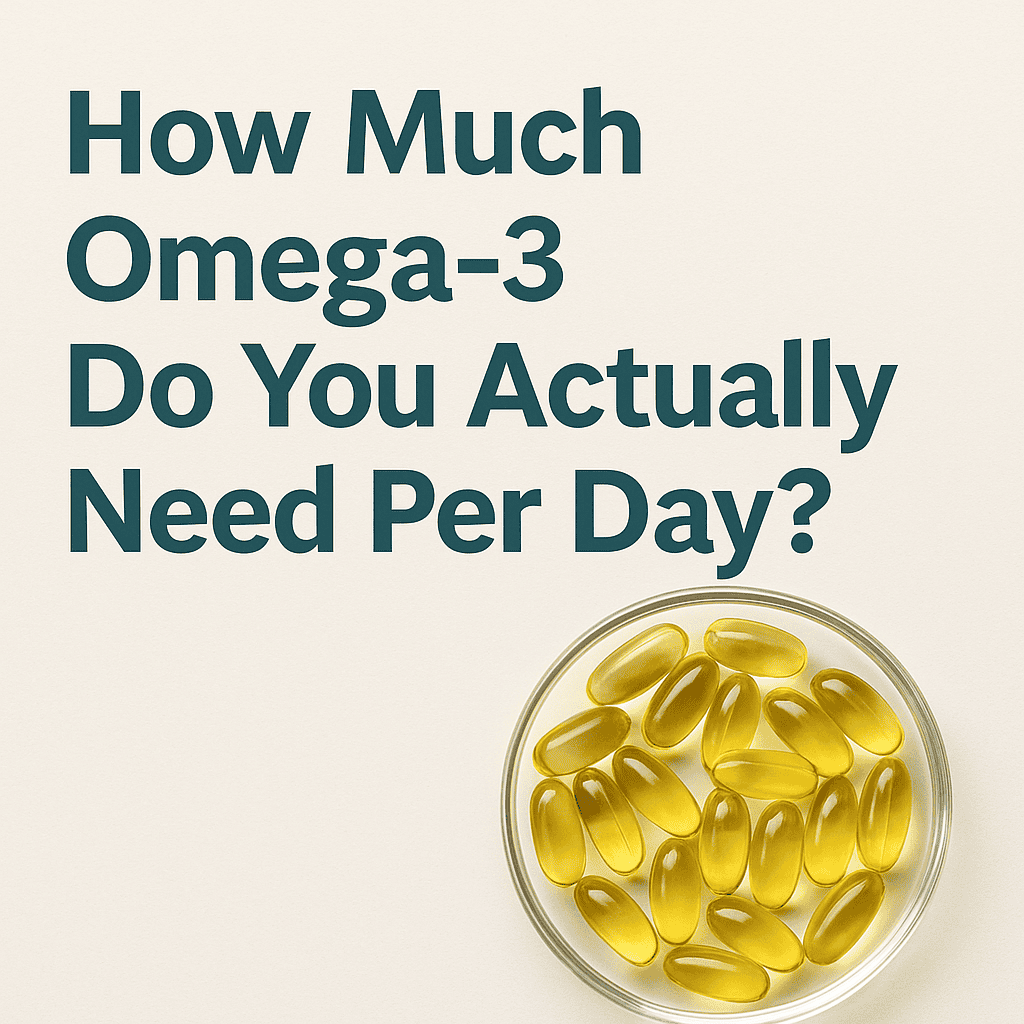
How Much Omega-3 Do You Actually Need Per Day?
There is not one universal supplement number every adult must take, but for most adults who are using omega-3 supplements, a practical starting point is about 1,000 mg/day of combined EPA + DHA. A common higher everyday range is 1,500–2,000 mg/day when fish intake is low or the goal is a stronger recovery, triglyceride, or general omega-3 coverage strategy.
The real mistake is usually not “too little fish oil.” It is dosing by the big fish oil mg number on the bottle instead of the smaller EPA + DHA numbers on the label. Food-first guidance still matters too: for the general population, seafood intake remains the main baseline recommendation, while pregnancy, heart disease, and high triglycerides each deserve their own lane.
This page owns the daily-dose question. If you want deeper form comparisons, daily safety, or “is it working?” troubleshooting beyond the dose question, those live in dedicated omega-3 child pages.
Key terms: omega-3 dosage, EPA, DHA, fish oil label math, how much fish oil per day, omega-3 with food, omega-3 safety
Quick Take
For most supplement users, 1,000 mg/day combined EPA + DHA is the clean baseline, and 1,500–2,000 mg/day is a common higher everyday range. Dose by EPA + DHA, not “fish oil mg,” take it with a meal, and remember that 4 g/day belongs to prescription triglyceride management, not ordinary wellness use.
TL;DR decision
If you want the shortest useful answer, start around 1,000 mg/day EPA + DHA, take it with food, and check whether your bottle actually delivers that much active omega-3. Move higher only when the goal and context justify it, and get clinician input if you use blood thinners, have surgery planned, are pregnant, or are dealing with high triglycerides.
Evidence standard: human trials, dose ranges, guideline-level sources when available
Who this is for: adults who want a practical omega-3 dose target and a reliable way to read labels without guessing
Who this is not for: anyone trying to self-manage very high triglycerides, blood thinners, bleeding risk, or pregnancy-specific dosing without clinician guidance
Reviewed by: VerifiedSupps Editorial Team
Last reviewed: March 30, 2026
Parent Hub
Omega-3: The Complete Science-Simple Guide
Start here if you want the full omega-3 map in one place: benefits, forms, timing, safety, and the rest of the cluster after you solve the dose question.
Omega-3 dose decoder by goal
This is the fast version. Choose the row that sounds most like you, then make sure your bottle can actually hit that target.
| If this is your goal | Practical EPA + DHA target | What to prioritize | Reality check |
|---|---|---|---|
| You already eat fatty fish regularly | Often low or none from supplements | Diet quality, not reflex supplementation | Fish twice weekly can already cover more than people expect |
| General supplement baseline | ~1,000 mg/day | Consistency + label math | Many “1,000 mg fish oil” caps only deliver ~300 mg EPA+DHA |
| Mood, calm baseline, or daily resilience | ~1,000–1,500 mg/day | Adequate total dose, often EPA-forward | Judge over weeks, not days |
| Recovery, soreness, or stronger omega-3 coverage | ~1,500–2,000 mg/day | Total EPA+DHA, taken with meals | Capsule burden is often the reason people quit |
| Pregnancy or breastfeeding context | Food-first + DHA emphasis | Low-mercury seafood or clinician-guided DHA plan | This is not the same decision as ordinary wellness dosing |
| High triglycerides | 4 g/day prescription omega-3 | Medical supervision | This is prescription territory, not casual supplement shopping |
Best next step (today): Look at your current bottle and add EPA + DHA per serving. Most people discover their real dose is much lower than they assumed.
How much omega-3 should you take per day?
There is no single official supplement number every healthy adult must hit. In real-world supplement use, though, about 1,000 mg/day of combined EPA + DHA is a smart baseline, while 1,500–2,000 mg/day is a common higher everyday range when diet is light on fatty fish or you want a stronger omega-3 strategy.
Mechanism
- EPA and DHA are the biologically relevant long-chain omega-3s people usually mean when they say “fish oil works.”
- They build into cell membranes over time, which is why consistency matters more than a big single dose.
- The bottle’s big “fish oil mg” number is not your active dose; the smaller EPA + DHA numbers are.
That is also why food-first advice and supplement advice can sound different without actually conflicting. The American Heart Association still emphasizes fish intake for the general public, while supplement dosing becomes more relevant when fish intake is low, the goal is very specific, or the clinician context changes the math.
What would change my recommendation
- Blood thinners, antiplatelets, bleeding disorders, or surgery planned: dose becomes a safety discussion, not just a supplement decision.
- Pregnancy or breastfeeding: seafood guidance and DHA emphasis matter more than generic fish-oil advice.
- Existing coronary heart disease: older AHA guidance cited in NIH materials points to about 1 g/day EPA + DHA, preferably from fish, with supplements considered under physician guidance.
- High triglycerides: this moves into prescription-dose territory, typically 4 g/day under medical supervision.
How much EPA and DHA do you actually need?
For most people, total EPA + DHA matters more than chasing a perfect ratio. Hit the right total first. Then, if your goal is more specific, you can decide whether an EPA-forward or DHA-forward product makes more sense.
A useful way to think about it is this: EPA is often emphasized when people care about mood steadiness, stress resilience, and inflammation-related recovery. DHA is more structural and matters more in brain, eye, and pregnancy-related conversations. But for ordinary adult supplement use, the common failure point is not a bad ratio. It is an inadequate total dose.
That is why a calm starting strategy works so well: get to about 1,000 mg/day combined EPA + DHA, take it consistently with meals, and only then start refining product ratios if your goal really calls for it. If your bottle is giving you 300–500 mg/day combined, you are often still in “maybe helpful, maybe too low to notice much” territory.
Pregnancy is different. NIH-linked guidance summarized in the ODS fact sheet and FDA/EPA fish advice both push the conversation toward low-mercury seafood intake and DHA adequacy, not generic “take more fish oil” advice.
How do you calculate EPA + DHA from a fish oil label?
Ignore the front-label fish-oil number and go straight to the Supplement Facts panel. Add the EPA line and the DHA line together. That total is your usable omega-3 dose per serving.
This is the part that trips people up most. A bottle can say 1,000 mg fish oil on the front and still only provide about 300 mg combined EPA + DHA. That is not fake; it just means most of the oil weight is not the EPA and DHA you were trying to dose.
Example 1: EPA 330 mg + DHA 220 mg = 550 mg EPA + DHA per serving. That is the number you dose from.
Example 2: If the serving size is 2 softgels and the label says EPA 360 mg + DHA 240 mg, that means the serving provides 600 mg combined, or 300 mg per softgel.
Simple label rule: always check two things before buying—EPA + DHA per serving and how many capsules make up that serving. A good bottle is not one with the biggest front label. It is the one that gets you to your target without turning dose math into a daily chore.
How many fish oil capsules should you take per day?
Capsules per day = your EPA + DHA target divided by EPA + DHA per capsule. That is it. Once you do that math once, the guesswork disappears.
If your goal is 1,000 mg/day and each capsule provides 500 mg EPA + DHA, you need 2 capsules/day. If each capsule provides only 300 mg, you need a little over 3 capsules/day, which usually means either 3 capsules or a higher-potency product.
If your goal is 1,500 mg/day and each capsule provides 550 mg, you need 3 capsules/day. If your goal is 2,000 mg/day and each capsule gives 400 mg, you are now at 5 capsules/day and should probably ask whether the bottle itself is the problem.
That is the hidden quality test. A low-potency bottle can be cheap up front but expensive in capsule burden, missed doses, and poor adherence. If your math keeps landing you at 4 to 6 capsules a day, moving to a more concentrated product is often the better decision.
When should you take omega-3 for best absorption?
Take omega-3 with a meal. Time of day matters much less than food, consistency, and whether the dose is spread in a way your stomach tolerates well.
This is especially important if you are using an ethyl ester product or if you regularly take supplements on an empty stomach. In real-world use, meal quality and regularity often matter more than people think. A product that looks “weak” can sometimes just be a product that is being taken badly.
If you get fishy burps, reflux, or nausea, the first moves are usually better than switching forms immediately: take it mid-meal, split the dose, or anchor it to your largest reliable meal of the day. Morning versus night is much less important than “with food, every day.”
Practical rule: if a supplement works only when you remember it occasionally, it is not a good plan yet. Build omega-3 into a meal you actually eat consistently.
Is there a safe upper limit for omega-3 supplements?
For ordinary daily use, most people stay far below pharmacologic dosing. The NIH ODS fact sheet notes that the European Food Safety Authority considers up to about 5 g/day of combined EPA + DHA from supplements safe for long-term use, and FDA has similarly concluded that dietary supplements providing no more than 5 g/day EPA + DHA are safe when used as recommended.
That does not mean most people need anywhere near that amount. It means the ceiling for safety and the dose that is sensible for a normal adult are not the same thing. Everyday use usually sits well below that. Once you move into the 4 g/day range, you are in the same neighborhood as prescription omega-3 therapy used for high triglycerides.
This is also where bleeding questions matter more. Older NIH-cited data note that doses in the 2–15 g/day range can increase bleeding time by affecting platelet aggregation, even though current safety reviews suggest typical supplement use is generally well tolerated. In practice, the caution zones stay the same: blood thinners, bleeding disorders, upcoming surgery, and self-escalating doses without a clear reason.
Useful rule: 1–2 g/day is everyday territory for many supplement users. 4 g/day is therapeutic territory. Treat those as different decisions.
Why isn’t omega-3 working for me?
Usually because the real EPA + DHA dose is lower than you thought, the supplement is being taken inconsistently, or the expectations are wrong. Omega-3 is usually a slow baseline builder, not a stimulant, so “I didn’t feel anything on day three” is not a useful test.
Common mistakes
- Dosing by fish oil mg instead of EPA + DHA
- Taking it on an empty stomach or with a tiny snack
- Using a low-potency product that quietly leaves you underdosed
- Expecting a quick mood or energy hit instead of a gradual trend
Clean test protocol
| Inputs | One product only, clear EPA + DHA label, target of 1,000–1,500 mg/day combined, taken with the same meal daily. |
|---|---|
| Duration | Run it for 4 to 8 weeks before judging, unless side effects or clinician concerns stop the test earlier. |
| 3 metrics | Track recovery/stiffness, mood steadiness or stress reactivity, and one tangible physical signal such as skin dryness, joint comfort, or clinician-guided triglycerides. |
| Stop conditions | Stop and reassess if GI symptoms stay persistent, you notice unusual bruising or bleeding, surgery is approaching, or medications make the dose a safety issue. |
How to tell it’s working
The signal is usually subtle and trend-based. People who respond often notice steadier recovery, less stiffness, less “edgy” baseline mood, or better overall consistency rather than a dramatic sensation. If you are looking for a caffeine-like effect, you will probably decide too early that omega-3 did nothing.
Red flags / seek care
Get clinician input before pushing the dose higher if you take anticoagulants or antiplatelets, have a bleeding disorder, or have surgery planned. Seek urgent medical care for significant bleeding, severe allergic symptoms, chest pain, or symptoms that clearly do not fit a routine supplement issue.
Selected Professional References
These are the key sources behind the dose ranges, label-math logic, pregnancy guidance, and safety guardrails used in this guide.
Omega-3 Fatty Acids — Health Professional Fact Sheet
Best one-stop reference for practical EPA + DHA context, pregnancy guidance, typical supplement labeling, and upper-range safety discussion.
Used for: daily-dose framing, pregnancy DHA context, safety and upper-range dosing
Fish and Omega-3 Fatty Acids
Useful for the food-first baseline and the reminder that fish intake is still the main public-health recommendation for most people.
Used for: fish twice weekly baseline, food-first guidance
Advice About Eating Fish
Best official reference for pregnancy and breastfeeding fish guidance, lower-mercury choices, and seafood serving guidance.
Used for: pregnancy and breastfeeding context, low-mercury seafood choices
Omega-3 Fatty Acids for the Management of Hypertriglyceridemia
Important for drawing a clean line between ordinary supplement use and therapeutic 4 g/day prescription-dose omega-3 for triglycerides.
Used for: high-triglyceride prescription context, why 4 g/day is not routine wellness dosing
Go Deeper (VerifiedSupps Guides)
Once your dose is clear, these are the next pages that solve the most common follow-up questions.
EPA vs DHA: What Matters Most?
Use this when the dose is set and now you want to know whether the ratio should change for your goal.
Triglyceride vs Ethyl Ester Fish Oil
Best next read if you want to understand why meals, form, and absorption can change real-world results.
How to Tell if Fish Oil Is Working
Go here if your main question is not dose anymore, but what to track and how long to judge it fairly.
Is Fish Oil Safe to Take Every Day?
Open this if the real question is long-term safety, bleeding concerns, or who should be more cautious.
Final Takeaway
If you want the cleanest everyday answer, start with about 1,000 mg/day combined EPA + DHA, take it with a meal, and make sure your bottle actually delivers that much active omega-3. Push higher only when the goal clearly justifies it, and treat 4 g/day as a medical-dose conversation, not normal supplement guesswork.
FAQ
Is 1,000 mg fish oil the same as 1,000 mg omega-3?
No. Fish oil mg is the total oil weight. Your real omega-3 dose is the combined EPA and DHA listed on the label.
How much EPA and DHA should I take for general health?
A practical supplement baseline for many adults is around 1,000 mg/day combined EPA + DHA, especially when fatty fish intake is low.
How much omega-3 should I take for high triglycerides?
That is usually a prescription-dose question, often 4 g/day under medical supervision, not a casual supplement plan.
Should I take omega-3 in the morning or at night?
Either can work. Taking it with a real meal matters more than the exact time of day.
Should I take omega-3 with food?
Yes. Food usually improves tolerance and can make absorption more consistent, especially with some formulations.
Is more omega-3 always better?
No. Higher doses are not automatically better. There is a big difference between a useful daily range and therapeutic medical dosing.
Do I need a perfect EPA:DHA ratio?
Usually no. For most people, hitting an adequate total EPA + DHA dose matters more than chasing a perfect ratio.
How long does omega-3 take to work?
Usually weeks, not days. Omega-3 tends to behave like a baseline builder rather than an immediate-feeling supplement.
What if I do not eat fish?
Supplements become more useful when fish intake is low. In pregnancy or if fish is avoided entirely, DHA-focused strategies may deserve more attention.
When should I ask a clinician before taking omega-3?
Ask first if you use blood thinners or antiplatelets, have a bleeding disorder, have surgery planned, are pregnant, or are trying to manage very high triglycerides.
VerifiedSupps Medical Disclaimer
This content is for educational purposes only and is not medical advice. Omega-3 supplements can interact with medications and may be inappropriate in some settings, especially if you use anticoagulants or antiplatelet medications, have a bleeding disorder, have surgery planned, are pregnant or breastfeeding, or are trying to manage very high triglycerides. Prescription-dose omega-3 therapy is not the same thing as ordinary supplement use. Always consult a qualified healthcare professional before changing your dose in a higher-risk situation.