Magnesium and Vivid Dreams: Why It Can Cause Intense Dreams or Nightmares
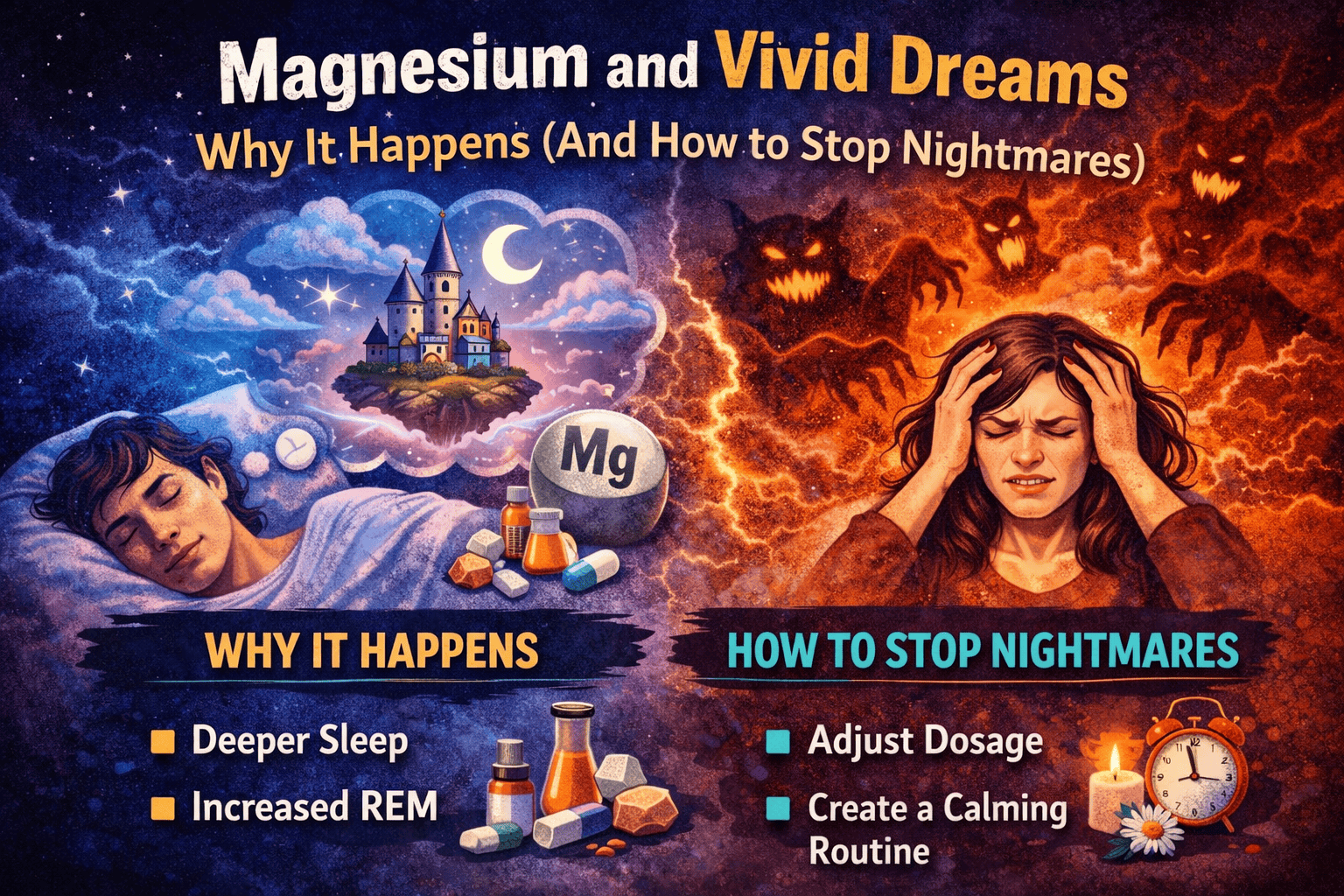
Magnesium can make dreams more vivid in some people—sometimes even intensifying nightmares—especially when taken close to bedtime. This is usually not “toxicity.” It’s more often a sleep-architecture and recall effect: deeper sleep, fewer awakenings, more consolidated REM, or stronger dream memory.
Quick take
- Vivid dreams often reflect changed sleep continuity/REM timing or better dream recall.
- Nightmares are different: if they’re distressing, reduce dose, move earlier, and remove stacking first.
- Most reliable fix: take magnesium with dinner (not bedtime) and lower the dose for 7–10 nights.
Evidence standard: human trials, dose ranges, guideline-level sources when available
For: people who noticed vivid dreams/nightmares after magnesium and want a clean fix plan
Not for: severe, trauma-linked nightmares or safety concerns without clinician support
Last reviewed: March 4, 2026
Parent Hub
Magnesium for Sleep Handbook: mechanism, timing, forms, and decision trees
If you want a full sleep plan (not just dream intensity), start here.
Can magnesium cause vivid dreams?
Yes, it can—especially if magnesium improves your sleep continuity or shifts how easily you remember dreams. This page “owns” one intent: magnesium makes dreams vivid (and how to reduce that). It’s not a general “best magnesium” guide.
| If your goal is… | Most likely driver | Best first move |
|---|---|---|
| Keep magnesium but reduce dream intensity | Timing too late or dose too high | Move to dinner and lower dose for 7–10 nights |
| Stop nightmares (distressing dreams) | Stacking + stress load + bedtime dosing | Pause stacking, move earlier, step down dose; stop if distress persists |
| Fix 2–4am wakeups linked to dream intensity | Sleep fragmentation + REM recall + physiology (GI/reflux) | Earlier timing with food; keep other sleep aids stable |
| Know if it’s really magnesium | Correlation (stress, illness, meds, melatonin) | Use the clean 7–14 day test (one variable at a time) |
What would change my recommendation?
- You have PTSD or severe, trauma-linked nightmares (stability matters more than supplement experimentation).
- You recently changed SSRIs/SNRIs, melatonin, cannabis/alcohol use, or sleep schedule (common nightmare drivers).
- You have kidney disease or use magnesium-containing laxatives/antacids regularly.
- Dreams come with chest pain, fainting/near-fainting, or sustained irregular heartbeat.
- Nightmares are causing dread of sleep or major daytime impairment (treat as clinical problem, not “a supplement quirk”).
Can magnesium cause nightmares?
It can increase dream intensity for some people, and in a high-stress context that can translate into nightmares. But nightmares also commonly track with stress, illness, sleep deprivation, alcohol/cannabis changes, melatonin timing, and medication changes. In other words: magnesium may be the trigger, or it may be a bystander.
Practical distinction
- Vivid dreams: intense but not distressing.
- Nightmares: distressing, fear-based dreams that disrupt sleep and mood.
- Plan: treat nightmares like a side effect—reduce dose, move earlier, remove stacking, and stop if distress persists.
Does magnesium glycinate cause vivid dreams?
It can in some people—most often when taken close to bedtime or at a higher-than-needed dose. The fix is usually not “avoid glycinate forever.” It’s timing and dose: move earlier, step down, and keep everything else stable long enough to judge.
If dreams started suddenly
Assume timing overlap first: take it with dinner for a week and lower the dose before switching forms.
If nightmares are distressing
Treat it as a side effect: step down dose, move earlier, remove stacking, or stop and reassess.
Best time to take magnesium to avoid vivid dreams
For dream-sensitive people, the most common “best time” is dinner or early evening. Bedtime dosing increases the chance that magnesium’s most noticeable effects overlap with the night’s sleep stage transitions.
- If bedtime dosing caused nightmares: move it earlier first (before changing forms).
- If you’re taking other sleep aids: keep them stable during your magnesium test window.
- If you wake at 2–4am: earlier timing + food often helps by reducing late GI and sleep fragmentation.
How much magnesium causes vivid dreams?
There’s no single number, because the effect is subjective and timing-dependent. But higher doses and bedtime dosing make dream changes more noticeable. For most dream-sensitive people, the best approach is a conservative dose that you can tolerate without side effects.
Conservative dosing ladder (dream-sensitive)
| Tier | Elemental magnesium | Best fit |
|---|---|---|
| Starter | 100–150 mg | Nightmare/dream sensitive, first re-try |
| Standard | 150–250 mg | Most sleep trials if tolerated |
| Upper conservative | 250–350 mg | Only if clearly tolerated |
If dream changes are your only side effect, you can often solve it with timing and dose rather than quitting magnesium entirely.
How long do vivid dreams last after starting magnesium?
For many people, it’s a short adjustment window—often a few nights to about two weeks—especially if magnesium improved sleep continuity. If nightmares persist and feel distressing, treat that as a reason to stop and reassess rather than “pushing through.”
Rule of thumb: vivid dreams that are interesting can be observed. Nightmares that cause dread, awakenings, or daytime impairment should be managed like a side effect.
How to stop magnesium nightmares
Treat nightmares as a “reduce and stabilize” problem, not a willpower problem. Most fixes work because they reduce REM disruption, gut-driven awakenings, and stacking effects.
- Move earlier: dinner or 2–4 hours before bed.
- Cut dose: drop to 100–150 mg elemental for 5–7 nights.
- Remove stacking: pause melatonin/THC/alcohol/sedating antihistamines if it’s safe to do so.
- Stop and re-test: if nightmares are distressing, stop magnesium for 3 days, then reintroduce low and early.
- If nightmares remain severe: prioritize clinical evaluation and stability over supplement experimentation.
Magnesium vivid dreams not going away: troubleshooting and how to tell it’s working
Dream intensity is easy to misread because it’s strongly influenced by stress, sleep debt, and other sleep aids. A clean test gives you a real answer: is magnesium the driver, or just present?
Common mistakes
- Bedtime-only dosing: most likely to intensify dreams in sensitive people.
- Starting too high: then trying to “outsmart” it with more supplements.
- Stacking: magnesium + melatonin + antihistamine + alcohol/THC makes interpretation impossible.
- Changing multiple variables: dose + timing + form in the same week.
Clean test protocol (7–14 nights)
- Hold the stack steady: no new sleep aids; stable caffeine cutoff and alcohol/THC pattern.
- Use dinner timing: same time nightly for the entire test.
- Use a conservative dose: start low and hold for 7 nights.
- Only one change after 7 nights: timing OR dose OR form (not all).
- If nightmares are distressing: stop immediately and reassess.
How to tell it’s working
- Track: dream intensity (0–10), nightmare frequency, awakenings, and next-day mood (0–10).
- Realistic window: changes often stabilize within 7–14 nights when timing and dose are consistent.
- What not to expect: instant dream suppression if stress, meds, or sleep debt are the real drivers.
- Success definition: dream intensity becomes neutral or manageable without compromising overall sleep quality.
Selected Professional References
NIH ODS: Magnesium (Health Professional)
Safety limits (GI-driven UL), side effects, deficiency context, and medication interactions.
ods.od.nih.gov
NHLBI: Stages of sleep (REM and dreaming)
Helpful grounding: why dreaming is linked to REM and why changes in sleep continuity can change dream recall.
nhlbi.nih.gov
MedlinePlus: Nightmares (medical encyclopedia)
High-trust overview of common nightmare drivers (stress, illness, substances, medications).
medlineplus.gov
PMC: Oral magnesium supplementation for insomnia (systematic review)
Context: magnesium may improve sleep outcomes in some groups; dream effects are likely indirect (sleep continuity/recall).
pmc.ncbi.nlm.nih.gov
PubMed: Magnesium supplementation and insomnia in older adults (trial)
Shows magnesium can improve insomnia-related outcomes in some populations, which can indirectly affect REM and recall.
pubmed.ncbi.nlm.nih.gov
NCBI Bookshelf: Parasomnias (nightmare disorder overview)
Clinical context: what nightmare disorder is and how it differs from other sleep disturbances.
ncbi.nlm.nih.gov
Go Deeper (VerifiedSupps Guides)
Magnesium timing: morning vs night
Why bedtime dosing backfires for some people (dreams, grogginess, awakenings).
Magnesium dosage guide
Elemental math, safe tiers, and how to titrate without side effects.
Magnesium forms explained
Glycinate vs threonate vs taurate vs citrate: what changes in real life.
Magnesium side effects and safety
Red flags, who should be cautious, and when to stop and reassess.
Final takeaway
Magnesium can make dreams more vivid by changing sleep continuity and dream recall. If you dislike the effect, the highest-yield fixes are simple: lower dose, earlier timing, and no stacking during your test. If nightmares are distressing or persistent, treat it as a side effect and prioritize stability.
FAQ
Can magnesium cause vivid dreams?
Yes for some people, especially with bedtime dosing or higher doses. The most reliable fix is earlier timing and a lower dose.
Can magnesium cause nightmares?
It can increase dream intensity in some people, and stress/stacking can turn that into nightmares. Treat distressing nightmares as a side effect.
Does magnesium glycinate cause vivid dreams?
It can, especially if taken right before bed. Move it earlier and lower the dose before you assume the form is the problem.
How long do vivid dreams last after starting magnesium?
Often a short adjustment window (a few nights to about two weeks). Distressing nightmares are a valid reason to stop and reassess sooner.
What’s the best time to take magnesium to avoid vivid dreams?
Dinner or early evening is a common sweet spot for dream-sensitive people.
How do I stop magnesium nightmares quickly?
Move earlier, cut dose to a conservative level, remove stacking, and stop magnesium if nightmares remain distressing.
Is this a sign I’m taking too much magnesium?
Not necessarily. Dream changes alone aren’t a toxicity sign. GI side effects and overall tolerance are better dose indicators.
When should I get help for nightmares?
If nightmares are severe, persistent, linked to trauma, or causing major daytime impairment or safety concerns, seek professional support.
VerifiedSupps Medical Disclaimer
This content is for educational purposes only and is not medical advice. Supplements can affect individuals differently and may interact with medications and health conditions. Consult a qualified healthcare professional before starting, stopping, or changing magnesium, especially if you have kidney disease, take prescription medications, or have a history of severe nightmares, PTSD, or other mental health conditions. Seek urgent help for chest pain, fainting/near-fainting, severe shortness of breath, sustained irregular heartbeat, or if you feel unsafe.