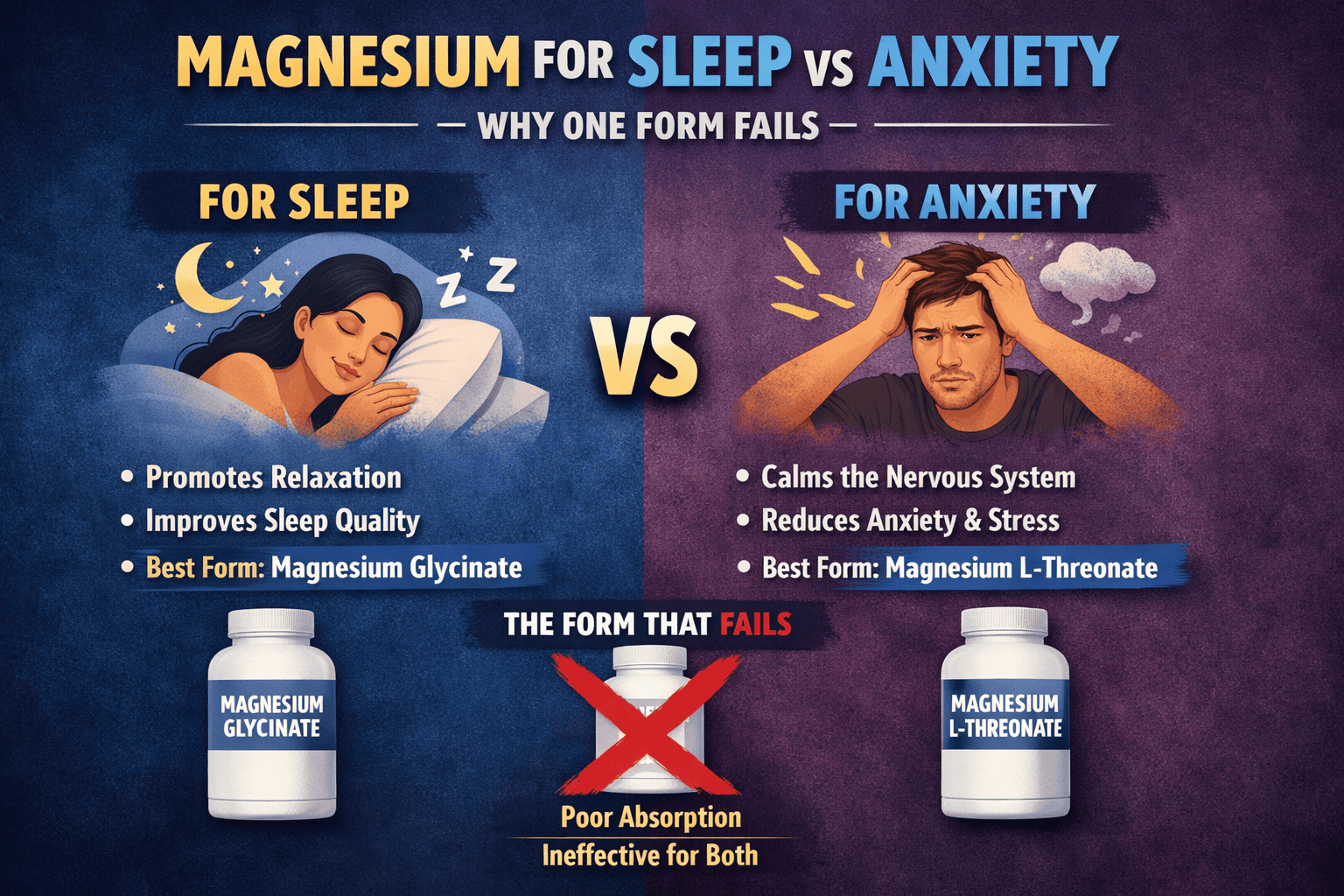
Magnesium for Sleep vs Anxiety: Why One Form Fails
Direct answer: magnesium can support both sleep and anxiety, but “magnesium” isn’t one experience. What people call “it worked” or “it failed” is usually a mismatch between your pattern (racing mind vs tense body) and your dose, timing, and tolerance.
If your first try failed, don’t assume magnesium is useless. Most failures come from wrong form for the pattern, under-dosing elemental magnesium, or not running a clean test.
What is the best magnesium for sleep vs anxiety?
The “best” form depends on what your brain and body are doing at night. This guide owns one intent: choosing a form that matches sleep vs anxiety patterns. If you want a deep dive on a single form, that’s a different intent.
| Your intent | What it usually feels like | First-pick strategy | Common way it “fails” |
|---|---|---|---|
| Tension sleep (tight body, cramps, jaw/shoulders “on”) | Body won’t downshift | Calming, well-tolerated form + evening dose | Dose too low or too inconsistent |
| Racing mind (rumination, planning brain) | Thought loop, light sleep | Consistency + timing routine; don’t judge on one night | Expecting a sedative effect |
| Physical anxiety (wired body, tight chest, restless baseline) | Somatic stress | Tolerable form + split dosing to stay steady | GI side effects end the test early |
| Cognitive anxiety (rumination, “what if” brain) | Mental noise | Run a clean 14-day test; track rumination and sleep latency | Switching forms every 2–3 days |
- Kidney disease or reduced eGFR: magnesium dosing becomes clinician territory.
- SSRIs/SNRIs, benzodiazepines, stimulants: the “signal” can be masked or misattributed.
- Thyroid meds, antibiotics, bisphosphonates: spacing matters and can change outcomes.
- Low blood pressure or frequent dizziness: treat hydration and sleep hygiene as first priority.
- Iron deficiency, B12 deficiency, sleep apnea suspicion: magnesium may help less than fixing the root driver.
Does magnesium help sleep and anxiety?
For many people, yes—especially when baseline magnesium status is low and the trial is consistent. But the realistic benefit is usually supportive, not “knockout sedation” or instant calm. Think: easier downshift, fewer tension signals, slightly quieter rumination over time.
Why did magnesium help my anxiety but not my sleep (or the reverse)?
Because sleep and anxiety are different targets. Sleep can fail even if anxiety improves when your sleep problem is mainly timing/routine or sleep architecture rather than tension. Anxiety can fail even if sleep improves when your anxiety is mostly cognitive rumination and the trial never reaches consistency.
- You expect a sedative effect (magnesium isn’t a sleeping pill)
- Timing is off (too late, too inconsistent)
- You’re not matching “tension sleep” vs “racing mind” vs “wake-ups”
- The dose is too low or too irregular to move baseline
- GI side effects end the test early
- You treat cognitive rumination like a purely physical problem
How much magnesium should I take for sleep or anxiety?
The practical answer is: start at a tolerable dose and earn your way up. Many people do well starting around 100–150 mg elemental magnesium daily, then increasing gradually if tolerated. The most common mistake is dosing “capsule mg” instead of elemental magnesium.
- Days 1–3: 100–150 mg elemental once daily with food
- Days 4–7: if tolerated, split into two smaller doses (more stable feel)
- Week 2: small increase only if your metrics improve and GI stays calm
What is the best time to take magnesium for anxiety or sleep?
If your goal is sleep, an evening dose with dinner is the most common “stable” option. If your goal is anxiety baseline, split dosing (earlier + evening) often feels smoother than a single nighttime hit. If magnesium makes you feel wired, moving it earlier can be a high-yield change.
Why did magnesium make my anxiety worse?
The most common reasons are timing (too close to bedtime for your system), dose jumps (titrated too fast), or a form/tolerance mismatch that creates discomfort that your brain reads as anxiety. The safest move is to reduce the dose, move timing earlier, and run a calmer, slower test.
- Pause for 48 hours if you feel clearly worse
- Restart at a lower elemental dose with dinner
- Keep the form and timing stable for 7 nights
Magnesium troubleshooting: how to tell it’s working for sleep or anxiety
Magnesium “works” when your target metric moves in the right direction without side effects. The most common failure is changing too many variables to know what did what.
- Switching forms every few days (no stable test)
- Dosing “once daily” at a level your gut can’t tolerate
- Not tracking anything (so “it didn’t work” is a feeling, not a result)
- Expecting a sedative effect instead of gradual support
- Pick one form and keep it unchanged for 14 nights.
- Use a tolerable elemental dose with dinner; split if your gut is sensitive.
- Track 3 metrics nightly: time to fall asleep, night awakenings, and morning calm.
- For anxiety, add one daytime metric: baseline tension (0–10) at the same time daily.
- Only change one variable after day 14 (dose or timing, not both).
- Sleep: shorter sleep latency or fewer awakenings across 7–14 nights (not one night).
- Anxiety: baseline tension score drops modestly and feels more stable across the day.
- Tolerance: no ongoing GI upset or “wired” feeling that forces you to stop.
- What not to expect: instant calm if stress load, caffeine, or sleep schedule is the main driver.
- New severe symptoms (confusion, fainting/near-fainting, dangerous palpitations)
- Persistent diarrhea or dehydration symptoms
- Known kidney disease without clinician guidance
- Any reaction that feels clearly wrong for your body
Selected Professional References
- NIH Office of Dietary Supplements: Magnesium (Health Professional Fact Sheet)
- Boyle NB et al. Magnesium supplementation for subjective anxiety and stress: systematic review (PMC)
- Abbasi B et al. Magnesium supplementation and insomnia outcomes: double-blind placebo-controlled trial (PubMed)
- Hausenblas HA et al. Magnesium L-threonate and sleep: randomized controlled trial (PubMed)
- Costello RB et al. Perspective: call for re-evaluation of the magnesium UL (PMC)
Go Deeper (VerifiedSupps Guides)
Final Takeaway
If magnesium “failed,” assume mismatch before you assume failure. Name your pattern (tension-body vs racing-mind; physical vs cognitive anxiety), run a clean 14-night test with a tolerable elemental dose and stable timing, then adjust one variable at a time.