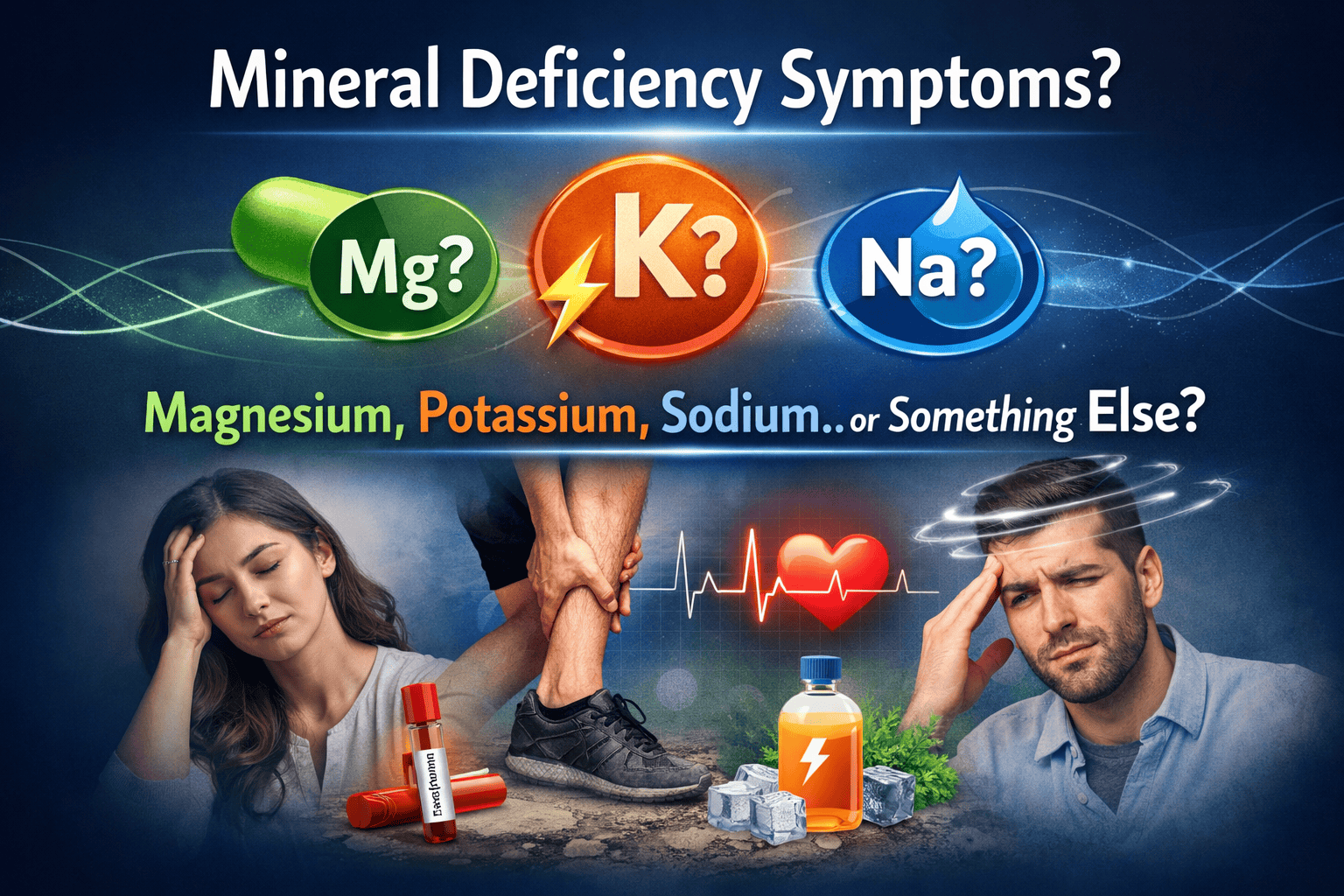
Mineral Deficiency Symptoms: How to Tell If It’s Magnesium, Potassium, Sodium — or Something Else
Direct answer: fatigue, cramps, dizziness, and palpitations can overlap across minerals—so “symptoms alone” aren’t a diagnosis. The goal is a smarter first decision: which signal is strongest (magnesium vs potassium vs sodium) and whether the real issue is balance rather than one missing piece.
If you’ve been guessing (or stacking minerals), this page helps you sort the pattern, pick one lever, and run a calm, clean test.
How can I tell if it’s magnesium, potassium, or sodium?
Look for the dominant pattern—not the loudest symptom. Minerals overlap, but the “main storyline” often isn’t subtle once you ask the right question: is this volume (sodium), electrical output (potassium), or downshift/relaxation (magnesium)?
| Your dominant signal | Most likely mineral lever | What to try first | Most common mistake |
|---|---|---|---|
| Dizziness on standing, “low BP” feeling, worse with lots of water | Sodium (volume stability) | Pair fluids with sodium; test in the trigger context | More water without sodium |
| Cramps + weakness, heavy legs, “flat” performance | Potassium (electrical output) | Increase dietary potassium; check meds first | High-dose potassium supplements without context |
| Tension sleep, twitching, “wired but tired” | Magnesium (downshift) | Tolerable form + slow titration for 7–14 days | Stopping early due to GI side effects |
| Headaches after heat/sweat, fatigue improved by “proper hydration” | Sodium (often) | Rebalance sodium + fluids; avoid dilution | Assuming it’s magnesium by default |
- Kidney disease or reduced eGFR: potassium and magnesium supplementation require clinician oversight.
- Heart rhythm concerns or new/worsening palpitations: don’t self-treat; get medical guidance.
- Diuretics, ACE inhibitors/ARBs, spironolactone: these can shift sodium/potassium quickly.
- Very high blood pressure or salt-sensitive hypertension: sodium strategy changes.
- Recent vomiting/diarrhea, heat illness, endurance events: losses can be large and fast—treat as higher stakes.
What are the symptoms of magnesium deficiency?
Magnesium patterns often feel like downshift failure: tension, twitching, poor sleep, and a nervous system that won’t settle. Many people describe it as “my body can’t fully relax,” especially at night.
- Tension sleep: difficulty winding down, restless tight body
- Twitching/tension signals: eyelid twitching or muscle tightness (not diagnostic, just a pattern)
- Stress sensitivity: feeling more reactive than usual
- Cramping at rest: especially when not in a sweat-loss context
What are the symptoms of low potassium?
Potassium patterns often feel like electrical output problems: weakness, “heavy legs,” cramps with low performance, and sometimes rhythm sensations. Potassium is also the mineral where medical context matters most.
- Weakness more than tightness: low output, heavy legs
- Cramps during activity (especially with sweat loss and low fueling)
- Constipation + fatigue can occur in low potassium states
- Palpitations: can have many causes—treat as a caution flag, not a DIY diagnosis
What are the symptoms of low sodium?
Sodium patterns often look like volume instability: dizziness on standing, headaches after sweating or high water intake, and “dehydration feelings” that don’t improve with water alone. Sodium is frequently misunderstood because of blanket low-salt messaging.
- Dizziness when standing (especially low BP tendencies)
- Headaches around sweating/heat or after lots of water
- Fatigue during heat/exercise that feels like you “can’t keep going”
- Symptoms improve with fluids + sodium (not water alone)
When is it an electrolyte balance issue (not one mineral)?
Balance issues are more likely when symptoms change day to day and don’t track cleanly with one lever. Water intake, sweat loss, diet shifts, and training load can all move the system—sometimes enough that “more of one mineral” makes you feel worse.
- Symptoms fluctuate with heat, sweat, or big water intake changes
- Single-mineral trials didn’t change the trend
- You feel better briefly, then worse when you “add more”
- The same symptom appears with different triggers (sleep loss + heat + stress)
How do I test mineral supplements safely (without guessing)?
The safest “self-test” is a clean protocol: choose one lever, keep everything else stable, and track a few repeatable metrics. If your symptoms are severe or escalating, skip testing and get medical guidance.
- Using a bundled electrolyte product (you never learn which lever mattered)
- Over-drinking water without adjusting sodium
- Jumping to potassium supplements without medical context
- Switching magnesium forms every few days
- Pick one lever based on the dominant signal (often sodium + fluids first if dizziness/headaches dominate).
- Keep context stable (caffeine, training spikes, sleep schedule, water volume).
- Test in the trigger (same workout time, same heat exposure) so results are repeatable.
- Track 2–3 metrics daily (e.g., standing dizziness 0–10, cramps episodes, sleep downshift).
- Change one variable only after day 7 if nothing moves.
- Sodium success: less dizziness on standing and fewer heat/sweat headaches within 2–7 days in the same context.
- Magnesium success: improved downshift (sleep latency/tension) over 7–14 nights without GI issues.
- Potassium (diet-first) success: fewer cramps/weakness episodes over 1–2 weeks (assuming training is stable).
- Failure signal: no measurable change after a clean window, or symptoms worsen—pause and reassess.
- Confusion, fainting/near-fainting, chest pain, or severe weakness
- Concerning palpitations or new/worsening rhythm symptoms
- Persistent vomiting/diarrhea or dehydration signs
- Known kidney disease or heart disease without clinician guidance
When should I get labs or see a doctor?
If symptoms are persistent, severe, or scary, labs are often the cleanest way to stop guessing. Electrolyte problems can be serious, and palpitations or fainting should not be treated as “supplement experiments.”
- Chest pain, fainting/near-fainting, confusion, severe weakness
- Frequent or worsening palpitations
- Kidney disease, heart disease, or you take diuretics/ACE inhibitors/ARBs
- Persistent symptoms that don’t respond to a clean 7–14 day protocol
Selected Professional References
- NIH Office of Dietary Supplements: Magnesium (Health Professional Fact Sheet)
- NIH Office of Dietary Supplements: Potassium (Health Professional Fact Sheet)
- MedlinePlus Medical Encyclopedia: Low blood sodium (hyponatremia)
- MedlinePlus Medical Encyclopedia: Low blood potassium (hypokalemia)
- MedlinePlus: Sodium blood test
Go Deeper (VerifiedSupps Guides)
Final Takeaway
Mineral symptoms overlap because the system is connected. Your best move is not a bigger stack—it’s a cleaner decision: identify the dominant signal (sodium volume, potassium electrical output, magnesium downshift), test one lever for 7–14 days, and let the data—not the fear—decide the next step.