By VerifiedSupps Editorial Team
Sodium Dosage Guide: Simple, Safe, Science-Backed
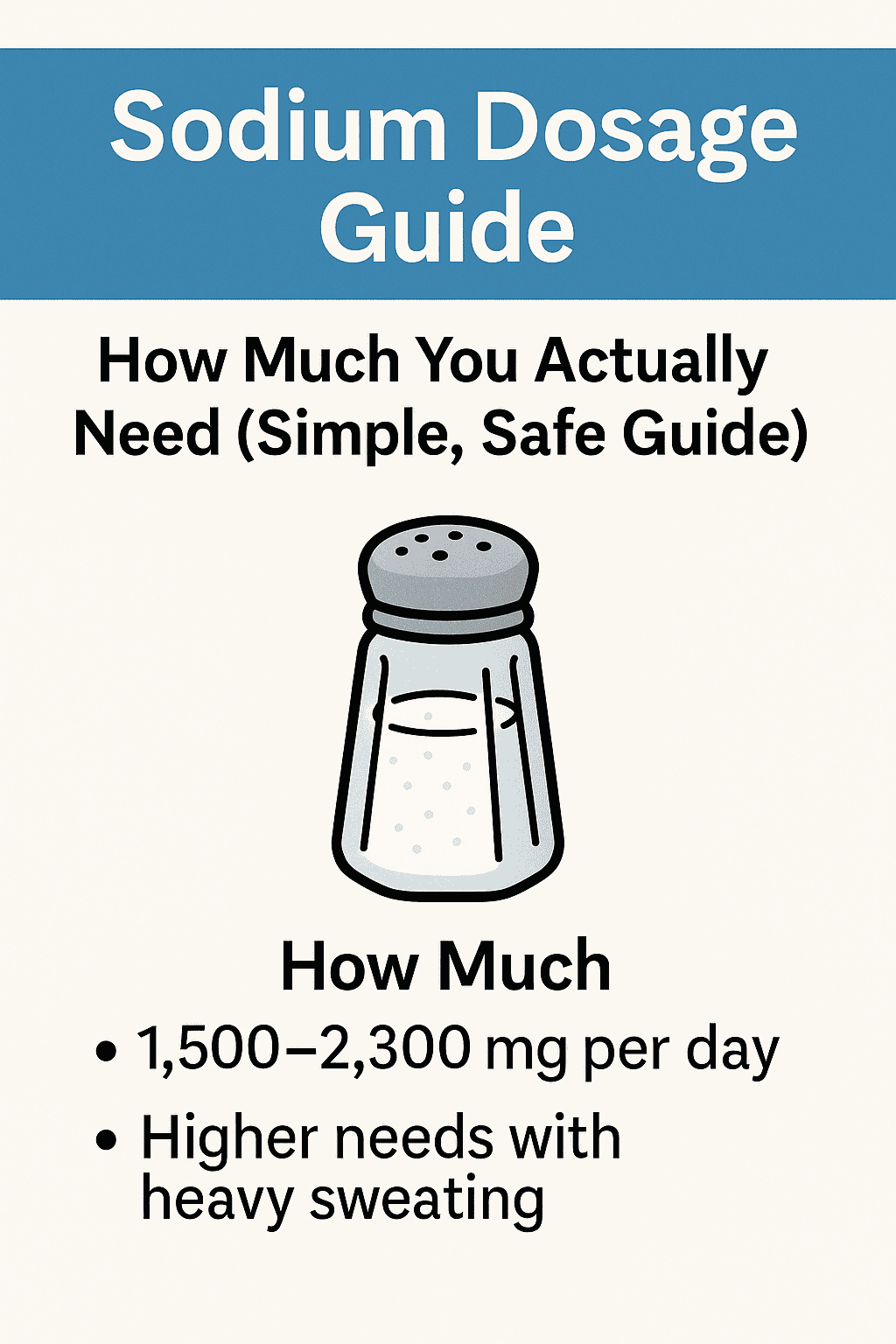
Sodium is not automatically “good” or “bad.” It is context-based. Many adults do fine in general-guidance ranges around 1,500 to 2,300 mg per day, but that is not the whole story if you sweat heavily, train hard, use saunas, drink a lot of water, live in heat, or eat very low-carb.
The most common sodium mistake is treating sedentary advice like it should also apply to high-sweat days. The second most common mistake is drinking more plain water when the real problem is that sodium is too low for the amount of fluid loss or fluid intake.
This page is focused on practical sodium dosing for real-life situations like workouts, sweat loss, heat, headaches, dizziness, and hydration problems, not just generic sodium warnings in isolation.
Key terms: sodium, hydration, sweat loss, low sodium symptoms, electrolyte balance, heat headaches, dizziness, daily sodium intake
Quick Take
If you get headaches, dizziness, or that “water still isn’t hydrating me” feeling during heat, sweat, or high water intake, sodium is often the first electrolyte lever worth testing safely. For sedentary low-sweat days, lower general-guidance ranges often make more sense than workout-day thinking.
TL;DR decision
Use baseline guidance for quiet days. Use context for sweat days. If symptoms reliably show up with heat, sweating, or lots of water, a structured sodium test often makes more sense than simply drinking more plain water.
Evidence standard: human trials, dose ranges, guideline-level sources when available
Who this is for: active people, heavy sweaters, low-carb eaters, sauna users, or anyone who feels worse with more water alone
Who this is not for: people on sodium-restricted medical diets, with kidney disease, heart failure, severe hypertension, or anyone specifically told to restrict sodium
Author: VerifiedSupps Editorial Team
Reviewed by: VerifiedSupps Editorial Team
Published: 2026-03-12
Updated: 2026-03-12
Last reviewed: 2026-03-12
Parent Hub
Electrolytes Complete Guide
Sodium makes the most sense inside the full sodium, potassium, and magnesium system. Use the main electrolytes hub if you want the bigger picture rather than sodium in isolation.
Sodium fit-check table
This helps you decide whether sodium is likely a missing lever, a maybe, or something to approach very cautiously.
| Situation | Sodium relevance | Most useful move | What to watch |
|---|---|---|---|
| Heavy sweat, heat, sauna, long workouts | High | Structured sodium and hydration test | Headaches, dizziness, washed-out feeling |
| High water intake but still feel dehydrated | Often high | Check sodium before adding even more water | Frequent urination, poor relief |
| Sedentary, processed-food-heavy pattern | Lower | Do not assume you need more sodium | Blood pressure and overall food pattern |
| Kidney disease, heart failure, sodium restriction | Special case | Use clinician guidance, not self-testing | Medical instructions first |
Best next step (today): Match your sodium decision to your actual sweat and water pattern, not to a generic fear-based rule.
How much sodium do you need per day?
Start with baseline guidance, then adjust for real life. General guidance often lands around 1,500 to 2,300 mg per day, but that is only the starting point. Heat, sweat, workouts, high water intake, and low-carb eating can all push functional needs higher on certain days.
Mechanism
- Sodium helps regulate fluid balance and blood-volume stability.
- Sweat, heat, and extra fluid intake change the context faster than many people realize.
- The right number is not static if your output is not static.
How much sodium should you take for workouts and sweating?
On high-sweat days, sedentary sodium logic often stops being useful. The more sweat, heat, and fluid loss are part of the day, the more sodium becomes a performance and stability variable rather than just a background nutrient.
Simple rule
If the day includes hard training, heavy sweating, or heat exposure, you usually should not think about sodium the same way you would on a low-output desk day.
Why doesn’t drinking more water fix low sodium?
Hydration is not a water-only problem. If sodium is too low relative to sweat loss or fluid intake, more plain water can actually make symptoms feel worse: more urination, headaches, lightheadedness, and the strange feeling that water is not really “sticking.”
Classic clue
“I drank a ton of water and felt worse” is often a sodium-context clue, not proof that hydration itself is a bad idea.
How do you know if you are getting too little sodium?
Too little sodium usually shows up as a pattern, not as one isolated symptom. The pattern often includes heat sensitivity, dizziness when standing, workout headaches, “water goes right through me,” or a washed-out feeling after sweating.
Context matters
Those symptoms do not prove low sodium by themselves. They just make sodium a more reasonable variable to test if sweat, water intake, or heat are part of the picture.
How do you know if you are getting too much sodium?
Too much sodium is more often a long-term health-context issue than a short-term workout issue, especially in sedentary processed-food-heavy patterns or in people with sodium-sensitive blood pressure. If blood pressure, kidney disease, or clinician-directed restriction is part of your picture, sodium changes stop being a casual self-experiment.
Sodium troubleshooting: how to tell if it is working
Sodium “works” when hydration stability improves in the same context that normally triggers symptoms. The biggest mistake is changing multiple electrolytes, caffeine, food, and water all at once, then pretending the result means something clean.
Common mistakes
- Adding more water without changing sodium.
- Using random electrolyte mixes and never learning which lever actually mattered.
- Ignoring potassium balance entirely.
- Judging one weird day instead of a repeatable pattern.
Clean test protocol
| Inputs | Pick one repeatable trigger context: same workout time, same heat exposure, similar water intake, and reasonably stable diet. |
|---|---|
| Duration | Use a 7 to 14 day window instead of trying to conclude everything from one afternoon. |
| 3 metrics | 1) standing dizziness, 2) heat or workout headache frequency, 3) post-sweat energy stability. |
| Stop conditions | Stop and get help for confusion, fainting, chest pain, severe weakness, severe heat illness signs, or any known medical condition that makes sodium changes something you should not self-manage. |
How to tell it is working
You are looking for less dizziness in the same daily context, fewer heat or workout headaches, and a steadier less-washed-out feeling after sweating. You are not looking for a dramatic stimulant-like effect.
Red flags / seek care
Treat confusion, fainting, severe weakness, chest pain, seizures, or severe heat illness symptoms as medical issues, not supplement experiments.
Selected Professional References
These are the main external sources behind the baseline guidance, sodium-health context, and urgency framing.
Adult sodium intake recommendation
Useful for the big-picture guideline framing around sodium and cardiovascular risk.
Used for: baseline guidance
Sodium and potassium DRI update
Useful for CDRR framing and why baseline numbers are guidance, not one-size-fits-all performance rules.
Used for: intake framework
Sodium and health overview
Useful for population-level sodium context and why processed-food patterns matter.
Used for: population context
Low blood sodium overview
Useful for urgency signs and why severe low-sodium situations are medical, not casual self-testing.
Used for: urgency flags
Go Deeper (VerifiedSupps Guides)
These next-step guides help you tighten the rest of the hydration and electrolyte picture around sodium.
Sodium and hydration
Use this if your main question is why plain water sometimes makes hydration feel worse.
Sodium deficiency signs
Use this if the main issue is symptoms like dizziness, headaches, or heat intolerance.
High sodium foods list
Use this if you want practical food-based ways to raise sodium rather than guessing with random mixes.
Sodium vs potassium
Use this if the bigger question is balance, not sodium alone.
Final Takeaway
Sodium dosing is not a moral issue. It is a context issue. Baseline guidance matters, but sweat, heat, water intake, diet style, and medical status can all change what the right answer looks like. If sodium really is the lever, a clean 7 to 14 day test usually shows it more clearly than internet debate ever will.
Frequently Asked Questions
Is sodium bad for hydration?
No. Sodium is part of hydration stability. Problems usually come from mismatch, dilution, or medical context, not from sodium simply existing.
Can too little sodium cause dizziness?
Yes, especially when heat, sweating, high water intake, or low-salt eating are part of the context.
Why do I pee a lot after drinking water?
Sometimes it is because water is being increased without enough electrolyte balance, especially sodium.
Should athletes consume more sodium?
Often yes, because sweat loss can make sodium more relevant for hydration stability and performance than it would be on sedentary days.
Who should not increase sodium casually?
People with kidney disease, heart failure, sodium-restricted diets, or severe hypertension should follow clinician guidance rather than self-testing.
Can too much sodium cause headaches?
Sometimes, but headaches also have many causes. The surrounding context matters more than the headline symptom by itself.
What is the safest way to test sodium?
Pick a repeatable context, adjust sodium only first, track a few stability markers for 7 to 14 days, and stop early if symptoms feel dangerous or escalate quickly.
Does low-carb eating change sodium needs?
For many people, yes. Low-carb phases often make sodium and fluid balance feel more important, especially early on.
VerifiedSupps Medical Disclaimer
This content is for educational purposes only and does not constitute medical advice. Sodium needs vary by activity, climate, medications, diet style, and health status. People with kidney disease, heart failure, severe hypertension, cardiovascular conditions, or sodium-restricted medical diets should talk with a healthcare professional before intentionally changing sodium intake or using electrolyte supplements. Seek urgent medical care for confusion, fainting, seizures, chest pain, severe weakness, or severe heat illness symptoms.