By VerifiedSupps Editorial Team
Omega-3 for Athlete Recovery: Does It Help Soreness, Joints, and Readiness?
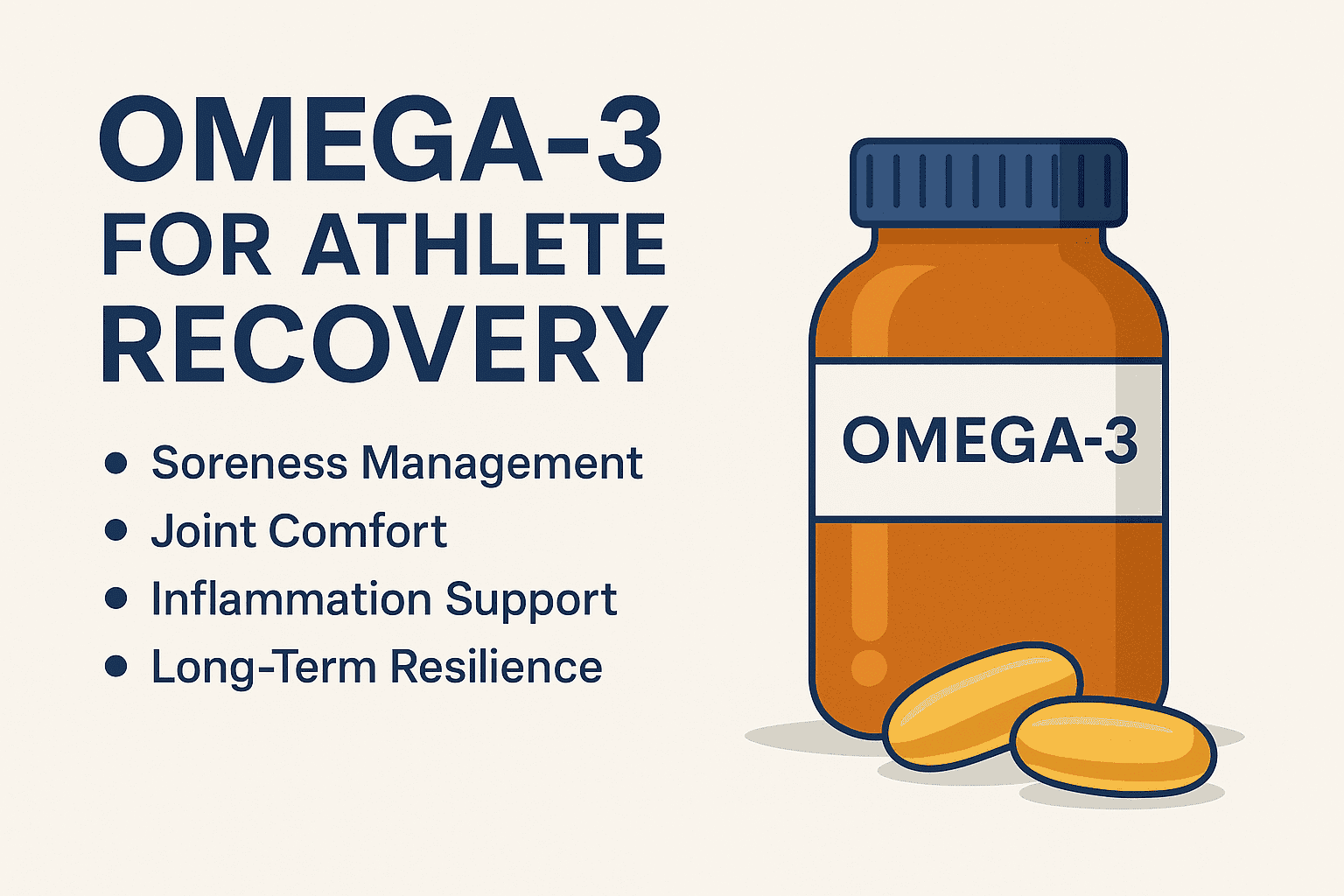
Omega-3 will not replace sleep, protein, calories, or sensible programming. If it helps recovery, it usually shows up as a quieter benefit: less soreness carryover, steadier joint comfort, and a smoother “back-to-baseline” feel during hard blocks. The evidence is mixed rather than magical, so the smartest expectation is a modest recovery smoother, not an instant performance spike.
Scope: this page stays focused on athlete recovery outcomes like soreness, joint comfort, readiness, dose, timing, and safety. It is not a general omega-3 heart-health page and it is not a product roundup.
Key terms: EPA + DHA, DOMS, omega-3 index, triglyceride form, ethyl ester form, label math
Quick Take
Best fit: you train hard enough that soreness, stiffness, or “not quite ready again” feelings are limiting consistency, and you want a low-drama baseline supplement that works through routine, not hype.
TL;DR decision: If you want a recovery smoother, buy by EPA + DHA, not “fish oil mg,” take it with a meal every day, and judge it by soreness and readiness trends over 4 to 8 weeks. If you already eat fatty fish consistently or your training basics are messy, the marginal benefit will usually be smaller.
Evidence standard: human trials, dose ranges, guideline-level sources when available
Who this is for: athletes or active people looking for less soreness drag, better joint comfort baseline, or smoother recovery between sessions.
Who this is not for: anyone expecting same-day performance effects, ignoring sleep and protein, or taking anticoagulants or dealing with surgery planning without clinician input.
Last reviewed: March 8, 2026
Parent Hub
Omega-3 Complete Guide
Use the full omega-3 map when you need the broader picture on benefits, dose, timing, forms, testing, and safety.
Omega-3 recovery decision table
Use this before you buy. It will save you more than another bottle ever will.
| Your pattern | Omega-3 fit | What to track | Best next step |
|---|---|---|---|
| I want less soreness carryover between training days | High | DOMS score, warm-up unlock time, next-day readiness | Buy by EPA + DHA and anchor it to one daily meal |
| My joints feel stiff or “loud” during volume blocks | Medium | Morning stiffness and movement smoothness | Treat it as a comfort baseline, not a painkiller |
| I already eat fatty fish 2+ times per week | Conditional | Weekly fish intake and optional omega-3 index | Check total intake before assuming you need more capsules |
| I want a same-day performance pop | Low | Not the right use case | Do not judge omega-3 like a pre-workout |
Does omega-3 help recovery after exercise?
Sometimes, yes—but think “modest recovery smoother,” not guaranteed performance enhancer. The most balanced reading is that omega-3 may reduce subjective soreness in some athletes and some protocols, but the effect is not consistent enough to treat it like a universal recovery fix.
Mechanism
- EPA and DHA become part of cell membranes and shift signaling related to training stress.
- Higher EPA and DHA relative to arachidonic acid can tilt signaling toward less inflammatory activity.
- In the real world, the “feel” is often less soreness drag and smoother readiness, not a dramatic power surge.
This page stays on athlete recovery patterns rather than general omega-3 uses like heart-health messaging.
Does omega-3 reduce muscle soreness after workouts?
It may reduce soreness a little for some people, especially when EPA + DHA intake is low to begin with and the supplement is taken consistently for several weeks. It is much less convincing as a way to erase DOMS after one brutal session.
The best way to think about it is not “Will I stop getting sore?” but “Will I recover with a little less friction across repeated training weeks?” That is a much more realistic target.
What would change my recommendation?
- You already eat fatty fish regularly and your omega-3 status is probably decent.
- Your biggest problem is sleep debt, low energy intake, or low protein rather than true soreness carryover.
- You are only willing to test it for a few days instead of a few weeks.
- You are using “fish oil mg” on the front label instead of checking EPA + DHA on the supplement facts panel.
- You want a same-day performance sensation rather than a quieter long-game effect.
Is omega-3 good for joint pain in athletes?
Think joint comfort, not true pain treatment. Omega-3 may be useful as a baseline tool for smoother movement and less stiffness during high-volume training, but it is not the right answer for sharp injury pain, swelling, or instability.
- More realistic target: slightly better morning comfort and easier warm-up unlock.
- Less realistic target: a supplement that fixes an irritated tendon, acute injury, or a bad training decision.
- If symptoms are sharp, localized, worsening, or clearly injury-linked, treat that as an injury problem first.
How much EPA and DHA should athletes take for recovery?
Dose by EPA + DHA combined, not by “fish oil 1000 mg.” For general omega-3 status, athlete guidance from the Australian Institute of Sport targets a combined EPA + DHA intake around 500 to 600 mg per day as a minimum baseline. Recovery-focused trials often go higher, commonly landing around 2 to 3 g/day of combined EPA + DHA for several weeks.
Simple label math
- Find EPA on the label.
- Find DHA on the label.
- Add them together.
- That total is your real daily recovery dose, not the giant “fish oil” number on the front.
Food-first still counts. If you eat oily fish regularly, you may need less supplemental EPA + DHA than someone starting from a low baseline.
When should you take omega-3 for best absorption?
Take it with food, and preferably with a consistent meal you actually remember. Timing matters far less than the habit, but taking omega-3 alongside a meal improves the odds of better tolerance and better absorption.
- Best default: with your biggest or most consistent meal.
- If fish burps happen: split the dose across two meals.
- If your stomach is sensitive: take it mid-meal, not fasted.
- If you miss days: do not overcompensate with random mega-doses.
How long does fish oil take to work for recovery?
Think in weeks, not days. If omega-3 is going to help your recovery, it is usually easier to see across a 4 to 8 week block than after a single hard workout.
Week 1
Mostly a tolerance and routine window.
Weeks 3 to 6
More realistic window for soreness and readiness trends.
Weeks 6+
A better time to judge whether it truly belongs in your baseline stack.
Is omega-3 safe to take every day for athletes?
For most healthy athletes, usual supplemental intake is well tolerated. Official sources note that combined EPA + DHA intakes up to about 5 g/day appear safe when used as recommended, and clinically significant bleeding has not been shown in general populations. The bigger real-world issues are burps, reflux, mild GI upset, and medication context.
Common side effects
- Fish burps or reflux
- Nausea, heartburn, or diarrhea
- Unpleasant taste if the product is poor quality or stored badly
Who should be more cautious
- Anyone on anticoagulants or antiplatelet medication
- Anyone with surgery planned
- Anyone with fish allergy concerns
- Anyone layering very high doses on top of a complex medical picture
Why isn’t omega-3 improving my recovery?
Most failed omega-3 tests come from underdosing EPA + DHA, inconsistent use, or bigger bottlenecks drowning out the effect. If sleep, calories, protein, or load management are off, omega-3 becomes a tiny voice in a loud room.
Common mistakes
- Buying by front-label fish oil mg instead of EPA + DHA.
- Taking it only on training days.
- Stopping because of burps instead of splitting the dose across meals.
- Judging the result after a few days instead of a few weeks.
Clean test protocol
- Inputs: stable training week, stable protein intake, stable sleep routine.
- Duration: 6 weeks minimum.
- 3 metrics: DOMS 1–10, warm-up unlock time, back-to-back session readiness.
- Stop conditions: concerning bruising or bleeding, severe GI issues, or clinician-advised stop.
How to tell if it’s working
Look for lower average weekly soreness, quicker warm-up unlock, and less “I cannot go again tomorrow” feeling. Do not expect an obvious stimulant feel, a dramatic body-composition shift, or acute pain relief from a real injury.
Red flags / seek care
- Sharp, localized pain with swelling, instability, or loss of function
- Worsening pain after a clear injury event
- Black stools, unexplained bruising, or unusual bleeding
- Chest symptoms, fainting, or severe weakness
Selected Professional References
External links only. These are presented as premium clickable tabs so you can audit the claims quickly.
Omega-3 Fatty Acids — Health Professional Fact Sheet
Strong official source for EPA + DHA basics, absorption context, safety, and bleeding guidance.
Used for: label basics, safety, inflammation-signaling context
Omega-3 Supplements: What You Need To Know
Covers seafood vs supplement context, supplement forms, mild side effects, and food-first guidance.
Used for: forms, seafood baseline, common side effects
Fish Oils
Excellent athlete-specific source for omega-3 index targets, intake baselines, with-meal use, and recovery context.
Used for: athlete status, O3I targets, with-meal dosing
International Society of Sports Nutrition Position Stand: Long-Chain Omega-3 Polyunsaturated Fatty Acids
Current sports-nutrition position that specifically addresses soreness, strength, sleep, and insufficiency risk in athletes.
Used for: athlete-specific decision framing
Omega-3 Polyunsaturated Fatty Acid Supplementation for Reducing Muscle Soreness after Eccentric Exercise
Important reality check: low-quality evidence did not show a clinically important reduction in soreness after eccentric exercise.
Used for: keeping the article honest and non-hype
Omega-3 Fatty Acid Supplementation on Post-Exercise Inflammation, Muscle Damage, Oxidative Response, and Sports Performance
Useful for dose ranges, timing windows, and the nuance that some studies do show meaningful improvements in soreness-related outcomes.
Used for: recovery trial context and time-window framing
Go Deeper (VerifiedSupps Guides)
Four next reads that directly support dose, form, timing, and “is it actually doing anything?” decisions.
How Much Omega-3 Per Day?
Use this when you want cleaner EPA + DHA target setting instead of guessing off the bottle.
Triglyceride vs Ethyl Ester Fish Oil
Helpful when form confusion is getting in the way of simple label decisions.
Best Time of Day to Take Omega-3
Use this if burps, meal timing, or consistency is the real problem.
How to Tell if Fish Oil Is Working
Best next read when you want cleaner signals, timelines, and less supplement guesswork.
Final Takeaway
Omega-3 is not a shortcut around bad recovery habits, but it can make hard training more sustainable when the basics are already in place. The best use case is simple: dose by EPA + DHA, take it with meals, test it for at least 6 weeks, and judge it by soreness carryover, warm-up feel, and session-to-session readiness. That is a much smarter expectation than looking for an instant “feel.”
FAQ
Does omega-3 reduce DOMS?
It may reduce soreness a little for some athletes, but the effect is mixed and is better judged over several weeks than after one workout.
Is fish oil or krill oil better for athletes?
Fish oil usually gives a clearer EPA and DHA dose and often better value per serving. Krill can still work, but the main question is the actual EPA and DHA delivered, not the marketing story.
Should athletes take omega-3 every day?
If they use it, daily intake is usually more useful than training-day-only use because the goal is a steadier baseline rather than an acute effect.
How much EPA and DHA should I look for on the label?
Look at the combined EPA plus DHA amount, not the front-label fish oil number. That combined total is the real dose that matters.
Can I get enough omega-3 from fish instead of supplements?
Yes, some people can, especially if they regularly eat oily fish. Supplements are most useful when fish intake is low, inconsistent, or impractical.
How long before omega-3 helps recovery?
Most people should judge recovery effects over 4 to 8 weeks rather than a few days.
Does omega-3 help joints or just soreness?
It may help both soreness carryover and general joint-comfort baseline, but it is not a treatment for a true injury.
Can omega-3 cause fish burps or stomach issues?
Yes. Burps, reflux, nausea, and mild GI issues are among the most common complaints, which is why taking it with food matters.
Is omega-3 safe with blood thinners or before surgery?
That is a clinician-check situation. Official sources note usual intakes are generally safe, but anticoagulant or surgical contexts deserve personalized guidance.
Can omega-3 improve performance directly?
Any performance benefit is more likely to be indirect through smoother recovery, better session-to-session readiness, and more sustainable training.
VerifiedSupps Medical Disclaimer
This content is for informational and educational purposes only and does not constitute medical advice. Supplements can interact with medications and may be inappropriate for certain conditions. Always consult a qualified healthcare professional before starting omega-3 supplements, especially if you take anticoagulants or antiplatelet medications, have a bleeding disorder, have surgery planned, have a fish allergy concern, or are managing injuries or medical conditions.