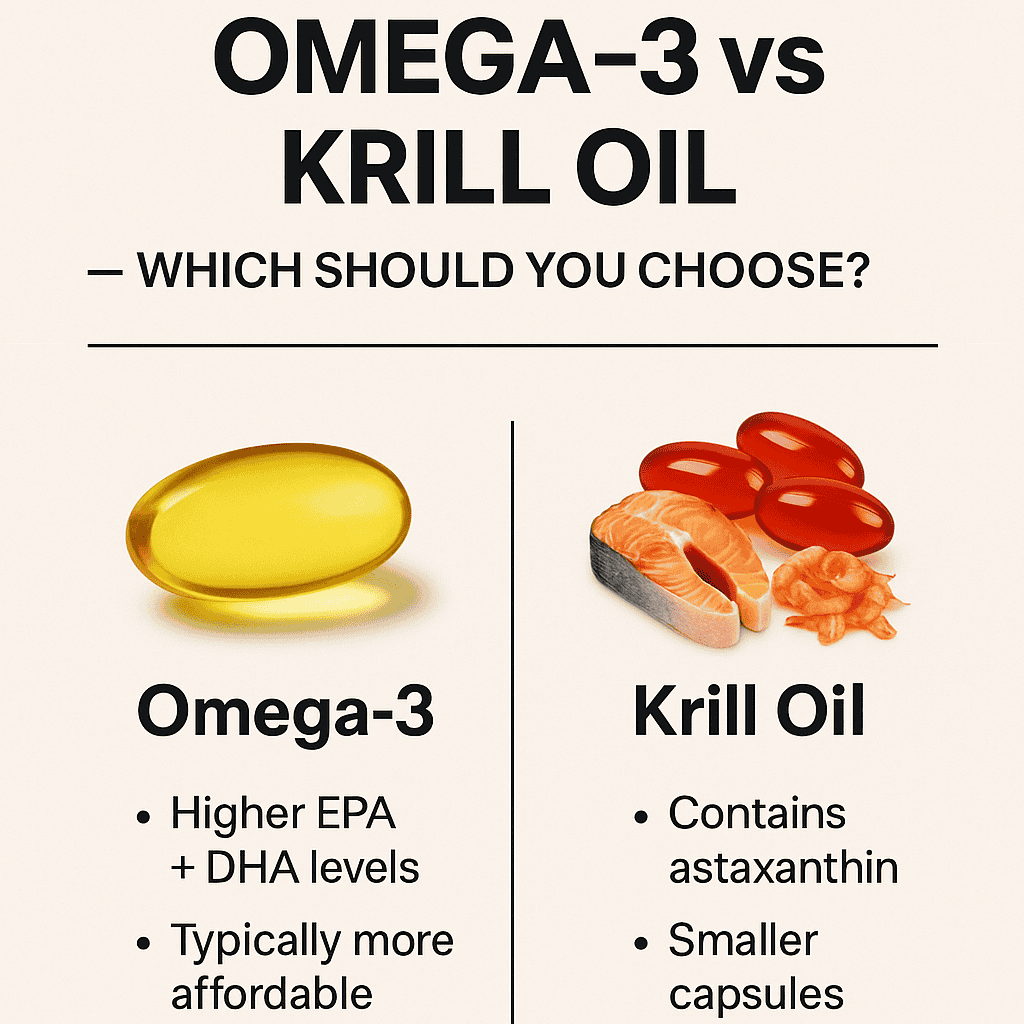
Omega-3 vs Krill Oil: Which Should You Choose?
If your goal is simply “get enough EPA + DHA,” fish oil usually wins on dose and cost. If your goal is “I’ll actually take this every day because it’s gentler,” krill oil can be a strong fit—even though it typically delivers less EPA + DHA per capsule.
This page is a calm decision: dose, comfort, absorption reality, and when krill is genuinely worth paying for.
Quick Take
- Best value per mg EPA+DHA: fish oil (usually).
- Most “gentle” feel: krill oil (often), with smaller capsules.
- Absorption truth: both absorb; the winning product is the one you take consistently.
- Best rule: compare by EPA + DHA per serving, not “oil mg.”
Evidence standard: human studies on omega-3 bioavailability and incorporation (fish oil vs krill), plus guideline-level sources for omega-3 basics and safety.
This is for you if: you want a clear choice for daily omega-3 without marketing noise.
Not for you if: you have a shellfish allergy (krill is a crustacean) and are looking for “workarounds” without clinician guidance.
Last reviewed: March 2, 2026
Parent Hub: Want the full omega-3 map (benefits, dosing, timing, forms, safety) in one place?
Open: Omega-3 Complete Guide (VerifiedSupps)
Krill vs fish oil decision table
This is the fastest way to choose without overthinking.
| If you care most about… | Usually choose | Why | What to verify |
|---|---|---|---|
| Potency and best value per mg EPA+DHA | Fish oil | Typically higher EPA+DHA per serving at lower cost | EPA+DHA listed clearly; form (TG/rTG vs EE) |
| Gentler digestion / smaller capsules | Krill oil | Often easier for sensitive stomachs; smaller softgels | Total EPA+DHA per serving (often lower) |
| Hitting a specific EPA+DHA target (1,000–2,000 mg/day range) | Fish oil | Fewer capsules needed in most cases | EPA+DHA per capsule; number of capsules/day |
| “I just want something I’ll actually take daily” | Whichever you tolerate best | Consistency usually beats theoretical “best” | Burps/GI comfort + adherence |
If you’re torn: start with fish oil for dose/value. Switch to krill if comfort is the bottleneck.
Is krill oil better than fish oil?
Krill oil isn’t automatically “better.” It’s often easier to tolerate, but fish oil usually provides more EPA + DHA for the price. The better choice is the one that lets you reach a consistent EPA+DHA intake without friction.
What would change my recommendation?
- Shellfish allergy: avoid krill unless a clinician explicitly clears it.
- You need a higher EPA+DHA target: fish oil usually gets you there with fewer capsules.
- Fish oil burps or nausea: krill (or meal timing/splitting doses) may solve it.
- Cost sensitivity: fish oil usually wins per mg EPA+DHA.
What is the difference between krill oil and fish oil?
Both deliver omega-3s (EPA and DHA), but they’re packaged differently. Krill oil commonly contains omega-3s in phospholipid-associated forms and includes naturally occurring astaxanthin. Fish oil omega-3s are typically in triglyceride (TG/rTG) or ethyl ester (EE) forms depending on processing.
Practically: krill often feels easier; fish oil often hits higher EPA+DHA targets more efficiently.
Does krill oil absorb better than fish oil?
Some studies suggest krill oil can have strong bioavailability in certain comparisons, but “better absorption” doesn’t always translate into “more omega-3 delivered” because krill products often contain less EPA+DHA per capsule. High-quality fish oil (especially TG/rTG) is also highly absorbable.
Real-world rule: compare your daily total EPA+DHA. The product that gets you to your target consistently is the one that “wins.”
Does krill oil have EPA and DHA?
Yes. Krill oil contains EPA and DHA—usually in smaller amounts per capsule than many fish oil concentrates. That’s why krill can feel “easy” but may require more capsules to match a fish-oil EPA+DHA target.
If you’re choosing krill, the single most important step is checking how much EPA + DHA is listed per serving.
Which is better for burps and stomach comfort?
Many people find krill oil gentler and report fewer fishy burps. But fish oil can also be very tolerable when taken mid-meal, split into smaller doses, and sourced fresh.
Three tolerance fixes that usually work
- Take omega-3 mid-meal (not empty stomach).
- Split doses if you take more than one capsule.
- If a product smells strongly rancid, stop and switch.
Why krill oil or fish oil “isn’t working”
Most “no results” outcomes come from underdosing EPA+DHA, inconsistent use, or judging too early. Omega-3 tends to show up as baseline improvements over weeks.
Common mistakes
- Choosing krill oil and assuming “small capsule = high dose”
- Comparing products by “oil mg” instead of EPA+DHA
- Taking it inconsistently (every few days)
- Expecting a stimulant-like feeling
How to tell it’s working
- Recovery/stiffness: less “drag” after training or creaky mornings (weeks)
- Mood baseline: steadier, less reactive feel (weeks)
- Skin/eyes: gradual comfort changes (weeks to months)
- Optional confirmation: omega-3 index testing (clinician-guided is ideal)
A clean 6-week test
- Pick one product and calculate your daily EPA+DHA.
- Take it with the same meal daily (consistency beats perfect timing).
- Track 2–3 signals weekly (recovery feel, mood steadiness, skin/eye comfort).
- If nothing changes, reassess EPA+DHA dose and adherence before switching sources.
Selected Professional References
- NIH Office of Dietary Supplements: Omega-3 Fatty Acids (Health Professional Fact Sheet)
- Review: comparison of krill oil vs fish oil bioavailability (PMC)
- Comparative bioavailability study: fish oil vs krill oil (PubMed)
- Acute bioavailability: krill products vs fish oil (PubMed)
- American Heart Association: Fish and Omega-3 Fatty Acids
Go Deeper (VerifiedSupps Guides)
If you want to go deeper, these pair perfectly with this comparison.
Final Takeaway
Fish oil usually wins for potency and cost. Krill oil often wins for comfort and smaller capsules. If you choose based on EPA + DHA per serving and pick the option you’ll actually take daily, you’re making the “right” decision.
FAQ
Is krill oil better than fish oil for omega-3?
Not automatically. Fish oil usually delivers more EPA+DHA for the price. Krill often feels gentler but is typically lower dose per capsule.
Does krill oil reduce fishy burps?
Many people report fewer burps with krill. Meal timing and freshness matter a lot for fish oil too.
How much EPA and DHA is in krill oil?
It varies, but many krill products are lower EPA+DHA per capsule than fish oil. Always check the Supplement Facts.
Can I take krill oil if I’m allergic to shellfish?
Krill is a crustacean. If you have a shellfish allergy, avoid krill unless a clinician specifically clears it.
Is it okay to combine fish oil and krill oil?
Usually unnecessary. Most people benefit more from reaching a consistent EPA+DHA target using one reliable source.
Which is best for heart health?
Both provide EPA+DHA. In many cases, fish oil is the more efficient way to reach meaningful EPA+DHA intake. Discuss personal goals and medical context with a clinician.