Omega-3 vs Fish Oil: What’s the Difference?
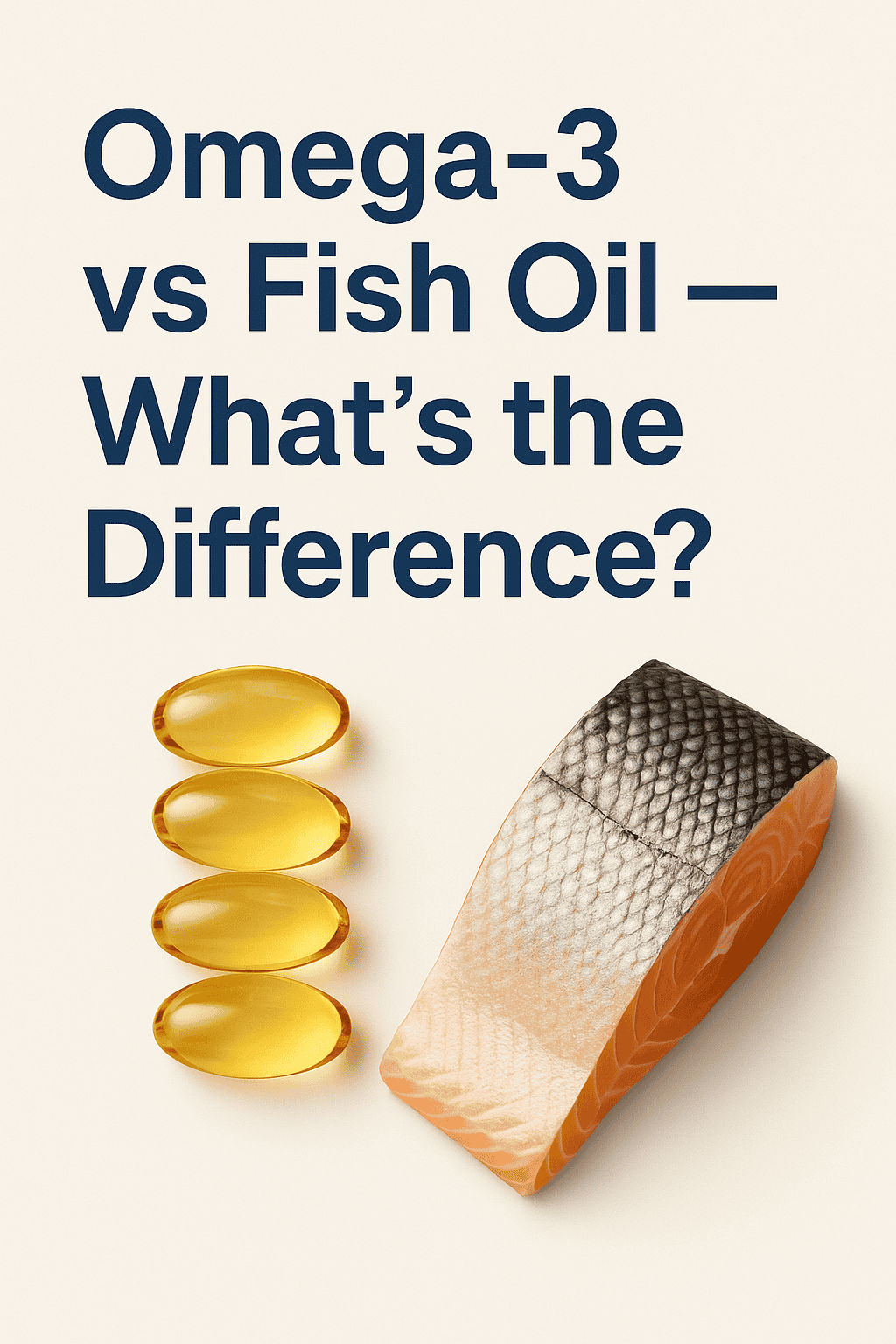
They’re related, but not the same: fish oil is the source, and omega-3s (EPA + DHA) are the active ingredients inside that oil. Once you focus on EPA + DHA per serving, most label confusion disappears.
This guide gives you a clean definition, label math you can do in seconds, and a practical way to choose a product that actually matches your goal.
Quick Take
- Fish oil = the oil from fish (a container with mixed fats).
- Omega-3 = EPA + DHA (the parts your body actually uses).
- Best buying rule: choose by EPA + DHA per serving, not “fish oil mg.”
- Best use rule: take omega-3 with meals for smoother absorption.
Evidence standard: human trials and systematic reviews when available; guideline-level sources for safety and intake basics.
This is for you if: you want label clarity and a simple way to pick a product.
Not for you if: you’re trying to use supplements as a substitute for medical care for diagnosed conditions.
Last reviewed: March 2, 2026
Parent Hub: Want the complete omega-3 map (science, dosing, timing, forms, safety) in one place?
Open: Omega-3 Complete Guide (VerifiedSupps)
Fish oil label decoder (the part that saves you money)
This is how to tell a “strong” product from a weak one in 10 seconds.
| What the label says | What it actually means | What to do | Fast example |
|---|---|---|---|
| “1,000 mg fish oil” | Oil weight (not the omega-3 dose) | Ignore it; find EPA and DHA lines | Fish oil 1000 mg can still be low EPA+DHA |
| EPA ___ mg + DHA ___ mg | The active omega-3 dose | Add them together for EPA+DHA | EPA 360 + DHA 240 = 600 mg EPA+DHA |
| “Omega-3” without EPA/DHA amounts | Unclear dose | Treat as a red flag for comparison shopping | You can’t dose what you can’t see |
The only number that consistently predicts “strength” is EPA + DHA per serving.
Is omega-3 the same as fish oil?
Not exactly. Fish oil is the oil extracted from fish (a mixture of fats). Omega-3 refers to the specific fatty acids inside that oil—mainly EPA and DHA—that drive most of the benefits people care about.
What would change my recommendation?
- If you don’t eat fish: algae oil can provide DHA (and sometimes EPA) without fish.
- If you’re on blood thinners: discuss omega-3 dosing with a clinician.
- If you get GI issues: taking with meals and splitting doses often matters more than the term on the front label.
What is fish oil and what does it contain?
Fish oil is an umbrella term for oil from fatty fish (often anchovy/sardine/mackerel blends). It contains some EPA and DHA, plus other fats. The amount of EPA+DHA varies widely by product—so “fish oil” alone doesn’t tell you how strong it is.
Practical meaning: a fish oil can be “high quality” yet low dose, or “high dose” yet poorly labeled. You’re buying EPA+DHA clarity.
What does “omega-3” mean on a supplement label?
On labels, “omega-3” should ideally mean EPA + DHA amounts listed in mg. If EPA and DHA aren’t clearly listed, you can’t accurately compare products or dose intelligently.
If you remember one thing: “omega-3” is not the front label number. It’s the EPA + DHA lines.
How much EPA and DHA should I look for?
Most people aim for a daily target based on EPA + DHA combined. The exact number depends on goals, but the key point is that your product should make it easy to hit your target without guessing.
Decision tip: choose a product that provides a meaningful EPA+DHA amount per serving so you’re not taking “tiny doses” accidentally.
Omega-3 vs fish oil vs krill oil: what’s the difference?
The simple comparison is: omega-3 = the actives (EPA/DHA); fish oil and krill oil are different sources that deliver those actives. Whichever you choose, the core question remains the same: how much EPA + DHA do you get, and can you take it consistently?
Source differences can matter for tolerance and preference, but dose clarity and consistency usually matter more.
Does fish oil form affect absorption?
It can. Products may use triglyceride (TG/rTG) or ethyl ester (EE) forms. Many people focus on form because it can change absorption consistency—especially if meal timing is inconsistent. Regardless of form, taking omega-3 with a meal is one of the most reliable absorption improvements.
Why fish oil “doesn’t work” for some people
Most “no effect” outcomes come from underdosing EPA+DHA, inconsistent use, or expecting a fast, stimulant-like feeling. Omega-3 tends to show up as gradual baseline improvements.
Common mistakes
- Choosing a product with low EPA + DHA per serving
- Taking it sporadically (then judging results)
- Taking it without meals when tolerance is poor
- Focusing on “fish oil mg” instead of EPA+DHA
How to tell it’s working
- Recovery: less lingering soreness or stiffness (weeks)
- Mood baseline: steadier, less reactive feel (weeks)
- Skin/eyes: gradual comfort improvements (weeks to months)
- Optional confirmation: omega-3 index testing (clinician-guided is ideal)
A clean 4–6 week test
- Pick one product with clear EPA+DHA and take it with the same meal daily.
- Track 2–3 signals (recovery, mood steadiness, skin/eye comfort).
- If nothing changes, reassess dose clarity and adherence before switching sources.
Go Deeper (VerifiedSupps Guides)
If you want the next layer, these are the most useful follow-ups.
Final Takeaway
Fish oil is the source. Omega-3 (EPA + DHA) is the active dose. If you buy by EPA+DHA and take it consistently with meals, you’ve already done 90% of what matters.
FAQ
Is fish oil the same thing as omega-3?
Fish oil is the source. Omega-3 refers to the active fats (EPA + DHA) inside it.
Why does fish oil “1000 mg” not mean 1000 mg omega-3?
That number is oil weight. Your real omega-3 dose is EPA + DHA on the Supplement Facts panel.
Is omega-3 better than fish oil?
They’re not competitors. “Omega-3” is what you’re trying to get; fish oil is one way to deliver it.
Do I need EPA and DHA or is ALA enough?
ALA is plant omega-3, but conversion to EPA/DHA can be limited. Many people prefer direct EPA+DHA from fish or algae.
Should I take fish oil every day?
Many people do, but daily use depends on your goals, diet, and medical context. If you take blood thinners or have surgery planned, consult a clinician.