Magnesium · Cognitive Support · Brain-Focused Form
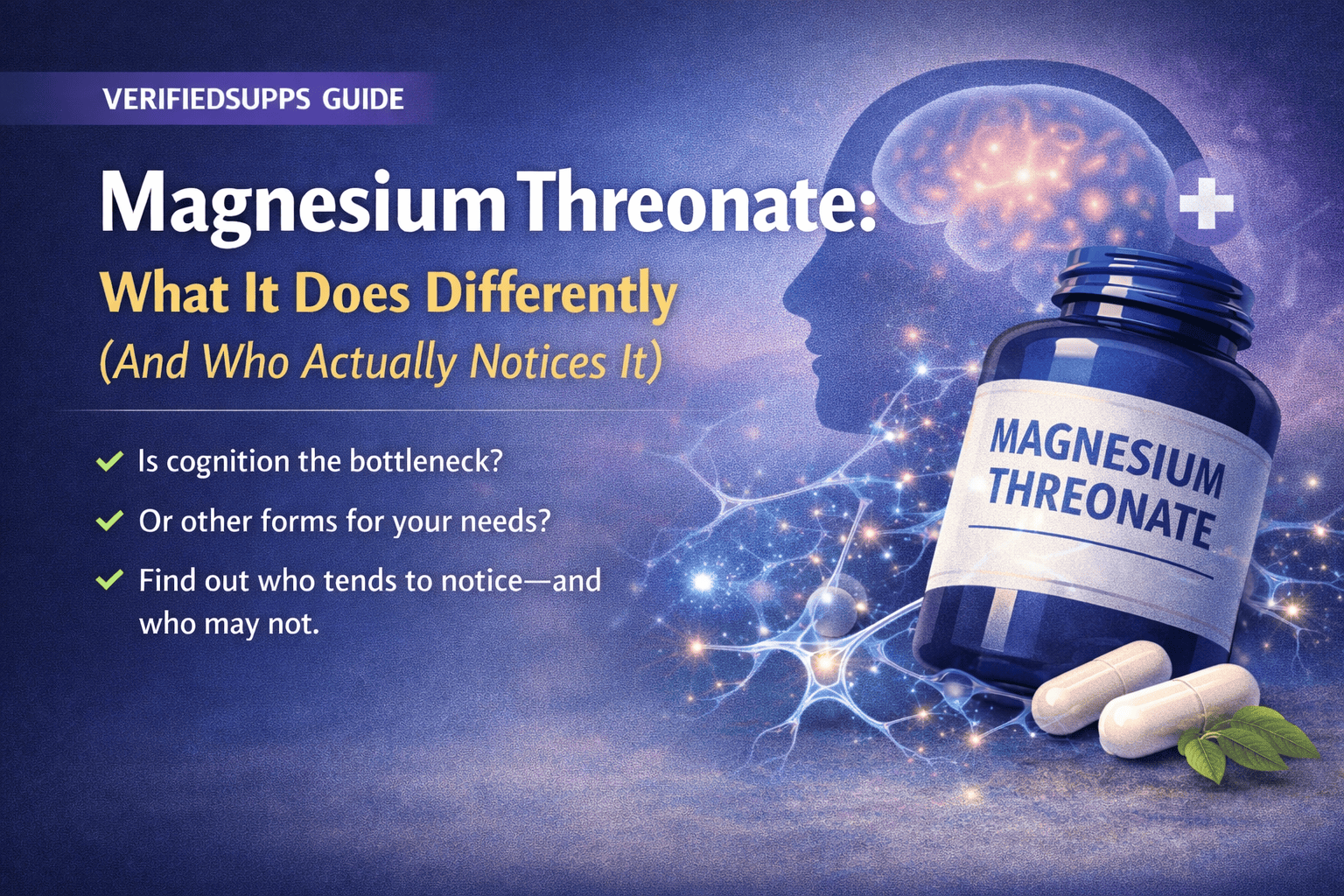
Magnesium Threonate: What It Does Differently (And Who Actually Notices It)
Magnesium threonate gets framed as “the brain magnesium.” Sometimes that’s helpful. Sometimes it’s just marketing.
This guide keeps it simple: what it actually does differently, who tends to notice it, and when another form is the smarter move.
What it is
Who it’s for
How it feels
Dosage & timing
Quick Take
Choose magnesium threonate when your goal is cognitive support (mental clarity, focus, “less mental noise”).
If your goal is sleep, muscle relaxation, or body-based stress, it’s usually not the best first pick.
What Magnesium Threonate Actually Is
The “different” part is distribution, not dosage
Magnesium threonate is magnesium bound to L-threonic acid (a metabolite of vitamin C).
That bonding changes how it behaves in the body.
The key distinction isn’t that it contains “more magnesium.” Most threonate products actually provide
less elemental magnesium per serving. The claim to fame is that it may raise magnesium levels in the brain
more effectively than many other forms, which matters if your goal is cognitive support.
Who Magnesium Threonate Is a Good Fit For
When the bottleneck is mental, not physical
Threonate may be worth considering if your main goal looks like this:
🧠 Cognitive support
Focus, mental clarity, learning, deep work.
🌫️ Mental fatigue
“Brain tired” more than physically tense.
🌀 Mental overload
Overthinking, too many tabs open, noisy head.
🧩 Executive function
Planning, memory, sustained attention.
People who respond well often describe mental ease and clarity — not sedation, not a “relaxed body,” and not a strong immediate feeling.
Key Decision
If you want magnesium mainly for sleep or muscle relaxation, threonate is usually not your best first move.
If you want magnesium for cognitive support, threonate is one of the few forms designed with that goal in mind.
When Magnesium Threonate May Not Be the Best Choice
Common reasons people feel “nothing”
Threonate may not be ideal if:
Sleep onset is your main issue: you’re hoping for a noticeable nighttime “downshift.”
Stress is mostly physical: tight muscles, restless body, chest tension.
You want obvious calm: threonate tends to be subtle rather than immediately relaxing.
In those situations, other magnesium forms are often a better first step.
How Magnesium Threonate Typically Feels
Quiet improvements, not a “hit”
If someone notices threonate, the descriptions tend to cluster around:
Clearer thinking: less friction when you sit down to focus.
Less mental noise: fewer background thoughts competing for attention.
More stable attention: better follow-through on cognitively demanding tasks.
Unlike glycinate, it usually doesn’t feel sleepy. Unlike taurate, it usually isn’t about physical calm. It’s most noticeable when the bottleneck is cognitive.
How Much Magnesium Threonate Should You Take?
Elemental magnesium is the number that matters
Magnesium threonate products vary widely, and they often contain less elemental magnesium per capsule than you’d expect.
Many protocols target the equivalent of 100–200 mg elemental magnesium per day, often split into multiple doses.
Important dosing note
Always check the label for elemental magnesium, not just total compound weight. The compound number can look “big” while the elemental magnesium is modest.
Best Time to Take Magnesium Threonate
Earlier or split dosing is common
Threonate is commonly taken:
Earlier in the day: especially if you’re using it for focus or mental clarity.
In divided doses: morning + afternoon/evening is a common pattern.
With or without food: based on your digestion and tolerance.
If it feels mentally activating for you, consider avoiding it right before bed.
Go Deeper (VerifiedSupps Guides)
If you’re deciding between forms, these guides make the tradeoffs clearer.
Final Takeaway
Magnesium threonate is not a general-purpose magnesium. It’s a targeted option for people whose bottleneck is cognitive, not physical.
If your mind feels overloaded but your body feels fine, it can be a smart, specific tool — and a subtle one.
Frequently Asked Questions
Is magnesium threonate “the best” magnesium?
It’s best only for a specific goal: cognitive support. For sleep, muscle tension, or body-based stress, other forms are often a better fit.
Will I feel it right away?
Usually not. If it helps, it often feels like a gradual improvement in clarity and mental ease over days to weeks.
Can I take it at night?
Some people do, but others find it mentally activating. If sleep is the goal, a different magnesium form is often more reliable.
How do I know the dose is correct?
Check the label for elemental magnesium, not just total compound weight. That’s the number that reflects actual magnesium intake.
VerifiedSupps Medical Disclaimer
This content is for informational and educational purposes only and does not constitute medical advice.
It is not intended to diagnose, treat, cure, or prevent any disease. Always consult a qualified healthcare professional
before starting any supplement—especially if you are pregnant, nursing, have a medical condition, or take prescription medications.