Magnesium Not Helping Sleep: Why It Happens and What To Do
Direct answer: it’s common for magnesium to “do nothing” for sleep. Magnesium helps sleep indirectly by lowering arousal and tension—not like a sedative. If your insomnia is driven by circadian timing, sleep-disordered breathing, stimulants, pain/reflux, or an anxiety loop, magnesium alone may not move the needle.
It’s not always the magnesium — it’s the setup. Most failures come from dose, timing, form, or stacking. This page gives you a clean troubleshooting path so you can stop guessing.
Why is magnesium not helping me sleep?
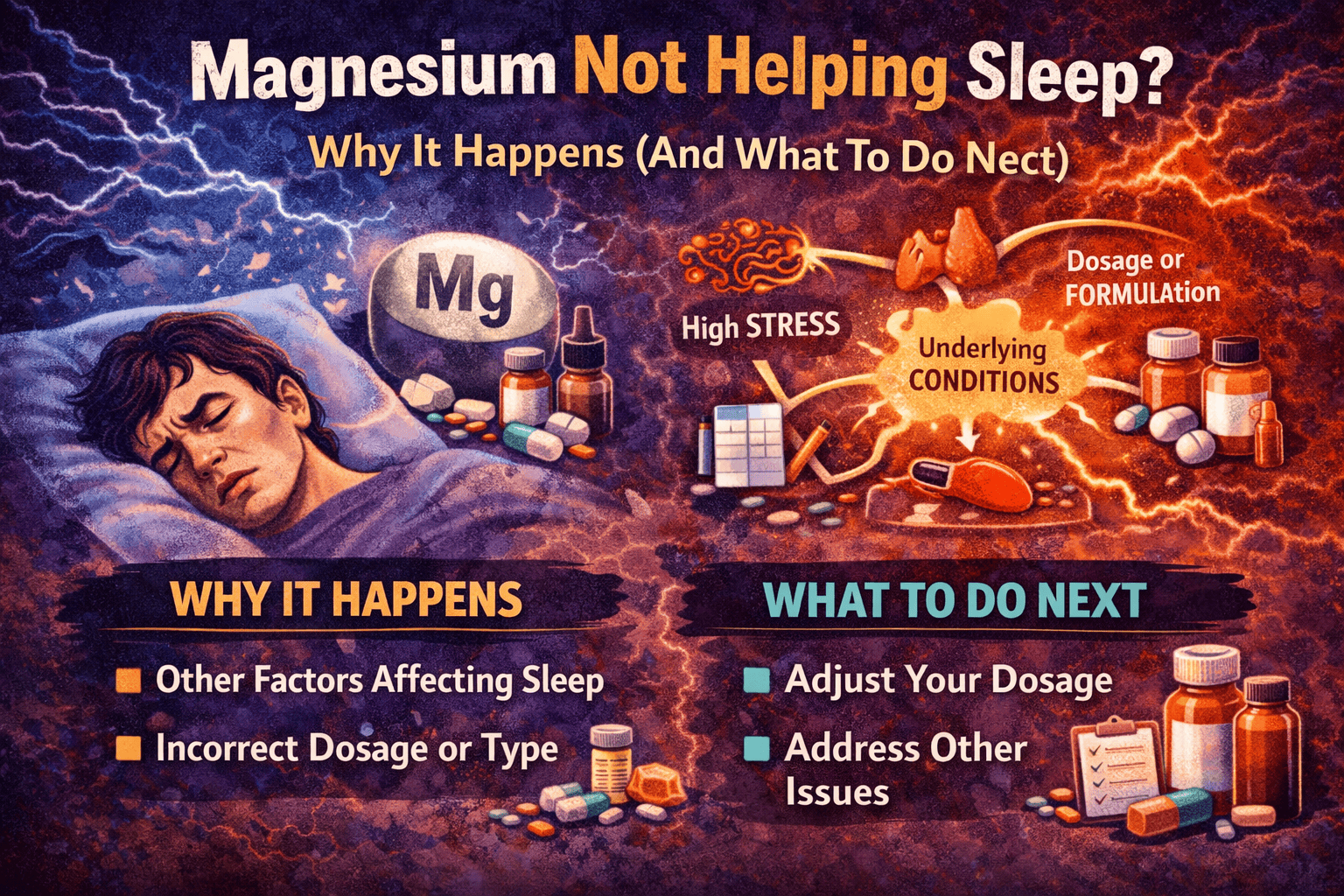
Most of the time, magnesium isn’t “failing.” It’s just not the limiting factor. Magnesium helps sleep indirectly by lowering arousal and tension—not by forcing sleep onset.
- It’s not always the magnesium — it’s the setup. Timing, dose, and stacking change how magnesium feels.
- If you’re already magnesium-replete, you may feel nothing. That’s a normal outcome, not a failure. (NIH ODS)
- GI stimulation can ruin sleep even if magnesium is “calming”. This is common with GI-active forms.
- Most failures come from dose, timing, form, or stacking. People change three variables at once, then can’t interpret the result.
- Sleep problem isn’t magnesium-responsive. Circadian mismatch, sleep apnea risk, stimulants, pain/reflux, or anxiety loops often dominate.
Why does magnesium not work for sleep?
Because magnesium doesn’t “knock you out.” It can support sleep readiness (less tension, calmer baseline), but it won’t override a strong driver like circadian timing or sleep-disordered breathing. In clinical insomnia, behavioral treatment (CBT-I) is widely recommended as first-line. (ACP guideline)
Translation: magnesium is an adjunct. If it helps, it’s usually subtle and cumulative.
How long does magnesium take to work for sleep?
Some people notice a small shift within a few nights. Many don’t. A fair test window is long enough to stabilize timing and tolerance.
Evidence in older adults with insomnia symptoms shows benefit in some outcomes, but results vary. (PubMed trial)
How many nights should I try magnesium for sleep?
Give it 7–14 nights before judging, assuming your timing and dose are stable. If you want a more conservative research-style window, use 2–4 weeks. A meta-analysis in older adults suggests modest average effects, not dramatic “first night” changes. (PubMed · PMC)
What to do if magnesium isn’t helping sleep (people type this exact intent)
The 5 most common reasons magnesium doesn’t work for sleep
Your timing is too late
Late dosing can backfire: vivid dreams, restlessness, or GI movement at night. Many people do better with dinner or early evening instead of “right before bed.”
Your dose is off (too high or too low)
Too low can feel like nothing. Too high can cause grogginess, vivid dreams, or GI stimulation. Adjust in small steps and keep the trial stable.
Wrong form for your goal
GI-active forms can disrupt sleep even if magnesium is “calming.” If your gut is active at night, sleep quality usually drops.
You’re stacking too many sleep aids
Most “magnesium made it worse” stories involve stacking: magnesium + melatonin + antihistamines + alcohol/THC + late caffeine. Then magnesium gets blamed.
Sleep problem isn’t magnesium-responsive
Circadian mismatch, apnea risk, stimulants, pain/reflux, or anxiety loops can dominate. Magnesium can support—but not drive—sleep improvement.
Magnesium not helping sleep and making it worse
When magnesium makes sleep worse, the usual culprits are late dosing, dose too high, GI stimulation, or stacking too many sleep aids.
Magnesium keeps me awake
Try one clean change: move it earlier. If that fixes it, timing was the driver. If not, lower dose and simplify the stack.
Magnesium insomnia worse
“Worse” often means more awakenings, more vivid dreams, or more body restlessness. That points to dose/timing/stacking issues before it points to magnesium being “wrong for you.”
Magnesium makes me restless at night
Restlessness after magnesium often tracks with GI activity, late timing, or a dose that’s too high for your tolerance. Move earlier and simplify first.
Best time to take magnesium for sleep
For many people, the best time is dinner or early evening—early enough to avoid late GI stimulation and dream intensity, but close enough to bedtime to support downshift.
Should I take magnesium right before bed?
If you’re sensitive, “right before bed” is often too late. If bedtime dosing makes you restless, gives vivid dreams, or wakes you up, move it earlier.
Should I take magnesium with dinner for sleep?
Many people tolerate dinner dosing best. It also reduces the chance that magnesium-related GI effects show up at 2–4am.
Magnesium waking up at night
If magnesium is linked to waking up at night, suspect GI activity, late timing, dose too high, or stacking (melatonin, alcohol/THC, antihistamines).
Does magnesium glycinate help sleep?
Often, yes—when your sleep problem is tension/arousal-driven and your dose/timing are reasonable. It’s commonly chosen for bedtime because many people find it gentler than GI-active forms.
Magnesium glycinate not helping sleep
If glycinate isn’t helping, suspect timing too late, dose too low/high, stacking, or the wrong driver (circadian/apnea/stimulants/anxiety loop). Don’t immediately jump to “more.”
Does magnesium threonate help sleep?
Some people notice sleep depth changes; others feel nothing. If it helps, it’s usually subtle and easier to detect after a stable week.
Does magnesium citrate help sleep?
It can reduce tension, but citrate is more likely to cause GI movement, which can disrupt sleep. If your gut is active at night, sleep quality usually suffers.
Which magnesium is best for sleep?
“Best” is the form that supports downshift without causing GI stimulation, grogginess, or restlessness in your body.
What to do next (simple protocol)
- Move earlier: dinner or early evening first.
- Adjust dose: lower if restless/groggy; raise slowly if nothing happens.
- Remove stack: stop changing melatonin, antihistamines, alcohol/THC, caffeine timing during the trial.
- Switch form: only after timing + dose are reasonable.
- Trial length: give it 7–14 nights before judging.
Go Deeper (VerifiedSupps Guides)
Final Takeaway
If magnesium isn’t helping sleep, assume it’s the setup: timing, dose, form, or stacking. Run a clean 7–14 night trial. If sleep still doesn’t improve, magnesium probably isn’t your bottleneck—shift focus to circadian timing, apnea risk, stimulants, pain/reflux, or anxiety loops (CBT-I is first-line for chronic insomnia). (ACP guideline)