Is Retatrutide Approved Yet? FDA Status, Availability, and Timeline
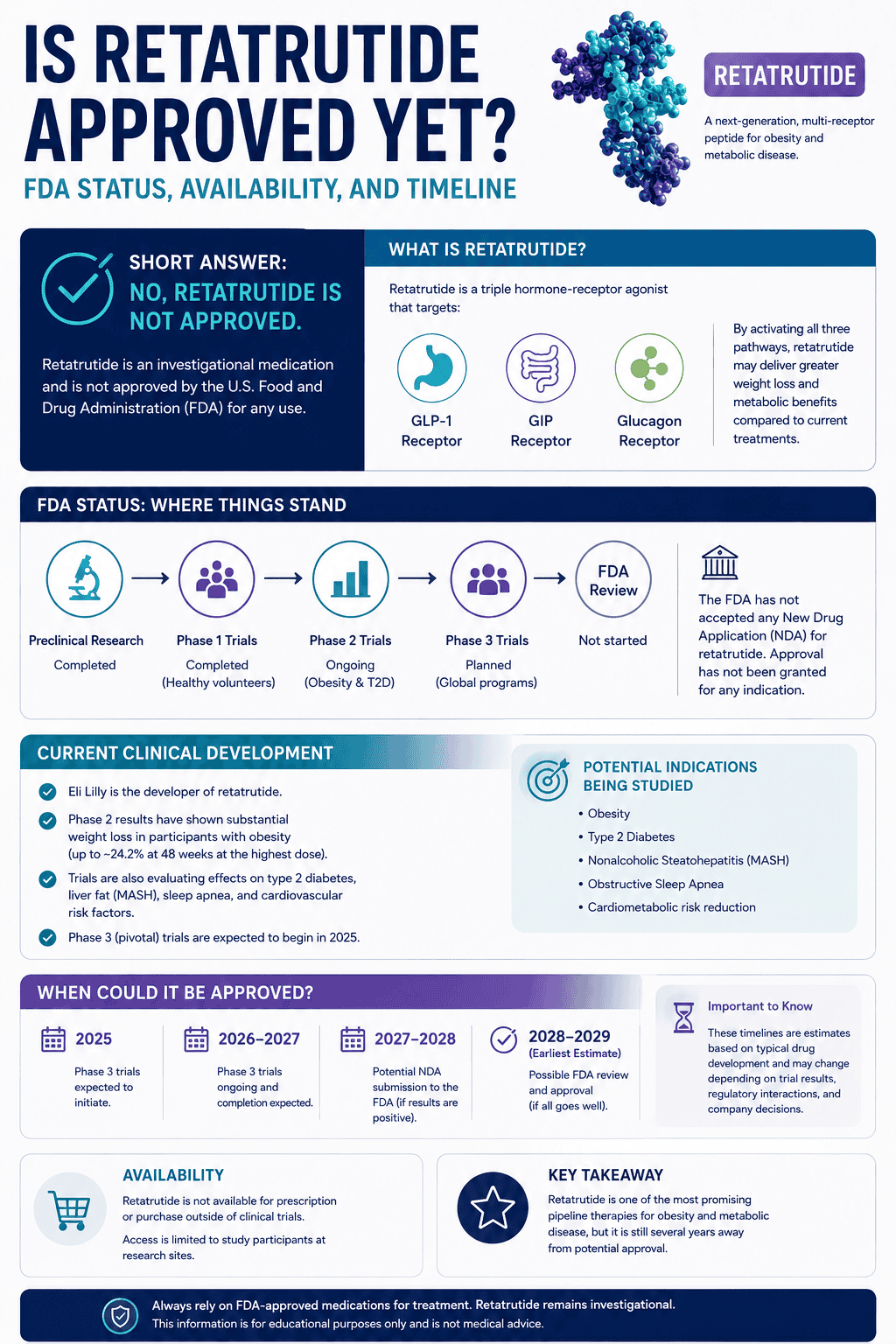
No. As of May 19, 2026, retatrutide is not FDA-approved for weight loss, type 2 diabetes, or any other condition. It remains an investigational once-weekly triple hormone receptor agonist being studied by Eli Lilly in Phase 3 clinical trials.
Retatrutide has produced strong late-stage trial results, including substantial weight loss in TRIUMPH-4 and meaningful A1C and weight reductions in TRANSCEND-T2D-1. Those results are important, but they are not the same as FDA approval, public availability, or an approved prescription label.
This article explains the U.S. FDA status, public availability, realistic approval timeline, and why online “research retatrutide” products should be avoided.
Who this is for: Readers trying to understand whether retatrutide is approved, when it may become available, and what current trial data actually mean.
Who this is not for: Anyone looking for retatrutide dosing instructions, gray-market access, or injectable research peptide use.
Reviewed by VerifiedSupps Editorial Team • Last reviewed: May 19, 2026
The answer-first view is simple: retatrutide is one of the most watched obesity drug candidates, but it is not approved yet. There is no FDA-approved retatrutide prescription, no approved retatrutide brand name, and no legitimate consumer version available from a pharmacy.
The reason people are asking is understandable. Retatrutide has shown unusually large weight-loss signals in clinical trials, including up to 24.2% mean weight loss at 48 weeks in Phase 2 and up to 28.7% at 68 weeks in the Phase 3 TRIUMPH-4 trial in adults with obesity or overweight and knee osteoarthritis.
But approval depends on more than one strong trial. Lilly still needs the broader Phase 3 evidence package, safety review, manufacturing review, labeling review, and regulatory approval before retatrutide can become a normal prescription option.
For clinical-result context, see our guides to retatrutide trial results, retatrutide weight loss, side effects, and status, and how retatrutide works.
Key Takeaways
- Retatrutide is not FDA-approved as of May 19, 2026.
- Lilly describes retatrutide as an investigational once-weekly triple agonist that activates GIP, GLP-1, and glucagon receptors.
- Retatrutide has completed at least two Phase 3 trials: TRIUMPH-4 in obesity with knee osteoarthritis and TRANSCEND-T2D-1 in type 2 diabetes.
- Additional Phase 3 results are expected before any clear FDA approval timeline can be treated as reliable.
- The FDA has stated that retatrutide cannot be used in compounding under federal law and has warned against unapproved GLP-1 products sold online.
- A possible approval decision could fall in 2027 if data, submission, and review proceed favorably, but that is an estimate, not a confirmed date.
Is retatrutide FDA approved yet?
No. Retatrutide is not currently FDA-approved and is considered investigational. It is being studied in clinical trials, not prescribed as an approved treatment.
That means there is no FDA-approved retatrutide product for obesity, overweight, type 2 diabetes, sleep apnea, knee osteoarthritis, fatty liver disease, or any other condition.
| Question | Current answer |
|---|---|
| Is retatrutide FDA-approved? | No. |
| Is there an approved retatrutide prescription? | No. |
| Is there an approved brand name? | No approved brand label exists yet. |
| Can retatrutide be compounded? | The FDA says retatrutide cannot be used in compounding under federal law. |
| How can people access it now? | Only through properly regulated clinical trials. |
This is the key distinction: retatrutide may be promising, but it is not available for routine medical use. A clinical trial candidate does not become a treatment option until regulators review and approve it.
When will retatrutide be available?
There is no confirmed public availability date for retatrutide. Availability depends on completion of Phase 3 trials, regulatory submission, FDA review, approval, manufacturing readiness, and commercial launch.
A cautious timeline would place possible FDA action sometime after the major Phase 3 evidence package is complete and submitted. If submission occurs after 2026 readouts and the FDA review proceeds normally, a 2027 decision is possible, but not guaranteed.
| Milestone | Status | What it means |
|---|---|---|
| Phase 2 obesity data | Published in 2023 | Showed up to 24.2% mean weight loss at 48 weeks in adults with obesity or overweight without diabetes. |
| TRIUMPH-4 Phase 3 data | Topline results announced in December 2025 | Showed up to 28.7% mean weight loss at 68 weeks in adults with obesity or overweight and knee osteoarthritis. |
| TRANSCEND-T2D-1 Phase 3 data | Topline results announced in March 2026 | Showed A1C reductions and up to 16.8% mean weight loss at 40 weeks in adults with type 2 diabetes. |
| Additional Phase 3 readouts | Expected across 2026 and beyond | Needed to clarify broader weight-loss efficacy, safety, maintenance dosing, and specific populations. |
| FDA submission | Not publicly confirmed as approved or complete for retatrutide | A formal application would need FDA review before approval. |
| FDA decision | No confirmed date | Standard FDA review is generally targeted at 10 months, while priority review is generally targeted at 6 months after filing milestones. |
The practical takeaway: retatrutide may be a 2027-plus availability story, not a product people can safely access today. Any date you see online should be treated as an estimate unless it comes from Lilly or the FDA.
Can you buy retatrutide now?
No legitimate FDA-approved consumer route exists for retatrutide right now. Products sold online as retatrutide, “triple G,” “research retatrutide,” or “not for human consumption” should be treated as unsafe and unverified.
The FDA has warned that unapproved GLP-1 products sold online may be counterfeit, mislabeled, contaminated, improperly stored, or contain the wrong amount of active ingredient. The FDA has also stated that retatrutide and cagrilintide cannot be used in compounding under federal law because they are not components of FDA-approved drugs and have not been found safe and effective for any condition.
- No approved pharmacy version: Retatrutide is not available like Zepbound, Wegovy, or Mounjaro.
- No legal compounding shortcut: FDA has specifically addressed retatrutide in its GLP-1 compounding warnings.
- No safe research-vial assumption: “Research use only” labeling does not prove identity, purity, sterility, or safe dosing.
- No do-it-yourself protocol: Trial dosing is medically monitored and should not be copied from online discussions.
This is especially important because retatrutide is powerful enough that improper use could plausibly cause serious problems, including dehydration from vomiting or diarrhea, excessive weight loss, electrolyte issues, medication interactions, gallbladder problems, or worsening nutritional status.
For a broader safety framework, read our guide on whether peptides are safe.
What Phase 3 results are available for retatrutide?
The most important available Phase 3 results are TRIUMPH-4 for obesity with knee osteoarthritis and TRANSCEND-T2D-1 for type 2 diabetes. Both were positive, but neither automatically means retatrutide is approved.
TRIUMPH-4 tested retatrutide in adults with obesity or overweight and knee osteoarthritis, without diabetes. Lilly reported that the 12 mg weekly dose produced 28.7% mean body-weight reduction at 68 weeks, compared with 2.1% for placebo, using the efficacy estimand.
TRANSCEND-T2D-1 tested retatrutide in adults with type 2 diabetes and inadequate glycemic control with diet and exercise alone. Lilly reported A1C reductions of 1.7% to 2.0% across doses at 40 weeks and up to 16.8% mean weight loss at the 12 mg dose.
Mechanism
- GLP-1 receptor activation: Supports satiety, appetite reduction, slower gastric emptying, and glucose regulation.
- GIP receptor activation: May add appetite and metabolic effects when paired with GLP-1 activity.
- Glucagon receptor activation: May influence energy expenditure and liver-metabolic pathways, but also adds safety questions that require careful trial review.
- Approval gap: Strong mechanism and strong trial results still require full regulatory evaluation.
For deeper comparisons, see retatrutide vs tirzepatide and retatrutide vs semaglutide for weight loss.
What has to happen before FDA approval?
Before retatrutide can be approved, Lilly must generate and submit enough evidence for FDA to judge safety, effectiveness, dosing, manufacturing quality, and labeling. Positive trial results are only one part of the process.
The FDA review process usually asks several practical questions:
- Does it work? The drug must show clinically meaningful benefit in the intended population.
- Is the benefit durable? Regulators need to understand whether weight loss is maintained and what happens over longer treatment periods.
- What are the safety risks? Common, uncommon, and serious adverse events must be evaluated across larger datasets.
- What dose should be approved? Retatrutide trials include multiple doses and escalation schedules, but the final label would determine actual prescribing.
- Can it be manufactured consistently? FDA must review quality, manufacturing, and control data.
- Who should not use it? Contraindications, warnings, precautions, pregnancy guidance, and monitoring needs must be defined.
Even after approval, availability can still depend on manufacturing capacity, launch timing, insurance coverage, prescribing demand, and clinician comfort with the label.
What side effects could affect retatrutide approval or use?
The main side effects reported so far are gastrointestinal, which is consistent with incretin-based medicines. Nausea, diarrhea, constipation, vomiting, and reduced appetite are the key tolerability issues to watch.
In TRIUMPH-4, Lilly reported nausea, diarrhea, constipation, vomiting, and decreased appetite as common adverse events. Dysesthesia was also reported more often with retatrutide than placebo, especially at the 12 mg dose, although Lilly described those events as generally mild and rarely leading to discontinuation.
- GI tolerability: Nausea, vomiting, diarrhea, and constipation can affect adherence and safety.
- Dehydration risk: Persistent vomiting or diarrhea can lead to fluid and electrolyte issues.
- Gallbladder and pancreas questions: These are important to monitor across GLP-1-based therapies and larger trial datasets.
- Lean mass loss: Large weight loss can include muscle loss if protein intake, resistance training, and medical monitoring are not handled well.
- Excessive weight loss: Lilly noted some discontinuations were related to perceived excessive weight loss in TRIUMPH-4.
For a focused breakdown, read retatrutide and muscle loss and retatrutide, belly fat, and metabolic health.
How does retatrutide approval status compare with tirzepatide, semaglutide, and CT-388?
Retatrutide is behind approved obesity medicines in regulatory status, even if its trial results look stronger in some settings. Tirzepatide and semaglutide are approved prescription drugs; retatrutide and CT-388 remain investigational.
| Drug | Mechanism | Current status | Practical meaning |
|---|---|---|---|
| Semaglutide | GLP-1 receptor agonist | Approved for weight management under specific labels | Available by prescription when clinically appropriate. |
| Tirzepatide | GIP/GLP-1 receptor agonist | Approved for weight management under the Zepbound label | Available by prescription when clinically appropriate. |
| Retatrutide | GIP/GLP-1/glucagon triple agonist | Investigational; Phase 3 program ongoing | Clinical-trial access only until regulatory approval. |
| CT-388 | GLP-1/GIP receptor agonist | Investigational; Phase 3 development | Not available outside clinical research. |
The most important real-world difference is not hype. It is regulatory certainty. Approved medicines have labels, dosing schedules, contraindications, pharmacy supply chains, adverse-event reporting systems, and clinician oversight. Investigational drugs do not have that public-use framework yet.
For pipeline comparisons, see CT-388 vs tirzepatide, CT-388 for weight loss, VK2735 for weight loss, and MariTide for weight loss.
References
- Eli Lilly and Company. What to Know About Retatrutide. Last updated March 2026.
This Lilly source supports the current status that retatrutide is investigational, not FDA-approved, not available for public use, and legally available only to participants in Lilly clinical trials.
- Eli Lilly Medical Information. What Retatrutide Clinical Trials Are Being Conducted in People With Obesity or Overweight?
This source supports the TRIUMPH clinical trial overview, including TRIUMPH-1 through TRIUMPH-9, TRIUMPH-Outcomes, primary endpoints, trial populations, and the broader Phase 3 program design.
- Eli Lilly and Company. Retatrutide TRIUMPH-4 Phase 3 Topline Results. December 11, 2025.
This release supports the TRIUMPH-4 data, including 28.7% mean body-weight reduction at 68 weeks, knee osteoarthritis outcomes, common adverse events, and Lilly’s statement that additional Phase 3 readouts were expected in 2026.
- Eli Lilly and Company. Retatrutide TRANSCEND-T2D-1 Phase 3 Topline Results. March 19, 2026.
This release supports the type 2 diabetes Phase 3 data, including A1C reductions of 1.7% to 2.0% across doses and up to 16.8% mean weight loss at 40 weeks with the 12 mg dose.
- Jastreboff AM, et al. Triple-Hormone-Receptor Agonist Retatrutide for Obesity. New England Journal of Medicine. 2023.
This peer-reviewed Phase 2 trial supports the earlier obesity data showing substantial body-weight reductions through 48 weeks, including up to 24.2% mean weight loss in the 12 mg group.
- U.S. Food and Drug Administration. FDA’s Concerns With Unapproved GLP-1 Drugs Used for Weight Loss. Content current as of February 4, 2026.
This FDA source supports the safety and legality cautions around unapproved GLP-1 products, including the FDA’s statement that retatrutide cannot be used in compounding under federal law.
- U.S. Food and Drug Administration. GLP-1 Solution Warning Letter. September 9, 2025.
This FDA warning letter supports the point that retatrutide products sold outside approval pathways may be treated as unapproved new drugs and misbranded drugs.
- U.S. Food and Drug Administration. Development & Approval Process for Drugs.
This FDA source supports the regulatory timeline discussion, including the difference between standard review and priority review timing goals after an application is submitted and accepted for review.
FAQ
Is retatrutide approved yet?
No. Retatrutide is not FDA-approved as of May 19, 2026. It remains an investigational medication in clinical development.
Is retatrutide available by prescription?
No. There is no approved retatrutide prescription product available to the public. Current legitimate access is limited to regulated clinical trials.
Can retatrutide be compounded?
The FDA says retatrutide cannot be used in compounding under federal law. Online or compounded products labeled as retatrutide should not be treated as safe, legal, or verified.
When could retatrutide get FDA approval?
There is no confirmed approval date. If the remaining Phase 3 data are positive and Lilly submits a complete application, a possible FDA decision could occur in 2027, but this is only an estimate.
What will the retatrutide brand name be?
No approved brand name can be confirmed because there is no FDA-approved retatrutide label yet. Any brand-name claims online should be treated cautiously unless confirmed by Lilly or FDA labeling.
Is retatrutide in Phase 3?
Yes. Lilly is studying retatrutide in Phase 3 programs for obesity, type 2 diabetes, knee osteoarthritis pain, obstructive sleep apnea, chronic low back pain, cardiovascular and renal outcomes, and metabolic dysfunction-associated steatotic liver disease.
Is retatrutide better than tirzepatide?
That cannot be fully concluded yet. Retatrutide has shown very strong trial results, but tirzepatide is already FDA-approved and has a mature prescribing label. Direct and complete Phase 3 comparisons are still needed for stronger conclusions.
Is it safe to buy retatrutide online?
No. Online retatrutide products may be mislabeled, contaminated, improperly stored, incorrectly dosed, or entirely fake. Retatrutide should not be used outside a properly regulated clinical trial unless it receives regulatory approval and is prescribed by a qualified clinician.
Medical Disclaimer
This article is for educational purposes only and does not provide medical advice, diagnosis, or treatment. Retatrutide is an investigational drug candidate and is not FDA-approved as of this review date. Do not buy, compound, inject, or use products labeled as retatrutide outside a regulated clinical trial unless retatrutide receives regulatory approval and is prescribed by a qualified clinician. People considering obesity or diabetes treatment should speak with a licensed healthcare professional about approved options, contraindications, side effects, glucose monitoring, nutrition, muscle preservation, and long-term care planning.