Magnesium Isn’t One Supplement. It’s a Category.
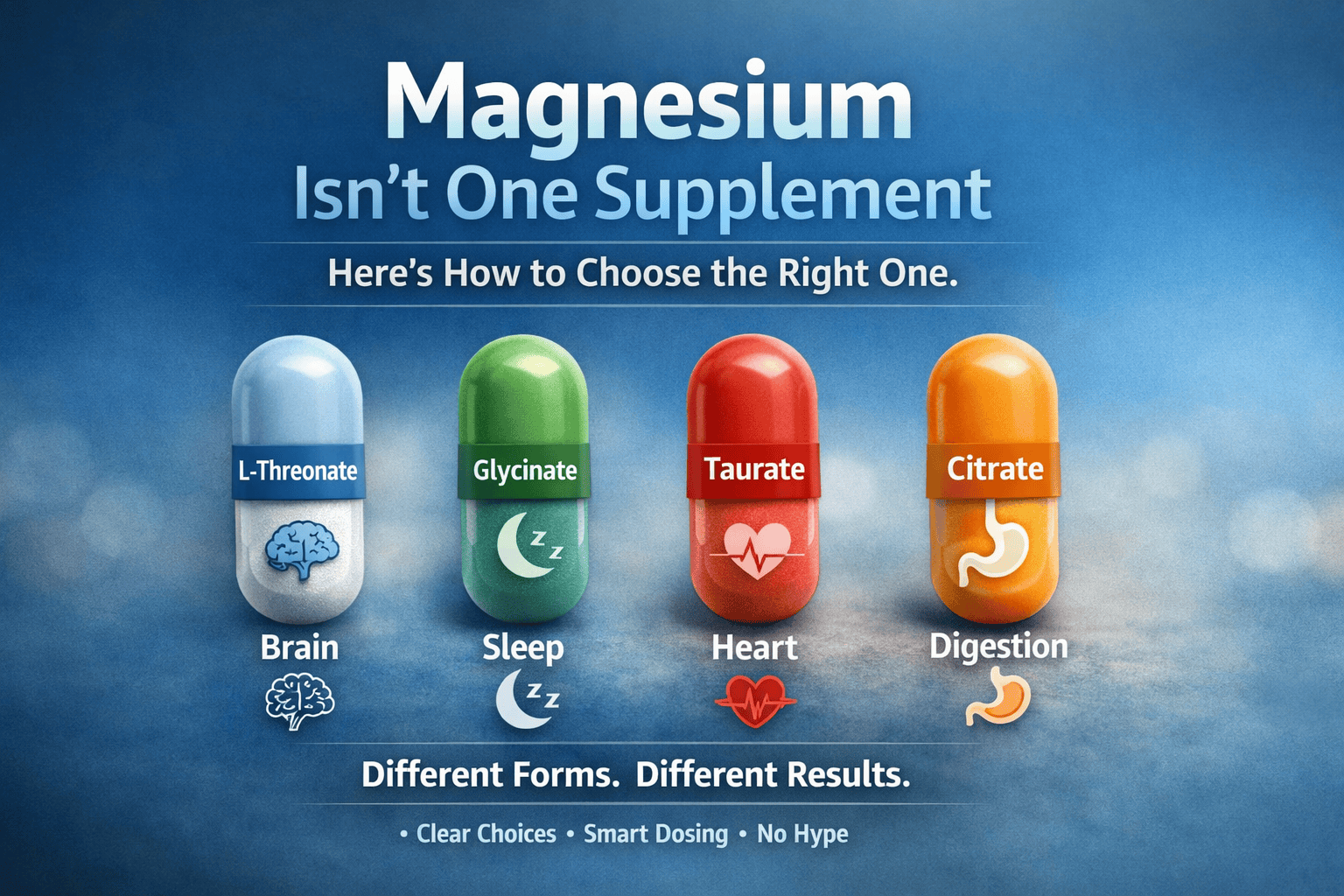
Direct answer: if “magnesium” helped one person’s sleep but gave someone else diarrhea, that’s not mysterious—it’s usually a form mismatch. Magnesium works like a category of tools: different forms behave differently in the gut, nervous system, and routines.
This guide helps you pick a form based on intent (sleep, calm, cognition, digestion), use a tolerable elemental dose, and run a clean test so you actually learn what works.
Which magnesium should I take?
Choose magnesium by job. This page owns one intent: helping you match a form to a goal and test it cleanly. If you want a laxative, treat that as a digestion job. If you want sleep/calm, treat it as a downshift job. If you want cognition, treat it as a cognition job.
| Your intent | Best first strategy | How to judge it | Common failure mode |
|---|---|---|---|
| Sleep downshift / tension sleep | Tolerance-first calming strategy + evening consistency | Sleep latency + awakenings across 7–14 nights | Expecting sedation in 1 night |
| Physical stress / steady body calm | Physiology-first strategy + split dosing if helpful | Baseline tension score (0–10) + fewer spikes | Chasing a strong “feeling” |
| Cognition / mental clarity | Cognition-first strategy + longer test window | Deep-work minutes + “mental noise” score over 14–28 days | Judging like a sleep aid |
| Regularity / constipation relief | Treat as a digestion tool and use minimum effective dose | Predictable stool consistency without dehydration signs | Turning a short-term tool into a daily habit |
- Kidney disease or reduced eGFR: magnesium dosing becomes clinician territory.
- Thyroid meds, antibiotics, bisphosphonates: mineral spacing matters.
- Very low blood pressure or frequent dizziness: hydration/sodium strategy may matter more.
- New/worsening palpitations, fainting, chest pain: evaluation first.
- Chronic diarrhea/IBS-D/IBD: any magnesium strategy should be cautious and tolerance-first.
What is the best magnesium for sleep?
The best magnesium for sleep is the one that helps you downshift without creating new problems (GI disruption, wired feeling). Many people do best with a tolerance-first calming approach, stable evening timing, and a 7–14 night window.
What is the best magnesium for anxiety?
Magnesium is most likely to help when “anxiety” is largely physiological (tension, restlessness, tight chest, wired baseline). If anxiety is mostly rumination, magnesium may still support baseline regulation, but it’s usually not the only lever.
How much magnesium should I take?
The dose language that matters is elemental magnesium, not the total “compound” weight. A tolerance-first approach is simplest: start low, stabilize timing, then titrate only if the metrics improve and side effects stay calm.
When is the best time to take magnesium?
Timing should match intent. For sleep-downshift goals, evening timing is common. For baseline steadiness, split dosing can feel smoother. If magnesium feels “wired” for you, moving it earlier is often a high-yield adjustment.
Magnesium troubleshooting: how to tell it’s working
Magnesium is best judged by trend metrics, not sensations. “Working” usually looks like fewer bad nights, less tension, smoother downshift, or improved regularity—depending on the job you chose.
- Choosing a digestion tool for a calm/sleep goal (or vice versa)
- Not tracking elemental magnesium and taking too much at once
- Judging after 1–2 doses
- Changing caffeine, sleep schedule, and supplements simultaneously
- Pick one job: sleep downshift, physical calm, cognition, or digestion.
- Pick 2 metrics: sleep latency + awakenings, tension score + spike count, or stool consistency + urgency.
- Hold timing stable and take with food if it improves tolerance.
- No new supplements during the window.
- Change one variable after day 7 if unclear (dose OR timing OR form).
- Sleep: shorter sleep latency or fewer awakenings across multiple nights.
- Calm/tension: lower baseline tension score and fewer “wired body” moments.
- Cognition: more deep-work minutes and lower “mental noise” score over 14–28 days.
- Digestion: predictable regularity without watery diarrhea or dehydration signs.
- Chest pain, fainting/near-fainting, confusion, severe weakness
- Concerning palpitations or symptoms that escalate fast
- Persistent watery diarrhea or dehydration symptoms
- Known kidney disease without clinician guidance
Selected Professional References
- NIH Office of Dietary Supplements: Magnesium (Health Professional Fact Sheet)
- NIH Office of Dietary Supplements: Magnesium (Consumer Fact Sheet)
- MedlinePlus Medical Test: Magnesium blood test
- Costello RB et al. Perspective: call for re-evaluation of the magnesium UL. 2023. (PMC)
- MedlinePlus Medical Encyclopedia: Magnesium deficiency (hypomagnesemia)
Go Deeper (VerifiedSupps Guides)
Final Takeaway
Magnesium becomes simple when you treat it like a category: pick the job, use a tolerable elemental dose, keep timing stable, and measure the right outcome. Most failures aren’t “magnesium doesn’t work”—they’re mismatches and noisy tests.