Magnesium Safety
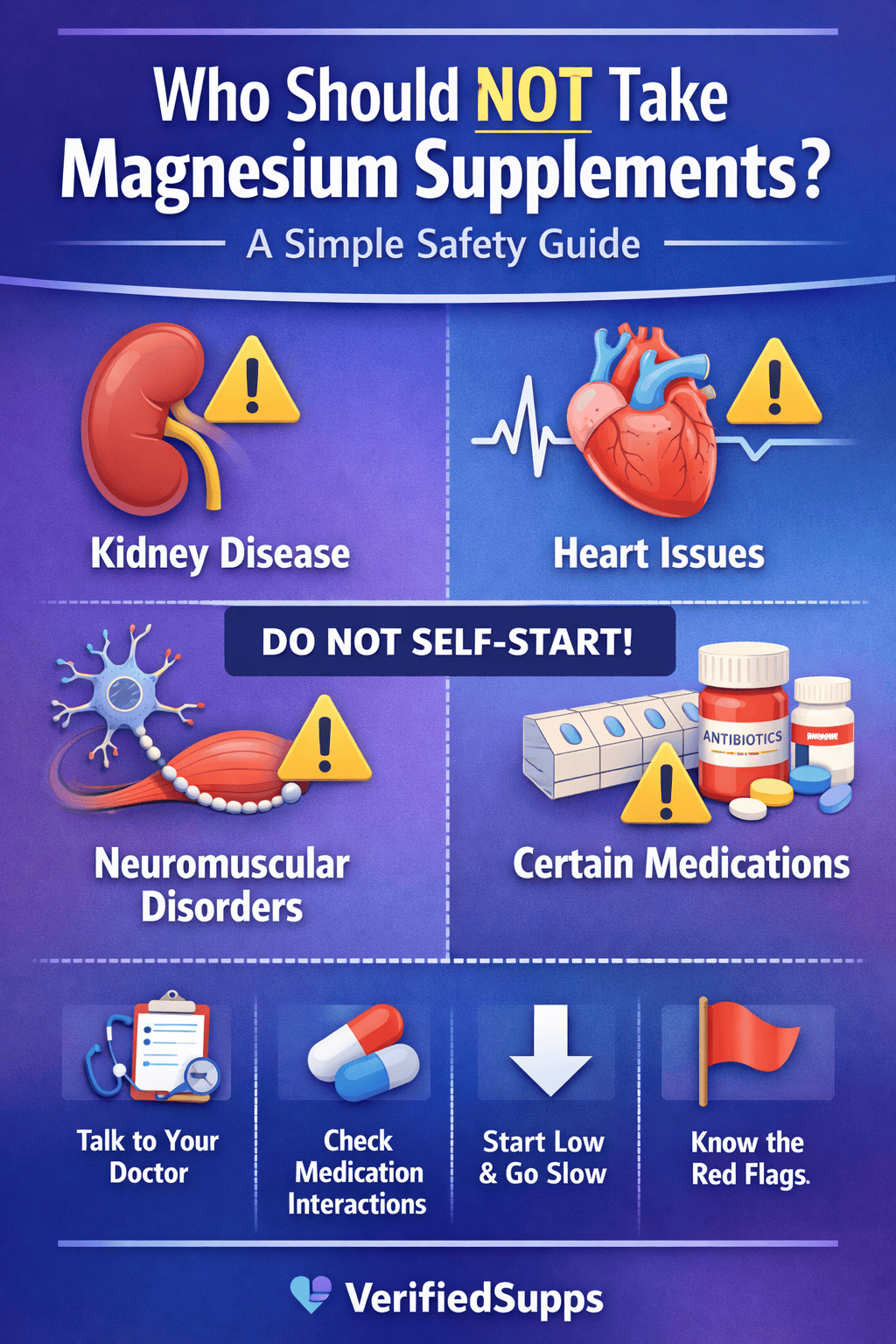
Who Should NOT Take Magnesium Supplements? A Simple Safety Guide
Magnesium is one of the most common “safe” supplements people try for sleep, stress, cramps, or general wellness.
And for most healthy adults, it’s genuinely low-risk.
But there are a few situations where magnesium supplements aren’t a casual add-on — they’re something to pause and discuss first.
Clear “avoid” groups
Medication spacing
Dose guardrails
Red flags
Quick Take
If you have kidney disease, a neuromuscular condition like myasthenia gravis, or a heart conduction problem, do not self-start magnesium supplements without a clinician’s guidance.
If you’re on certain medications, magnesium may be fine — but timing and spacing matter.
The Safety Rule Most People Miss
There’s a reason magnesium can feel “safe” and “problematic” at the same time:
magnesium in food and magnesium in supplements behave differently in real life.
Magnesium from food
Generally self-limiting in healthy people. Your kidneys can clear excess, and food forms rarely “hit” the gut in one big dose.
Magnesium from supplements
Concentrated, dose-dependent, and more likely to cause side effects or interactions — especially if clearance is impaired or timing is off.
Who Should NOT Self-Start Magnesium Supplements
This is the simple filter. If any of these apply, the safest move is to pause and get clinician guidance before supplementing.
Not because magnesium is “bad,” but because the margin for error is smaller.
1) Kidney disease or reduced kidney function
Your kidneys are the main exit route for excess magnesium. If clearance is reduced, magnesium can build up and cause weakness, low blood pressure, abnormal heart rhythm, or more serious toxicity.
2) Myasthenia gravis or significant neuromuscular disorders
Magnesium influences neuromuscular signaling. In myasthenia gravis, extra magnesium can worsen weakness and—at higher exposures—may increase risk of serious symptoms.
3) Heart conduction problems (especially heart block)
Magnesium affects electrical conduction and muscle contraction. If you have known conduction disease or are being managed for rhythm issues, don’t experiment without medical direction.
4) You already use magnesium as a laxative or antacid
Some products contain meaningful magnesium (often in forms more likely to cause diarrhea). Adding a “sleep magnesium” on top can unintentionally stack your dose.
If You Take These Medications, Don’t Guess
For many people, magnesium isn’t “forbidden” with medications — it’s just easy to take it in a way that makes the medication less effective.
The fix is usually simple: separate the doses and confirm the plan with a pharmacist if you’re unsure.
Antibiotics (tetracyclines / fluoroquinolones)
Magnesium can bind and reduce absorption. A common strategy is spacing magnesium several hours away from the antibiotic dose.
Levothyroxine
Minerals can interfere with absorption. Spacing is typically recommended, and consistency matters more than “perfect timing once.”
Bisphosphonates
These are very timing-sensitive. If you take them, get a clear spacing plan before adding magnesium.
Complex medication regimens
If you’re on multiple prescriptions (especially for blood pressure, heart rhythm, or kidney issues), treat magnesium like a real intervention — ask a pharmacist to sanity-check it.
Not sure where you fall?
Use this simple decision path:
(1) If you have kidney disease, heart conduction disease, or myasthenia gravis → don’t self-start.
(2) If you’re on timing-sensitive meds → ask a pharmacist how to space it.
(3) If neither applies → start low, split doses, and take with food.
Dose Guardrails That Prevent Most Problems
Most “magnesium intolerance” isn’t mysterious. It’s usually a dosing strategy problem.
Here’s the calm, low-risk way to do it if you’re a healthy adult and magnesium is appropriate for you.
Start low
Begin with a modest dose and increase gradually over 7–14 days. This is especially useful if you’re sensitive to GI effects.
Split doses
Two smaller doses are often better tolerated than one large dose. Absorption has a “speed limit.”
Take with food
Food can reduce GI upset and make the experience smoother for many people.
Respect the “diarrhea ceiling”
Diarrhea is the most common limiting factor. If it happens, it’s usually a signal to lower, split, or change form — not to power through.
Red Flags: When to Stop and Get Help
Most magnesium side effects are mild (especially GI-related).
But if magnesium builds up — which is mainly a concern when kidney clearance is impaired — symptoms can move beyond “annoying” into “not safe.”
Stop magnesium and seek medical advice if you notice:
- New or worsening muscle weakness, heavy limbs, or unusual fatigue
- Lightheadedness, fainting, or unusually low blood pressure symptoms
- Confusion, severe lethargy, or difficulty staying alert
- Slow heartbeat, palpitations, or any concerning rhythm symptoms
- Persistent diarrhea with dehydration signs (dry mouth, dizziness, very dark urine)
Go Deeper (VerifiedSupps Guides)
Final Takeaway
Magnesium supplements are low-risk for many healthy adults — but not for everyone.
If you have kidney disease, myasthenia gravis, or heart conduction problems, don’t self-start.
If you take timing-sensitive medications, don’t guess: space it or confirm with a pharmacist.
And if you’re healthy, most issues are preventable with a calm approach: start low, split doses, and take with food.
Frequently Asked Questions
Is magnesium safe for most people?
For most healthy adults, yes — especially when doses are modest and taken with food.
Why do people say kidney disease is a problem with magnesium?
Because kidneys clear excess magnesium. If clearance is reduced, magnesium can accumulate.
Do I need to avoid magnesium if I take medications?
Not always. Many interactions are about absorption and can be managed with spacing and consistency.
Is diarrhea a sign magnesium is “not for me”?
Usually it’s a form or dose issue. Lowering, splitting, or changing the form often solves it.
What’s the safest way to start magnesium?
Start low, take with food, split doses, and avoid stacking multiple magnesium products.
VerifiedSupps Medical Disclaimer
This content is for educational purposes only and does not provide medical advice, diagnosis, or treatment.
Supplements can interact with medications and medical conditions. If you are pregnant, nursing, have a medical condition (especially kidney, heart, or neuromuscular conditions),
or take prescription medications, consult a qualified healthcare professional or pharmacist before starting, stopping, or changing any supplement.
If you experience concerning symptoms, seek medical care promptly.