L-Citrulline Benefits: The Calm, No-Fluff Explanation That Actually Makes Sense
L-citrulline helps performance mainly by raising nitric oxide availability (via increasing arginine), which can improve blood flow. In real life, that usually shows up as better pumps, smoother endurance, and less “early burn” during hard sets—especially when the dose is high enough to matter.
This guide is decision-first: what citrulline does, what it’s best for, how to dose it, how to pick between pure citrulline and citrulline malate, and what to troubleshoot if it isn’t working.
Quick Take
- Core benefit: improved blood flow support (NO pathway), which can improve pumps and endurance.
- Most common mistake: taking too little (many products are underdosed).
- Typical performance pattern: best 30–60 minutes pre-workout, with hydration and sodium in place.
- Safety note: if you use nitrates, PDE5 inhibitors, or blood pressure medication, confirm compatibility with a clinician.
Parent Hub: Want the full citrulline cluster in one place (benefits, dosing, timing, comparisons, and safety)?
Open: L-Citrulline (VerifiedSupps hub)
L-citrulline “dose + goal” decoder
Use this to avoid the #1 problem: underdosing (and thinking citrulline “doesn’t work”).
| Goal | Most practical form | Typical range | Timing |
|---|---|---|---|
| Pumps + workout performance | Pure L-citrulline | Often 6–8 g | 30–60 min pre |
| Pre-workout “label matches the stack” | Citrulline malate (2:1) | Often ~8 g total (check ratio) | 30–60 min pre |
| Daily circulation support | Pure L-citrulline | Often ~3 g daily | Any consistent time |
If you’ve tried 1–2 g and felt nothing, that doesn’t mean citrulline is useless. It often means the dose never reached the level that reliably changes blood flow during training.
What does L-citrulline actually do?
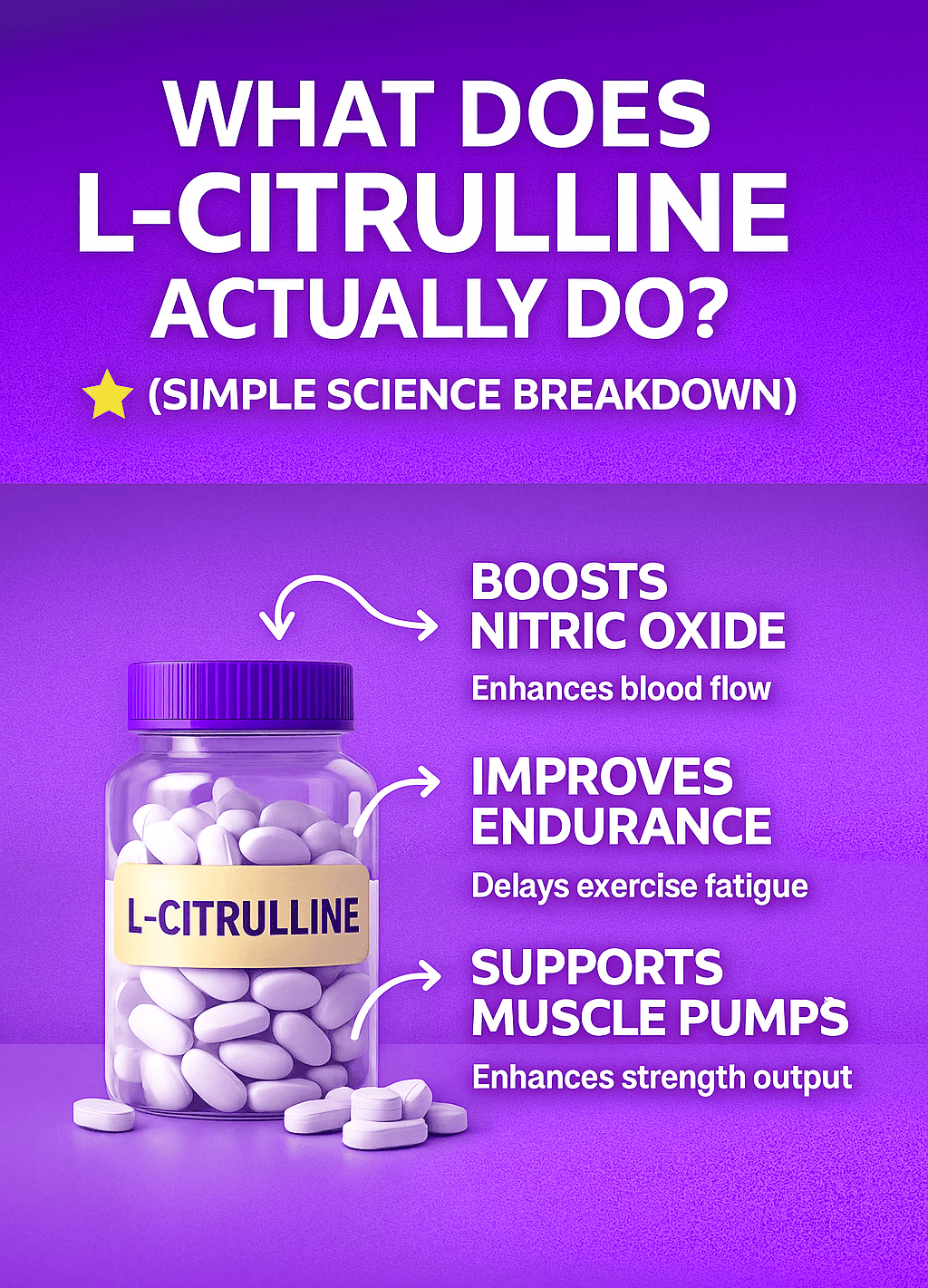
L-citrulline primarily increases arginine availability in the body, which supports nitric oxide production. Nitric oxide helps blood vessels relax, which can improve circulation—especially noticeable during exercise.
That “pump” feeling is the surface-level sign. The deeper point is delivery: oxygen, nutrients, and fluid get where they need to go more efficiently when blood flow is supported.
How does L-citrulline increase nitric oxide?
Citrulline is converted (largely in the kidneys) into L-arginine, and arginine is the direct substrate used to produce nitric oxide. In practice, citrulline can raise blood arginine more reliably than taking arginine itself, because arginine is more heavily broken down before it meaningfully raises circulating levels.
Plain-English version
Citrulline is often the “better upstream input.” Instead of trying to force arginine through a leaky pipeline, you feed the system earlier and let the body convert it in a steadier way.
Does L-citrulline really help with pumps?
For many people, yes—especially at a real dose. Pumps are essentially a “blood flow + demand” signal. When nitric oxide support improves vessel relaxation, pumps often feel fuller, show up earlier, and last longer.
Why it’s not just cosmetic
- Better delivery of oxygen and fuel during hard sets.
- More efficient hydration and electrolyte movement into working tissue.
- Often improved “session quality” when volume is high.
Important: pumps also depend heavily on training style, glycogen/carbs, and hydration/sodium. Citrulline supports the pathway, but it doesn’t replace the basics.
Does L-citrulline improve endurance and reduce fatigue?
It can. The most common “endurance” effect people notice is less early burn and a slightly smoother ability to sustain effort—especially in higher-rep work, repeated sets, cycling-style output, and conditioning.
What it can look like in training
- You hold performance longer before you feel “gassed.”
- Your later sets feel less like a cliff.
- Your workout feels more “dialed” rather than chaotic.
This tends to be more noticeable when your training is limited by local fatigue and circulation rather than by pure strength.
What is the best L-citrulline dose for pumps and performance?
The most common effective performance range is 6–8 g of pure L-citrulline taken 30–60 minutes pre-workout. Lower doses can still help some people, but underdosing is the fastest way to get “no results.”
Two dosing principles that prevent most confusion
- Dose the ingredient, not the label: many pre-workouts include citrulline, but not enough.
- Separate “daily support” from “performance”: daily circulation support is often lower than pre-workout performance dosing.
If you’re sensitive, start lower and build up. If your stomach is sensitive, mix with water and consider a light snack.
L-citrulline vs citrulline malate: which is better?
If your goal is nitric oxide support as directly as possible, pure L-citrulline is usually the cleanest choice. Citrulline malate can still work well, but results depend on the ratio and how much actual citrulline you’re getting.
Practical takeaways
- Pure citrulline: simplest dosing, easiest to interpret.
- Malate: can be fine, but you need clarity on the ratio (2:1 is commonly referenced on labels).
- Decision rule: if label math feels unclear, pure citrulline is easier.
If you’re comparing products, always convert to “how many grams of citrulline am I actually taking?” rather than trusting the blend name.
Why isn’t L-citrulline working? Common mistakes
When citrulline “does nothing,” it’s almost always one of three things: dose, context, or expectations. Fix those, and the same product often feels completely different.
The most common blockers
- Underdosing: 1–2 g often won’t move the needle for pumps in trained lifters.
- Hydration/sodium are low: you can’t pump well if you’re under-hydrated or flat on electrolytes.
- Low carbs / low glycogen: pumps are harder to feel when glycogen is depleted.
- Training style mismatch: very low-volume strength work may not “show” pumps like higher-volume training.
- Timing inconsistency: taking it 5 minutes pre-workout and expecting a full effect is common.
- Product ambiguity: proprietary blends or unclear malate ratios make dosing unreliable.
A simple 2-workout “clean test”
- Take a clear, measured dose (not a blend) 30–60 minutes pre.
- Hydrate normally and include sodium (don’t test it on a “flat” day).
- Use a higher-volume session where pumps are normally noticeable.
Go Deeper (VerifiedSupps Guides)
If you want the clean next step, these are the most useful follow-ups.
Final Takeaway
L-citrulline is a fundamentals supplement: it supports blood flow via the nitric oxide pathway. When you dose it correctly, workouts often feel smoother—better pumps, better endurance, less early burn. If it “did nothing,” troubleshoot dose, hydration/sodium, timing, and whether your training style actually produces a pump signal.
FAQ
How long does L-citrulline take to work?
For workout use, many people take it 30–60 minutes before training. Some notice pumps the first session at a real dose; others notice it more clearly after repeated use and better overall training consistency.
Is 3 grams of L-citrulline enough?
Often not for maximal pumps in trained lifters. Around 3 g is commonly used for daily support, while performance-focused pre-workout dosing is often higher.
Can L-citrulline lower blood pressure?
It may support blood pressure in some contexts because it influences nitric oxide and vascular tone. If you already use blood pressure medication, confirm safety with your clinician.
Is citrulline malate better than pure citrulline?
Not automatically. Malate can work well, but you need clarity on the ratio and the actual citrulline amount. Pure citrulline is simpler for dosing and label math.
Can I take L-citrulline every day?
Many people do. Daily use should still fit your medical and medication context. If you’re on nitrates, PDE5 inhibitors, or blood pressure medication, confirm compatibility first.
Does L-citrulline cause stomach issues?
Most people tolerate it well, but some experience mild stomach discomfort at higher doses. Mixing it in water and avoiding “dry scooping” usually helps.
Why do I get no pump even with citrulline?
Check dose, hydration/sodium, glycogen status, training volume, and timing. Pumps are a combined signal, not a single-ingredient guarantee.
Can I combine citrulline with creatine or caffeine?
Often yes. Creatine supports strength/repeatability, caffeine supports alertness, and citrulline supports blood flow. If you’re sensitive, change one variable at a time so you can judge effects.