By VerifiedSupps Editorial Team
L-Citrulline vs L-Arginine: What Actually Works Better for Pumps, Performance, and Blood Flow?
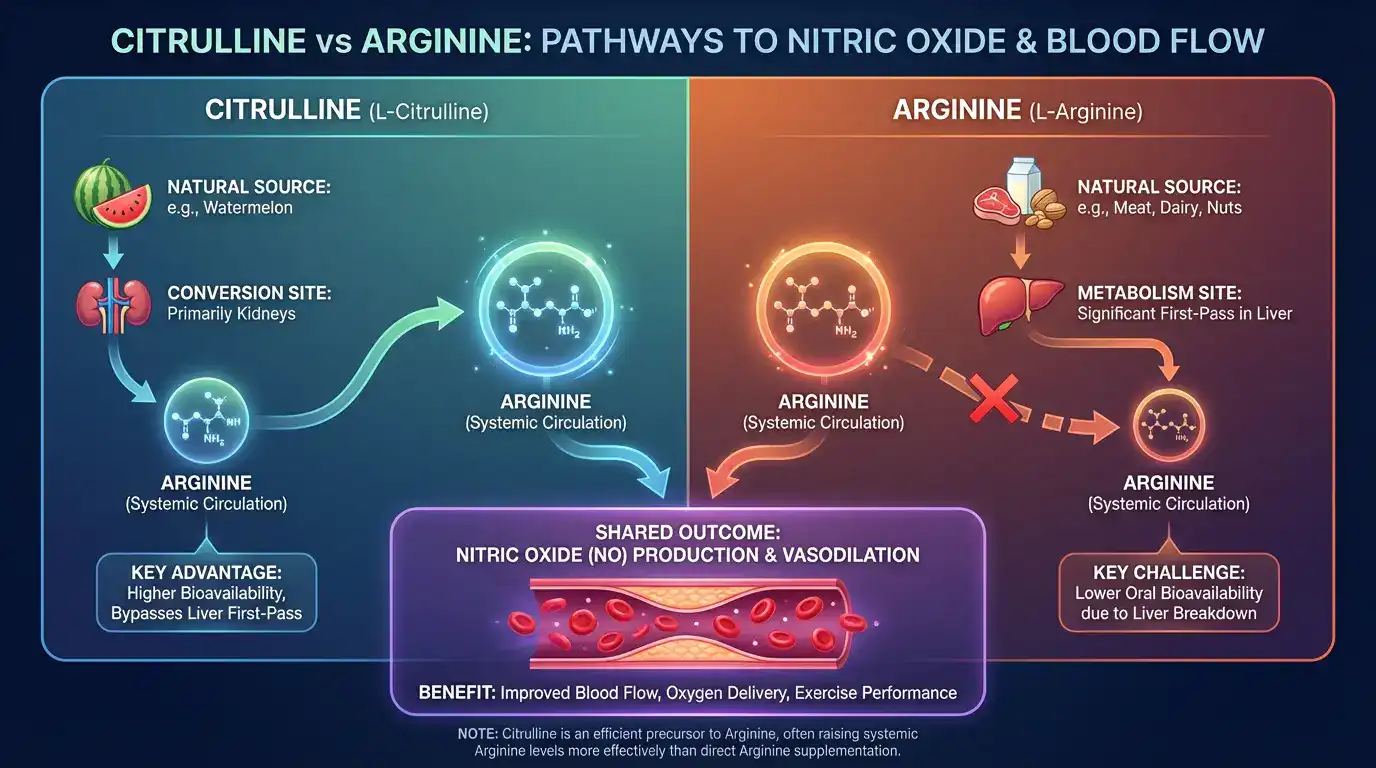
For most oral supplement use, L-citrulline is the better default than L-arginine. The main reason is pharmacokinetics: citrulline bypasses much of the first-pass loss that makes oral arginine less reliable, so it often raises usable arginine availability more effectively once it is inside the body.
That does not mean citrulline turns every workout into an instant pump festival. The more honest takeaway is that citrulline is the cleaner, more evidence-friendly choice for people chasing pumps and work capacity from an oral nitric-oxide supplement, while arginine still has some relevance in blood-pressure or niche clinical discussions.
This page covers the oral supplement decision for pumps, blood flow, and performance. It does not re-cover the entire L-citrulline guide or the broader citrulline malate debate except where those questions change the citrulline-versus-arginine decision.
Key terms: oral bioavailability, first-pass metabolism, plasma arginine, nitric oxide, pump support, citrulline malate
Quick Take
Best fit: you want a cleaner oral pump and blood-flow ingredient, not the “direct precursor” that sounds best on paper. For most gym-focused oral use, citrulline is the smarter first trial. Arginine is the less reliable oral choice for pumps, even though it remains relevant in some blood-pressure and clinical contexts.
TL;DR decision
If your goal is pumps, work capacity, and better oral nitric-oxide support, start with pure L-citrulline, not arginine. A practical first trial is 6 g about 30–60 minutes before training, with hydration and sodium dialed in. If blood-pressure management or a specific medical use case is the real target, arginine is not automatically irrelevant—but that is a different question than “best pre-workout pump ingredient.”
Evidence standard: human trials, dose ranges, guideline-level sources when available
Who this is for: lifters, athletes, and people comparing oral nitric-oxide ingredients for pumps, blood flow, and performance.
Who this is not for: anyone looking for medical treatment advice for hypertension, erectile dysfunction, or vascular disease rather than a practical supplement comparison.
Reviewed by: VerifiedSupps Editorial Team
Last reviewed: March 9, 2026
Parent Hub
L-Citrulline Complete Guide
Use the broader L-citrulline guide if you want the full nitric-oxide map, including standalone benefits, daily use, safety, and the wider citrulline supplement landscape.
Citrulline vs arginine quick chooser
This is the fast version of the whole page.
| If you want… | Better first choice | Why | Best next step |
|---|---|---|---|
| A cleaner oral pump ingredient | L-citrulline | It usually survives oral delivery better and more reliably raises usable arginine availability. | Start with 6 g before training and keep the rest of the setup stable |
| The more “direct” precursor on paper | L-arginine | It is the immediate NO substrate, but that does not make it the better oral pump supplement. | Do not confuse pathway logic with better oral performance |
| A blood-pressure or vascular-health discussion | Different question | Arginine is not automatically irrelevant outside the gym-performance context. | Do not import performance conclusions into medical use cases |
| The simplest gym-focused answer | L-citrulline | It is the cleaner first trial for pumps, blood flow, and oral performance use. | Use pure citrulline if you want the cleanest dosing math |
What should I take before my next pump workout? Start with 6 g of pure L-citrulline about 30–60 minutes pre-workout, not arginine, and fix hydration and sodium before you declare the whole category useless.
Is L-citrulline or L-arginine better for pumps?
For most people using an oral supplement for pumps, L-citrulline is the better choice. It is simply the cleaner first trial because it is more likely to change the physiology you are trying to change after it passes through the gut and liver.
Mechanism
- Better oral delivery: citrulline escapes much of the first-pass loss that limits oral arginine.
- Better usable arginine support: once absorbed, citrulline can raise circulating arginine availability more reliably.
- Better gym-context evidence: direct human comparison found citrulline, but not arginine, improved high-intensity exercise performance after 7 days at 6 g/day.
Why does L-citrulline work better than L-arginine?
It mostly comes down to what happens before the supplement reaches circulation. Oral arginine is heavily exposed to intestinal and hepatic metabolism, which makes it a less efficient way to raise the arginine that actually matters for nitric-oxide support.
- Arginine problem: significant first-pass loss can happen before oral arginine reaches the peripheral circulation.
- Citrulline advantage: it bypasses hepatic first-pass handling and is then converted to arginine after absorption.
- Practical result: the more impressive “direct precursor” story does not beat the better oral pharmacokinetics story.
What would change my recommendation?
- If the goal were a specific blood-pressure or vascular-health conversation rather than gym pumps.
- If future direct oral human trials showed arginine consistently outperforming citrulline for gym performance, which current data do not.
- If you personally respond poorly to citrulline at workable doses and tolerate arginine better.
- If you are comparing combination strategies rather than single-ingredient pump supplements.
How much L-citrulline should I take for pumps?
A very practical gym-focused first trial is 6 g of pure L-citrulline, taken 30–60 minutes before training. That is cleaner than guessing with arginine doses or hiding behind a proprietary blend that never tells you the real amount.
- Pure L-citrulline: 6 g is a strong default first test.
- If sensitive: start around 3–4 g and work up.
- Citrulline malate: the common acute research dose is often 8 g, but the label math is murkier because not all of that is pure citrulline.
- Do not judge low-dose blends: 1–3 g hidden in a pre-workout is often not a fair trial.
When should I take L-citrulline for blood flow and performance?
For gym-focused use, the cleanest timing rule is 30–60 minutes before training. That is not because timing is magical, but because it gives the oral dose enough time to actually matter before the work starts.
- Best default: about 30–60 minutes pre-workout.
- If you are comparing products: do not change the timing from workout to workout and expect a clean answer.
- Hydration matters: even a well-timed dose can feel flat if fluid and sodium status are poor.
Is L-citrulline safe to take every day?
For many healthy adults, L-citrulline is generally well tolerated. The more important caution is not everyday use by itself. It is blood-pressure context, especially if you already run low, get lightheaded, or use medications or compounds that also push vasodilation.
- Main side effect pattern: GI fullness or stomach discomfort, especially at higher doses.
- Blood-pressure context: citrulline has been studied for vascular and blood-pressure effects, so medication overlap is not a casual issue.
- Practical rule: if you use nitrates, PDE5 inhibitors, or blood-pressure medication, do not freestyle higher-dose nitric-oxide stacks.
Why is L-citrulline not working for pumps?
Usually because the trial was weak, not because the entire ingredient class is fake. Citrulline has a cleaner oral logic than arginine, but it is still not a guaranteed pump switch that overrides dose, hydration, timing, or training style.
Common mistakes
- Using 1–3 g in a pre-workout blend and calling it a “real” citrulline trial
- Ignoring hydration and sodium, then blaming the NO ingredient
- Expecting a visible pump from low-rep strength work or very long rest periods
- Changing dose, timing, and training style all at once
- Expecting every study or every person to show a dramatic acute effect
Clean test protocol
| Inputs | 6 g pure L-citrulline, 30–60 minutes pre-workout, stable hydration, and a higher-rep or shorter-rest session structure |
|---|---|
| Duration | Use the same setup for 3–4 sessions before you judge the ingredient |
| 3 metrics | Subjective pump, work capacity during later sets, and next-day soreness or perceived effort |
| Stop conditions | Repeated GI upset, clear lightheadedness, or any concerning interaction pattern with medication or vascular symptoms |
How to tell it’s working
The believable signal is not “my veins exploded.” It is a steadier later-set pump, a little more work tolerance, or a cleaner “fullness” feel in the right kind of session. Some trials are positive, others are flat, which is why your own clean setup matters.
Red flags / seek care
If you get significant dizziness, faintness, unusual chest symptoms, or have medication concerns around vasodilation or blood pressure, stop and get appropriate medical guidance.
Selected Professional References
External links only. These are rendered as premium clickable tabs so you can audit the claims quickly.
L-Citrulline Supplementation Improves High-Intensity Exercise Performance in Humans
Most important head-to-head source here because it directly compared 6 g/day citrulline versus 6 g/day arginine and found performance benefits only with citrulline.
Used for: direct gym-context decision
Pharmacokinetic and Pharmacodynamic Properties of Oral L-Citrulline
Best source for the core mechanism claim that oral citrulline efficiently raises plasma arginine and NO-dependent signaling.
Used for: mechanism and oral-delivery advantage
The Effects of Oral L-Arginine and L-Citrulline Supplementation on Blood Pressure
Useful because it explains that both can raise plasma arginine, but citrulline is approximately twice as potent because of lower first-pass metabolism.
Used for: potency, first-pass, and BP caution context
A Critical Review of Citrulline Malate Supplementation and Exercise Performance
Best source for why citrulline malate dosing can be messy and why the common acute 8 g CM dose does not guarantee a positive ergogenic result in every protocol.
Used for: CM dose math and mixed-results honesty
Therapeutic Potential of Citrulline as an Arginine Supplement
Most useful source for the plain-English pharmacology: oral citrulline is more effective than oral arginine at improving plasma arginine because it bypasses hepatic first-pass metabolism and intestinal arginase loss.
Used for: the core why-citrulline-wins logic
Go Deeper (VerifiedSupps Guides)
Four next reads that make the rest of the nitric-oxide and pump conversation easier once the citrulline-versus-arginine decision is clear.
Citrulline Dosage Guide
Best next read if you want cleaner dose tiers by goal and a less guessy first trial.
Best Time to Take L-Citrulline
Best next read if timing is the real issue and you want the simplest rules that actually matter.
Citrulline Malate vs Pure Citrulline
Best next read if label math and “which form should I buy?” are the real questions.
Is L-Citrulline Safe to Take Daily?
Best next read if the real question is daily use, blood-pressure context, and who should be cautious.
Final Takeaway
If you want the cleanest oral choice for pumps and blood flow, pick L-citrulline. Arginine is the direct precursor on paper, but citrulline is usually the better oral performance tool in practice because it gets through the system more efficiently. That still does not make it magic: dose, timing, hydration, and session style decide whether the ingredient gets a fair chance to work.
FAQ
Is L-citrulline or L-arginine better for pumps?
For most oral supplement use, L-citrulline is the better choice because it supports usable arginine availability more effectively after digestion.
Why does L-arginine not work as well orally?
A lot of oral arginine can be lost to intestinal and hepatic first-pass metabolism before it reaches the peripheral circulation.
How much L-citrulline should I take for pumps?
A practical first trial is about 6 g of pure L-citrulline taken 30–60 minutes before training.
When should I take L-citrulline before a workout?
For most gym-focused use, 30–60 minutes before training is the cleanest default timing rule.
Is citrulline malate better than pure L-citrulline?
Not automatically. Pure L-citrulline is often easier to dose cleanly, while citrulline malate adds ratio confusion and produces mixed performance results.
Can I take L-citrulline every day?
Many healthy adults do, but blood-pressure and medication context matter, especially with nitrates, PDE5 inhibitors, or blood-pressure drugs.
Does L-citrulline lower blood pressure?
It can influence blood pressure and vascular function, which is why stacking it with blood-pressure-active drugs deserves caution.
Why am I not getting a pump from citrulline?
The most common reasons are under-dosing, poor hydration or sodium status, off timing, and a training style that is not very pump-friendly.
Does arginine still make sense for anything?
Yes, especially in some blood-pressure and vascular-health conversations, but that is a different question than best oral pre-workout pump support.
VerifiedSupps Medical Disclaimer
This content is for informational and educational purposes only and does not constitute medical advice. Supplements can affect individuals differently and may interact with medications and medical conditions. Consult a qualified healthcare professional before starting, stopping, or changing supplementation, especially if you have cardiovascular disease, low blood pressure, take blood pressure medications, nitrates, PDE5 inhibitors, or other prescription medications, or if you are pregnant or breastfeeding. Seek medical attention for severe, rapidly worsening, or concerning symptoms.