By VerifiedSupps Editorial Team
Epitalon Benefits: Longevity, Telomeres, Sleep, and What the Evidence Actually Shows
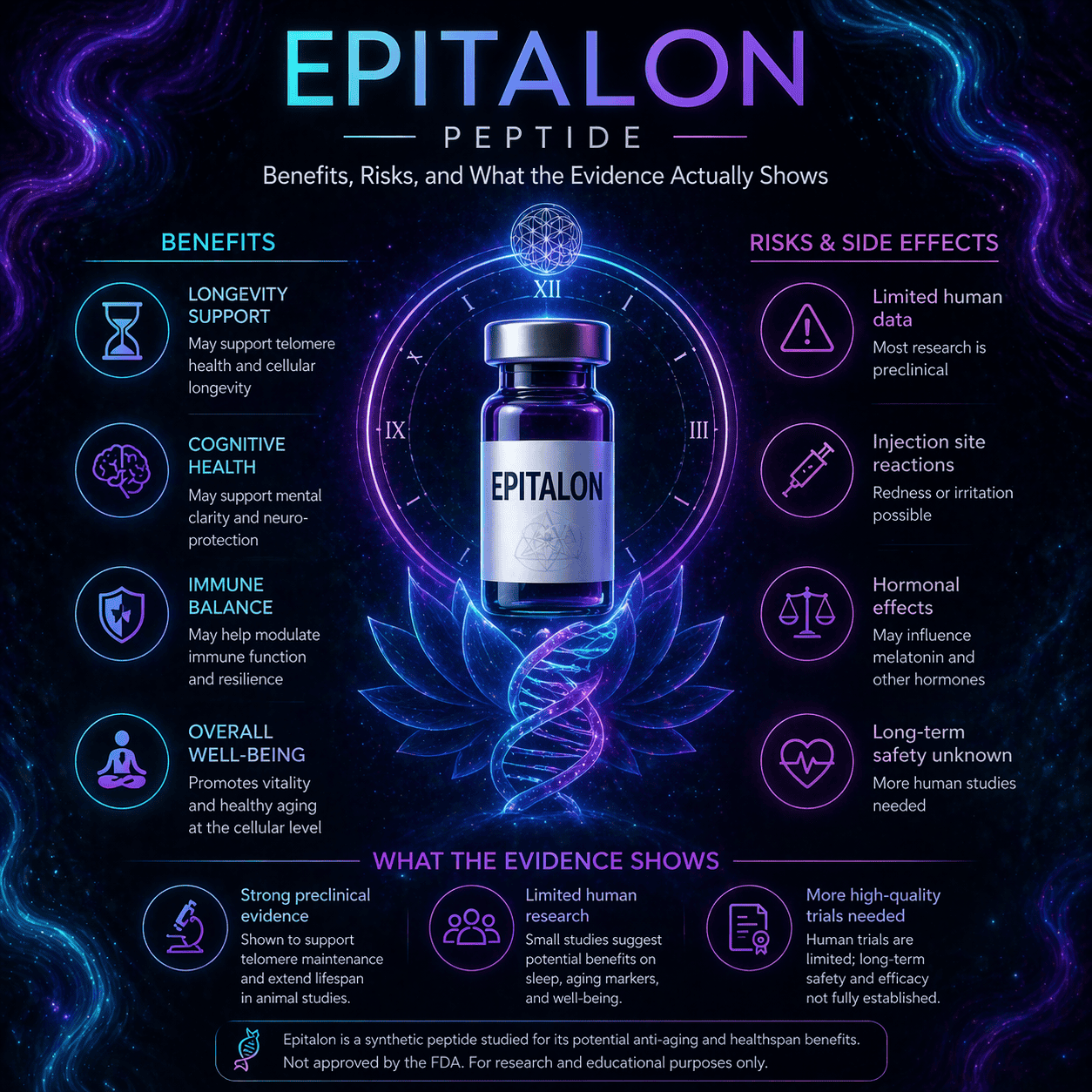
Epitalon is one of the most talked-about “longevity peptides” because it sits at the intersection of telomeres, pineal-gland biology, melatonin, and aging research. It is not a random internet peptide with no scientific history. It is a tetrapeptide, Ala-Glu-Asp-Gly, also called AEDG or epithalon, originally linked to the pineal peptide extract epithalamin.
The evidence, however, is much less settled than the marketing. Epitalon has interesting cell, animal, and older clinical signals, including telomerase and telomere research, antioxidant models, and eye-retina studies. What it does not have is a strong modern human trial base proving that it extends life, reverses aging, restores sleep, or safely works as a routine longevity therapy.
This page is specifically about Epitalon’s claimed benefits, evidence gaps, dosing uncertainty, and safety status. It is not a sourcing guide or an endorsement of gray-market peptide use.
Key terms: Epitalon, Epithalon, Epithalone, AEDG, Ala-Glu-Asp-Gly, telomerase, telomeres, pineal peptide, melatonin, longevity, epithalamin
Quick Take
Epitalon is best understood as a promising but unproven longevity-research peptide. The strongest case is mechanistic and preclinical. The weakest part of the claim is the leap from telomere and pineal biology to “proven anti-aging treatment” in humans.
TL;DR decision
Epitalon is worth watching, not treating as settled. The current evidence supports scientific interest in aging biology, telomere regulation, melatonin rhythm, and retinal research, but not confident public-use claims for lifespan extension, sleep correction, or anti-aging therapy.
Evidence standard: human trials, dose ranges, guideline-level sources when available
Who this is for: people hearing about Epitalon for longevity, telomeres, sleep, pineal function, eye health, or anti-aging and wanting a careful evidence-based read
Who this is not for: anyone looking for sourcing, injection protocols, or reassurance that Epitalon is already a proven human longevity therapy
Reviewed by: VerifiedSupps Editorial Team
Last reviewed: April 20, 2026
Parent Hub
VerifiedSupps Articles
Browse the broader article hub if you want a calmer framework before treating any peptide with a longevity story as clinically proven.
Epitalon evidence decoder: what is actually supported?
This table separates the strongest mechanism claims from the biggest marketing leaps.
| If your real goal is… | Best current answer | Why | Best honest framing |
|---|---|---|---|
| Lifespan extension | Not proven in humans | Animal and older peptide-literature signals exist, but no modern approval-grade human longevity trial proves lifespan extension | Interesting geroscience, weak clinical certainty |
| Telomere or telomerase support | Mechanistically plausible | Cell-line studies report telomerase-related and telomere-length changes, but this does not prove longer healthy life | Mechanism, not outcome |
| Sleep or melatonin rhythm | Possible but underproven | Pineal and melatonin-related research exists, but controlled healthy-user sleep trials are not strong | Plausible, not settled |
| Routine medical or supplement use | No | FDA flags compounded epitalon for immunogenicity and impurity concerns, and NCATS describes it as not approved in the U.S. or Europe | Unsettled safety and regulatory status |
Best next step (today): Evaluate Epitalon as a research peptide with intriguing aging mechanisms, not as a proven longevity intervention.
Does Epitalon actually work for longevity?
There is not enough modern human evidence to say that Epitalon works for longevity. It has interesting aging-related biology and older research signals, but it has not proven that it extends healthy human lifespan.
This is where the conversation often goes wrong. A peptide can affect telomerase, antioxidant systems, melatonin biology, chromatin state, or animal aging markers and still fail to prove real longevity benefit in humans. Epitalon belongs in that “promising but unproven” category.
Mechanism
- Epitalon is an AEDG tetrapeptide linked to the pineal peptide extract epithalamin and studied for geroprotective and neuroendocrine effects.
- Research links Epitalon to telomerase, antioxidant enzymes, melatonin-related biology, and gene-expression regulation.
- Those mechanisms are biologically interesting, but they are not the same as proof of slower human aging or longer lifespan.
What would change my recommendation: independent, well-controlled human trials showing clinically meaningful aging, sleep, function, or disease-risk outcomes, not only biomarker or cell-line changes.
What dose or cycle of Epitalon is proven?
No public-use dose or cycle of Epitalon is clinically proven. Online protocols are not the same as validated dosing.
This matters because Epitalon is often discussed in “cycles,” usually with confident numbers and timing claims. But a clinically established protocol would require a defined indication, route, dose, duration, safety monitoring, and human outcome data. That standard has not been met.
| What people ask | Evidence-based answer |
|---|---|
| What dose is best? | No validated public-use dose can be called best. |
| How long should a cycle last? | No cycle length is proven for longevity, sleep, telomeres, or anti-aging. |
| Which route is safest? | The current safety story is unresolved, and FDA has specifically flagged route-related immunogenicity concerns for compounded epitalon. |
The practical takeaway is simple: any confident internet dosing schedule is operating ahead of the evidence.
Does Epitalon need specific timing to work?
No timing schedule has been proven to make Epitalon work. The timing story is mostly theoretical and is usually tied to pineal function, circadian rhythm, and melatonin biology.
That theory is understandable. If a peptide is discussed in relation to the pineal gland and melatonin, people naturally wonder whether nighttime, fasting, sleep stage, or seasonal timing matters. But without controlled human timing trials, this remains speculation.
The safest current answer is that timing claims should be treated as protocol folklore unless they are attached to a specific clinical study and outcome.
Does Epitalon increase telomeres or telomerase?
Epitalon has been linked to telomerase activation and telomere-length changes in cell studies, including newer quantitative work in human cell lines. That is one of the main reasons it became famous in longevity circles.
But there are two major cautions. First, cell-line findings do not automatically translate into safe, meaningful human longevity outcomes. Second, telomerase biology is not inherently simple. Telomerase can support cell maintenance, but telomerase reactivation is also a central feature of many cancers. A telomerase-related mechanism should be handled carefully, not marketed casually.
What is supported
Epitalon can affect telomerase and telomere-related markers in cell research.
What is not proven
That taking Epitalon safely extends healthy human lifespan or meaningfully reverses biological age.
The best frame is “telomere-relevant mechanism,” not “proven human anti-aging therapy.”
Does Epitalon help sleep, melatonin, or circadian rhythm?
Possibly, but the evidence is not strong enough to call Epitalon a proven sleep treatment. The sleep story comes from its pineal-gland origin and from research suggesting effects on melatonin-related biology, especially in aging contexts.
This is a plausible pathway, but it is not the same as having strong controlled trials showing reliable improvements in sleep onset, sleep duration, sleep architecture, or daytime function in typical users. Anecdotes about sleep improvement should not be treated as proof.
The calm answer is that Epitalon may be relevant to circadian and pineal biology, but it is not a substitute for diagnosing sleep disorders, circadian rhythm problems, insomnia, depression, sleep apnea, medication effects, or poor sleep hygiene.
What human evidence exists for Epitalon?
There is some human-oriented evidence, but it is uneven and not enough for mainstream approval-grade claims. The better-known clinical areas include older Russian or Eastern European peptide research, retinal disease discussions, epithalamin-related aging studies, and small or specialized clinical reports.
One reason this topic is difficult is that Epitalon is often blended with epithalamin, the pineal extract that inspired it. Those are related historically, but they are not identical. Evidence for an extract does not automatically become proof for a synthetic tetrapeptide, and older regional clinical data do not always meet the design standards expected for modern global drug approval.
The cleanest read is that Epitalon has enough history to deserve scientific attention, but not enough modern human evidence to justify confident anti-aging, dementia-prevention, sleep-treatment, or longevity claims.
Is Epitalon safe and legal right now?
Epitalon’s safety and regulatory story is not settled. NCATS describes Epitalon as still under preclinical and clinical development and not approved for therapeutic or prophylactic use by a government health authority in the U.S. or Europe. FDA also lists epitalon among bulk drug substances that may present significant safety risks in compounding.
FDA’s specific concern is that compounded drugs containing epitalon may pose immunogenicity risk for certain routes of administration because of aggregation and peptide-related impurities. FDA also says it has not identified safety-related information for the proposed route of administration and lacks enough information to know whether it would cause harm in humans.
That does not prove every Epitalon product is harmful. It does mean the current safety confidence should be low, especially for unverified injectable or compounded products.
What should you do before trying Epitalon?
The safest move is to treat Epitalon as an experimental peptide rather than a routine supplement. Its most exciting claims are still ahead of the evidence.
Common mistakes
- Assuming telomerase activation automatically means safer or longer human life.
- Treating epithalamin extract studies as direct proof for synthetic Epitalon protocols.
- Using anecdotal sleep reports as proof of circadian repair.
- Ignoring FDA’s immunogenicity, impurity, and safety-information concerns.
Clean test protocol
| Inputs | A clear goal, a realistic understanding that longevity proof is incomplete, and medical review of existing conditions, sleep problems, cancer history, immune issues, and medications |
|---|---|
| Duration | Reassess only when stronger controlled human outcome trials or clearer regulatory decisions become available. Current evidence is not enough for confident routine use. |
| 3 metrics | Whether the evidence is cell, animal, or human; whether the claimed benefit is a biomarker or real outcome; and whether the route and product quality are medically legitimate |
| Stop conditions | Any gray-market sourcing, any cancer-active or immune-related concern without physician review, or any claim that Epitalon is proven to reverse aging, extend life, or replace medical care |
How to tell it’s working
Right now, the better test is whether your interpretation becomes more precise. A good Epitalon review should make you less impressed by vague “longevity peptide” language and more focused on evidence tier, route, human outcomes, and safety status.
Red flags / seek care
Seek medical care for severe swelling, rash, trouble breathing, chest pain, fainting, neurological changes, or strong reactions after using any unverified peptide product. Treat uncertain source quality as a safety problem, not a technical detail.
Selected Professional References
These are the most useful sources for understanding Epitalon’s identity, telomere and aging biology, human-evidence gaps, and current safety status.
FDA Risk Language for Epitalon
The most important official source for why Epitalon’s compounded-product safety story is not settled.
Used for: immunogenicity, aggregation, impurities, and limited safety information
Epitalon Drug and Development Status
A useful official reference for the current non-approved status in the U.S. and Europe.
Used for: approval status and development context
Epitalon and Telomere Length in Human Cell Lines
Helpful for the strongest modern telomere-mechanism discussion, while keeping the finding in cell-line context.
Used for: telomerase and telomere mechanism, not human longevity proof
Epitalon, Lifespan Markers, and Tumor Incidence in Mice
Useful because it shows why the longevity story became interesting, while also showing that mean lifespan did not increase in that mouse model.
Used for: animal aging context and limits
Epithalamin / Epithalon Cognitive Vitality Summary
A useful cautious summary for brain-health, melatonin, dementia, and healthy-aging evidence gaps.
Used for: sleep, melatonin, and dementia-proof limitations
Epitalon and Retinitis Pigmentosa
Helpful for the older human clinical discussion around retina-related use, while keeping it separate from longevity claims.
Used for: human clinical-evidence context outside longevity
Antioxidant Properties of Pineal Peptides
Useful for the oxidative-stress and pineal-peptide mechanism layer often used in Epitalon discussions.
Used for: antioxidant mechanism context
April 2026 503A Category Update
Useful for the current policy context around peptides under compounding review.
Used for: current FDA compounding-policy context
Go Deeper (VerifiedSupps Guides)
These are the best next reads if you want the longevity-peptide and safety cluster to make more sense after the Epitalon evidence picture is clear.
Are Peptides Safe?
Best next read if you want the broader safety framework before trusting any longevity peptide claim.
MOTS-c Peptide
Helpful if you want another example of a peptide where mechanism is exciting but human proof is still catching up.
BPC-157: What Does It Do?
Useful if you want another peptide case where online confidence often exceeds human clinical evidence.
GHK-Cu for Skin and Hair
Helpful if your next question is how peptide evidence changes when the target is skin aging rather than whole-body longevity.
Final Takeaway
Epitalon is one of the more interesting longevity peptides because the biology is genuinely compelling: telomeres, telomerase, melatonin, pineal function, antioxidant pathways, and aging models all make it worth watching. But the clinical conclusion should stay conservative. The evidence does not yet support calling Epitalon a proven anti-aging therapy, a validated sleep treatment, or a safe routine longevity protocol. The best current answer is: promising research peptide, incomplete human proof, and real safety uncertainty.
FAQ
What is Epitalon?
Epitalon is a synthetic tetrapeptide, Ala-Glu-Asp-Gly, also called AEDG or epithalon. It is linked historically to epithalamin, a pineal peptide extract.
Does Epitalon actually work for longevity?
Epitalon has interesting aging-related mechanisms and preclinical signals, but it has not proven that it extends healthy human lifespan.
Does Epitalon increase telomeres?
Cell-line studies suggest Epitalon can affect telomerase and telomere-related markers, but that does not prove safe or meaningful human lifespan extension.
Does Epitalon help sleep?
Epitalon may be relevant to pineal and melatonin biology, but controlled human evidence for reliable sleep improvement is not strong enough to call it a proven sleep treatment.
What dose of Epitalon is proven?
No public-use dose or cycle of Epitalon is clinically proven for longevity, sleep, telomeres, or anti-aging.
Is Epitalon the same as epithalamin?
No. Epithalamin is a pineal extract, while Epitalon is a synthetic tetrapeptide inspired by that research. Related evidence should not be treated as automatically interchangeable.
Is Epitalon approved?
NCATS describes Epitalon as still under preclinical and clinical development and not approved for therapeutic or prophylactic use in the United States or Europe.
Is Epitalon safe?
Epitalon’s safety is not settled. FDA says compounded epitalon may pose immunogenicity risk for certain routes and that it lacks sufficient safety information for the proposed route of administration.
Why is Epitalon so popular online?
Epitalon is popular because it connects to telomeres, telomerase, melatonin, and longevity biology. Those ideas are interesting, but the human proof is much weaker than the marketing usually suggests.
What is the safest way to think about Epitalon right now?
Treat Epitalon as a promising research peptide with interesting aging-related biology, not as a proven anti-aging, sleep, telomere, or lifespan therapy.
VerifiedSupps Medical Disclaimer
This content is for educational purposes only and is not medical advice. Epitalon is not a routine approved anti-aging, sleep, telomere, or longevity therapy. Interesting aging-related biology should not be confused with proven clinical benefit. Do not use unverified peptide products as a substitute for evidence-based medical care, cancer screening, sleep evaluation, or prescribed treatment. Seek urgent medical care for chest pain, fainting, trouble breathing, severe swelling, neurological symptoms, or strong reactions after any peptide product.