By VerifiedSupps Editorial Team
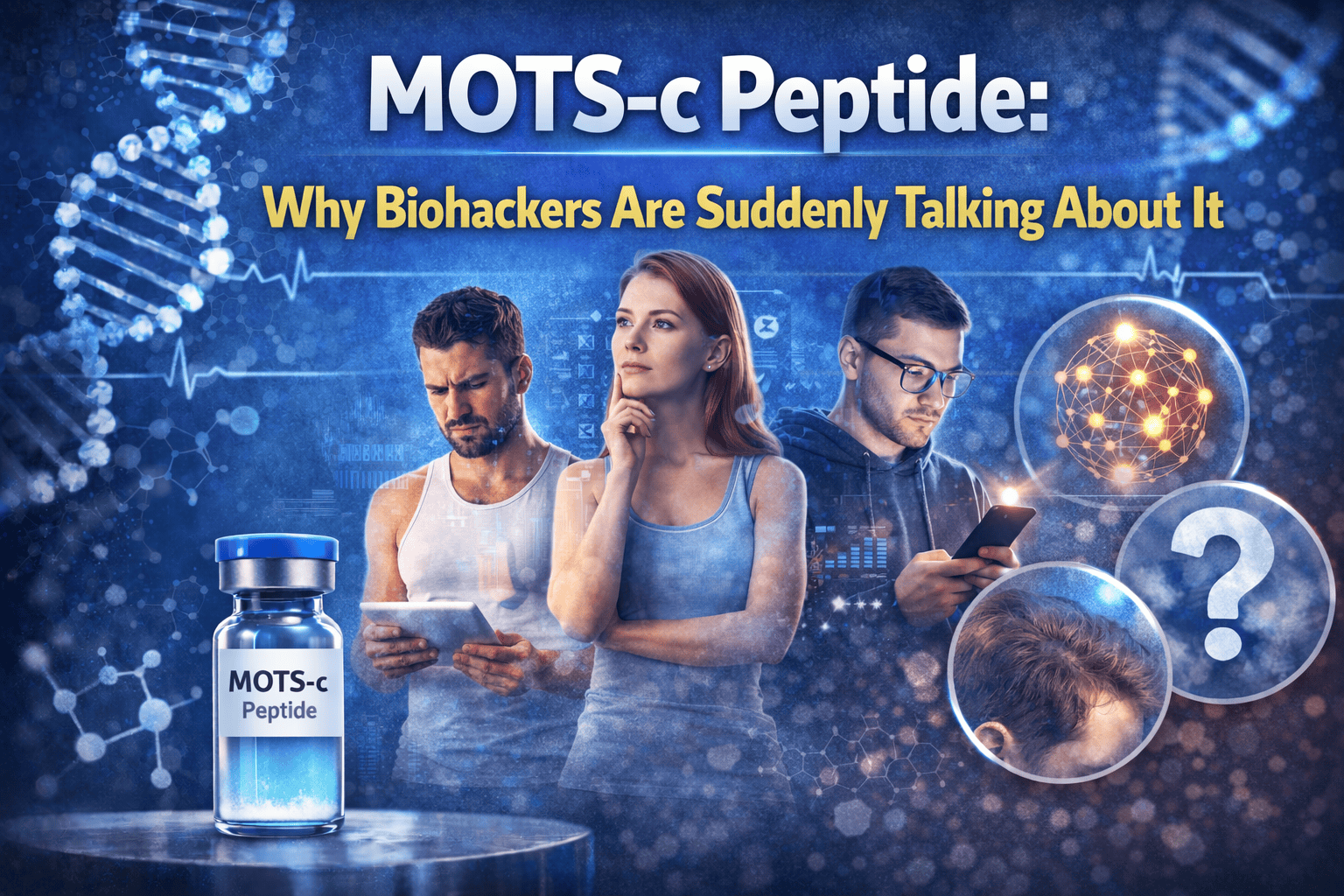
MOTS-c: Why Biohackers Are Suddenly Talking About It
MOTS-c is getting attention because it hits a very specific biohacker nerve: it is a mitochondrial-derived peptide with animal data suggesting better insulin sensitivity, protection against diet-induced obesity, and exercise-mimetic effects. That combination makes it sound like a metabolism, performance, and longevity shortcut all at once.
But the human story is still much thinner than the buzz. There are no published randomized therapeutic results for MOTS-c itself yet. What we mostly have are strong mouse data, human biomarker studies, an acute human exercise-response signal, and now a newly enrolling phase 2a trial in prediabetes and overweight or obesity.
This page is for the real MOTS-c question: what it is, why the hype is rising now, what the human evidence actually looks like, and why the legal and safety picture still should make you slow down.
Key terms: MOTS-c, mitochondrial-derived peptide, exercise mimetic, AMPK, insulin sensitivity, metabolic flexibility, prediabetes, obesity, aging, biohacking
Quick Take
Biohackers are suddenly talking about MOTS-c because it sounds like a mitochondrial exercise mimetic that could touch fat loss, insulin sensitivity, and healthy aging all at once. The problem is that the current human evidence is still far behind that story.
TL;DR decision
MOTS-c is interesting for a reason. But right now it is still much more of a promising research peptide than a proven human tool for fat loss, performance, or longevity.
Evidence standard: human trials, dose ranges, guideline-level sources when available
Who this is for: people hearing about MOTS-c for longevity, fat loss, exercise, or metabolism and trying to figure out whether the excitement is earned
Who this is not for: anyone looking for sourcing advice, underground injection protocols, or reassurance that a research peptide is already clinically settled
Reviewed by: VerifiedSupps Editorial Team
Last reviewed: April 16, 2026
Parent Hub
VerifiedSupps Articles
Use the broader article hub if you want a calmer framework before treating the newest peptide trend like a finished clinical answer.
Quick reality check: why is MOTS-c suddenly getting so much attention?
Because it checks almost every modern biohacker box at once: mitochondria, exercise, insulin sensitivity, longevity, and now an actual human trial.
| Why people are interested | What the evidence actually says | Best honest framing | Confidence |
|---|---|---|---|
| It sounds like an exercise mimetic | Exercise increases endogenous MOTS-c in humans; treatment improves physical performance in mice | Interesting biology, not proven human ergogenic therapy | Moderate |
| It sounds like a fat-loss or insulin-sensitivity peptide | Mice data are strong; human treatment data are still basically absent | Promising preclinical tool, not proven human therapy | Low to moderate |
| A real human trial just started | A phase 2a trial is now enrolling adults with prediabetes and overweight or obesity | Translation may finally be starting, but results are not here yet | High for trial existence, low for efficacy outcome |
| FDA and sports regulators are paying attention | FDA will discuss MOTS-c in July 2026 compounding talks; USADA says it is not approved and is prohibited in sport | Regulatory attention makes the peptide feel more real, but not more proven | High |
Best next step (today): Read MOTS-c as a peptide with a strong mouse story and a newly starting human-translation story, not as a finished answer that is merely “underground.”
Why are biohackers suddenly talking about MOTS-c?
Because MOTS-c sounds like a perfect modern peptide story. It is mitochondrial. It is tied to AMPK. It is discussed as an exercise mimetic. It has mouse data for insulin sensitivity and obesity resistance. And now it finally has a real phase 2a human study in metabolic dysfunction.
That combination is enough to make the peptide feel like a hidden upgrade for metabolism and aging. Add in the fact that it is prohibited in sport, and the mythology grows even faster. Substances do not get banned because they are fake, so the sports-ban angle makes some people assume the performance benefits must already be substantial. That leap is not evidence-based.
The real reason MOTS-c is suddenly louder is not that the science changed overnight. It is that several storylines finally collided: a cool mechanism, strong animal work, a real human trial, and more visible regulator attention.
What is MOTS-c and how is it supposed to work?
MOTS-c is a 16-amino-acid peptide encoded within the mitochondrial genome. That alone is enough to make it unusual. It is not just another lab-built fitness peptide. It comes from a short open reading frame in mitochondrial 12S rRNA, which is why it gets framed as a mitochondrial-derived signaling molecule rather than a standard hormone.
The 2015 Cell Metabolism paper described skeletal muscle as its main apparent target and tied its cellular action to the folate-purine-AMPK pathway. In plain English, the scientific appeal is that MOTS-c looks like a mitochondrial signal that can influence glucose handling, energy balance, and metabolic adaptation rather than simply forcing one narrow downstream effect.
Mechanism
- It appears to improve metabolic homeostasis in mice, especially under conditions of diet stress and age-related insulin resistance.
- It is repeatedly linked to AMPK-related signaling, which is one reason it gets compared to exercise or metabolic stress adaptation.
- It also appears to regulate adaptive nuclear gene expression and skeletal-muscle stress responses, which deepens the longevity and performance narrative around it.
What would change my recommendation: large human trials showing that this mitochondrial mechanism actually translates into real treatment benefit rather than just an elegant theory.
Does MOTS-c actually help weight loss or insulin sensitivity in humans?
Not in the way the current buzz often implies. The clean answer is that we still do not have published randomized therapeutic results for MOTS-c itself in humans. What we mostly have are biomarker studies and exercise-response studies, not proof that injecting or taking MOTS-c meaningfully changes human body fat or insulin sensitivity.
That matters because the preclinical story is much stronger. In mice, MOTS-c treatment prevented age-dependent and high-fat-diet-induced insulin resistance and also helped against diet-induced obesity. In humans, by contrast, the evidence is much more indirect. A 2018 study found similar plasma MOTS-c concentrations in lean and obese adults, with correlations to insulin resistance markers showing up mainly in lean individuals. A later 2020 healthy-aging study found circulating MOTS-c fell with age even while skeletal-muscle expression rose in older men.
So the best human answer right now is not “it works” or “it doesn’t.” It is “the biomarker story is interesting, but therapeutic proof is still missing.”
Does MOTS-c really work like an exercise mimetic?
That phrase is directionally understandable but easy to overread. It is fair to say MOTS-c has exercise-mimetic qualities in preclinical work and that human exercise itself can increase endogenous MOTS-c. It is not fair to jump from that to “MOTS-c is proven to replace exercise in humans.”
The strongest human acute signal comes from the 2021 Nature Communications study. In ten healthy young men, cycling exercise increased endogenous skeletal-muscle MOTS-c by about 11.9-fold after exercise, while circulating MOTS-c rose about 1.6-fold during exercise and 1.5-fold after. That is one of the main reasons people started calling it an exercise-response peptide rather than just another metabolic marker.
A second human signal came from a 16-week aerobic and resistance intervention in overweight or obese breast-cancer survivors, where MOTS-c increased in non-Hispanic White participants and was associated with better body composition and metabolic markers. That is interesting, but it is still not the same as proving exogenous MOTS-c therapy delivers those same benefits in the general public.
So yes, the exercise-mimetic label has a real scientific basis. No, it is not a license to treat MOTS-c like bottled exercise.
What dose of MOTS-c has actually been studied?
There is no validated public-use dose for MOTS-c that you can honestly call established. That is one of the clearest signs that the peptide is still in the experimental stage.
In the preclinical literature, different animal studies use different regimens. But that does not give consumers a reliable human protocol. The current phase 2a MOTS-MET trial confirms only that formal human therapeutic testing is beginning in a real way. It does not give you a clean consumer dosing blueprint.
The public trial listing tells us the study is testing 12 weeks of subcutaneous MOTS-c versus placebo in adults with prediabetes and overweight or obesity, with safety follow-up through week 16. What it does not give the public is a settled everyday-use answer. That gap is exactly why “dosing advice” around MOTS-c is usually much more confident than the evidence deserves.
Is MOTS-c safe and legal to use?
Right now, this is not a comfortable safety story. MOTS-c is still experimental, not FDA-approved, not a legitimate dietary ingredient, and not something you should treat like a casual longevity supplement.
FDA’s current compounding-risk page says compounded drugs containing MOTS-c may pose significant risk for immunogenicity for certain routes of administration and may also involve peptide-related impurity and active-pharmaceutical-ingredient characterization issues. FDA also states that it has not identified human exposure data on drug products containing MOTS-c administered by any route and lacks important information about whether it would cause harm in humans.
There is also a legal and sports-governance angle that matters. USADA says MOTS-c is not approved by FDA for human use, is not legitimate in dietary supplements, and is prohibited at all times in sport because it sits under WADA’s AMPK-activator language. Athletes also cannot get a Therapeutic Use Exemption for it because there is no approved therapeutic use.
A final reason people are talking about it right now is regulatory visibility. FDA has already scheduled a July 2026 Pharmacy Compounding Advisory Committee meeting where MOTS-c-related bulk drug substances will be discussed for obesity and osteoporosis. That does not make the peptide safe, approved, or clinically settled. It just means it is officially on the radar.
What should you do before trying MOTS-c?
Treat this as a research story, not a retail story. The biggest mistake is assuming that because the mechanism is cool and the mouse data are strong, the peptide is already ready for ordinary self-use. It is not.
Common mistakes
- Treating animal metabolic results like proven human fat-loss results.
- Treating “exercise mimetic” as if it means “proven to replace exercise.”
- Using sports prohibition or FDA discussion as proof of real-world therapeutic effectiveness.
- Assuming anything sold online as MOTS-c is legitimate just because a real phase 2a study now exists.
Clean test protocol
| Inputs | A clear reason for interest, a realistic understanding that the best evidence is still preclinical, and a willingness to treat current human data as incomplete rather than settled |
|---|---|
| Duration | Reassess when actual phase 2a human results are published. Until then, the smart posture is watchful interest, not clinical certainty. |
| 3 metrics | Whether published human treatment data finally appear, whether those results actually improve insulin sensitivity or weight in real patients, and whether the safety picture becomes more defined rather than staying vague |
| Stop conditions | Any online seller pitching “real” MOTS-c for body composition or longevity now, any attempt to blur approval status, or any injection use based only on peptide-forum confidence rather than actual human outcomes |
How to tell it’s working
Right now, for most people, the more useful test is whether you are reading the science clearly. If MOTS-c ever becomes a real therapy, the proof should show up as reproducible improvements in insulin sensitivity, metabolic markers, body composition, or physical function in published human trials, not just in mouse studies and social-media clips.
Red flags / seek care
If you are using any unverified product sold as MOTS-c and develop persistent vomiting, severe swelling, chest pain, fainting, palpitations, trouble breathing, or a strong injection-site reaction, stop and seek medical care. Also treat source uncertainty itself as a safety problem, not just a technical detail.
Selected Professional References
These are the most useful sources for understanding why MOTS-c is interesting, why the hype is rising now, and why the human-translation story is still incomplete.
Cell Metabolism: MOTS-c and Metabolic Homeostasis
The foundational paper behind the insulin-sensitivity, obesity, and mitochondrial-signaling claims.
Used for: discovery, AMPK link, mouse obesity and insulin-resistance protection
Nature Communications: MOTS-c as an Exercise-Induced Regulator
The key reason MOTS-c became an exercise-mimetic topic in the first place.
Used for: human exercise-induced increases and mouse physical-performance data
Aging: MOTS-c in Healthy Aging Men
Useful because it shows how the human biomarker story gets more complicated with age rather than cleaner.
Used for: lower circulating levels with age and higher muscle expression in older men
Plasma MOTS-c Levels in Lean and Obese Adults
A useful reminder that the human obesity story is far less dramatic than the mouse story.
Used for: human plasma levels and insulin-sensitivity associations
Scientific Reports: Exercise and MOTS-c in Breast Cancer Survivors
Helpful for showing that human exercise interventions can shift MOTS-c, but not in a universally simple way.
Used for: longer human exercise-response context
MOTS-MET Phase 2a Trial Listing
This is one of the main reasons the peptide feels newly relevant in 2026.
Used for: currently enrolling phase 2a human translation
FDA: MOTS-c Compounding Risk Language
The most important official source for why MOTS-c is not a casual safety story.
Used for: immunogenicity, impurities, and lack of human exposure data
July 2026 FDA Pharmacy Compounding Advisory Meeting
A good explanation for why MOTS-c has become a more visible peptide topic this year.
Used for: current regulatory attention and evaluated use cases
USADA: What Is the MOTS-c Peptide?
Useful because it puts approval status, supplement status, and sports prohibition in one place.
Used for: not approved, not a dietary ingredient, prohibited in sport
Go Deeper (VerifiedSupps Guides)
Use these next if your real goal is metabolism, aging, body composition, or simply building a better filter for new-ingredient hype.
Longevity Benefits of NAD
A better next read if your real interest in MOTS-c is actually about mitochondria, aging, and metabolic longevity.
Berberine Benefits
Useful if your real focus is insulin sensitivity and glucose support through a more established non-peptide lane.
How Much Protein Do You Actually Need?
Helpful if your real goal is body composition, performance, or muscle support without leaning on experimental peptides.
How to Choose Supplements Without Guesswork
The best next read if MOTS-c mainly got your attention because it sounded advanced, rare, or more “cutting edge” than the evidence really is.
Final Takeaway
Biohackers are talking about MOTS-c because the peptide sits right at the intersection of three irresistible ideas: mitochondrial signaling, exercise-like effects, and better metabolism. The science behind that interest is not fake. But the human therapeutic story is still very incomplete. The cleanest way to think about MOTS-c right now is not “hidden miracle” or “obvious scam.” It is “serious research peptide with strong preclinical appeal, real early human relevance, and nowhere near enough published human treatment data to act like the case is already closed.”
FAQ
What is MOTS-c?
MOTS-c is a 16-amino-acid mitochondrial-derived peptide encoded within the mitochondrial genome and linked to metabolic regulation and AMPK-related signaling.
Why are biohackers suddenly talking about MOTS-c?
Because it combines several attention-grabbing ideas at once: mitochondrial signaling, exercise-mimetic claims, insulin sensitivity, fat-loss potential, and now a newly enrolling human phase 2a study.
Does MOTS-c help weight loss in humans?
That is not proven yet. The strongest weight-loss and insulin-sensitivity data are still preclinical, not published human treatment results.
Is MOTS-c an exercise mimetic?
It has exercise-mimetic qualities in preclinical work, and human exercise can raise endogenous MOTS-c. But that is not the same as proving exogenous MOTS-c therapy can replace exercise in humans.
Is MOTS-c approved for human use?
No. MOTS-c is still experimental and is not approved by FDA for human use.
Is there a real human MOTS-c trial now?
Yes. A phase 2a study in adults with prediabetes and overweight or obesity began enrolling in 2026, but results are not available yet.
Is MOTS-c legal in supplements?
No. USADA says MOTS-c is not a legitimate dietary ingredient and cannot legally be used in dietary supplements.
Is MOTS-c banned in sport?
Yes. USADA states that MOTS-c is prohibited at all times under WADA’s AMPK-activator language.
Is there a proven MOTS-c dose for consumers?
No. There is no established public-use therapeutic dose backed by published human treatment data.
What is the safest way to think about MOTS-c right now?
Treat it as a promising research peptide with interesting biology and limited human translation so far, not as a settled fat-loss or longevity therapy.
VerifiedSupps Medical Disclaimer
This content is for educational purposes only and is not medical advice. MOTS-c is an experimental peptide, not an approved therapy for weight loss, diabetes, performance, or longevity. Strong mouse data and interesting human exercise-response data do not replace published human treatment outcomes. Do not use unverified products sold as MOTS-c as a substitute for medical care, evidence-based obesity treatment, or normal exercise and nutrition. Seek urgent medical care for chest pain, fainting, trouble breathing, severe swelling, persistent vomiting, or significant reactions after using any unverified peptide product.