By VerifiedSupps Editorial Team
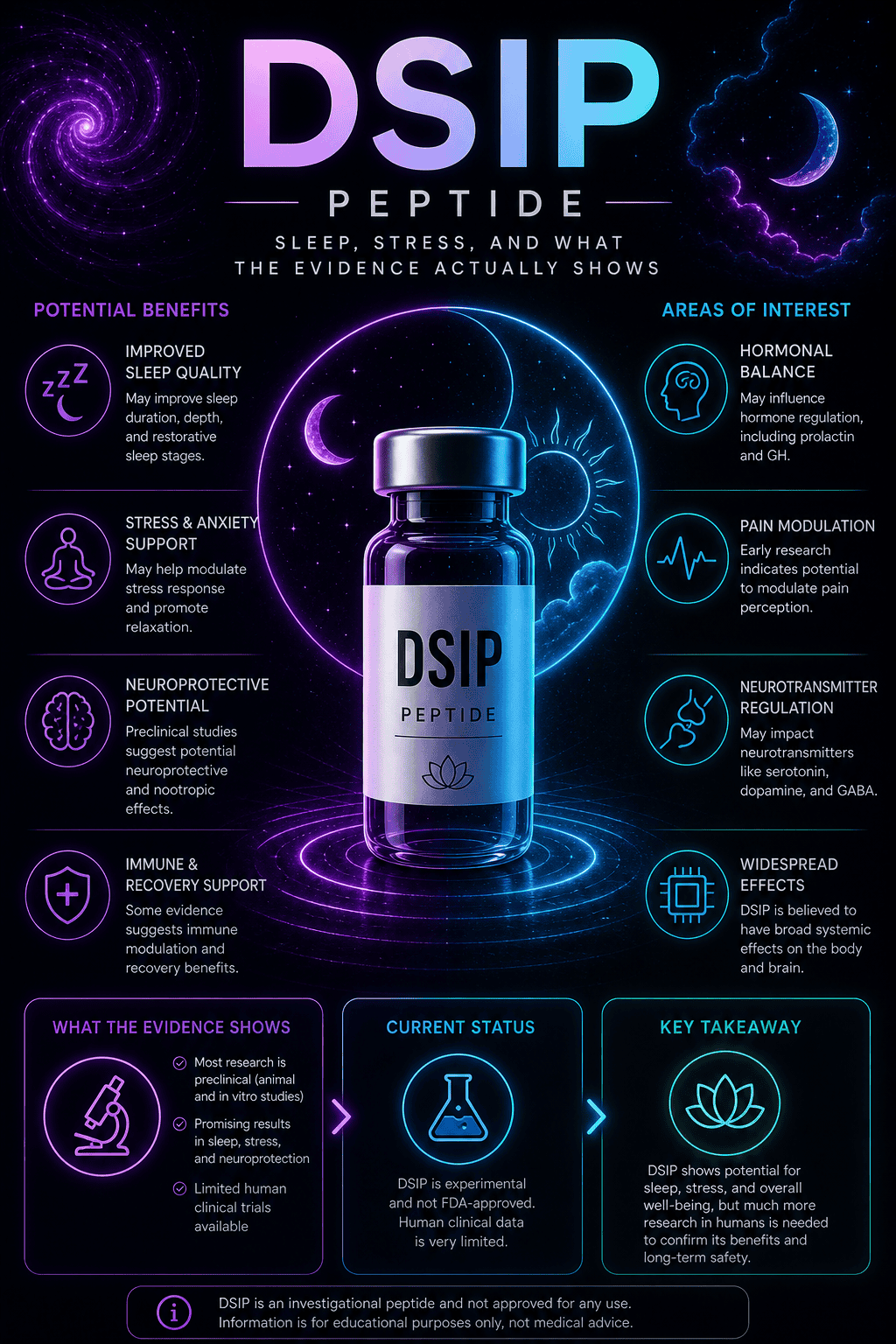
DSIP Peptide: Sleep, Stress, and What the Evidence Actually Shows
DSIP, short for delta sleep-inducing peptide, sounds like a direct answer for poor sleep. The evidence is much less direct: human studies are old, small, mostly injection-based, and mixed.
The practical answer is cautious: DSIP is interesting as a sleep-regulation research peptide, but it is not a proven first-line sleep treatment, not a standard insomnia medication, and not something to self-source for chronic sleep problems.
This guide focuses on DSIP sleep evidence, stress claims, studied dosing context, safety gaps, and current practical status; it does not provide injection instructions, sourcing advice, or a full insomnia treatment plan.
Key terms: DSIP, delta sleep-inducing peptide, emideltide, slow-wave sleep, insomnia, ACTH, cortisol, research peptide
Quick Take
DSIP may influence sleep architecture in some small studies, but the clinical evidence is not strong enough to treat it like a reliable insomnia solution. The best-supported sleep path still starts with diagnosis, CBT-I-style behavioral treatment, and targeted medical care when symptoms are persistent or severe.
TL;DR decision
Do not make DSIP your first move for poor sleep. If insomnia is ongoing, start with a sleep diary, screen for sleep apnea and medication causes, and use clinician-guided treatment before considering any unapproved peptide.
Evidence standard: human trials, dose ranges, guideline-level sources when available
Who this is for: readers seeing DSIP promoted for sleep, stress, anxiety, recovery, or peptide protocols and wanting a grounded evidence check
Who this is not for: anyone looking for self-injection instructions, research-vial sourcing, or a substitute for insomnia diagnosis and medical care
Reviewed by: VerifiedSupps Editorial Team
Last reviewed: May 4, 2026
Parent Hub
Are Peptides Safe?
Start here for the broader safety framework: regulated medical use, research peptides, purity concerns, injection risks, and why approval status matters.
DSIP evidence decoder
This is the fastest way to read the DSIP evidence without confusing mechanism, anecdotes, and clinical proof.
| What you want | What DSIP evidence shows | Confidence level | Better next move |
|---|---|---|---|
| “I want deeper sleep tonight” | Small studies suggest possible sleep-efficiency changes, but results are not consistent enough for a dependable outcome | Low to mixed | Use a sleep diary, fixed wake time, and avoid alcohol or late stimulants first |
| “I have chronic insomnia” | Human trials were small, older, and not enough to place DSIP in guideline-level insomnia care | Not first-line | Start with CBT-I-style care and screen for medical causes |
| “My sleep is stress-related” | Stress and endocrine findings are mostly mechanistic, preclinical, or mixed in humans | Exploratory | Track stress timing, caffeine, rumination, and nighttime awakenings |
| “I found DSIP online” | Online research-peptide products are not the same as approved, labeled, clinician-supervised medication | Safety uncertain | Do not self-inject; discuss persistent sleep issues with a clinician |
Best next step (today): write down your sleep latency, nighttime awakenings, wake time, caffeine timing, alcohol use, and next-day sleepiness for seven nights before chasing a peptide solution.
Does DSIP peptide actually work for sleep?
DSIP may affect sleep in some study settings, but the evidence is not strong enough to call it a reliable insomnia treatment. The main issue is not that DSIP has no evidence; it is that the evidence is small, old, mixed, and difficult to translate into real-world use.
Mechanism
- DSIP is a nonapeptide originally linked to delta-wave sleep activity in animal research.
- Human insomnia studies explored whether DSIP could change sleep efficiency, sleep latency, awakenings, and daytime function.
- Mechanism does not prove outcome: a peptide that influences sleep signals in a lab does not automatically become a dependable insomnia therapy.
What dose of DSIP has been studied?
There is no approved consumer dose for DSIP. Older human studies often used intravenous DSIP around 25 nmol/kg in controlled settings, which should be read as research context, not a dosing recommendation.
| Study context | What was studied | What it means |
|---|---|---|
| Early human sleep studies | Intravenous DSIP, commonly described around 25 nmol/kg | Not comparable to online nasal, subcutaneous, or research-vial protocols |
| Repeated insomnia protocols | Several doses across consecutive nights under lab conditions | Research monitoring shaped the safety and interpretation |
| Modern self-use claims | Often extrapolated from old injection studies or anecdotal protocols | Not a reliable substitute for approved labeling or clinician care |
The dose problem is one reason DSIP is easy to overread. Route, purity, formulation, timing, repeated exposure, and medical screening all change the risk-benefit picture.
When would DSIP be taken for sleep in studies?
DSIP timing is not standardized for real-world sleep use. Older studies used controlled injection timing, including afternoon dosing before lab nights or morning infusion designs, but that does not create a validated bedtime protocol.
| Timing question | Evidence-based answer | Practical caution |
|---|---|---|
| Before bed? | Not established by a modern approved label | Avoid turning lab timing into DIY timing |
| Afternoon? | Some insomnia studies administered DSIP before study nights | Study timing was supervised and route-specific |
| Morning? | Some early work reported delayed sleep-related effects after morning infusion | Not enough to recommend morning use for insomnia |
For most readers, the timing question is less important than the diagnosis question. Sleep apnea, restless legs, circadian rhythm mismatch, depression, anxiety, medication effects, alcohol, and late caffeine can all look like “bad sleep” but need different solutions.
Is DSIP safe or approved for insomnia?
DSIP should be treated as an investigational peptide, not as an approved insomnia medication. Safety is not just about the molecule; it also includes route of administration, product purity, peptide impurities, sterility, immune response, and whether the sleep problem has been properly diagnosed.
| Safety issue | Why it matters | Clean decision rule |
|---|---|---|
| Regulatory status | DSIP is not part of standard, guideline-supported insomnia care | Do not treat it like a prescribed sleep medication |
| Compounded or research peptide quality | Peptide-related impurities, aggregation, sterility, and concentration accuracy can change risk | Avoid unregulated products marketed for human use |
| Hidden sleep disorder | Sleep apnea, bipolar-spectrum symptoms, PTSD, pain, reflux, and medication effects can drive insomnia | Do not mask persistent symptoms without evaluation |
| Medication and sedation context | Alcohol, sedatives, opioids, antihistamines, psychiatric medicines, and sleep aids can complicate risk | Use clinician guidance before combining anything sleep-active |
Safety uncertainty should not be interpreted as safety. For DSIP, the modern human evidence base is too thin to confidently map long-term risks, vulnerable populations, or interaction patterns.
DSIP troubleshooting: what if sleep or side effects do not make sense?
The safest troubleshooting frame is not “adjust the peptide.” It is “protect the diagnosis, reduce sleep noise, and know when symptoms are medical.”
Common mistakes
- Using DSIP before tracking the basics: wake time, caffeine, alcohol, naps, stress timing, screen use, and bedroom schedule.
- Assuming “more deep sleep” is the same as better insomnia treatment.
- Ignoring red flags such as loud snoring, witnessed pauses in breathing, severe daytime sleepiness, mood changes, panic, or medication-related insomnia.
Clean test protocol
| Inputs | Fixed wake time, consistent sleep window, caffeine cutoff, alcohol notes, evening stress notes, medication list, light exposure, and a simple sleep diary. |
|---|---|
| Duration | Track for 14 nights before judging any sleep intervention. Use clinician guidance sooner if symptoms are severe, sudden, or linked to medication changes. |
| 3 metrics | Sleep latency, wake time after sleep onset, and next-day function using a simple 1 to 10 alertness score. |
| Stop conditions | Stop self-experimenting and seek care for severe sleepiness while driving, breathing pauses during sleep, chest pain, confusion, allergic symptoms, severe mood changes, hallucinations, mania-like symptoms, or thoughts of self-harm. |
How to tell it’s working
A useful sleep intervention should improve more than a wearable score. Look for easier sleep onset, fewer long awakenings, steadier wake time, better daytime function, and less anxiety about sleep.
Red flags / seek care
Seek medical help for severe daytime sleepiness, falling asleep while driving, witnessed breathing pauses, new chest pain, fainting, severe anxiety or depression, mania-like symptoms, hallucinations, persistent vomiting after any substance use, or thoughts of self-harm.
Does DSIP help stress, anxiety, or cortisol?
DSIP has stress-related research, but it is not established as an anxiety treatment or cortisol-control therapy. Some studies suggest endocrine or stress-modulating effects, while others found little or no effect on ACTH and cortisol responses in humans.
Sleep-stress loop
Stress can worsen insomnia, and poor sleep can raise next-day stress sensitivity.
Endocrine signal
DSIP has been studied around ACTH, CRH, cortisol, and stress-related signaling.
Clinical gap
Mechanistic stress data do not equal proven anxiety relief or sleep recovery.
The practical interpretation: if your sleep problem is stress-driven, DSIP is not the clean first test. Start with the pattern you can measure: evening rumination, late caffeine, alcohol, work timing, light exposure, bedtime variability, and whether anxiety symptoms need direct treatment.
How should DSIP compare with proven sleep support?
DSIP should sit behind better-supported sleep strategies, not ahead of them. For chronic insomnia, guideline-level care favors CBT-I and diagnosis-driven treatment over unapproved sleep peptides.
| Main sleep issue | Better first step | Why it beats guessing with DSIP |
|---|---|---|
| Trouble falling asleep | Fixed wake time, stimulus control, caffeine cutoff, and light timing | Targets the behavior and circadian drivers directly |
| Waking up often | Screen for sleep apnea, pain, reflux, alcohol, nocturia, and restless legs | Avoids masking a treatable cause |
| Stress-related insomnia | CBT-I, relaxation training, worry scheduling, and anxiety care when needed | Treats the pattern that keeps the nervous system activated |
| Poor sleep quality despite enough hours | Sleep diary plus medical review of breathing, medications, mood, and alcohol | Quality problems often need diagnosis, not stronger sleep-pressure experiments |
Supplements may have a place for some sleep goals, but DSIP is not in the same category as basic sleep hygiene, CBT-I, magnesium sufficiency, or clinician-prescribed insomnia treatment. It is an investigational peptide with unresolved questions.
Selected Professional References
These sources support the evidence balance, trial context, stress discussion, safety framing, and insomnia-care comparison used in this guide.
Delta-Sleep-Inducing Peptide: A Review
Supports the basic DSIP identity, early sleep-factor concept, and historical sleep research context.
Used for: mechanism and historical framing
DSIP: A Still Unresolved Riddle
Supports the cautious interpretation that DSIP remains mechanistically interesting but clinically unresolved.
Used for: uncertainty and claim-strength limits
DSIP and 24-Hour Sleep-Wake Behavior in Severe Chronic Insomnia
Supports the older placebo-controlled insomnia evidence reporting improvements in sleep and daytime function under supervised conditions.
Used for: human sleep trial context
DSIP on Sleep of Chronic Insomniac Patients
Supports the small double-blind insomnia trial with mixed practical interpretation and limited therapeutic confidence.
Used for: mixed sleep-efficacy interpretation
DSIP Short-Term Administration in Chronic Insomniacs
Supports the point that some sleep variables moved in favorable directions while statistical and clinical significance remained limited.
Used for: trial nuance and dose-context caution
DSIP, CRH, ACTH, and Cortisol Secretion
Supports the caution that human stress-hormone findings are mixed and should not be simplified into cortisol-control claims.
Used for: stress and cortisol claim limits
FDA: Bulk Drug Substances That May Present Significant Safety Risks
Supports the safety caution around compounded emideltide/DSIP, including immunogenicity, peptide impurities, and insufficient safety information.
Used for: safety and compounding-risk framing
AASM Behavioral and Psychological Treatments for Chronic Insomnia
Supports CBT-I as a strong recommendation for chronic insomnia and helps place DSIP behind guideline-level care.
Used for: sleep-care comparison and decision hierarchy
Go Deeper (VerifiedSupps Guides)
Use these related guides to separate sleep support, peptide safety, and nervous-system claims without giving DSIP more certainty than the evidence supports.
The Complete Sleep Stack
A broader sleep-support framework for readers who want practical steps before experimental peptides.
Magnesium for Sleep Handbook
Understand when magnesium makes sense for sleep and when poor sleep needs a different explanation.
Semax Benefits
Compare another nervous-system peptide topic through the same evidence-first lens.
Epitalon Peptide
A related peptide guide for readers comparing sleep, longevity, and regulation claims.
Final Takeaway
DSIP is a historically interesting sleep peptide with small human studies and unresolved clinical value. The best decision today is to treat it as research territory, not as a proven sleep fix, and to prioritize diagnosis-driven insomnia care before considering any unapproved peptide.
FAQ
What is DSIP peptide?
DSIP stands for delta sleep-inducing peptide. It is a small peptide originally linked to delta-wave sleep research, but it remains an investigational peptide rather than a standard insomnia treatment.
Does DSIP actually improve sleep?
Possibly in some small study settings, but the evidence is mixed. Older trials reported some favorable sleep changes, while other data suggest weak or limited therapeutic benefit.
Is DSIP good for chronic insomnia?
DSIP is not a first-line chronic insomnia treatment. Guideline-level care favors CBT-I, diagnosis-driven treatment, and clinician-guided medication when appropriate.
What dose of DSIP was studied?
Older human studies often used intravenous DSIP around 25 nmol/kg in supervised research settings. That is not an approved consumer dose or a self-use protocol.
When should DSIP be taken?
There is no validated bedtime timing protocol. Older studies used controlled timing such as afternoon dosing before laboratory sleep nights or morning infusion designs.
Is DSIP safe?
Safety is not well established for routine human use. Concerns include product quality, route of administration, peptide impurities, immune reactions, sterility, interactions, and missed diagnosis of the sleep problem.
Is DSIP FDA approved?
DSIP is not an FDA-approved insomnia medication in standard clinical use. FDA compounding materials also identify safety-information gaps for emideltide, another name used for DSIP.
Does DSIP reduce stress or anxiety?
DSIP has stress-related and endocrine research, but it is not established as an anxiety treatment. Human cortisol and ACTH findings are mixed and should not be treated as proven stress relief.
Can DSIP be combined with sleep supplements?
Combining sleep-active products can increase uncertainty, especially with alcohol, sedatives, opioids, antihistamines, psychiatric medication, or diagnosed sleep disorders. Use clinician guidance rather than stacking sleep aids.
What should I try before DSIP?
Start with a sleep diary, fixed wake time, caffeine and alcohol review, light timing, CBT-I-style strategies, and medical screening for sleep apnea, restless legs, pain, reflux, mood disorders, and medication causes.
VerifiedSupps Medical Disclaimer
DSIP is an investigational peptide, not a dietary supplement or approved insomnia treatment. This article is for educational purposes only and does not provide medical advice, diagnosis, prescribing guidance, dosing instructions, injection instructions, or a recommendation to purchase unapproved products. Sleep problems can be caused by medical, psychiatric, respiratory, neurologic, medication-related, or substance-related factors. Speak with a licensed clinician if insomnia persists, and seek urgent care for severe daytime sleepiness while driving, breathing pauses during sleep, chest pain, fainting, severe allergic symptoms, hallucinations, mania-like symptoms, severe mood changes, or thoughts of self-harm.