By VerifiedSupps Editorial Team
GHK-Cu for Skin and Hair: Hype, Evidence, and Safety
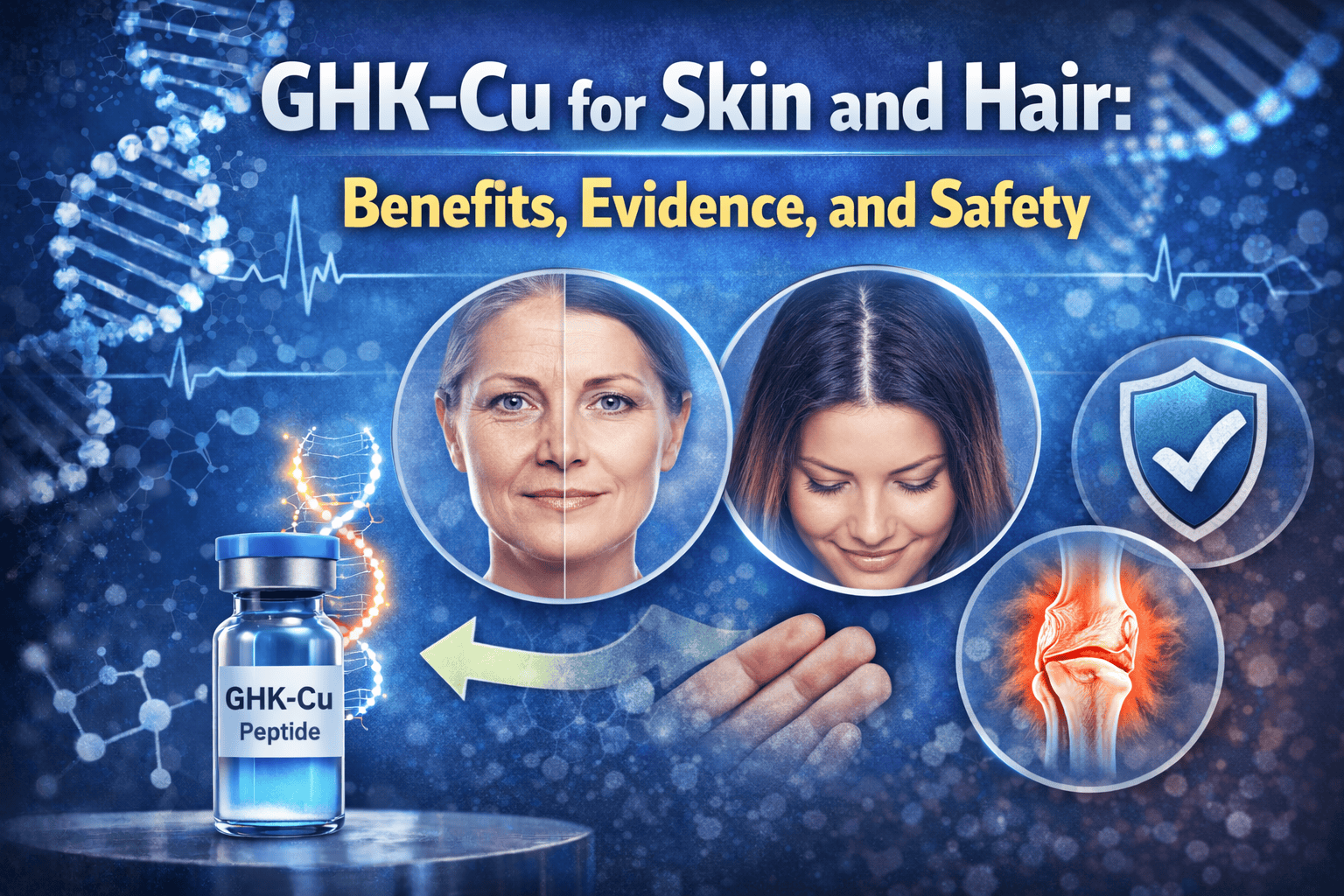
GHK-Cu is not pure hype, but it is also not as settled as the marketing often makes it sound. For skin, there is enough human signal to say topical copper peptide looks promising for photoaging and skin quality, but the studies are still smaller, older, and less definitive than many people assume.
For hair, the story is weaker. The best human signal is not really a clean GHK-Cu monotherapy story at all. It comes from a combination product using 5-aminolevulinic acid plus GHK peptide, which makes the hair case more tentative than the skin case.
This page is for the practical question: what GHK-Cu is actually good at, what the best skin and hair data really show, and why topical cosmetic use and injectable peptide use should not be treated like the same safety category.
Key terms: GHK-Cu, copper peptide, copper tripeptide-1, skin aging, wrinkles, photoaging, hair growth, scalp density, topical peptide, injectable peptide
Quick Take
GHK-Cu makes the most sense as a topical skin-care ingredient with modest but plausible anti-aging upside. It makes less sense as a hair-growth hero ingredient, and much less sense as a casually treated injectable anti-aging shortcut.
TL;DR decision
For skin, topical GHK-Cu is reasonable to try if your expectations are modest and you care about texture, fine lines, and skin quality more than dramatic transformation. For hair, the evidence is thinner and much less clean. For injectables, the safety story is much less comfortable than for ordinary topical cosmetics.
Evidence standard: human trials, dose ranges, guideline-level sources when available
Who this is for: anyone comparing GHK-Cu skin serums, hair products, or peptide clinic claims and trying to separate realistic upside from overstatement
Who this is not for: anyone looking for injectable dosing guidance, underground sourcing, or reassurance that a peptide is “safe because it’s natural”
Reviewed by: VerifiedSupps Editorial Team
Last reviewed: April 16, 2026
Parent Hub
VerifiedSupps Articles
Use the main article hub if you want a calmer framework for comparing newer cosmetic peptides against simpler, more established options.
Quick decision table: when does GHK-Cu actually make sense?
This is the fastest way to stop treating a topical cosmetic peptide like a miracle skin-and-hair fix.
| If your real goal is… | Best reading of GHK-Cu | Why | Practical expectation |
|---|---|---|---|
| Mild photoaging, skin texture, fine lines, and skin quality | Reasonable topical try | Small older human studies suggest benefits, but the evidence is not blockbuster-level | Subtle, gradual, cosmetic improvement |
| A primary hair-growth treatment | Weak fit | The best human hair trial used a 5-ALA + GHK combination, not clean GHK-Cu monotherapy | At most, complementary or experimental |
| Post-laser recovery and faster wrinkle improvement after procedures | Mixed | One randomized post-laser study did not show objective wrinkle or overall skin-quality superiority | Do not assume procedure-like results |
| Injectable anti-aging or hair rescue | Poor risk-reward | FDA flags compounded injectable GHK-Cu for immunogenicity concerns and limited human safety data | Do not treat it like ordinary skin care |
Best next step (today): If your goal is skin aging, think topical and modest. If your goal is hair, do not let GHK-Cu outrank better-established treatments just because the peptide story sounds advanced.
Does GHK-Cu actually help skin and hair?
A fair, evidence-based answer is: probably more for skin than for hair. Topical GHK-Cu has enough human skin data to be plausible as a cosmetic anti-aging ingredient. The hair case is much less convincing because the best human study used a combination formula, not clean GHK-Cu alone.
That does not make the ingredient fake. It just means the evidence is uneven. For skin, there is a real signal, but it is built from smaller and older studies, some of them abstract-level rather than the kind of modern, large, independently replicated dermatology trials people assume exist. For hair, the signal is not strong enough to treat GHK-Cu like a front-line regrowth therapy.
Mechanism
- GHK-Cu appears to influence collagen, elastin, glycosaminoglycans, and other extracellular-matrix pathways relevant to skin remodeling.
- It also has wound-healing, anti-inflammatory, and repair-related biology that makes the skin-care case more plausible than the average cosmetic peptide claim.
- For hair, the biological story includes dermal-papilla and growth-factor signaling, but the direct human proof is still too thin to treat that mechanism like a settled outcome.
What would change my recommendation: a few stronger modern randomized trials showing clear skin benefit against good comparators, and at least one cleaner human hair study using GHK-Cu itself rather than a mixed active formula.
What does GHK-Cu actually do for skin?
The most defensible skin claim is modest photoaging support. That means texture, elasticity, skin density, and fine-line improvement, not a drug-level anti-aging reset.
What looks reasonably real
Older human studies summarized in later reviews suggest improvements in skin density, thickness, laxity, and wrinkles after about 4 to 12 weeks of topical use, especially in photoaged skin.
What should make you cautious
Much of the positive skin literature is old, small, and partly abstract-level. That is not the same thing as saying it does nothing. It just means confidence should stay measured.
One older human comparison reported higher procollagen improvement with GHK-Cu than with vitamin C or retinoic acid in a very small 20-person study using thigh-skin biopsies. Later summaries also describe a 12-week 71-woman facial study and a 41-woman eye-area study with favorable wrinkle and density results. Those findings are interesting, but they should be read as encouraging cosmetic evidence, not final proof that GHK-Cu is broadly superior to established actives.
The more sobering counterweight is the 2006 randomized post-CO2-laser study. It did not show statistically significant objective improvement in wrinkles or overall skin quality versus control, even though patients using GHK-Cu reported higher satisfaction. That is exactly why the right skin framing is “promising but modest,” not “proven game changer.”
Does GHK-Cu help hair growth?
Maybe a little, but the current human evidence is too thin to rank it as a serious stand-alone hair-growth therapy. The strongest human study here did not test clean GHK-Cu alone. It tested a combination of 5-aminolevulinic acid and GHK peptide in men with pattern hair loss.
What the trial actually showed
Forty-five men used the combination once daily for 6 months. Hair count increased more in the active groups than placebo, with the 50 mg/mL group showing the strongest hair-count gain.
What it did not prove
It did not show significant differences in hair length or thickness at 6 months, and it does not prove that topical GHK-Cu alone is a reliable hair-regrowth treatment.
This is the main hair caution: a positive combo-product study is not worthless, but it is also not a clean license to make strong GHK-Cu hair claims. The broader lab literature around dermal fibroblasts, dermal papilla cells, and growth-factor signaling helps the theory, but the human proof still has not caught up.
So the honest hair answer is that GHK-Cu may be an interesting adjunct ingredient, especially in multi-active formulas, but it is not yet one of the better-proven hair-loss tools by human standards.
How do you actually use GHK-Cu for skin and hair?
For ordinary consumers, the relevant lane is topical use, not injections. In skin care, GHK-Cu is usually sold under the cosmetic ingredient name Copper Tripeptide-1. The more realistic question is not “what is the perfect dose?” but “is the product built well enough to actually deliver a hydrophilic peptide through skin or scalp?”
That matters because GHK and GHK-Cu are not effortless penetrators. Review-level and ex vivo skin-permeation work suggests that the peptide can penetrate and be retained in skin, but also makes clear that permeability is one of the central bottlenecks. In plain English: formulation quality matters more than dramatic marketing language.
For skin, a fair test window is about 8 to 12 weeks because that roughly matches the better-known photoaging studies. For hair, you need longer. The best human combo-product study ran 6 months, which is much more realistic than expecting a scalp serum to visibly change density in a few weeks.
The most honest application advice is simple: topical only, consistent use, stable routine, and no fantasy timeline.
Is GHK-Cu safe for skin and hair?
Topically, the safety story is reasonably reassuring. Injectably, it is much less reassuring. That split is the single most important safety point on the page.
Topical cosmetic use
The Cosmetic Ingredient Review panel concluded that Copper Tripeptide-1 and related tripeptide-1 ingredients are safe in present practices of use and concentration in cosmetics. Typical cosmetic concentrations are low.
Compounded injectable use
FDA flags compounded injectable GHK-Cu for possible immunogenicity risk related to aggregation and peptide impurities, and says human safety data are limited.
This is why topical copper-peptide skin care and injectable “anti-aging peptides” should never be treated as the same conversation. The topical side is a cosmetic safety question. The injectable side is a compounded-peptide risk question.
The best human hair study reported no adverse events over 6 months, which is useful but not strong enough to erase the broader limits of the evidence base. Small studies can be encouraging without settling the whole safety story.
Is injectable GHK-Cu different from topical copper-peptide skin care?
Very different. This is where a lot of the online confusion starts.
A topical serum or cream sold as Copper Tripeptide-1 is being used in the cosmetic lane, where the safety review is about current use concentrations on the skin. An injectable compounded GHK-Cu product lives in a very different lane, where issues like aggregation, impurity profile, immunogenicity, route of administration, and limited human safety data become much more important.
So if someone takes a topical anti-aging serum safety profile and casually transfers that comfort to injections, that is not evidence-based reasoning. It is category confusion.
Why do some GHK-Cu products disappoint?
Usually because the expectations are wrong, the formulation is weak, or the user is asking the ingredient to do a job it has not actually proven. The most common failure is expecting drug-level results from a cosmetic peptide with modest human evidence.
Common mistakes
- Expecting dramatic wrinkle reversal instead of gradual texture and quality changes.
- Expecting meaningful hair regrowth from GHK-Cu alone when the best human hair data do not even test it that cleanly.
- Ignoring formulation and penetration issues just because the ingredient name sounds sophisticated.
- Treating topical cosmetic use and injectable peptide use as if they share the same risk profile.
Clean test protocol
| Inputs | One well-formulated topical product, a stable routine, no major new actives added at the same time, and baseline photos for skin or scalp |
|---|---|
| Duration | Skin: 8 to 12 weeks. Hair: around 6 months if you are testing a topical formula with realistic discipline. |
| 3 metrics | Fine-line or texture change, irritation/tolerability, and hair count or shedding trend rather than vague “feels thicker” impressions |
| Stop conditions | Persistent irritation, rash, swelling, worsening scalp inflammation, or any decision to escalate into injectable use based on weak cosmetic results |
How to tell it’s working
For skin, think slightly better texture, a smoother look, and a modest fine-line improvement over time. For hair, the most honest signal is reduced shedding or a small density benefit over months, not a sudden obvious regrowth event.
Red flags / seek care
Seek medical care for severe allergic-type swelling, spreading rash, significant scalp inflammation, trouble breathing, or any injection-related reaction if someone has moved beyond topical cosmetic use.
Selected Professional References
These are the most useful sources for separating topical cosmetic use from compounded injectable use, and for understanding what the human skin and hair evidence actually looks like.
CIR Safety Assessment of Tripeptide-1 and Copper Tripeptide-1
The key source for why topical copper-peptide cosmetics and injectable peptides should not be treated like the same safety category.
Used for: topical cosmetic safety and current use concentrations
FDA Risk Language for Injectable GHK-Cu
The most important official source for the current immunogenicity and limited-human-data concerns around compounded injectable GHK-Cu.
Used for: injectable risk and limited human safety data
Topically Applied GHK as an Anti-Wrinkle Peptide
The best recent review for the anti-wrinkle story, older human volunteer studies, and the skin-permeation problem that affects real-world performance.
Used for: skin efficacy, formulation limits, and why expectations should stay moderate
5-ALA + GHK Peptide on Hair Growth
Important because it is the clearest human hair study people often use to justify copper-peptide hair claims, even though it is not clean GHK-Cu monotherapy.
Used for: hair-count results, no thickness change, and hair-evidence limitations
Effects of Topical Copper Tripeptide Complex on CO2 Laser-Resurfaced Skin
A valuable reality check because it shows that not every GHK-Cu skin question has a clearly positive human answer.
Used for: mixed clinical results and the difference between satisfaction and objective benefit
Human Skin Penetration of a Copper Tripeptide In Vitro
Useful because it explains why formulation quality matters so much for a peptide like GHK-Cu.
Used for: skin penetration, retention, and formulation realism
Anti-Aging Activity of the GHK Peptide
Helpful for tracking where the better-known skin claims came from and why so many of them trace back to small older studies and meeting abstracts.
Used for: origin of the older positive skin evidence
Go Deeper (VerifiedSupps Guides)
These are the better next reads if your real goal is skin quality, hair support, or cleaner supplement decision-making without leaning too hard on one peptide story.
Omega-3 for Skin and Hair
A stronger next read if you want more established support for barrier health, inflammation, and overall skin-hair quality.
Zinc Benefits
Helpful if your question is really about nutrient support for skin, scalp, and repair rather than a cosmetic peptide alone.
Mineral Deficiency Symptoms
Useful if hair shedding or skin changes may actually be a deficiency problem instead of a peptide problem.
How to Choose Supplements Without Guesswork
The best next read if you want a better filter for ingredient hype before adding another serum or peptide product.
Final Takeaway
GHK-Cu deserves neither the “miracle peptide” label nor the “totally useless” label. The best evidence says it is most reasonable as a topical skin-quality ingredient with modest anti-aging upside, thinner hair evidence, and a very different safety profile once people move into injectable territory. If you keep it in the cosmetic lane and keep your expectations realistic, it makes sense. If you expect it to outperform the entire rest of skin care or hair-loss treatment, that is where the hype starts outrunning the evidence.
FAQ
Does GHK-Cu actually work for skin?
Probably to a modest degree. The best human signal is in photoaged skin, where small older studies suggest improvements in skin density, thickness, fine lines, and overall skin quality.
Does GHK-Cu help hair growth?
The human evidence is much thinner than it is for skin. The best hair study used a 5-ALA plus GHK combination product, not clean GHK-Cu monotherapy.
Is GHK-Cu the same as Copper Tripeptide-1?
In cosmetic ingredient language, GHK-Cu is commonly represented as Copper Tripeptide-1.
Is GHK-Cu better than vitamin C or retinoids?
One small older study suggested stronger procollagen improvement than vitamin C or retinoic acid, but that is nowhere near enough to call GHK-Cu broadly superior to established actives.
Is topical GHK-Cu safer than injectable GHK-Cu?
Yes, they should be treated as very different risk categories. Topical Copper Tripeptide-1 has a cosmetic safety conclusion from CIR, while FDA flags compounded injectable GHK-Cu for immunogenicity risk and limited human safety data.
How long should you test GHK-Cu for skin?
A fair skin test is about 8 to 12 weeks, because that roughly matches the better-known photoaging studies.
How long should you test GHK-Cu for hair?
Much longer than skin. The best human combination trial ran for 6 months.
Can GHK-Cu irritate skin or scalp?
Any topical product can irritate some users, especially if the routine is already aggressive. Persistent irritation or rash is a reason to stop and reassess.
Does GHK-Cu work especially well after lasers or procedures?
Not clearly. One randomized post-laser study did not show objective superiority in wrinkle or overall skin-quality outcomes, even though patient satisfaction was higher.
What is the most honest way to use GHK-Cu right now?
Use it as a topical skin-quality ingredient with modest expectations, not as a miracle anti-aging or hair-growth fix.
VerifiedSupps Medical Disclaimer
This content is for educational purposes only and is not medical advice. GHK-Cu used in cosmetic skin-care products is not the same thing as compounded injectable peptide use, and those routes should not be treated as equally safe or equally validated. Topical cosmetic use may be reasonable for some people with realistic expectations, but the human evidence is still modest and product quality matters. Seek medical care for severe rash, swelling, trouble breathing, significant scalp inflammation, or any reaction tied to injected or compounded peptide use.