Creatine Side Effects: What’s Real vs What’s a Myth
(VerifiedSupps — Human. Simple. Science-backed.)
Creatine monohydrate is one of the most studied supplements in sports nutrition, and for most healthy adults the “side effects” are usually misunderstood rather than dangerous. The most common real effects are mild water-weight changes, occasional stomach upset (usually from dosing mistakes), and a rise in blood creatinine that can confuse lab results.
Covers: kidneys, hair loss claims, bloating, hydration/cramps, GI issues, long-term safety, and how to reduce side effects. Not focused on diagnosing medical conditions.
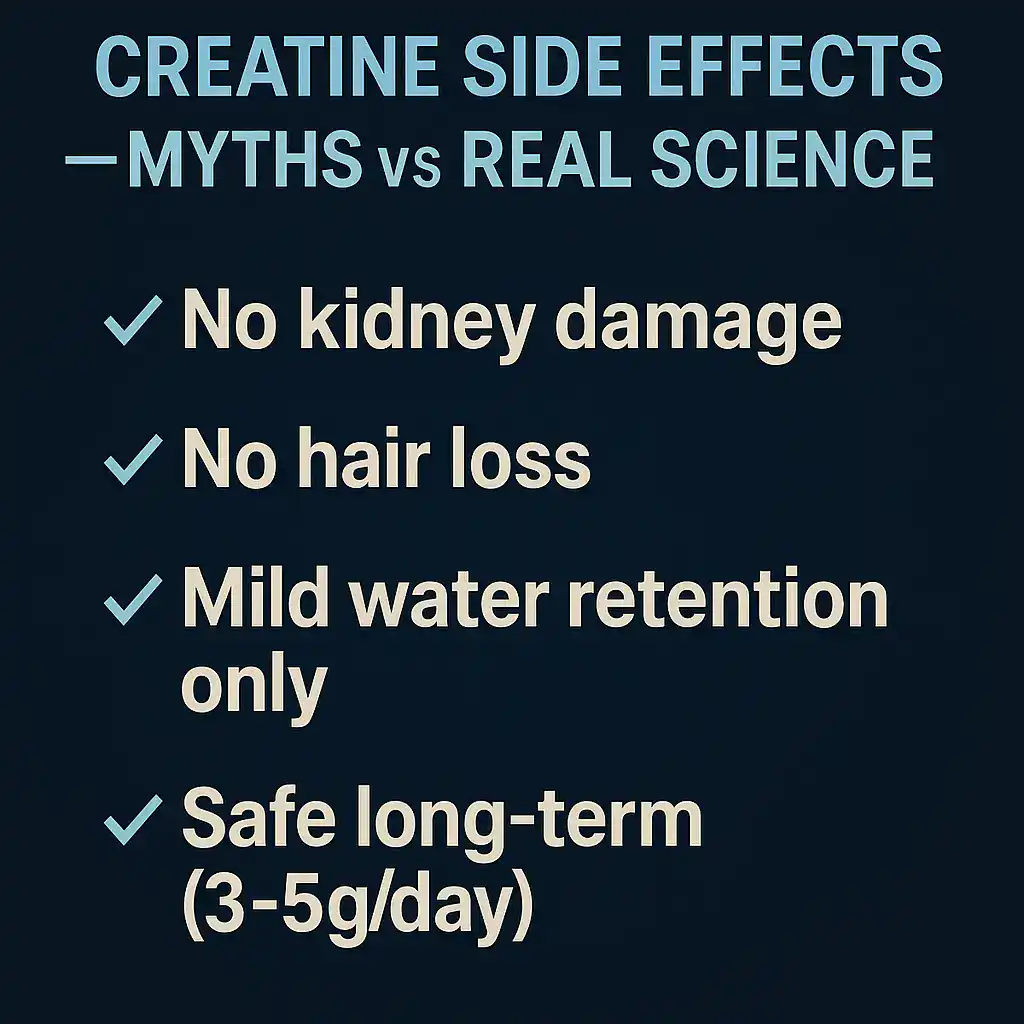
Quick Take: For most people, creatine is safe at 3–5 g/day. The “big myths” (kidney damage in healthy people, dehydration, hair loss) aren’t supported by the broader evidence.
- Most common real effect: small water-weight change (especially early or with loading)
- Most common avoidable effect: GI upset from large single doses or poor mixing
- Most common lab confusion: higher creatinine without true kidney injury
- Best “side-effect prevention”: skip loading, split doses if needed, hydrate normally
Parent Hub: Creatine Monohydrate
Benefits, dosing, timing, and how to use creatine without confusion.
Open the creatine hub →
What are the real side effects of creatine?
The most common real side effects are temporary water-weight changes and occasional stomach upset—usually from dosing too much at once. A third “effect” is a creatinine bump on labs, which is often misread as kidney damage.
Constraint: “side effects” depend heavily on dose, loading, mixing, hydration, and what your baseline diet/training looks like.
Creatine Side Effects Decoder (what’s real vs what’s a myth)
| Claim | Reality | Who it affects | Fast fix |
|---|---|---|---|
| “Creatine hurts kidneys” | Not supported in healthy users at standard doses; creatinine can rise without true injury | People with kidney disease or unclear kidney labs need clinician guidance | Use 3–5 g/day; tell your clinician you supplement; consider kidney markers beyond creatinine |
| “Creatine causes hair loss” | A single small DHT study sparked the rumor; hair loss was not measured and results haven’t been consistently replicated | People already prone to androgenetic alopecia may be more anxious about any DHT discussion | If concerned, avoid loading and track shedding objectively for 6–8 weeks |
| “Creatine causes bloating” | Often a water shift (mostly inside muscle), especially early or with loading | More common with 20 g/day loading or large single doses | Skip loading; use 3–5 g/day; split doses; mix well |
| “Creatine dehydrates you” | Evidence does not support dehydration as a typical outcome at recommended doses | People who under-hydrate or train in heat without electrolytes may feel worse | Hydrate normally; match fluids/sodium to sweat rate |
| “Creatine wrecks your stomach” | GI upset can happen, usually from big doses at once or poor mixing | More likely during loading or if taken dry/on an empty stomach | Take with food; split doses; dissolve fully; reduce dose temporarily |
Bottom line: most “creatine horror stories” are dosing mistakes, lab misunderstandings, or blaming creatine for what training + dehydration already cause.
Does creatine damage your kidneys?
In healthy people using standard doses, creatine supplementation has not been shown to meaningfully harm kidney function in the broader research—but it can raise serum creatinine, which can look scary on lab work.
Constraint: if you have diagnosed kidney disease, unexplained abnormal kidney labs, or take medications that affect kidney function, you should discuss creatine with a clinician before using it.
Why creatinine rises (and why that’s not automatically “damage”):
Creatine can convert to creatinine. So a higher creatinine number can reflect more creatine turnover—not necessarily a drop in filtration. This is exactly why kidney function should be interpreted in context (and sometimes with additional markers) if you supplement.
- If you get labs: tell your clinician you use creatine before interpreting creatinine changes.
- If you’re anxious: avoid loading and stick to 3–5 g/day for a few months before re-checking.
- If you have kidney disease: don’t self-experiment. Get individualized guidance.
Does creatine cause hair loss?
There’s no direct evidence that creatine causes hair loss. The rumor mostly traces back to a single small study showing a change in DHT-to-testosterone ratio—without measuring hair loss—and it hasn’t become a consistent finding across the wider creatine literature.
Constraint: if you’re genetically prone to androgenetic alopecia, anything related to DHT can feel personal. That’s understandable—but the leap from “DHT changed” to “you’ll go bald” isn’t supported by direct outcome data.
If you want a calm, practical approach:
- Skip loading; use 3–5 g/day.
- Track shedding (photos or a simple weekly note) instead of guessing day-to-day.
- If you notice sustained shedding, pause and reassess other common causes (stress, sleep, diet shifts, new meds, scalp issues).
Does creatine cause bloating or water weight?
Creatine can cause a small increase in water weight, especially in the first 1–3 weeks or during a loading phase. This is usually a water shift associated with creatine storage in muscle—not fat gain.
Constraint: people vary. Some notice nothing. Others notice a quick scale change (often from water + glycogen shifts when training hard).
How to minimize “bloat” without losing benefits:
- Skip loading: use 3–5 g/day from day one.
- Split doses: 2–3 g twice daily if you feel puffy or your stomach feels off.
- Mix well: fully dissolve; avoid taking it “dry.”
If your goal is performance, a small water shift is often part of why creatine works (more usable energy in high-intensity efforts).
Does creatine dehydrate you or cause cramps?
The “creatine causes dehydration/cramps” claim is not supported as a typical outcome at recommended doses. In controlled settings (including heat and dehydration contexts), creatine has not reliably shown increased cramping or heat intolerance.
Constraint: cramps are multi-factorial. If you train hard, sweat a lot, under-salt, and under-drink, you can cramp with or without creatine.
Simple cramp-proofing (no drama):
- Hydrate to thirst and match fluids to sweat rate.
- Don’t forget sodium if you sweat heavily.
- If cramps started with creatine, reduce dose and reassess training load and electrolyte intake first.
Can creatine upset your stomach or cause diarrhea?
Yes—GI upset is one of the few genuinely common complaints, and it’s usually caused by large single doses, loading, or poor mixing rather than creatine being inherently harsh.
Constraint: if you already have a sensitive stomach, you may need a slower ramp-up.
Fix it fast:
- Drop to 2–3 g/day for a week, then climb back up if tolerated.
- Take with food (or at least not completely empty).
- Split the dose (morning/evening) if 5 g at once bothers you.
- Dissolve fully in a larger glass of water.
Why does creatine make me feel weird?
When people feel “off” on creatine, it’s usually a dose + hydration + GI issue—not a dangerous reaction. Fixing one or two basics typically resolves it.
Work through this in order (it’s the fastest way to find the real cause):
- Check your dose: if you loaded or took 8–10 g at once, scale back to 3–5 g/day (or 2–3 g/day temporarily).
- Mixing matters: gritty, half-dissolved creatine often correlates with stomach issues.
- Hydration + salt: if you’re dieting, fasting, or training in heat, low fluids/sodium can feel like “creatine side effects.”
- Caffeine + stimulants: heavy pre-workouts can cause jitters, GI upset, and headaches that get blamed on creatine.
- Timing: if it bothers your stomach pre-workout, move it to a meal later in the day. Creatine works by saturation, not acute timing.
- Form quality: stick to plain creatine monohydrate. Avoid “liquid creatine” and exotic blends if you’re sensitive.
- Lab anxiety: if you saw creatinine rise, don’t panic—tell your clinician you supplement and interpret labs in context.
Pause and get medical guidance if you develop severe dizziness/fainting, chest pain, severe persistent vomiting/diarrhea, or new concerning symptoms—especially if you have known kidney disease or cardiovascular disease.
Is creatine safe to take every day long term?
For most healthy adults, daily creatine monohydrate at 3–5 g/day is widely considered safe in the research and by major sports-nutrition reviews. The most consistent long-term “effect” remains weight gain driven by water and lean mass changes, not organ damage.
Constraint: long-term safety data is strongest in healthy populations at standard dosing. If you have kidney disease or complex medical conditions, you need individualized advice.
What type of creatine is best if you want fewer side effects?
- Best default: plain creatine monohydrate (micronized if you prefer better mixing).
- If you’re sensitive: avoid loading, split the dose, and don’t combine with harsh stimulant pre-workouts.
- Forms to be cautious with: “liquid creatine,” “ethyl ester,” and proprietary blends (they add confusion without clear superiority).
Consistency beats timing: take it when you’ll remember it, ideally with a meal if your stomach is sensitive.
Selected Professional References
External links only. These are high-signal sources for safety, myths, kidneys, hydration, and the hair-loss claim.
- International Society of Sports Nutrition position stand: safety and efficacy of creatine (PMC) — broad review of benefits, dosing, and safety across populations.
- Common questions and misconceptions about creatine supplementation (PMC) — direct myth-by-myth discussion (kidneys, dehydration, hair loss).
- Effect of creatine supplementation on kidney function: systematic review & meta-analysis (PMC) — summarizes creatinine changes vs GFR outcomes.
- Creatine supplementation and DHT-to-testosterone ratio in rugby players (PubMed) — the study that sparked the hair-loss rumor (hair loss not measured).
- Creatine use and exercise heat tolerance in dehydrated men (PMC) — addresses cramps, dehydration, and heat concerns.
- How creatine supplements can elevate serum creatinine without kidney pathology (PMC) — example of lab interpretation pitfalls (especially with certain forms).
Go Deeper (VerifiedSupps Guides)
If you want clean, specific deep-dives, these are the best next reads.
Creatine and Kidney Safety
How to interpret creatinine labs and who should be cautious.
Creatine and Hair Loss
What the DHT study did (and didn’t) prove.
Creatine Timing
Before vs after workout, and what matters more than timing.
Best Creatine for Beginners
What to buy, what to avoid, and a simple first-month plan.
Final Takeaway
Creatine’s safety profile is strong in healthy users at standard dosing, and most feared “side effects” are either myths or avoidable mistakes.
If you want the cleanest experience: use creatine monohydrate, skip loading, take 3–5 g/day, mix it well, and hydrate normally.
If you have kidney disease or abnormal kidney labs, don’t guess—get clinician guidance and interpret creatinine in context.
Frequently Asked Questions
How long do creatine side effects last?
If you experience water-weight changes, they typically stabilize within the first few weeks. GI issues usually resolve quickly once you reduce the dose, split dosing, and take it with food.
Will creatine make me gain fat?
Creatine doesn’t cause fat gain directly. Early weight changes are usually water and, over time, potentially more training-driven lean mass if your workouts improve.
Should I do a creatine loading phase?
Loading can saturate faster, but it also increases the chance of GI upset and rapid water-weight changes. If you want fewer side effects, skip loading and use 3–5 g/day consistently.
Can creatine cause headaches?
Some people report headaches, but it’s often hard to separate creatine from dehydration, under-salting, stimulant pre-workouts, or hard training in heat. If headaches appear, reduce dose and tighten hydration/electrolytes first.
Is creatine safe for women?
Creatine is commonly used by women and is studied across adult populations. The practical guidance is the same: use monohydrate, 3–5 g/day, and adjust if you get GI upset.
Can creatine affect blood test results?
Yes. Creatine can increase serum creatinine, which is commonly used in kidney assessment. That doesn’t automatically mean kidney damage, but it does mean labs should be interpreted with your supplement use in mind.
Is creatine safe if I have kidney disease?
This is the group that should not self-experiment. If you have diagnosed kidney disease or abnormal kidney function tests, talk with a clinician before using creatine and don’t rely on internet reassurance.
What’s the safest daily dose of creatine?
For most adults, 3–5 g/day of creatine monohydrate is the simplest, most commonly used maintenance range. If you’re sensitive, start at 2–3 g/day and increase slowly.