Creatine and Hair Loss: What the Evidence Actually Says
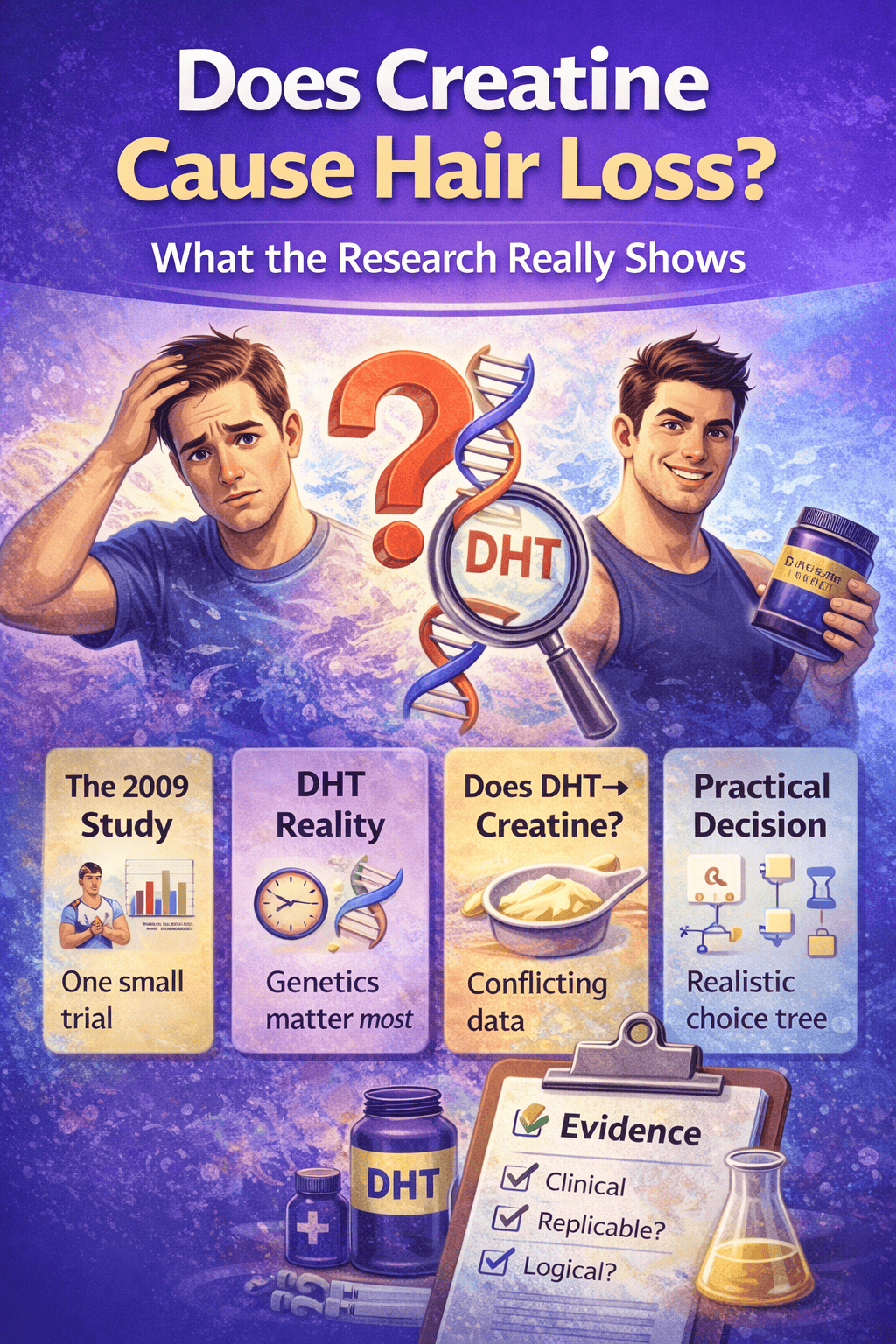
The internet version is a tidy chain: creatine → DHT → hair loss. The clinical question is tighter: does creatine meaningfully change hair outcomes in real people? Current evidence does not establish that creatine causes or accelerates hair loss, and newer controlled data directly measuring hair outcomes is reassuring.
Quick take
- Hair loss from creatine is unproven; one older study reported a DHT change, but it did not measure hair.
- Newer randomized data has directly measured hair growth parameters and did not find creatine-related hair changes.
- Best decision rule: if creatine meaningfully improves training, the evidence does not support fear-based avoidance. If anxiety is high, use a conservative, low-noise trial.
Evidence standard: human trials, dose ranges, guideline-level sources when available
For: people worried creatine might accelerate shedding or male pattern hair loss
Not for: sudden patchy hair loss or scalp inflammation (seek clinical evaluation)
Last reviewed: March 4, 2026
Parent Hub
Creatine Monohydrate: benefits, dosage, safety, and what evidence supports
If you want the full creatine map beyond hair concerns, start here.
Does creatine cause hair loss?
Based on current human data, creatine causing hair loss is not established. The classic worry came from a hormone signal in a small study (DHT changed; hair was not measured). More importantly, newer randomized research has directly measured hair growth parameters and did not find creatine-related hair changes.
| If you’re trying to decide… | Best evidence-based move | What to track | Time window |
|---|---|---|---|
| Start creatine with low worry | Use maintenance dosing; avoid loading if you want fewer variables | Training performance + calm weekly hair check | 8–12 weeks |
| You’re predisposed and anxious | Run a clean “trial” and stop if anxiety outweighs benefits | Photos in same light + shedding notes (weekly) | 8–12 weeks |
| You’re already shedding | Treat shedding as a clinical question, not a supplement mystery | Derm evaluation if persistent; rule out iron/thyroid/stress triggers | Weeks to months |
What would change my recommendation?
- Rapid, patchy hair loss, scalp inflammation, or eyebrow/body hair loss (think medical evaluation, not “DHT”).
- You’re within a major shedding window (recent illness, surgery, high stress, postpartum, rapid weight loss).
- You recently started/stopped hormone-active meds (androgens, finasteride/dutasteride, isotretinoin, SSRIs).
- You’re already highly distressed about hair loss (your best plan may be “reduce uncertainty,” not “prove a point”).
- You want maximal certainty: choose conservative dosing and a structured observe window.
Where did the creatine hair loss claim come from?
The concern largely traces back to a small study in male rugby players that measured hormones during creatine supplementation. It reported an increase in DHT after a loading phase—but it did not measure hair shedding, hair density, or hairline change. A hormonal signal is not the same as a clinical hair outcome.
- The study outcome was androgens, not hair.
- It was small and population-specific.
- It created a plausible story that grew faster than the data.
What does newer research show about creatine and hair growth?
This is the key update: newer randomized research has directly evaluated hair-related parameters alongside hormones. In that study, creatine did not meaningfully change DHT-related measures or hair growth parameters compared with placebo.
- Hair was measured (not just hormones).
- No meaningful group differences in hair parameters were reported.
- Interpretation: the “creatine = hair loss” claim looks weaker when hair outcomes are tested directly.
Does creatine increase DHT or testosterone?
In the broader creatine literature, consistent large androgen spikes are not a reliable finding. Some individual studies show changes; many do not. More importantly, a change in circulating DHT (even if present) doesn’t automatically translate to measurable hair changes—especially without genetic susceptibility.
The practical takeaway: if your hair concern hinges on “DHT might move,” your best strategy is not internet certainty—it’s a low-noise trial and calm measurement.
If you have male pattern baldness, should you avoid creatine?
Male pattern hair loss (androgenetic alopecia) is driven primarily by genetic follicle sensitivity and long-term androgen signaling. If you’re predisposed, DHT biology matters—but the evidence still does not show that creatine predictably accelerates progression.
- If creatine benefits your training, there isn’t evidence-based reason to fear it as a hair-loss trigger.
- If your anxiety is high, a conservative approach can be the healthiest choice even if risk is unproven.
- If shedding is active, don’t assume creatine is the cause—common triggers include stress, illness, iron status, thyroid function, and seasonality.
How to take creatine if you’re worried about hair loss
If your goal is reducing uncertainty (not maximizing “aggression”), choose the least dramatic protocol: fewer moving parts, slower conclusions, better clarity.
- Skip loading if you want fewer variables.
- Use maintenance dosing consistently (many people use 3–5 g/day).
- Avoid daily panic-checking; hair cycles don’t behave like daily biomarkers.
- Pick an observation window (8–12 weeks), then decide with your data.
How to tell if creatine is affecting shedding
Hair changes are slow and noisy, so “I noticed more hair in the shower” is not a clean signal. If you want an honest answer, you need a controlled approach and a realistic window.
Common mistakes
- Daily checking: normal shedding variability becomes “evidence.”
- Multiple changes at once: new shampoo, diet, stress, sleep, and creatine all in the same month.
- Ignoring obvious triggers: illness, weight loss, sleep deprivation, new meds.
- Short windows: 7 days is not a hair-outcome study.
Clean test protocol (8–12 weeks)
- Baseline: take consistent photos weekly (same lighting/angle) and note shedding once per week.
- Single variable: start creatine with maintenance dosing only; keep everything else steady.
- Hold for 8–12 weeks before deciding (hair cycles are slow).
- If anxiety spikes or shedding feels clearly worse, pause for several weeks and reassess calmly.
How to tell it’s working
- For hair clarity: you’re looking for stable weekly trends in photos and shedding notes, not day-to-day changes.
- For creatine benefit: expect better repeat-effort performance and training volume tolerance over weeks (not a stimulant “feel”).
- What not to expect: instant hairline movement or instant proof from a shower drain.
Selected Professional References
PubMed: Creatine and DHT ratio study (hormones measured, hair not measured)
The origin of the concern: DHT changed in a small sample, but hair outcomes were not assessed.
pubmed.ncbi.nlm.nih.gov
PubMed: Randomized trial measuring DHT and hair outcomes
Key update: directly measured hair growth parameters alongside hormones; no meaningful differences vs placebo reported.
pubmed.ncbi.nlm.nih.gov
PMC: Full-text version of the hair outcomes trial
If you want to verify details, this provides the full methods and outcome measures.
pmc.ncbi.nlm.nih.gov
PMC: ISSN position stand on creatine (safety and efficacy)
High-level safety/effectiveness review; helpful for grounding creatine claims in consensus evidence.
pmc.ncbi.nlm.nih.gov
PMC: Common questions and misconceptions about creatine
A practical review addressing frequent myths, including hormones and hair-loss claims.
pmc.ncbi.nlm.nih.gov
NCBI Bookshelf: Androgenetic alopecia overview
Background on follicle miniaturization and androgen sensitivity (genetics drives susceptibility).
ncbi.nlm.nih.gov
Go Deeper (VerifiedSupps Guides)
Creatine side effects: myths vs real
What’s common, what’s unlikely, and what data actually supports.
Is creatine bad for your kidneys?
How to interpret creatinine/eGFR and what long-term studies show.
Creatine before or after workout?
What timing can change (and what it doesn’t).
Best creatine for beginners
A simple, low-risk starting setup with minimal marketing noise.
Final takeaway
The strongest evidence-based statement is simple: creatine-related hair loss is not established. The original concern came from a small DHT signal without hair measurement, while newer randomized research has directly measured hair parameters and did not find creatine-related differences. If you’re predisposed and concerned, skip loading, use maintenance dosing, and evaluate calmly over an 8–12 week window.
FAQ
Does creatine cause hair loss?
Current evidence does not establish that creatine causes or accelerates hair loss, and newer controlled research has directly measured hair outcomes without showing meaningful differences.
Does creatine increase DHT?
One small study reported a DHT rise after a loading phase, but hair was not measured and results have not been consistently replicated across the broader literature.
Should I avoid creatine if male pattern baldness runs in my family?
Not necessarily. Genetics drives susceptibility. If worry is high, use maintenance dosing, skip loading, and run a calm 8–12 week observe window.
What if I notice more shedding after starting creatine?
Shedding is variable and often driven by stress, illness, sleep debt, diet changes, or medications. Use weekly photos and a single-variable 8–12 week test before attributing cause.
Is loading necessary?
No. Loading can saturate faster, but maintenance dosing is a lower-noise approach if you’re trying to minimize variables.
When should I get a clinician involved?
If hair loss is rapid, patchy, inflamed, or distressing; or if you want evaluation for iron/thyroid/stress triggers and evidence-based hair-loss treatment options.
VerifiedSupps Medical Disclaimer
This content is for educational purposes only and is not medical advice. Hair loss has many causes and may require medical evaluation. Consult a qualified clinician or dermatologist for sudden patchy hair loss, scalp inflammation, or rapidly progressive shedding. If you have kidney disease or complex medical conditions, consult a clinician before starting creatine or other supplements.