By VerifiedSupps Editorial Team
Petrelintide for Weight Loss: Results, Side Effects, and What Makes It Different
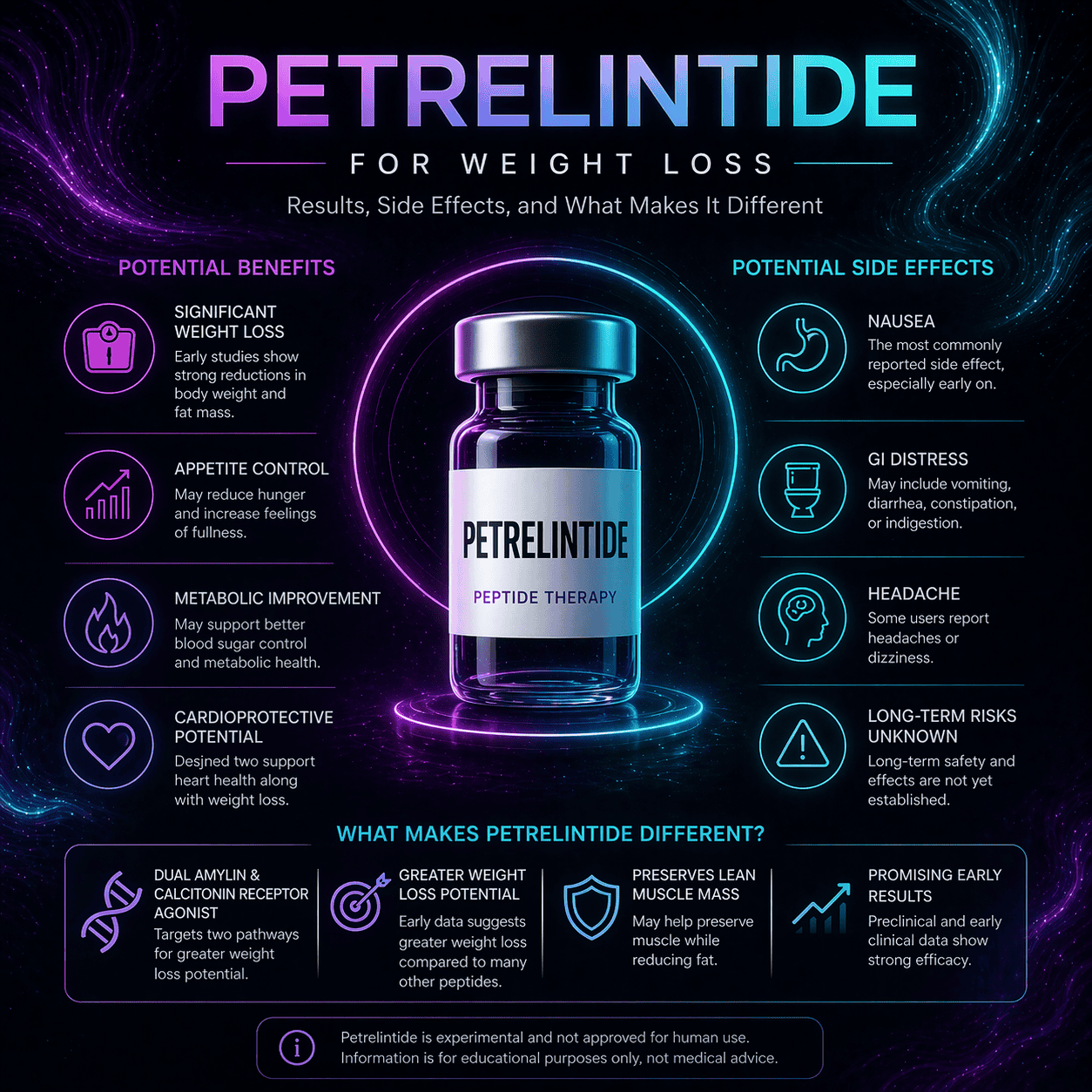
Petrelintide is one of the more interesting next-wave obesity drugs because it is not another GLP-1. It is a long-acting amylin analog designed for once-weekly injection, with the main pitch being meaningful weight loss plus a cleaner gastrointestinal tolerability profile.
The early weight-loss result is real but not category-leading: the latest Phase 2 ZUPREME-1 topline showed up to 10.7% mean weight loss at week 42 versus 1.7% with placebo. The more distinctive part was tolerability: no vomiting and no gastrointestinal adverse-event discontinuations at the maximally effective dose.
This page focuses on petrelintide’s results, side effects, mechanism, current development status, and what actually makes it different from GLP-1 drugs like semaglutide, tirzepatide, and newer pipeline candidates.
Key terms: petrelintide, ZP8396, amylin analog, weight loss, ZUPREME-1, ZUPREME-2, GLP-1 alternative, Roche, Zealand Pharma, CT-388 combination
Phase 2 weight loss
10.7%
at week 42
Placebo comparison
1.7%
at week 42
Current status
Phase 2 program
not approved
Quick Take
Petrelintide does not currently look like the most powerful weight-loss drug in the pipeline. It looks like a potentially useful amylin-based option if its tolerability profile holds up and if it works well alone or in combination with other obesity drugs.
TL;DR decision
Petrelintide is promising because it may offer moderate-to-meaningful weight loss with unusually mild GI tolerability. It is not approved, and its best future role may be as a better-tolerated amylin backbone or combination partner rather than a stand-alone “strongest weight-loss drug.”
Evidence standard: human trials, dose ranges, guideline-level sources when available
Who this is for: people comparing petrelintide with GLP-1 drugs, amylin drugs, and newer pipeline obesity medicines
Who this is not for: anyone looking for access outside clinical development, sourcing claims, or reassurance that petrelintide is already a public-use treatment
Reviewed by: VerifiedSupps Editorial Team
Last reviewed: April 20, 2026
Parent Hub
VerifiedSupps Articles
Use the broader article hub if you want a calmer framework for comparing obesity medicines without overreacting to one topline result.
Petrelintide quick answer table: what should you believe right now?
Use this to separate the exciting parts from the still-unproven parts.
| If you want to know… | Best current answer | Strongest evidence so far | What it means |
|---|---|---|---|
| Does petrelintide cause weight loss? | Yes, but moderately so far | Up to 10.7% at week 42 in ZUPREME-1 versus 1.7% placebo | Meaningful, but below the strongest GLP-1/GIP and triple-agonist results |
| Why is it different? | It targets amylin biology | Designed to increase satiety and potentially restore leptin sensitivity rather than acting mainly through GLP-1 | Different mechanism, different role |
| Are side effects better? | Potentially | ZUPREME-1 reported placebo-like tolerability and no vomiting at the maximally effective dose | Tolerability may be its strongest differentiator |
| Can you use it now? | No | It remains investigational and has not been approved by regulators | Pipeline candidate, not current care |
Best next step (today): Watch petrelintide for tolerability and combination potential, not just for the biggest single-drug weight-loss number.
Does petrelintide actually work for weight loss?
Yes, petrelintide has shown statistically significant weight loss in Phase 1 and Phase 2 trials. The current question is not whether it works at all. It is whether the amount of weight loss is competitive enough and whether its tolerability profile gives it a meaningful role.
In ZUPREME-1, a 42-week randomized Phase 2 dose-finding trial, petrelintide reached up to 10.7% mean weight loss versus 1.7% with placebo. That is clinically meaningful, but it is not in the same headline range as the strongest currently approved and late-stage obesity drugs.
Mechanism
- Petrelintide is a long-acting amylin analog designed for once-weekly subcutaneous administration.
- Amylin is co-secreted with insulin after eating and helps signal fullness and satiety.
- The major distinction is that petrelintide is not primarily a GLP-1 receptor agonist; its promise comes from a different appetite-regulation pathway.
What would change my recommendation: Phase 3 results showing durable weight loss, strong retention, meaningful metabolic outcomes, and tolerability that stays clearly better than GLP-1-heavy options.
How much weight loss has petrelintide shown so far?
The best current Phase 2 number is up to 10.7% mean body-weight reduction at week 42. Before that, the strongest Phase 1b multiple-ascending-dose result was 8.6% after 16 weekly doses, compared with 1.7% in the pooled placebo group.
Phase 2 ZUPREME-1
10.7%
Highest mean weight loss at week 42
Phase 1b MAD Part 2
8.6%
Highest mean weight loss after 16 doses
Placebo comparator
1.7%
Reported in both key early datasets
The result is meaningful, but the interpretation should be calm. Petrelintide’s value may not be “largest possible weight loss as monotherapy.” It may be “enough weight loss with better long-term tolerability or better combination potential.”
That is why the next data matter. ZUPREME-2 will test petrelintide in people with overweight or obesity and type 2 diabetes, and future combination studies may show whether petrelintide becomes more important as part of a broader obesity regimen.
What makes petrelintide different from GLP-1 drugs?
Petrelintide is different because it is built around amylin biology rather than GLP-1 biology. That could matter for people who need an alternative to GLP-1 receptor agonists, people who struggle with GI tolerability, or future combination strategies where a non-GLP-1 mechanism adds benefit without simply stacking the same side effects.
GLP-1-style drugs
Primarily reduce appetite and food intake through GLP-1 receptor pathways, with strong weight-loss efficacy but frequent gastrointestinal tolerability issues.
Petrelintide
Uses amylin analog activity to support satiety and may restore leptin sensitivity, with early signs of a more tolerable GI profile.
Petrelintide is also designed for chemical and physical stability around neutral pH, which may allow co-formulation or co-administration with other peptides. That is one reason Roche and Zealand are also exploring combinations, including petrelintide with CT-388.
What side effects does petrelintide have?
The most important side-effect story so far is tolerability. In ZUPREME-1, petrelintide’s adverse-event discontinuation rate in the maximally effective arm was similar to placebo, and the trial reported no vomiting in that maximally effective arm.
| Safety topic | What current trials suggest |
|---|---|
| Most common adverse events | Mostly gastrointestinal events, with most described as mild |
| Vomiting | No vomiting was reported in the maximally effective ZUPREME-1 treatment arm |
| GI discontinuations | No treatment discontinuations due to gastrointestinal adverse events in the maximally effective arm |
| Main open question | Whether this tolerability advantage holds in Phase 3, in diabetes, and in combination regimens |
This is where petrelintide could matter. If a drug gives less weight loss than the strongest options but is easier to stay on, it may still have a real clinical role. But that is exactly what larger and longer trials need to confirm.
Could petrelintide help preserve lean mass or work better in combinations?
Lean-mass preservation is a possibility, not a settled human claim. Zealand’s materials discuss potential lean-muscle preservation based on clinical and preclinical context, and ZUPREME-1 includes body-composition measurement as an exploratory endpoint. But we do not yet have enough human evidence to claim petrelintide meaningfully preserves muscle during weight loss.
The combination story may be more important. Petrelintide’s amylin mechanism could pair with GLP-1, GIP, or other incretin drugs in a way that adds weight-loss effect while potentially avoiding some overlapping GI burden. Roche and Zealand have already described plans to explore petrelintide with CT-388, Roche’s GLP-1/GIP dual agonist.
The clean interpretation is this: petrelintide’s best future may be either as a tolerable amylin monotherapy for selected patients or as a combination partner that makes stronger regimens easier to live with.
What is petrelintide’s current approval status?
Petrelintide is still investigational. It has not been approved for marketing by any regulatory authority.
The current program is still Phase 2. ZUPREME-1 tested petrelintide in people with obesity or overweight without type 2 diabetes. ZUPREME-2 is evaluating petrelintide in people with obesity or overweight and type 2 diabetes. The ZUPREME-1 data will inform Phase 3 design, and the diabetes trial is expected to provide another key readout.
So the status is simple: promising Phase 2 obesity candidate, not approved, and still several steps away from routine clinical use.
What should you do if you are watching petrelintide?
Do not compare petrelintide only by the largest percentage on a chart. Its most important question is whether it can create a better treatment experience: enough weight loss, fewer GI problems, and better combination potential.
Common mistakes
- Calling petrelintide a failure because 10.7% is lower than the most powerful GLP-1/GIP or triple-agonist results.
- Calling petrelintide a winner before Phase 3 confirms durability and tolerability.
- Assuming lean-mass preservation is proven before body-composition data are fully available.
- Treating an investigational drug as something that should be sourced or used now.
Clean test protocol
| Inputs | Weight-loss percentage, tolerability, discontinuation, vomiting and nausea rates, body-composition data, and combination-trial results |
|---|---|
| Duration | Reassess after full ZUPREME-1 presentation, ZUPREME-2 readout, and Phase 3 study design details |
| 3 metrics | Durable weight loss, GI tolerability, and whether it adds value as a monotherapy or combination partner |
| Stop conditions | Any seller claiming public access before approval, any blurred explanation of trial status, or any claim that petrelintide’s lean-mass or combination benefits are already proven |
How to tell it’s working
For petrelintide as a development program, “working” means Phase 3 can confirm a useful balance of weight loss, tolerability, adherence, and metabolic outcomes. A lower weight-loss number can still matter if the treatment is easier to sustain.
Red flags / seek care
Do not use any product claiming to be petrelintide outside legitimate clinical development. Seek medical care for severe vomiting, dehydration, severe abdominal pain, chest pain, fainting, trouble breathing, or symptoms of a serious allergic reaction after any unverified injectable product.
Selected Professional References
These sources support the current picture: Phase 2 results, early Phase 1b data, amylin mechanism, clinical-trial status, and Roche/Zealand development plans.
Roche: ZUPREME-1 Phase II Results
The most important current source for petrelintide’s 42-week weight-loss and tolerability results.
Used for: 10.7% weight loss, placebo comparison, vomiting, discontinuation, and status context
Zealand Pharma: Petrelintide Pipeline
The best source for mechanism, Phase 1b results, development status, and the Roche collaboration summary.
Used for: amylin mechanism, early 8.6% result, Phase 2 status, and investigational language
ZUPREME-1 Trial Record
Useful for verifying the official study purpose and trial design context for the obesity Phase 2 study.
Used for: trial design, efficacy, safety, and tolerability endpoints
ZUPREME-2 Trial Record
Important for the next major petrelintide question: performance in overweight or obesity with type 2 diabetes.
Used for: diabetes-trial status and future readout context
Development of Petrelintide
A useful source for why petrelintide is designed as a stable, long-acting human amylin analogue.
Used for: molecule design, stability, and long-acting amylin analogue context
Reuters: Mid-Stage Petrelintide Results
Helpful for broader market context and the interpretation that tolerability may matter as much as the weight-loss percentage.
Used for: external context on results, amylin category, and comparison limits
Roche and Zealand Collaboration
Useful for understanding why petrelintide is being developed both as a monotherapy and as part of a combination strategy.
Used for: collaboration, co-commercialization, and CT-388 combination context
Go Deeper (VerifiedSupps Guides)
These are the best next reads if you want to compare petrelintide with the broader next-generation obesity-drug landscape.
Retatrutide: Results, Side Effects, and Current Status
Best next read if you want to compare petrelintide with a more aggressive next-generation obesity candidate.
Retatrutide Trial Results
Useful if your next question is how to read early, topline, and published obesity-drug results without overreacting.
Retatrutide vs Tirzepatide
Helpful if you want a clean comparison between pipeline drugs and approved GLP-1/GIP therapy.
How Much Protein Do You Actually Need?
Useful if your real concern is body composition and lean-mass support during weight loss.
Final Takeaway
Petrelintide is not the most dramatic weight-loss drug in the pipeline by percentage alone. Its value is more nuanced: an amylin-based mechanism, once-weekly dosing, promising tolerability, and potential as a combination partner. If later trials confirm that it is easier to tolerate and easier to stay on, petrelintide could still matter even if its monotherapy weight loss remains more modest than the strongest GLP-1/GIP drugs.
FAQ
What is petrelintide?
Petrelintide, formerly ZP8396, is an investigational long-acting amylin analog designed for once-weekly subcutaneous administration in weight-management research.
Does petrelintide work for weight loss?
Petrelintide has shown meaningful weight loss in Phase 1 and Phase 2 studies, including up to 10.7% mean weight loss at week 42 in ZUPREME-1 versus 1.7% with placebo.
How much weight loss has petrelintide shown?
The strongest current Phase 2 result is up to 10.7% mean body-weight reduction at week 42. Earlier Phase 1b data showed up to 8.6% mean weight loss after 16 weekly doses.
What makes petrelintide different from GLP-1 drugs?
Petrelintide targets amylin biology rather than primarily acting as a GLP-1 receptor agonist. It is designed to increase satiety and may offer a different tolerability and combination profile.
What are petrelintide’s side effects?
The most frequently reported adverse events so far are gastrointestinal, but ZUPREME-1 reported placebo-like tolerability, no vomiting in the maximally effective arm, and no discontinuations due to gastrointestinal adverse events in that arm.
Is petrelintide better than Wegovy or Zepbound?
That is not proven. Petrelintide’s weight-loss numbers so far are lower than the strongest approved GLP-1/GIP results, but its tolerability and combination potential may make it clinically useful if confirmed.
Could petrelintide preserve muscle?
Lean-mass preservation is a possibility but not a proven human claim. Current body-composition data are not enough to say petrelintide meaningfully preserves muscle during weight loss.
Is petrelintide approved?
No. Petrelintide remains investigational and has not been approved for marketing by any regulatory authority.
What is ZUPREME-2?
ZUPREME-2 is a Phase 2 trial evaluating once-weekly petrelintide versus placebo in people with overweight or obesity and type 2 diabetes.
What is the safest way to think about petrelintide right now?
Treat petrelintide as a promising Phase 2 amylin-based obesity candidate with a potentially useful tolerability profile, not as an approved treatment or a proven best-in-class weight-loss drug.
VerifiedSupps Medical Disclaimer
This content is for educational purposes only and is not medical advice. Petrelintide is an investigational medicine and is not approved for routine weight-loss or diabetes treatment. Do not use unverified products claiming to contain petrelintide, and do not delay evidence-based obesity or diabetes care while waiting for a pipeline drug. Seek urgent medical care for severe vomiting, dehydration, severe abdominal pain, chest pain, fainting, trouble breathing, or symptoms of a serious allergic reaction after any unverified injectable product.