By VerifiedSupps Editorial Team
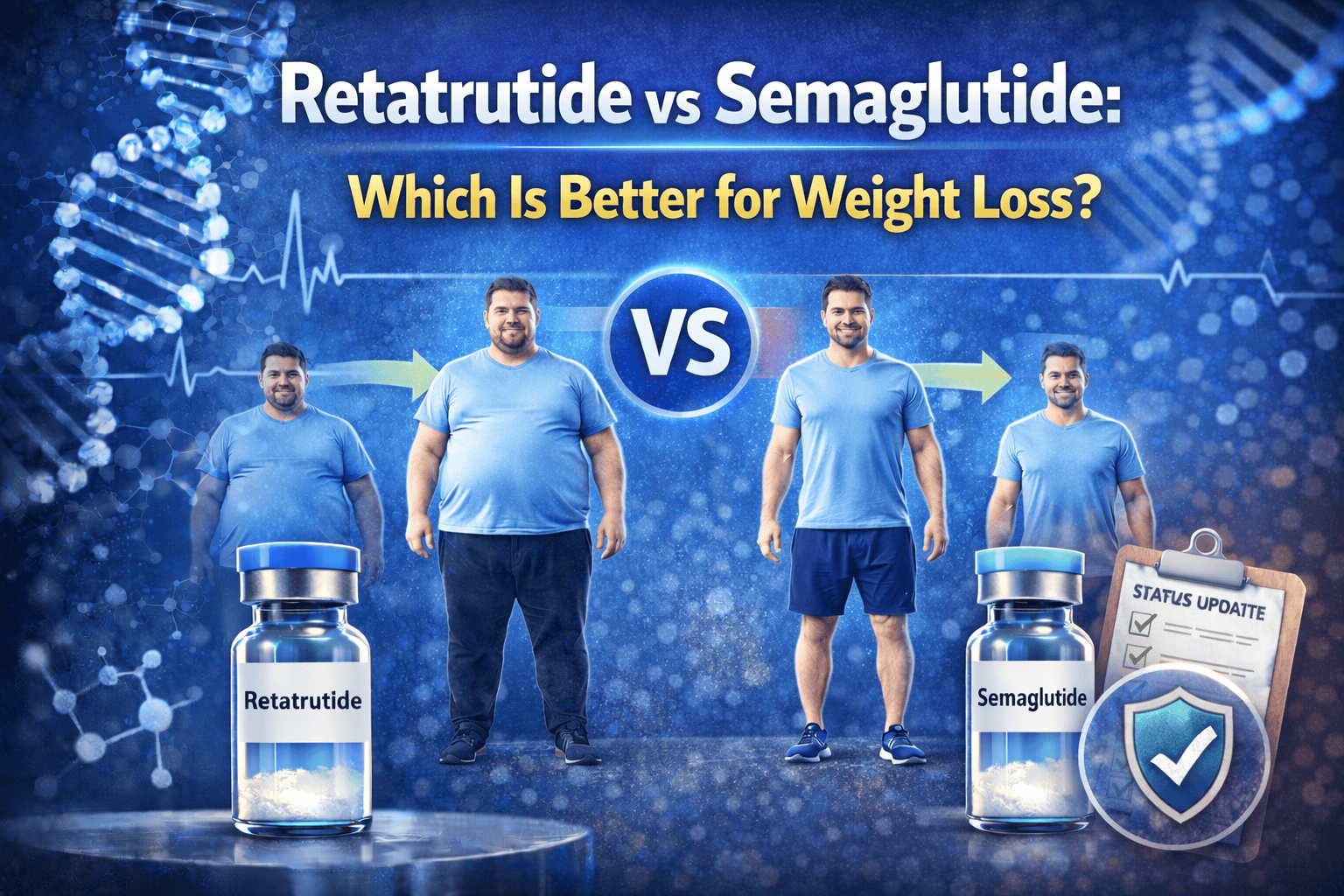
Retatrutide vs Semaglutide: Which Is Better for Weight Loss Right Now?
If you mean the better real-world choice today, semaglutide wins. It is approved, available, and backed by large published obesity trials plus a mature safety label.
If you mean the molecule that may eventually push more pure weight loss, retatrutide is the more exciting contender. But that answer is still partly a late-stage pipeline story, not a finished clinical conclusion.
For clarity, this comparison uses the best-established obesity benchmark for semaglutide — once-weekly semaglutide 2.4 mg — because that is still the cleanest published reference point most people mean when they compare semaglutide with newer obesity drugs.
Key terms: retatrutide, semaglutide 2.4 mg, Wegovy, triple agonist, GLP-1, GIP, glucagon, obesity medicine, weight loss, phase 3
Quick Take
Choose semaglutide if you want the more proven and accessible option now. Watch retatrutide if you care most about where obesity therapy may go next. The cleanest current comparison is “semaglutide wins on maturity and access; retatrutide may win later on raw efficacy, but that part is not settled yet.”
TL;DR decision
Semaglutide is the better choice right now. Retatrutide is the more speculative next-generation bet. That is the most honest simple answer.
Evidence standard: human trials, dose ranges, guideline-level sources when available
Who this is for: people comparing obesity medicines and trying to understand whether retatrutide is actually better than semaglutide or just newer and more exciting
Who this is not for: anyone looking for gray-market sourcing, trial shortcuts, or reassurance that an investigational medicine is safe to buy online
Reviewed by: VerifiedSupps Editorial Team
Last reviewed: April 17, 2026
Parent Hub
VerifiedSupps Articles
Use the broader article hub if you want a calmer framework for comparing new metabolic therapies without getting pulled around by headlines.
Quick decision table: which one fits your priority?
This is the fastest way to separate the better current choice from the more ambitious future possibility.
| If your priority is… | Better pick today | Why | Confidence |
|---|---|---|---|
| The more proven obesity drug right now | Semaglutide | Approved, available, and backed by large published obesity trials plus a mature safety label | High |
| The molecule that may eventually push more weight loss | Retatrutide | Its strongest obesity signals are larger, but the evidence is less mature and not yet fully head-to-head | Moderate |
| Something you can legitimately access now | Semaglutide | Retatrutide is still trial-only and not approved | High |
| A wait-and-watch pipeline bet | Retatrutide | The upside case is stronger than semaglutide’s, but the human evidence stack is still being built | Moderate |
Best next step (today): If you need the better current choice, semaglutide wins. If you are forecasting where obesity therapy may go next, keep watching retatrutide.
Retatrutide vs semaglutide: which is better for weight loss right now?
Right now, semaglutide is better. That is not because retatrutide looks weak. It is because semaglutide already crossed the line from exciting obesity drug to approved, labeled, and broadly characterized therapy.
Retatrutide is the more interesting “maybe later” answer if your question is which molecule may eventually push more raw weight loss. But that is still a forecast, not a finished conclusion. Today’s best answer and tomorrow’s most intriguing answer are different here.
Mechanism
- Semaglutide is a GLP-1 receptor agonist with a mature obesity evidence base and established clinical use.
- Retatrutide is a triple agonist that adds GIP and glucagon receptor activity on top of GLP-1 activity.
- That broader receptor profile is one reason retatrutide may ultimately outperform semaglutide on weight loss, but it also means the long-term efficacy and tolerability picture is still less settled.
What would change my recommendation: a published direct comparison showing retatrutide clearly beats semaglutide on clinically meaningful outcomes without an unacceptable tradeoff in tolerability or safety.
How much weight loss has retatrutide vs semaglutide shown?
If you are just scanning the biggest obesity numbers, retatrutide looks stronger. If you care about the most mature published evidence stack, semaglutide still holds that edge today.
Retatrutide
24.2%
Best published obesity result at 48 weeks in phase 2
The biggest public phase 3 number is even higher: 28.7% at 68 weeks in TRIUMPH-4, but that result is still topline rather than full publication.
Semaglutide
14.9%
Mean weight loss at 68 weeks in STEP 1 with semaglutide 2.4 mg
It also has two-year obesity data: 15.2% mean weight loss at 104 weeks in STEP 5.
So which one is “stronger”? In raw headline terms, retatrutide currently has the more aggressive obesity signal. In published maturity and duration of follow-up, semaglutide is still easier to trust because the evidence base is older, larger, and more clinically settled.
That is why this comparison is not just about percentages. It is also about how finished the evidence feels. Retatrutide’s best numbers may end up winning the long game, but semaglutide still owns the stronger present-tense proof structure.
Which has more side effects, retatrutide or semaglutide?
Both mostly live in the gastrointestinal side-effect lane. The main difference is that semaglutide’s safety picture is much better defined, while retatrutide’s higher-efficacy doses currently look less settled and potentially harder on tolerability.
Semaglutide 2.4 mg
The current Wegovy label reports nausea in 44%, diarrhea in 30%, vomiting in 24%, constipation in 24%, and abdominal pain in 20% of adults treated for weight reduction.
Permanent discontinuation due to adverse reactions was 6.8% overall in those adult obesity or overweight trials.
Retatrutide
TRIUMPH-4 reported nausea in 43.2% at 12 mg, diarrhea in 33.1%, constipation in 25.0%, vomiting in 20.9%, and decreased appetite in 18.2%.
Discontinuation due to adverse events reached 18.2% at 12 mg, which is a meaningful caution signal even if cross-trial comparisons are imperfect.
The cleanest comparison today is that semaglutide has the more established label and retatrutide has the more unsettled high-dose tolerability picture. That alone is enough to keep semaglutide ahead in real-world decision-making right now.
Is retatrutide or semaglutide approved and available now?
Semaglutide, clearly. Retatrutide is still trial-only.
Wegovy is currently FDA-approved for chronic weight management in adults with obesity or adults with overweight plus at least one weight-related comorbidity, and the current label also includes cardiovascular-risk reduction in certain adults with established cardiovascular disease and obesity or overweight. That is a very different level of maturity from a pipeline drug.
Retatrutide is different. Lilly says it is investigational, not approved, and legally available only to participants in Lilly-sponsored clinical trials. That single point settles the practical comparison for most people.
So if you are asking which one is the real present-tense option, semaglutide wins without much argument.
Is there a direct retatrutide vs semaglutide trial yet?
There is an ongoing comparison study, but there is not a published direct answer yet. That is important because most confident “retatrutide beats semaglutide” statements still are built mostly from cross-trial reading, not from finalized head-to-head data.
Clinical trial listings show an ongoing study investigating retatrutide compared with semaglutide in adults with type 2 diabetes and obesity. That means the direct question is real enough to be studied seriously, but not answered yet in the public literature.
So the best disciplined answer is this: retatrutide likely has the higher upside, semaglutide has the stronger current proof, and the direct comparison still has room to surprise people either way.
What should you do if you are deciding between retatrutide and semaglutide?
If the decision is for now, choose semaglutide. If the decision is about which molecule you want to keep watching, watch retatrutide. Most people do not need a more complicated answer than that.
Common mistakes
- Confusing stronger-looking pipeline upside with a better current treatment choice.
- Comparing top-line percentages across unrelated studies as if that were the same as a direct randomized head-to-head result.
- Ignoring approval status and real-world access as if they were minor details.
- Trusting anything sold online as retatrutide simply because the real molecule is in legitimate development.
Clean test protocol
| Inputs | Whether you need an approved therapy now, whether you care most about strongest current proof or highest future upside, and whether you are reading published evidence or just headlines |
|---|---|
| Duration | Reassess when direct comparison data arrive and when more full retatrutide phase 3 obesity publications land |
| 3 metrics | Approval and access, published efficacy depth, and tolerability at clinically meaningful doses |
| Stop conditions | Any blurred explanation of approval status, any fake-source “research” product, or any decision based mainly on social-media enthusiasm instead of what is actually published |
How to tell it’s working
Right now, the more useful test is whether your framework is clear. A good comparison should leave you with the right answer for the right time horizon: semaglutide for today, retatrutide as the more speculative future challenger.
Red flags / seek care
If you are using any unverified product claimed to be retatrutide or semaglutide and develop persistent vomiting, dehydration, chest pain, severe palpitations, trouble breathing, or a strong allergic-type reaction, stop and seek medical care. Fake-source risk is part of the safety profile here.
Selected Professional References
These are the key sources behind the current comparison: published efficacy, current labels, retatrutide toplines, and the still-open direct comparison question.
Once-Weekly Semaglutide in Adults With Overweight or Obesity
The anchor paper for semaglutide 2.4 mg as an obesity medicine benchmark.
Used for: 14.9% weight loss at 68 weeks
STEP 5: Two-Year Effects of Semaglutide
Important because it gives semaglutide something retatrutide still lacks: longer published obesity follow-up.
Used for: 15.2% mean weight loss at 104 weeks
Wegovy Prescribing Information
The key source for semaglutide’s current approved status and current safety language.
Used for: approval status, common adverse reactions, and present-tense access
Triple–Hormone-Receptor Agonist Retatrutide for Obesity
The anchor paper for the strongest published retatrutide obesity evidence so far.
Used for: 24.2% at 48 weeks and phase 2 tolerability
What to Know About Retatrutide
The cleanest official summary of mechanism, current status, and why the drug is still trial-only.
Used for: triple-agonist mechanism and “not approved yet” status
TRIUMPH-4 Results
The biggest public retatrutide obesity number so far, with the important caveat that it is still topline.
Used for: 28.7% at 68 weeks and current high-dose AE context
Retatrutide Compared With Semaglutide
The most important unresolved piece because it may finally answer the direct comparison question.
Used for: why the head-to-head answer is still pending
Semaglutide STEP Program Summary
Useful for the broader context around how semaglutide became the obesity benchmark in the first place.
Used for: the broader semaglutide obesity evidence base
Go Deeper (VerifiedSupps Guides)
These are better next reads if you want the deeper retatrutide-only picture or want to make smarter fat-loss decisions without relying on comparison headlines alone.
Retatrutide for Weight Loss
Best next read if you want the retatrutide-only efficacy story without the comparison layer.
Retatrutide: Results, Side Effects, and Current Status
Helpful if you want the cleaner retatrutide status snapshot after this head-to-head overview.
How Much Protein Do You Actually Need?
Useful if your real concern is lean-mass protection while body weight is coming down.
How to Choose Supplements Without Guesswork
The best next read if this comparison mainly reminded you how easy it is to confuse excitement with certainty.
Final Takeaway
Semaglutide is the better obesity medicine right now because it is approved, available, and supported by more mature efficacy and safety data. Retatrutide is the more intriguing future challenger because its strongest current weight-loss signals are more aggressive. Until the direct comparison data arrive, the cleanest answer is not “retatrutide beats semaglutide” or “semaglutide has nothing to worry about.” It is “semaglutide wins today, retatrutide may push the field further tomorrow.”
FAQ
Which is better right now, retatrutide or semaglutide?
Right now, semaglutide is the better choice because it is approved, available, and supported by more mature published obesity data and labeling.
Could retatrutide end up stronger than semaglutide?
Yes, it could. Retatrutide already has stronger-looking obesity signals, but the direct head-to-head answer is still not published.
How much weight loss has retatrutide shown so far?
The best published obesity result so far is 24.2% average weight loss at 48 weeks in phase 2, and the biggest public phase 3 number is 28.7% at 68 weeks in TRIUMPH-4.
How much weight loss has semaglutide shown so far?
In STEP 1, semaglutide 2.4 mg reached 14.9% mean weight loss at 68 weeks. In STEP 5, it reached 15.2% at 104 weeks.
Which has more mature safety information?
Semaglutide does. It has an FDA-approved prescribing label with established warnings, common adverse reactions, and approved-dose guidance.
What side effects matter most in both drugs?
Gastrointestinal side effects matter most in both, especially nausea, diarrhea, vomiting, and constipation during dose escalation.
Is retatrutide approved yet?
No. Retatrutide is still investigational and is legally available only in Lilly-sponsored clinical trials.
Is semaglutide approved for obesity?
Yes. Wegovy is FDA-approved for chronic weight management in adults with obesity or adults with overweight plus at least one weight-related comorbidity.
Is there a direct retatrutide vs semaglutide study underway?
Yes. A study comparing retatrutide with semaglutide is underway, so the direct superiority question is still open.
What is the safest current mindset?
Treat semaglutide as the better current option and retatrutide as the more speculative next-generation contender until the direct-comparison and fuller phase 3 evidence arrive.
VerifiedSupps Medical Disclaimer
This content is for educational purposes only and is not medical advice. Semaglutide is an FDA-approved prescription medicine with labeled indications, warnings, and dose-escalation guidance. Retatrutide is still investigational and should not be treated as a normal public-use option. Do not use unverified products sold as either medicine as a substitute for medical care, approved treatment, or legitimate clinical-trial participation. Seek urgent medical care for severe vomiting, dehydration, chest pain, shortness of breath, severe palpitations, or a strong allergic-type reaction after using any unverified injectable product.