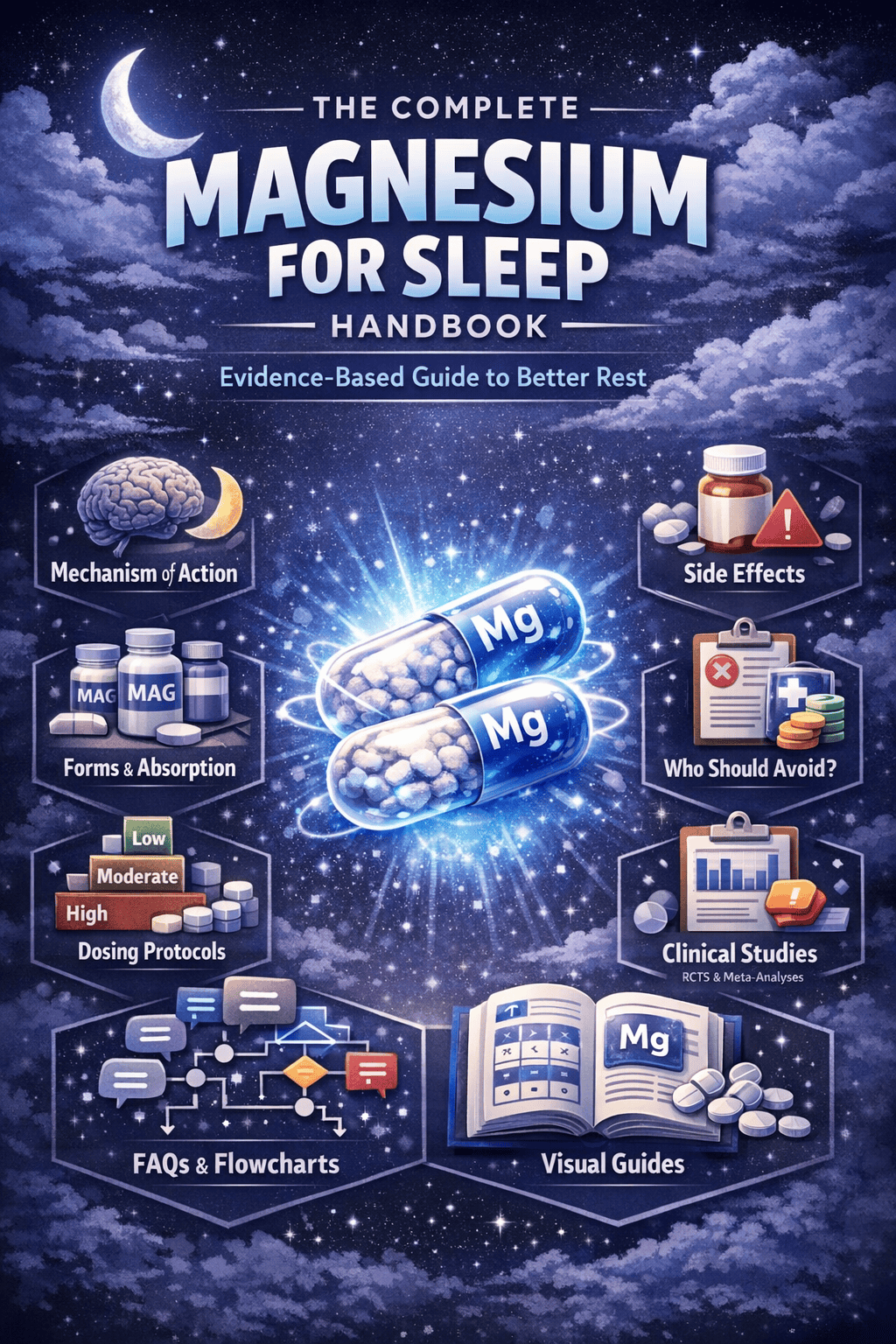
The Complete Magnesium for Sleep Handbook
Magnesium isn’t a sedative. It won’t “knock you out.” Its real value is more clinical: magnesium can support the physiology that makes sleep easier when your intake is low, your nervous system runs hot, or your sleep is fragile. This handbook is a reference—mechanism, forms, dosing tiers, timing, safety, and decision rules.
Quick take
- Best first move for most people: a well-tolerated form, conservative dose, and dinner/early-evening timing.
- Most common failure: under-sleeping, caffeine/stress, or sleep apnea risk dominates—magnesium can’t override that.
- Most common side effect: GI upset (dose/form related). That’s a dosing signal, not a “push through it” moment.
Evidence standard: human trials, dose ranges, guideline-level sources when available
For: people using magnesium for sleep readiness (tension, insomnia symptoms, fragile sleep)
Not for: kidney disease or severe insomnia with safety concerns without clinician support
Last reviewed: March 4, 2026
Parent Hub
How to Choose the Right Magnesium: form selection, dosing logic, and common mistakes
If you want the full “choose and troubleshoot” map beyond sleep, this is the hub.
Does magnesium help you sleep?
Sometimes. Magnesium tends to help most when sleep is limited by low intake, stress physiology, cramps/tension, or older-adult insomnia symptoms. In healthy adults with solid sleep and adequate intake, the effect is often small or absent.
Quick decision table: pick a simple starting plan
| Your situation | Best first form idea | Timing to try | What “working” looks like |
|---|---|---|---|
| Mind racing / tension | A well-tolerated “calm” form | Dinner or early evening | Less body tension, easier downshift |
| Constipation + sleep disruption | A more GI-active option (start low) | Earlier (so GI doesn’t wake you) | Less discomfort at night, fewer wakeups |
| Vivid dreams / nightmares | Any tolerated form (dose matters most) | Move earlier (avoid bedtime dosing) | Dream intensity settles within 1–2 weeks |
| Nothing happens | Form may not matter (your driver may not be Mg) | Keep one stable plan 7–14 nights | Either a subtle trend or no signal (both valid) |
The goal is a clean read: one form, one dose, one timing, held long enough to judge.
What would change my recommendation?
- Known or suspected kidney disease (magnesium can accumulate with impaired clearance).
- You’re on medications with strict timing rules (thyroid meds, some antibiotics, bisphosphonates).
- Night awakenings include choking/gasping, loud snoring, severe daytime sleepiness (possible sleep-disordered breathing).
- You have persistent severe insomnia with safety concerns (panic, severe depression, suicidal thoughts).
- You’re stacking multiple sleep aids (melatonin, antihistamines, alcohol/THC), which makes magnesium impossible to interpret.
How does magnesium help you sleep?
Indirectly. Magnesium supports systems that set “sleep readiness”: neural excitability balance, stress reactivity, and neuromuscular relaxation. If those systems are already stable, magnesium may feel like nothing—and that’s a normal outcome.
- Neural quieting: magnesium participates in regulating excitatory signaling (often discussed around NMDA-related activity).
- Stress physiology: low intake and high stress often travel together; improving basics can reduce “wired but tired” patterns.
- Muscle relaxation: less cramping/tension can reduce nighttime arousals.
- Sleep continuity: if you wake less, dreams can become more vivid (that’s not always a negative).
Which magnesium is best for sleep?
The best magnesium for sleep is the one you tolerate consistently without GI side effects or next-day grogginess. “Strongest” is not the goal—stable is the goal.
If you’re GI-sensitive
Choose a gentler approach: lower dose, food-first dosing, and avoid GI-active options as a starting point.
If constipation is part of the problem
A more GI-active option can help, but take it earlier so your gut doesn’t wake you at night.
If a form causes diarrhea, it’s not “stronger”—it’s too much GI for your body.
How much magnesium should I take for sleep?
Start conservatively. For sleep, the “right” dose is the smallest dose that improves sleep readiness without diarrhea or next-day heaviness.
Practical dosing rules
- Starter: 100–150 mg elemental nightly for 7–10 nights.
- Increase slowly: small steps only after stable tolerance.
- GI side effects are a stop sign: reduce dose, change timing, or reconsider form.
When is the best time to take magnesium for sleep?
For many people, dinner or early evening works best. Bedtime-only dosing can increase vivid dreams, awakenings, and next-day grogginess—especially at higher doses.
- If you get vivid dreams: move magnesium earlier first (don’t change three things at once).
- If you get diarrhea: take with food and consider lowering dose or switching away from GI-active options.
- If you wake at 2–4am: suspect sleep fragmentation + stacking (late caffeine/alcohol/THC/melatonin) more than magnesium itself.
How long does magnesium take to work for sleep?
Some people feel a subtle shift within days. A fair test window is usually 2–4 weeks at a tolerated dose, because sleep is naturally variable night-to-night and magnesium’s benefits (when they occur) often feel cumulative.
Reality check: if the primary driver is circadian mismatch, sleep apnea risk, heavy stimulant use, or chronic stress, magnesium won’t override it.
Who should not take magnesium for sleep?
This is where magnesium becomes clinical. The main safety issue is not “toxicity” in healthy people—it’s use in contexts where magnesium clearance is impaired or medication timing matters.
- Kidney disease or reduced kidney function (supplement decisions should be clinician-guided).
- Frequent low blood pressure symptoms (lightheadedness, near-fainting).
- Strict-timing medications (thyroid meds, some antibiotics, bisphosphonates) where spacing is required.
- Severe insomnia with safety concerns (panic, severe depression, suicidal thoughts): treat this as urgent clinical care, not supplement optimization.
Magnesium not helping sleep: common mistakes and how to tell it’s working
Most failures come from a messy trial: changing dose, timing, and other sleep aids at the same time, then expecting a clear answer. A clean test fixes that.
Common mistakes
- Expecting sedation: magnesium supports readiness; it doesn’t force sleep.
- Starting too high: diarrhea/grogginess destroys sleep quality.
- Bedtime-only dosing: vivid dreams/awakenings get misread as “magnesium is bad.”
- Stacking: melatonin/alcohol/THC/antihistamines create noise you can’t interpret.
Clean test protocol (7–14 nights)
- Pick one stable plan: one form, one dose, one timing (dinner or early evening is fine).
- Hold it for 7 nights (no other major changes).
- If GI side effects appear: reduce dose or stop; don’t push through.
- After 7 nights: change one variable only (dose OR timing), then hold again.
- Stop at 14 nights if there is no signal and move on to the true driver (sleep schedule, stimulants, CBT-I, apnea screening).
How to tell it’s working
- Track: sleep onset latency, number of awakenings, and next-day tension (0–10).
- Time window: tolerance effects show up in days; sleep readiness trends need 1–2 weeks.
- What not to expect: a “knockout” feeling or perfect sleep if lifestyle drivers remain unchanged.
- Success definition: less tension and fewer awakenings without new side effects.
Selected Professional References
NIH ODS: Magnesium (Health Professional)
Upper limit context (GI effects), deficiency risk factors, interactions, and clinical safety notes.
ods.od.nih.gov
ACP Clinical Guideline: CBT-I as first-line for chronic insomnia
Guideline-level reality check: magnesium is an adjunct, not the primary treatment for chronic insomnia.
acpjournals.org
PubMed: Magnesium supplementation and insomnia in older adults (trial)
A commonly cited RCT showing improvements in insomnia-related outcomes in an older population.
pubmed.ncbi.nlm.nih.gov
PMC: Oral magnesium supplementation for insomnia in older adults (systematic review)
Sets expectations: modest average effects and limitations in study quality.
pmc.ncbi.nlm.nih.gov
MedlinePlus: Insomnia overview
Useful for identifying non-magnesium drivers (sleep schedule, sleep apnea risk, medications).
medlineplus.gov
ScienceDirect: Magnesium L-threonate and sleep quality (study)
Emerging, form-specific evidence—useful, but not definitive for everyone.
sciencedirect.com
Go Deeper (VerifiedSupps Guides)
Best magnesium for sleep
Form selection by sleep pattern, tolerance, and common failure modes.
Magnesium timing: morning vs night
Dinner vs bedtime logic for dreams, awakenings, and next-day feel.
Magnesium dosage guide
Elemental math, safe tiers, and how to titrate without GI surprises.
Magnesium forms explained
Glycinate vs threonate vs taurate vs citrate: what changes in real life.
Final takeaway
Magnesium is a sleep-readiness tool, not a knockout pill. It tends to help most when intake is low, stress/tension is high, or sleep is fragile. Start low, time it earlier, and treat GI symptoms as dosing feedback. If there’s no clear signal after a clean 2–4 week trial at a tolerated dose, it’s reasonable to stop and focus on the true driver.
FAQ
Does magnesium help you sleep?
Sometimes—most often when low intake, stress physiology, cramps/tension, or older-adult insomnia symptoms are part of the picture.
Which magnesium is best for sleep?
The one you tolerate consistently without diarrhea or next-day grogginess. Tolerance usually matters more than “strength.”
How much magnesium should I take for sleep?
Start 100–150 mg elemental nightly, hold for 7–10 nights, then adjust slowly only if tolerated.
When is the best time to take magnesium for sleep?
Dinner or early evening works best for many people. Bedtime-only dosing can backfire for dream-sensitive users.
How long does magnesium take to work for sleep?
Some notice a subtle shift within days, but a fair trial is often 2–4 weeks at a tolerated dose.
Can magnesium cause vivid dreams?
Yes for some people, especially with bedtime dosing. The fastest fix is taking it earlier and lowering the dose.
Who should not take magnesium for sleep?
People with kidney disease, frequent low blood pressure symptoms, or strict timing medications should treat supplementation as clinician-guided.
What if magnesium isn’t helping sleep?
Run a clean 7–14 night test (one plan, no stacking). If there’s still no signal, magnesium may not be your bottleneck.
VerifiedSupps Medical Disclaimer
This content is for educational purposes only and is not medical advice. Supplements can interact with medications and health conditions. Consult a qualified clinician before starting, stopping, or changing magnesium if you have kidney disease, cardiovascular disease, low blood pressure, electrolyte disorders, or take prescription medications (including antibiotics or thyroid medication). Seek urgent medical care for chest pain/pressure, fainting/near-fainting, severe shortness of breath, severe confusion/agitation, or if you feel unsafe.