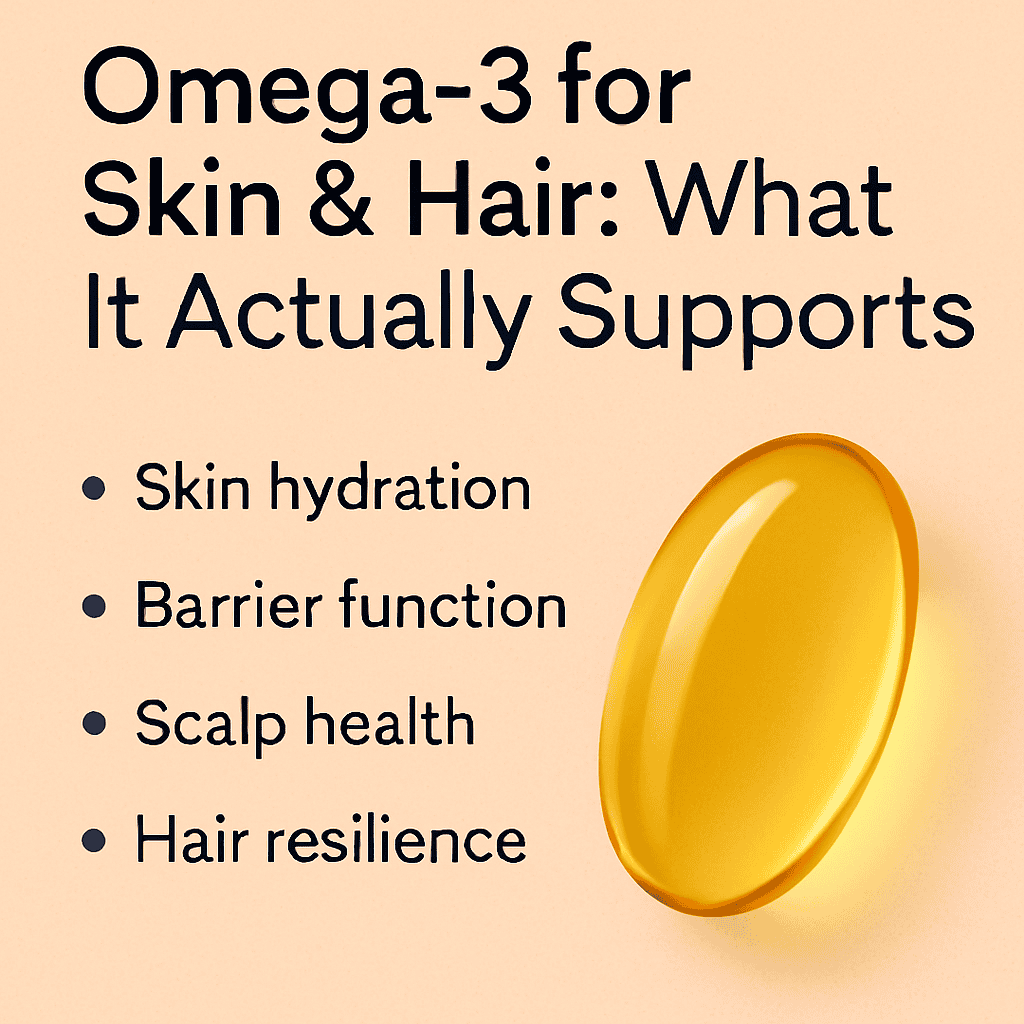
Omega-3 for Skin and Hair: What It Actually Supports
Omega-3 isn’t a topical—and it won’t “force” hair growth. If it helps, it usually shows up as less dryness, a steadier skin moisture barrier, and a calmer scalp baseline over time. Think structural support, not overnight change.
Intent: This page is about omega-3’s role in skin barrier comfort and scalp environment support (not acne treatment, not hair-loss diagnosis, not medical dermatology care).
Quick Take
If your diet is low in fatty fish and your pattern is dry skin + “reactive” weeks or dry/flaky scalp, omega-3 is a reasonable foundation lever. You’ll get the clearest answer by dosing based on EPA + DHA, taking it with meals, and judging trends over 8–12 weeks.
TL;DR decision: Use omega-3 for barrier comfort and scalp environment. Don’t use it to “treat” a rash, infection, or significant shedding without evaluation.
Parent Hub: Omega-3 Complete Guide
Benefits • dosing • EPA vs DHA • forms • timing • safety • troubleshooting (the full system view)
Skin + Scalp Omega-3 Decoder
Match your pattern → choose the first lever → run a clean test.
| Pattern you feel | Most likely lever | Why | Best next step (today) |
|---|---|---|---|
| Dry, tight skin in cold/dry seasons | Omega-3 (EPA+DHA) + barrier basics | Supports lipid-related barrier biology and steadier baseline signaling | Start daily EPA+DHA with a meal; keep moisturizer routine stable |
| Skin “reactive days” (irritated, sensitive weeks) | Omega-3 + consistency | May support inflammatory signaling balance over time | Track “irritated days” weekly for 8 weeks |
| Dry/flaky scalp baseline (not sudden infection) | Omega-3 + scalp routine stability | Supports “soil” (scalp environment) more than “plant” (growth) | Keep shampoo/actives stable; track itch/flakes weekly |
| Sudden rash, oozing, pain, infection signs, or rapid shedding | Medical evaluation | Not a supplement problem until red flags are ruled out | Seek clinical guidance; don’t delay care with “supplement testing” |
Clean test protocol
This keeps results readable (and prevents the “I changed 6 things” problem).
Inputs
- One omega-3 product with clear EPA + DHA
- Take with the same meal daily
- Keep skincare/shampoo stable
Duration
8 weeks minimum (12 weeks is ideal for scalp/hair feel).
3 metrics
- Skin tightness (1–10 weekly)
- “Irritated days” count (weekly)
- Scalp dryness/itch (1–10 weekly)
Stop conditions: new rash/swelling, infection signs, worsening pain, concerning bleeding/bruising, or any symptom that feels medical rather than cosmetic.
Does omega-3 help dry skin?
- Supports lipid-related barrier biology (the “keep water in” side)
- May support calmer inflammatory signaling over time
- Works best when baseline omega-3 intake is low
If omega-3 helps dry skin, it usually feels like less tightness and a steadier comfort baseline—not a dramatic “glow.” The most reliable way to judge is weekly tracking for 8+ weeks.
Who tends to notice it most: people who rarely eat fatty fish, and people whose dryness worsens with seasonal/weather swings.
Can omega-3 improve skin barrier and hydration?
The skin barrier is partly lipid-based. Omega-3 supports “inside-out” infrastructure while moisturizers work “outside-in.” When you use both consistently, the barrier often behaves more predictably.
What to look for
- Less “tight skin” days
- Fewer reapplications needed
- Lower reactivity during stress/weather
Time window
4–12 weeks, judged by trends (weekly), not daily fluctuations.
Does omega-3 help a calmer-looking complexion?
Sometimes—especially if your issue is a “reactive baseline.” Omega-3 is not a treatment for a diagnosed skin condition, but it may support steadier signaling over time.
Track this instead of guessing: weekly “irritated days” count + a 1–10 comfort score.
Does omega-3 help hair growth or hair thickness?
Omega-3 is better framed as scalp environment support than a hair-growth switch. If dryness and irritation are the driver, hair can feel more resilient over time. If hormones, iron, thyroid, or genetics are primary, omega-3 won’t override them.
Soil vs plant: omega-3 can support the “soil” (scalp comfort), not guarantee the “plant” (growth rate).
How much omega-3 should I take for skin and hair?
Plan by EPA + DHA combined (not “fish oil mg”). For skin/scalp goals, consistency and tolerance usually matter more than aggressive dosing.
Dose reality check
- Read the label: find EPA mg + DHA mg per serving.
- Take with food: tolerance and absorption usually improve.
- Judge trends: 8–12 weeks for skin/scalp signals.
If you take anticoagulants/antiplatelets, have a bleeding disorder, or have surgery planned, confirm omega-3 dosing with a clinician.
Which omega-3 is best for skin and hair?
The best omega-3 is the one you’ll take consistently at a clear EPA + DHA dose. “High potency” mainly helps by reducing capsule count (which improves adherence).
Premium potency (fewer capsules)
Useful if you want “less capsules, more clarity” and consistent daily intake.
Convenience pick (habit-friendly)
Best if easy reordering and routine simplicity drive consistency.
If you choose to purchase through these links, it may support this site at no extra cost to you.
Why omega-3 isn’t helping your skin or hair
Most “no change” outcomes come from one of three things: underdosing EPA + DHA, inconsistent use, or expecting cosmetic-speed results. Omega-3 works through slower structural and signaling changes.
Common mistakes
- “Fish oil 1000 mg” with low EPA + DHA
- Taking it sporadically
- Taking without meals → burps/GI → quitting
- Changing multiple skincare/hair variables at once
How to tell it’s working
- Skin: less tightness + fewer “irritated days” (4–8 weeks)
- Scalp: less dry/flaky baseline (6–12 weeks)
- Hair feel: less brittle “dryness feel” (8–12 weeks)
Red flags / seek care
- Rapidly worsening rash, oozing, severe pain, fever, or infection signs
- Sudden heavy shedding, patchy hair loss, scalp sores, or bleeding
- Concerning bruising/bleeding (especially on blood thinners)
- Symptoms that feel medical, not cosmetic
A clean 8-week test: one product • one meal daily • stable skincare • weekly tracking (tightness, irritated days, scalp comfort).
Selected Professional References
Primary sources and clinician-grade references used for definitions, safety, and evidence framing.
NIH ODS: Omega-3 Fatty Acids
Used for: definitions, safety notes, dosing context.
MedlinePlus: Fish Oil
Used for: safety, interactions, general evidence summaries.
PubMed: Omega-3 & Skin Hydration
Used for: clinical research trailheads (human trials).
PubMed: Omega-3 & Hair Outcomes
Used for: trial discovery (hair/scalp-related outcomes).
Go Deeper (VerifiedSupps Guides)
Four next reads that map directly to dose math, forms, and “is it working?” signals.
Final Takeaway
Omega-3 supports skin and hair best as a foundation nutrient: steadier barrier comfort, calmer baseline signaling, and a better scalp environment over time. Choose a clear EPA+DHA product, take it with meals, keep your routine stable, and judge trends over 8–12 weeks.
FAQ
Does omega-3 help dry skin?
It may support barrier comfort over time, especially when baseline omega-3 intake is low. Judge it by weekly trends, not daily changes.
How long does omega-3 take to help skin?
Many people judge skin comfort changes over 4–12 weeks of consistent EPA+DHA intake.
Does omega-3 help the skin barrier?
Omega-3 supports inside-out barrier biology while moisturizers work outside-in. Together can feel more stable than either alone.
Does fish oil help hair growth?
It’s better framed as scalp environment support than a growth switch. If dryness is the driver, hair can feel more resilient over time.
Should I take omega-3 with food?
Yes. Meals usually improve tolerance and absorption—especially if you’re burp-prone.
How do I know if my fish oil dose is high enough?
Look at EPA mg + DHA mg per serving. “Fish oil 1000 mg” is not the same as 1000 mg EPA+DHA.
Why isn’t omega-3 helping my skin?
Most often: low EPA+DHA, inconsistent use, or not enough time. Run an 8-week clean test with stable skincare before judging.
Who should be cautious with omega-3 supplements?
People on anticoagulants/antiplatelets, with bleeding disorders, or with surgery planned should consult a clinician before higher-dose use.