The Best Pump Stack: The Simple 4-Ingredient Formula That Actually Hits
(VerifiedSupps — human, simple, evidence-based)
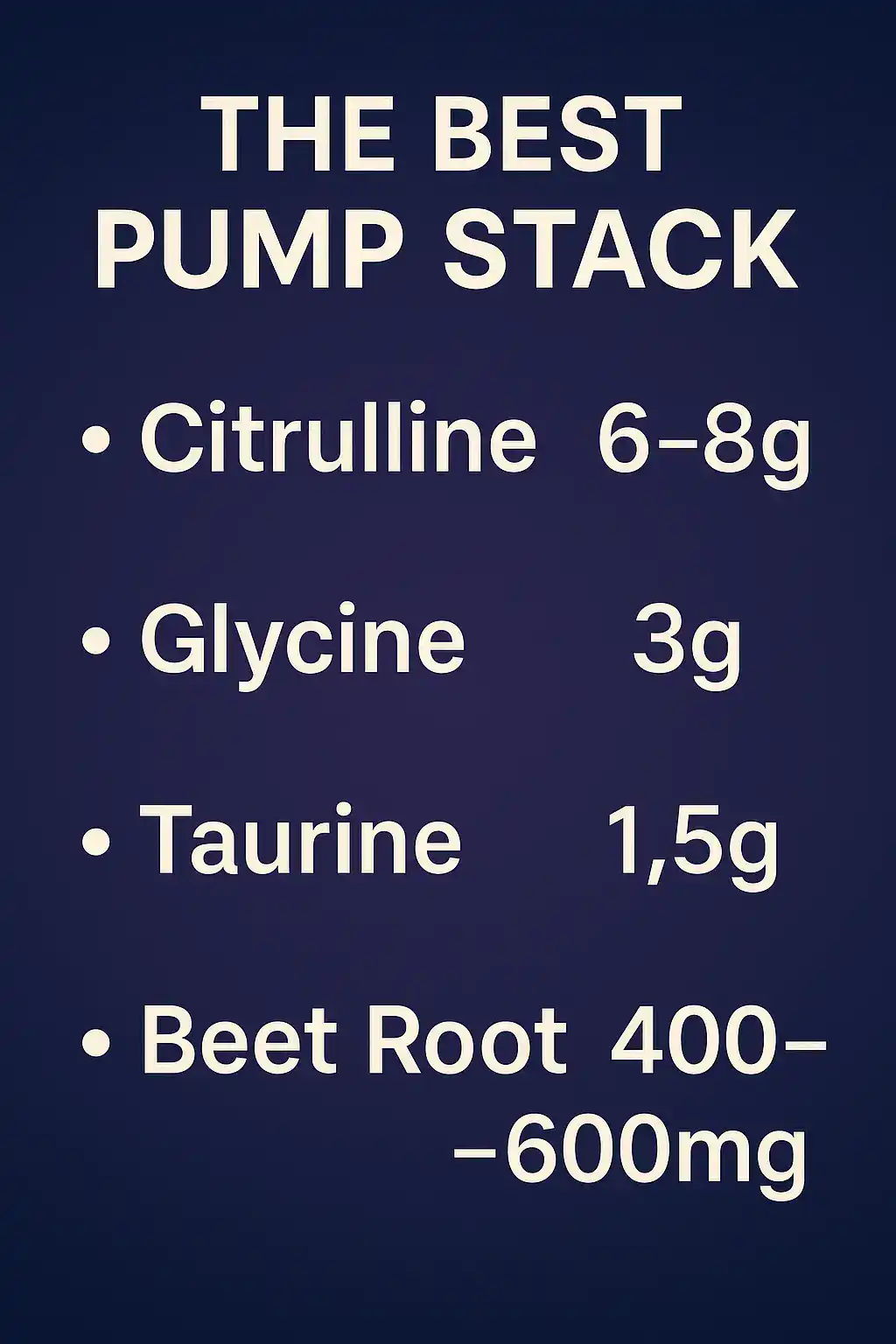
The most reliable “pump” comes from stacking ingredients that hit two nitric oxide pathways and support cell hydration. For most people, the simplest effective stack is L-citrulline + dietary nitrate (beet) + taurine + glycine, taken with the right timing and enough fluids.
Quick Take: Start here if your goal is a fuller pump without a complicated pre-workout label.
- L-citrulline: 6–8 g (most people notice this the most)
- Beet (nitrate): aim for a nitrate-standardized dose; timing matters
- Taurine: 1–2 g (cell hydration + contraction support)
- Glycine: 3 g (supportive add-on; not the primary driver)
Evidence note: citrulline and dietary nitrate have the strongest performance literature. Taurine has mixed-but-promising human data. Glycine is more “supportive” than “central.”
Parent Hub: L-Citrulline
The foundation ingredient for pump and blood-flow stacks: what it does, how to dose it, how to time it, and what to expect.
Open the citrulline hub →
What is the best pump stack for nitric oxide and blood flow?
For most lifters, the best simple pump stack is L-citrulline + dietary nitrate (beet) + taurine + glycine, because it supports blood flow through two nitric oxide pathways and improves the “fullness” side of the pump via cell hydration.
Constraint: the stack works best when you also nail timing, hydration, and training style (moderate-to-high reps with shorter rests produces more “pump signal” than low-volume strength work).
- L-citrulline: supports arginine availability (a precursor for nitric oxide signaling)
- Beet nitrate: supports the nitrate → nitrite → nitric oxide pathway (partly dependent on oral bacteria)
- Taurine: supports cell hydration and muscle function (helps the “full” feel)
- Glycine: supportive add-on (often included for tolerance and “smoothness,” with more indirect evidence)
Pump Stack Decoder: what to take, why it works, and when to take it
This is the “stealable” summary. If you only want the decision logic, use this and skip ahead to troubleshooting if needed.
| Ingredient | Best for | Not best for | Typical dose | Timing tip | Common issues |
|---|---|---|---|---|---|
| L-citrulline | Pump feel, blood-flow support, training “drive” | Expecting instant results at very low doses | 6–8 g | 30–60 min pre-workout | GI discomfort in some; benefits can be inconsistent |
| Beet (nitrate) | Endurance efficiency, sustained blood-flow signal | People sensitive to BP drops or on certain meds | Nitrate-standardized dose (often 300–600 mg nitrate equivalent) | Often works best 2–3 hours pre; some extracts can be closer | Mouthwash can blunt effect; may lower BP |
| Taurine | Cell hydration, cramp support, smoother contractions | Expecting it to replace citrulline/nitrate | 1–2 g | 30–60 min pre or daily | Usually well-tolerated; effects can be subtle |
| Glycine | Supportive add-on; “smooth” feel; recovery-friendly | If you want the minimal core stack | 3 g | 30–60 min pre or later in the day | Can be calming; direct pump evidence is less robust |
Label sanity check: for beet products, “mg of beet root” is not the same as “mg of nitrate.” If you want predictable results, look for nitrate-standardization or a clearly stated nitrate content.
How much L-citrulline should you take for a pump?
Most people start noticing a pump difference around 6–8 grams of L-citrulline, especially when taken 30–60 minutes before training.
Constraint: response is individual. Some studies show benefits while others find minimal acute effects—so treat citrulline as “high-probability, not guaranteed.”
- If 6 g feels like “nothing”: try 8 g and ensure you’re hydrated and training in a pump-friendly rep range.
- If it upsets your stomach: split the dose (for example, half earlier and half closer to training), or take with a small amount of food.
- If you train early: you can still use it, but avoid letting the stack replace sleep, fluids, and carbs if those are limiting you.
Form note (no hype): citrulline malate vs pure citrulline mainly changes what else you’re taking with it; your “pump feel” still comes down to total citrulline dose and timing.
Does beetroot work with citrulline or is it redundant?
It’s usually complementary, not redundant: citrulline supports nitric oxide signaling via arginine availability, while beet works through the nitrate → nitrite → nitric oxide pathway.
Constraint: beet’s pathway depends partly on oral bacteria. Heavy use of antibacterial mouthwash can blunt nitrate conversion, which can make beet feel “dead” even at good doses.
- Timing reality: nitrate often performs best when taken earlier (commonly 2–3 hours pre), while citrulline is commonly used closer (30–60 minutes pre).
- Performance angle: nitrate tends to show up more in endurance efficiency and oxygen cost than in a pure “vein pop” moment, although some people feel both.
- Practical tip: if you can’t time nitrate earlier, prioritize citrulline and treat beet as a “nice-to-have,” not the cornerstone.
Is taurine good for pumps or just hydration?
Taurine is mainly a hydration and muscle-function support ingredient that can make pumps feel rounder and more sustained, especially in higher-volume sessions.
Constraint: taurine is not a full replacement for citrulline or nitrate. It tends to “round out” a stack rather than drive the entire pump by itself.
- Dose: 1–2 g is a common practical range.
- When it helps most: high reps, shorter rests, sweaty sessions, fasted training, or if cramps/tightness shut pumps down.
- What to expect: less “spiky,” more “smooth” support—often noticed as better contraction quality and less fading.
Does glycine actually improve pumps and endurance?
Glycine is a supportive add-on more than a primary pump driver. Some people report better workout “smoothness” and endurance feel with 3 g, but the direct pump-specific evidence is less established than citrulline or dietary nitrate.
Constraint: if you want the minimum effective core, you could run citrulline + nitrate (and add taurine if hydration is limiting). Glycine is most useful when you want a simple fourth ingredient that’s generally well tolerated.
- Why it’s included: it’s easy to dose, tends to be gentle, and fits well in “clean” formulas.
- When it’s most noticeable: when your pump fades early due to tightness, stress, or poor recovery habits.
- Non-training bonus: many people use glycine later in the day for sleep quality, which indirectly improves training consistency.
When should you take a pump stack before a workout?
A simple timing strategy is citrulline + taurine + glycine 30–60 minutes pre-workout, and beet nitrate earlier when you can (often closer to 2–3 hours pre).
Constraint: if your training schedule is tight, it’s still fine to keep everything closer—but understand nitrate may be the ingredient that benefits most from earlier timing.
- Simple version: take the full stack, drink water, train.
- Best-practice version: nitrate earlier, the rest closer, and avoid antibacterial mouthwash around nitrate dosing.
- Hydration reality: a pump is partly fluids and electrolytes. If you’re under-hydrated, even a perfect stack can feel weak.
Why is my pump stack not working?
Most “this stack didn’t work” cases come down to timing, hydration, training variables, or nitrate conversion issues—not that the ingredients are useless.
Run this quick diagnostic in order (it catches the common misses fast):
- Hydration + sodium check: if you’re even mildly dehydrated, pumps flatten. Start with water and enough sodium for your sweat rate.
- Carb reality: very low-carb days often reduce pump fullness. Even a small carb meal earlier can change the feel.
- Timing mismatch: citrulline is typically used closer; nitrate often benefits from earlier timing. Adjust one variable at a time.
- Mouthwash issue (for nitrate): heavy antiseptic mouthwash use can blunt nitrate → nitrite conversion and reduce the “nitrate effect.”
- Dose too low: 2–3 g citrulline is commonly under-dosed for pump feel; many people need 6–8 g.
- Training doesn’t create a pump signal: heavy triples with long rest are great for strength, but they don’t reliably create a pump. Add a pump-focused finisher (moderate reps, shorter rest).
- Stimulants masking feedback: high caffeine can change perceived “connection.” If your pump is the goal, don’t over-stim yourself.
- Stop signals: dizziness, faintness, unusual palpitations, or severe headache are reasons to pause and reassess (especially if blood pressure runs low).
If your main issue is “citrulline doesn’t do anything for me,” that’s usually a dose/timing/training-variable problem—not a character flaw in the ingredient.
Is this pump stack safe for blood pressure and medications?
For healthy adults, these ingredients are commonly used and generally well tolerated, but a nitric oxide–supporting stack can lower blood pressure in some people—especially when nitrate is included.
Constraint: safety depends on your baseline blood pressure, medications, and medical history. If you’re prone to dizziness or already on blood-pressure support, start conservatively.
- Use extra caution if you take medications that affect blood pressure, or if your resting BP runs low.
- Avoid stacking aggressively with other strong vasodilators unless your clinician has cleared it.
- Kidney disease / pregnancy / breastfeeding: discuss with a clinician first (supplements aren’t automatically unsafe, but the risk/benefit is individual).
If you want the “cleanest” starting point, begin with citrulline alone for a week, then add nitrate or taurine next—one change at a time.
Selected Professional References
External links only. These are high-signal starting points for the evidence discussed above.
- Effects of Citrulline Supplementation on Exercise Performance (review) — summarizes mechanisms and mixed performance findings.
- Citrulline and endurance performance: systematic review & meta-analysis (PMC) — evaluates endurance outcomes and variability.
- Nitrate supplementation and exercise performance: systematic review & meta-analysis — classic overview of nitrate’s performance effect.
- Dietary nitrate supplementation and exercise-related outcomes (PMC) — mechanisms, oxygen cost, and practical considerations.
- Oral taurine dose and endurance performance (systematic review/meta-analysis) — assesses taurine’s effect across doses.
- Mouthwash and the nitrate–nitrite–nitric oxide pathway (PMC) — explains why antibacterial mouthwash can blunt nitrate bioactivation.
Go Deeper (VerifiedSupps Guides)
If you want the citrulline ecosystem (benefits, dosage, timing, forms), these are the best next reads.
L-Citrulline Benefits
What it actually does, who notices it most, and where the evidence is strongest.
Citrulline Dosage Guide
How much to take based on your goal, plus practical dosing mistakes to avoid.
Best Time to Take Citrulline
Timing that makes pumps hit earlier, with realistic expectations.
Citrulline Malate vs Pure Citrulline
Which form fits pumps vs endurance, and what labels often confuse people.
Final Takeaway
If your pumps are “hit or miss,” it’s usually not random—it’s usually timing, fluids, training variables, or nitrate conversion.
A clean, high-probability approach is 6–8 g citrulline plus a well-timed nitrate source, with taurine for hydration support and glycine as an optional stabilizer.
Start simple, change one variable at a time, and treat the stack as a tool—not a replacement for hydration, carbs, and smart training.
Frequently Asked Questions
How long does it take for a pump stack to kick in?
Citrulline-based effects are often felt within 30–60 minutes. Nitrate effects can be more timing-dependent and may work best when taken earlier. Hydration and training style can make the “kick-in” feel much faster or much slower.
Can you take L-citrulline and beetroot together?
Yes—many people combine them because they support nitric oxide through different routes. It’s not guaranteed to feel stronger for everyone, but it’s a logical pairing. If you feel dizzy or lightheaded, reduce doses and reassess timing.
Is 3 grams of citrulline enough for a pump?
For many people, 3 g is on the low side for noticeable pump effects. A common practical range is 6–8 g. If you’re sensitive, you can ramp up gradually rather than jumping straight to the high end.
Does mouthwash really reduce beetroot’s nitric oxide effect?
It can. The nitrate pathway relies on oral bacteria to help convert nitrate into nitrite, which then contributes to nitric oxide availability. Heavy use of antibacterial mouthwash may blunt this conversion, which can make nitrate products feel less effective.
Is taurine better for pumps or endurance?
It depends on your limiter. Taurine is often used for endurance feel and muscle function, and it can also help pumps by supporting cell hydration and smoother contractions. If your pumps fade because you cramp or tighten up, taurine may be especially helpful.
Can a pump stack lower blood pressure?
Yes, especially if it includes dietary nitrate and you’re sensitive or already have lower blood pressure. Start conservatively and pay attention to dizziness or lightheadedness. If you take blood-pressure medications or have a cardiovascular condition, check with a clinician first.
Should you take a pump stack fasted?
You can, but fasted training sometimes reduces pump fullness because glycogen and fluid shifts are different. If you train fasted and pumps feel flat, try more fluids and sodium, or experiment with a small carb intake earlier and see if the pump becomes more reliable.
How long does the pump effect last?
Many people feel the strongest pump window for 1–3 hours, but it varies with training density, hydration, and dosing. If your pump fades fast, the fix is often training structure (rest times, volume) as much as supplements.