Can You Take Magnesium With Antidepressants? Timing, Interactions, and Risks
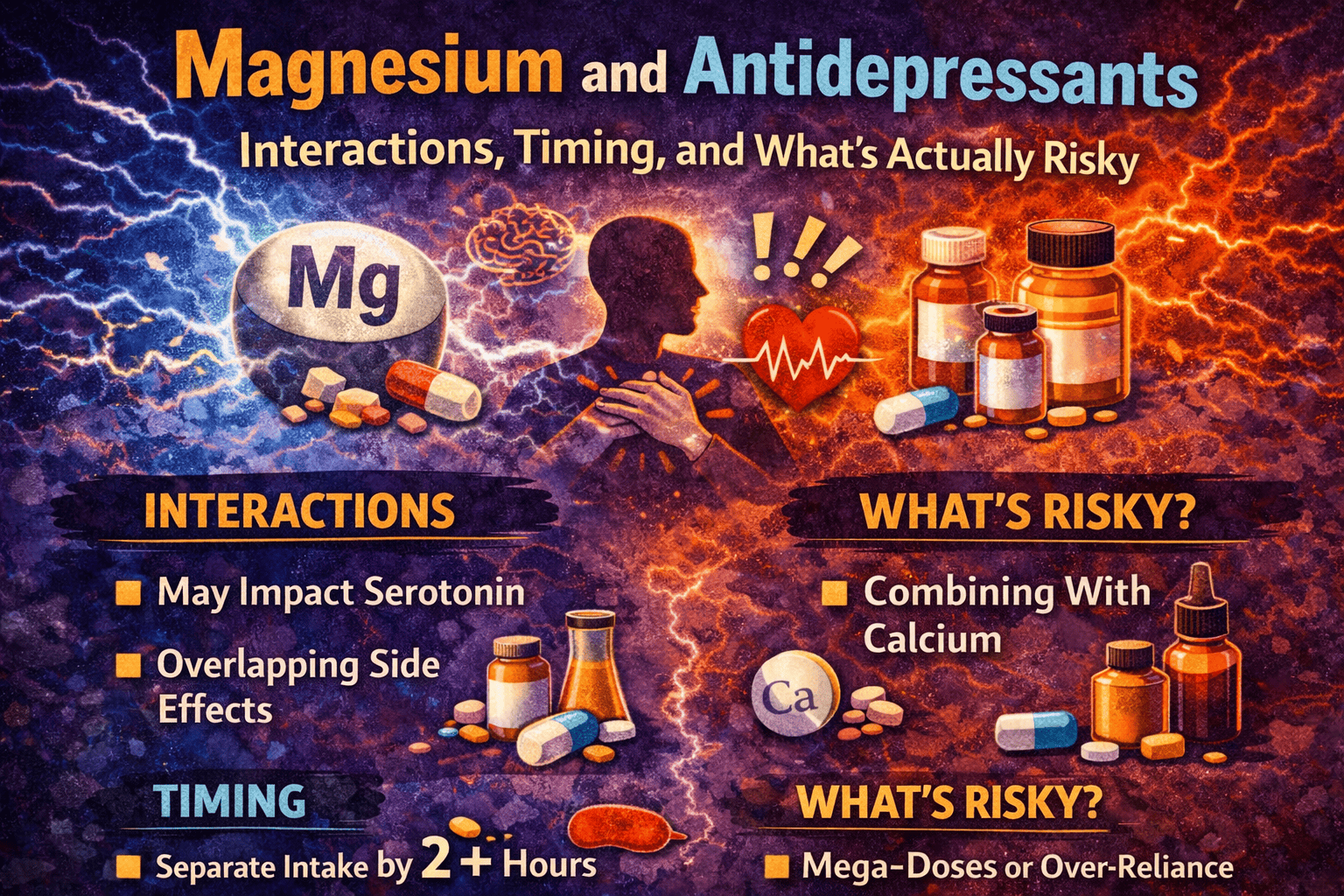
Direct answer: In most people, yes. Magnesium doesn’t usually “interact” directly with SSRIs the way some drugs do. Most concerns are about side effects overlap (sedation, GI effects) and timing/spacing—often because of other medications you take alongside an antidepressant.
If you’re asking “can you take magnesium with antidepressants?” this page is designed to match how people actually search: SSRIs vs SNRIs vs Wellbutrin, exact timing questions, “what’s actually risky,” and quick compatibility notes for common meds.
Quick Compatibility
Can you take magnesium with antidepressants?
For most people, yes. Magnesium is commonly used alongside antidepressants. The highest-yield things to get right are practical:
- Most concerns are about side effects overlap (sedation, GI effects) rather than dangerous interactions.
- The real timing issue is separation from certain medications (especially antibiotics and thyroid meds)—not usually the antidepressant itself.
- Start low and watch for additive sedation (especially if you already feel drowsy on your medication).
Is magnesium safe with SSRIs?
Usually, yes. Magnesium doesn’t usually “interact” directly with SSRIs the way some drugs do. When people feel worse, it’s most often GI intolerance, dizziness, or sleep changes that get interpreted as an “interaction.”
Is magnesium safe with SNRIs?
Usually, yes. The same patterns apply: overlap with GI effects, dizziness, sleepiness, or anxiety sensations. Keep changes clean during SNRI dose adjustments.
Does magnesium interact with antidepressants?
Most of the time, not in a dangerous “drug-drug interaction” way. Most concerns are about side effects overlap (sedation, GI effects) rather than dangerous interactions. The bigger risk category is indirect: magnesium can interfere with absorption of certain medications that bind minerals (external): MedlinePlus
What’s actually risky vs what’s mostly overblown?
When should I take magnesium if I take an antidepressant? (timing intent)
For many people, the simplest low-risk choice is magnesium with dinner or in the evening if your goal is sleep/tension relief. If you’re sensitive to sedation or vivid dreams, morning or earlier-afternoon magnesium can feel better.
Take with food if magnesium upsets your stomach. If you’re trying to avoid absorption/tolerance issues, separate by 2–4 hours (simple general guidance).
How many hours apart should magnesium and antidepressants be taken?
There isn’t one universal rule for every antidepressant, because magnesium doesn’t typically bind SSRIs/SNRIs in the gut. But spacing is still useful for two practical reasons: (1) reducing side-effect overlap confusion, and (2) creating a clean “trial” so you can see what magnesium changes.
Simple rule that works well in practice: separate by 2–4 hours if you’re trying to avoid absorption/tolerance issues. The real strict spacing is usually for other meds (thyroid hormone, certain antibiotics, bisphosphonates). External clinician-style overview: NIH ODS
SSRIs vs SNRIs vs Wellbutrin (what changes)
| Type | What people notice most | Magnesium strategy |
|---|---|---|
| SSRIs | GI changes early, sleep shifts, jitteriness vs fatigue variability | Start low and watch for additive sedation; avoid GI-active forms if you’re already nauseated |
| SNRIs | Similar overlap + sometimes more dizziness/activation feeling | Conservative dosing, stable timing; be careful stacking multiple calming agents |
| Wellbutrin | More “activating” feel for some; anxiety sensations can be amplified by GI discomfort | Prioritize GI-tolerable form; don’t add magnesium during dose changes if troubleshooting activation |
Common antidepressants (quick compatibility notes)
Magnesium and Zoloft (sertraline)
Usually compatible. Watch GI overlap early in treatment. If you’re already having nausea/diarrhea on sertraline, avoid GI-active magnesium forms and take with food.
Magnesium and Lexapro (escitalopram)
Usually compatible. The most common issue is symptom confusion (fatigue, dizziness, GI changes). Start low and keep timing consistent.
Magnesium and Prozac (fluoxetine)
Usually compatible. If you feel “wired,” assume overlap (caffeine, GI discomfort) before assuming a true interaction.
Magnesium and Celexa (citalopram)
Usually compatible. If you have personal QT risk history, discuss magnesium and electrolytes with your clinician (especially with rhythm symptoms).
Magnesium and Wellbutrin (bupropion)
Usually compatible. The common “problem” is activation/anxiety overlap plus GI sensations. Start low and avoid multiple changes at once.
Magnesium and Cymbalta (duloxetine)
Usually compatible. Monitor dizziness and sleepiness if you’re sensitive. Take with food if magnesium upsets your stomach.
Magnesium and Effexor (venlafaxine)
Usually compatible. Keep a clean trial: stable magnesium dose and timing, especially during medication changes.
Magnesium and Paxil (paroxetine)
Usually compatible. Watch for additive sedation (especially if you already feel drowsy). Start low and adjust slowly.
Magnesium and Trazodone
Usually compatible, but watch for additive sedation and next-day grogginess. If you feel over-sedated, move magnesium earlier or lower dose.
Magnesium and Amitriptyline (tricyclic)
Usually compatible, but tricyclics can increase sedation/dryness and sometimes affect rhythm in susceptible individuals. Keep dosing conservative and involve a clinician if you have heart/rhythm concerns.
Magnesium and MAOIs (rare but important)
Because MAOIs have broader interaction complexity, treat magnesium supplementation as “talk to your clinician first,” especially if you’re managing blood pressure or multiple medications.
Can magnesium cause serotonin syndrome?
Serotonin syndrome is typically driven by serotonergic medications and combinations—not magnesium. Magnesium is not considered a serotonergic drug. The practical risk is misattributing serious symptoms to supplements. If you suspect serotonin syndrome symptoms (fever, rigidity, severe confusion/agitation), treat it as urgent medical care.
Can magnesium worsen anxiety on antidepressants?
It can feel that way if magnesium causes GI discomfort, dizziness, or sleep disruption. Those sensations can be interpreted as anxiety—especially during early antidepressant adjustment. Keep changes clean, start low, and avoid stacking multiple calming or activating supplements at once.
Magnesium glycinate with SSRIs (is it okay?)
Usually yes. Glycinate is commonly chosen for tolerance and sleep support. If you’re sensitive to sedation, start low and watch for additive sedation—especially if you take your SSRI at night.
Magnesium and QT prolongation (is there a risk?)
Magnesium itself is not a classic QT-prolonging agent, but electrolyte status matters for cardiac rhythm. If you have a known QT issue, arrhythmias, fainting history, or are on multiple QT-relevant medications, discuss supplementation with a clinician—especially if you develop palpitations or near-fainting.
Magnesium and diarrhea while on antidepressants
This is common because antidepressants can affect GI function (especially early), and some magnesium forms (citrate/oxide) can add an osmotic/laxative effect. The fix is usually “take with food,” lower the elemental dose, split dosing, and choose a better-tolerated form.
Best magnesium form if you’re on antidepressants
| Goal | Often the best fit | What to watch |
|---|---|---|
| Sleep support | Glycinate (common choice) | Start low and watch for additive sedation |
| Anxiety sensitivity | Gentle, conservative dosing + stable timing | Symptom overlap can feel like “activation” |
| GI tolerance | Avoid GI-active forms if you’re already nauseated | Take with food if magnesium upsets your stomach |