L-Theanine for Calm Focus: What It Does, How to Take It, and What to Expect
L-theanine is a naturally occurring amino acid (best known from tea) that may support calm attention—often described as “relaxed but alert.” For many people, the most realistic benefits are a softer stress edge, smoother focus, and less caffeine tension (not a sedative, not a mood “flip switch”).
Quick Take: If you want the simplest starting setup, many people begin with 100–200 mg and adjust based on feel.
- Daytime calm focus: 100–200 mg (alone or with caffeine)
- Evening wind-down: 100–200 mg 60–120 minutes before bed
- If you feel “too calm”: use 100 mg and reassess
Evidence standard: we prioritize human trials, systematic reviews, and reputable clinical references when available.
Parent Hub: L-Theanine
Full guide: benefits, dosing, timing, safety, and what real-world users usually notice (without hype).
Open the L-theanine hub →
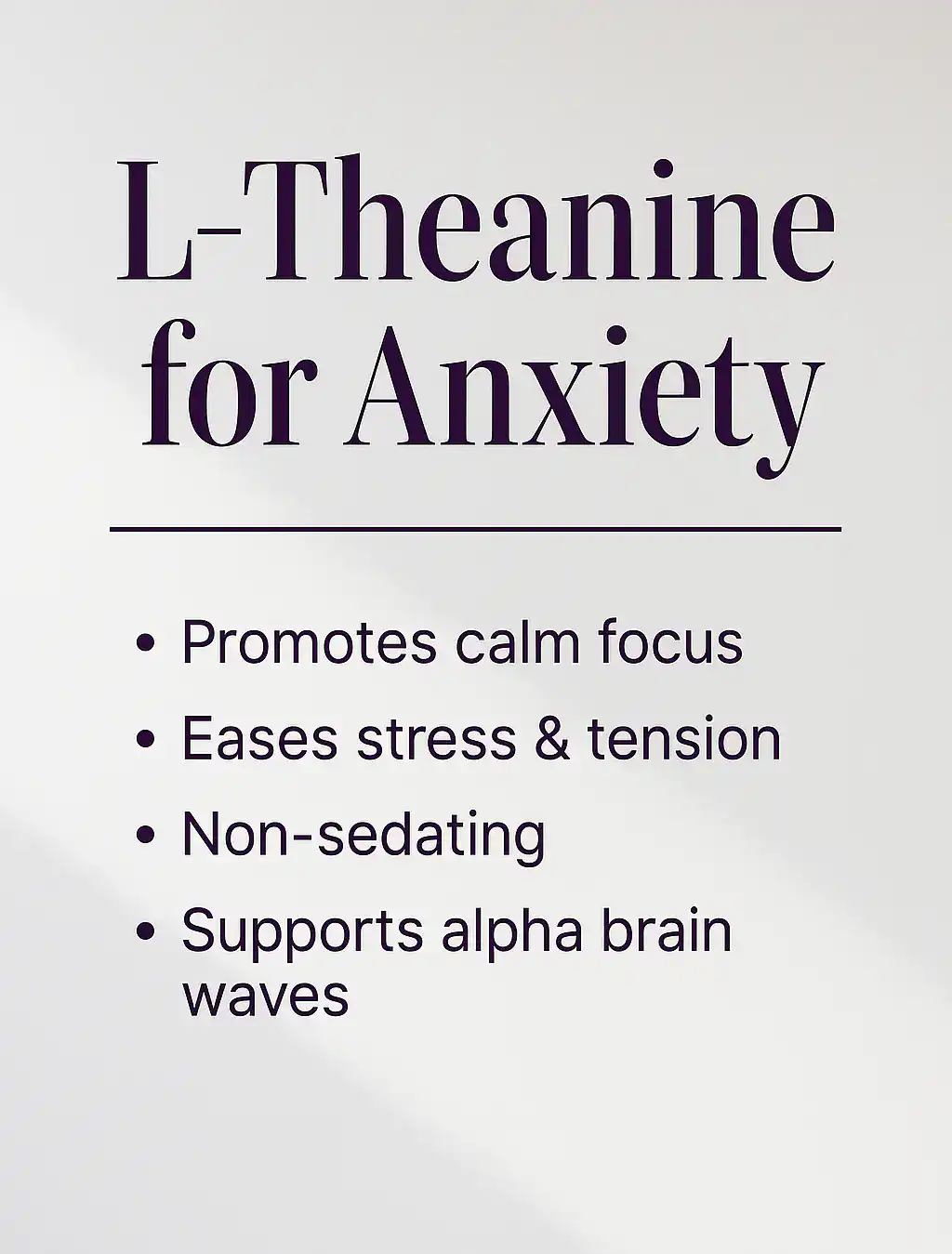
What does L-theanine do for anxiety and stress?
L-theanine is commonly used to support a calmer stress response and a more “even” mental feel. Many people describe it as turning down mental noise while keeping clarity intact—calm without feeling dulled.
| Use case | Typical starting amount | Timing | What to expect |
|---|---|---|---|
| Daytime calm focus | 100–200 mg | Morning or early afternoon | Smoother thinking, less edge, still alert |
| Stressful moments | 100–200 mg | 30–60 min before | Less “pressure,” more composure |
| Evening wind-down | 100–200 mg | 60–120 min before bed | Easier mental off-ramp; not usually sedating |
Decoder note: if your main issue is panic-level symptoms or severe functional impairment, supplements should be a clinician-informed add-on—not the main plan.
How does L-theanine work in the brain?
Human research suggests L-theanine can influence brain activity in a way that supports relaxed alertness (often discussed alongside “alpha” brainwave activity). It’s also studied for how it may support neurotransmitter balance involved in calm focus.
Constraint: mechanism is not destiny—your sleep, caffeine use, and stress load strongly affect what you feel.
- Practical translation: fewer sharp edges, more mental steadiness.
- What it’s not: a sedative, a stimulant, or a “numb” feeling.
How much L-theanine should I take for anxiety or calm focus?
A common practical range is 100–200 mg. Many people start at 100 mg to gauge sensitivity, then increase toward 200 mg if they want a deeper “smoothing” effect.
Constraint: higher isn’t always better. Some people feel best at the low end because it keeps the benefit without feeling too quiet.
Simple dosing ladder
- 100 mg: gentle smoothing (great first test)
- 150–200 mg: deeper calm focus
- 300 mg+: sometimes used in higher-stress contexts, but not automatically “better”
When is the best time to take L-theanine?
Timing depends on your goal: take it in the morning for calmer focus, or in the evening for an easier wind-down. Many people notice effects within about an hour.
Constraint: if you get drowsy, move it earlier or use a lower amount (like 100 mg).
- Daytime: morning or early afternoon
- Evening: 60–120 minutes before bed
- As-needed: 30–60 minutes before a stressful situation
Is L-theanine safe to take every day?
L-theanine is generally considered well tolerated for most healthy adults at commonly used amounts. The most common “side effect” reported is feeling a bit too relaxed—especially at higher doses or if you’re sensitive.
Constraint: if you are pregnant or breastfeeding, have a medical condition, or take prescription medications that affect the nervous system, discuss L-theanine with a clinician.
Common “too much” signals
- Sleepiness or low drive (reduce to 100 mg)
- Feeling “flattened” emotionally (use less or use it only situationally)
L-theanine with caffeine: does it reduce jitters and improve focus?
This is one of the most popular uses. Many people combine L-theanine with caffeine to get alertness while reducing the “sharp edges” (jitters, tension, racing thoughts) that caffeine can cause.
Constraint: if your caffeine dose is very high, L-theanine may help—but it won’t fully cancel overstimulation.
Simple pairing idea (common real-world pattern)
- With coffee: 100–200 mg theanine alongside your normal caffeine
- If you’re jitter-prone: lower caffeine first, then add theanine
Can L-theanine help with sleep or nighttime overthinking?
L-theanine is often used for sleep indirectly: not as a knockout, but as a way to make the mind easier to quiet. For people whose main barrier is mental overactivity, that can be meaningful.
Constraint: if your sleep problem is pain, sleep apnea, or severe insomnia, theanine should be a small supportive layer—not the only intervention.
- Common approach: 100–200 mg 60–120 minutes before bed
- Best fit: “wired but tired,” rumination, stress carryover
Why isn’t L-theanine working for me?
Most “it did nothing” experiences come from dose mismatch, expectation mismatch, or having a stress driver that needs a different lever (sleep debt, too much caffeine, high baseline anxiety, or life load).
- You expected a sedative: theanine is usually subtle. Judge it by mental smoothness, not “knockout.”
- Dose is too low (or too high): test 100 mg first, then 200 mg on a separate day.
- Caffeine is overpowering: if you’re very stimulated, reduce caffeine before blaming theanine.
- Timing is off: for events, take it 30–60 minutes before. For sleep wind-down, take it earlier (60–120 minutes).
- Too many changes at once: add theanine alone for a week so you can actually tell what it’s doing.
- Your main issue needs care: if symptoms are severe, persistent, or worsening, supplements should be clinician-guided support.
Clean test: Use 200 mg once daily for 7 days (same time each day), keep caffeine consistent, and track “mental edge” and sleep wind-down with a simple 1–10 note.
Selected Professional References
External links only. Use these as starting points to explore the human evidence and safety discussions.
- NIH PubChem: L-Theanine — basic compound overview and identifiers.
- PubMed: L-theanine and alpha wave (EEG) research — mechanistic human studies.
- PubMed: L-theanine for stress/anxiety trials — clinical studies and outcome measures.
- PubMed: L-theanine + caffeine and attention — combo studies on focus and performance.
- PubMed: L-theanine and sleep quality — sleep-related outcomes and tolerability.
- PMC: L-theanine safety discussions — open-access papers and reviews.
Go Deeper (VerifiedSupps Guides)
If you want practical use-cases and clean stack logic, these are the best next reads.
L-Theanine for Anxiety
How people use it for stress edge, racing thoughts, and calm clarity.
Caffeine + Theanine Stack
Calm focus, fewer jitters, and a cleaner attention curve.
Apigenin Benefits
A calm look at where apigenin fits for stress and sleep support.
The Perfect Sleep Stack
A simple nighttime framework (stack + timing + what to expect).
Final Takeaway
L-theanine is one of the cleaner “calm focus” tools: not sedating, not stimulating—just a softer internal edge for many people.
If you want a simple plan: start at 100 mg, move to 200 mg if needed, and match timing to your goal (daytime clarity or evening wind-down).
If symptoms are severe or persistent, treat supplements as support—not as replacement care.
Frequently Asked Questions
How long does L-theanine take to kick in?
Many people notice effects within about an hour. For daily baseline benefits, it’s often evaluated over a few days of consistent use rather than a single moment.
Can I take L-theanine every day?
Many people do. If you feel too relaxed or sleepy, reduce the dose or use it situationally rather than daily.
Does L-theanine lower blood pressure?
Some research explores stress-related physiological effects, but individual response varies. If you have low blood pressure or take BP medications, discuss use with a clinician.
Is L-theanine safe with caffeine?
It’s commonly paired with caffeine for smoother focus. If your caffeine dose is very high, consider reducing caffeine first and then adding theanine.
Can L-theanine make you sleepy?
It can, especially at higher doses or if you’re sensitive. If that happens, use 100 mg or move it to evening use.
Does L-theanine help with sleep?
It’s often used to make it easier to wind down, especially if overthinking is the main barrier. It’s not typically a sedative.
What’s a good starting dose of L-theanine for anxiety?
Many people start at 100 mg and increase to 200 mg if they want a stronger smoothing effect. The best dose is the one that helps without making you feel too quiet.
Can I take L-theanine with medications?
If you take prescription medications (especially those affecting mood, sleep, or anxiety), it’s best to discuss supplements with a clinician due to individual interaction risk and diagnosis context.