By VerifiedSupps Editorial Team
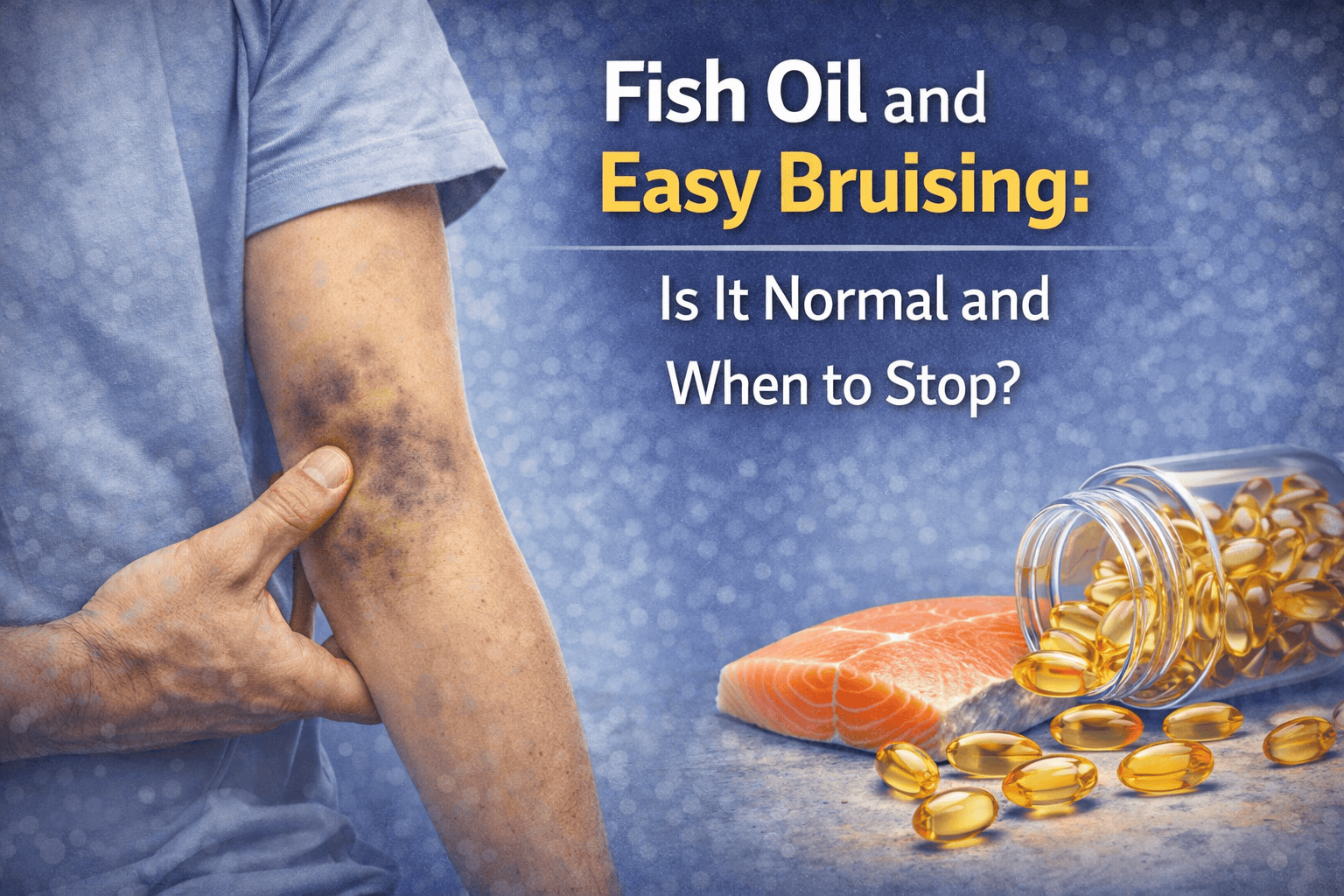
Fish Oil and Bruising: Is It Normal (and When to Stop)?
Maybe. Fish oil can make some people bruise a little more easily, especially at higher doses or when it is combined with aspirin, clopidogrel, warfarin, or other blood-thinning medication patterns. But that does not mean every bruise after starting fish oil is a dangerous bleeding problem.
The calmer way to think about it is this: a small bruise after an obvious bump is very different from frequent unexplained bruises, large dark bruises, bruising that is getting worse, or bruising that comes with nosebleeds, gum bleeding, black stools, or blood-thinner use. This page helps you separate those situations quickly.
This page is specifically about bruising from fish oil and when to stop. It is not the broad omega-3 benefits page, the general side-effects page, or a replacement for medical advice if bleeding symptoms look significant.
Key terms: fish oil, omega-3, bruising, easy bruising, bleeding risk, aspirin, warfarin, icosapent ethyl, EPA, DHA
Quick Take
A little easier bruising can happen, but it is not one of the most typical day-to-day fish oil side effects. Current evidence does not show that standard omega-3 supplements raise overall bleeding risk in most people, but high-dose purified EPA prescription therapy has a clearer bleeding signal, and bruising deserves more caution if you also use anticoagulants or antiplatelet drugs.
TL;DR decision
If bruising is small, explainable, and not getting worse, simplify the fish oil setup before panicking. If bruises are spontaneous, large, frequent, or come with other bleeding signs, stop and get medical advice instead of trying to “tough it out.”
Evidence standard: human trials, regulatory labeling, medication-safety guidance when available
Who this is for: people who started fish oil and are now noticing easier bruising or wondering whether it is a harmless nuisance or a stop sign
Who this is not for: anyone with major spontaneous bruising, black stools, vomiting blood, blood in the urine, severe nosebleeds, or other clearly dangerous bleeding symptoms
Author: VerifiedSupps Editorial Team
Reviewed by: VerifiedSupps Editorial Team
Published: March 24, 2026
Updated: March 24, 2026
Last reviewed: March 24, 2026
Parent Hub
Fish Oil Side Effects: What’s Normal and How to Fix It
Use the side-effects hub if bruising is only one part of a bigger tolerance question that also includes nausea, burps, reflux, diarrhea, or a general “fish oil is not agreeing with me” pattern.
Bruising quick decoder
This is the fastest way to decide whether you should keep watching, simplify the setup, or stop and escalate.
| What you’re noticing | What it most likely means | What to do today | Keep watching or stop? |
|---|---|---|---|
| A small bruise after a clear bump | Could be ordinary bruising, with fish oil only making it a little more noticeable | Review dose and medications, then watch the pattern | Usually watch |
| More bruising after increasing the dose | Dose or product context matters more than before | Drop back to the prior dose or pause completely | Usually pause or lower |
| Bruising while also on aspirin, NSAIDs, clopidogrel, warfarin, or another blood thinner | Higher-interaction context | Stop guessing and ask the clinician who manages the meds | Usually stop and check |
| Large unexplained bruises, bruises in clusters, nosebleeds, gum bleeding, black stools, or blood in urine | Not a normal “just keep taking it” situation | Stop the supplement and get medical advice urgently | Stop |
Best next step (today): If bruising seems dose-related or new, pause the supplement, review every medication and supplement that affects bleeding, and decide from there instead of continuing blindly.
Can fish oil actually cause bruising?
It can contribute, yes—but with an important nuance. Fish oil is better understood as having mild antiplatelet-type effects at higher doses than as being a true “blood thinner” in the same sense as prescription anticoagulants. That is why some people bruise a bit more easily while the overall bleeding-risk data for standard omega-3 supplements still looks fairly reassuring.
Mechanism
- Omega-3s can influence platelet aggregation and bleeding time.
- That effect does not automatically translate into dangerous bleeding in most standard supplement users.
- Bruising becomes more believable as a supplement effect when it begins after starting or increasing fish oil, especially if another bleeding-risk factor is also present.
Best interpretation: possible, but not the same as assuming fish oil is causing clinically important bleeding in everybody who takes it.
Is bruising from fish oil normal or a red flag?
It is better to think in patterns than in absolutes. Mild bruising after a clear bump can be a watch-and-review situation. But frequent unexplained bruises, bruises that are getting larger or more numerous, or bruising with other bleeding signs should push you out of “supplement optimization” mode and into “stop and check” mode.
Also remember that bruising is not one of the most typical fish-oil side effects listed by official sources. The usual side effects are things like burping, heartburn, stomach discomfort, diarrhea, nausea, and taste issues. That does not mean bruising cannot happen. It means you should take worsening or unexplained bruising more seriously than simple fishy burps.
Stop-and-check signs: spontaneous bruises, bruises in odd places, easy bruising that is clearly worsening, or bruising plus nosebleeds, gum bleeding, black stools, or blood in the urine.
Does fish-oil dose make bruising more likely?
That is one of the more credible explanations when bruising changes after you change the dose. NIH ODS notes that omega-3s in the 2 to 15 g/day EPA+DHA range can increase bleeding time, even though EFSA and FDA also concluded that combined EPA+DHA intakes up to about 5 g/day appear safe and have not been shown to cause bleeding problems when used as recommended.
This is where the prescription-versus-supplement distinction matters. The 2024 meta-analysis found no overall increased bleeding risk from omega-3 PUFAs broadly, but it did find a modest bleeding signal with high-dose purified EPA. That lines up with prescription icosapent ethyl labeling, which specifically warns about increased bleeding risk.
Practical rule: if bruising showed up after a dose increase—or if you are on a prescription high-dose EPA product—take the signal more seriously than if you are using an ordinary lower-dose mixed EPA/DHA fish oil.
Does fish oil interact with aspirin, warfarin, or surgery plans?
This is where context matters most. NIH ODS notes that fish oil can have antiplatelet effects at high doses and might prolong clotting times when taken with warfarin, even though most research suggests 3 to 6 g/day fish oil does not significantly change anticoagulant status in warfarin users. Prescription icosapent ethyl labeling goes farther by explicitly noting more bleeding in people using antithrombotic medications such as aspirin, clopidogrel, or warfarin.
For surgery, the modern evidence is more reassuring than older “always stop fish oil” rules imply. A large perioperative study found fish oil did not increase perioperative bleeding. Even so, this is not a reason to ignore the procedural team. Surgical instructions vary, and your medication mix matters.
Best rule: tell your clinician or surgeon exactly what you take, and let them make the procedural decision in context rather than using a one-line internet rule.
What should you do if fish oil seems to be causing bruises?
The first move is not to power through it. The first move is to simplify. Pause the supplement, review your dose, review every medication and supplement that also affects bleeding, and pay attention to whether the bruising pattern is obvious, mild, and explainable—or spontaneous and escalating.
If the bruising is mild and clearly tied to starting the supplement, a cautious restart at a lower dose may be reasonable only if you are not also on a blood thinner and you have no other bleeding signs. If you are on antiplatelets, anticoagulants, or have a bleeding-prone medical context, the smarter move is to ask the clinician managing those risks.
Safe default: stop first, sort the context second, then decide whether a lower-dose retry is even worth it.
Why does fish oil bruising happen, and how do you test it the smart way?
Most people do not need a complicated protocol here. They need a cleaner one. If bruising changed after fish oil, the goal is to reduce uncertainty, not create more of it.
Common mistakes
- Ignoring a dose increase and acting like nothing changed.
- Forgetting about aspirin, ibuprofen, clopidogrel, warfarin, or other overlapping bleeding-risk factors.
- Continuing the supplement after spontaneous or worsening bruising because the bottle says it is “heart healthy.”
Clean test protocol
| Inputs | Stop fish oil first, review all medications/supplements that affect bleeding, and only consider a lower-dose retry if the situation is clearly low-risk |
|---|---|
| Duration | Long enough to see whether the bruising pattern clearly settles before any retry |
| 3 metrics | Number of new bruises, whether bruises still appear after obvious bumps only, and whether any other bleeding signs show up |
| Stop conditions | Any spontaneous bruising, worsening bruising, nosebleeds, gum bleeding, black stools, blood in urine, or high-risk medication overlap |
How to tell it’s working
The best outcome is not “I pushed through it.” It is that the bruising pattern stops escalating, you stop getting unexplained new bruises, and the whole picture makes sense again.
Red flags / seek care
Seek urgent medical advice if bruising is spontaneous, large, rapidly worsening, or comes with nosebleeds, gum bleeding, coughing or vomiting blood, black stools, blood in urine, chest symptoms, fainting, or severe weakness.
Selected Professional References
These are the main sources behind the bleeding-risk nuance, medication overlap, prescription EPA warning, and surgery guidance in this article.
Omega-3 Fatty Acids: Health Professional Fact Sheet
Best source here for antiplatelet effects at high doses, warfarin interaction context, common side effects, and the up-to-5-g/day safety framing.
Used for: dose nuance, bleeding-time context, med interactions
Bleeding Risk in Patients Receiving Omega-3 Polyunsaturated Fatty Acids
Most useful source for the key nuance: no overall bleeding-risk increase from omega-3 PUFAs, but a modest signal with high-dose purified EPA.
Used for: overall bleeding-risk reality check
Icosapent Ethyl Prescribing Information
Important because prescription purified EPA has a clearer labeled bleeding risk than standard mixed EPA/DHA fish oil supplements.
Used for: prescription EPA bruising/bleeding context
Omega-3 Fatty Acids: Drug Information
Useful for common side-effect context and the reminder that bruising is not one of the most typical everyday complaints.
Used for: common side effects and consumer guidance
Fish Oil and Perioperative Bleeding
Helpful for the surgery question because it found no increased perioperative bleeding from fish-oil supplementation overall.
Used for: surgery and procedure-related caution
Go Deeper (VerifiedSupps Guides)
These are the best next pages if bruising is only one part of a larger fish-oil or omega-3 decision.
Omega-3 Complete Guide
Best for the broad omega-3 picture if bruising makes you rethink the supplement entirely.
How Much Omega-3 Per Day?
Use this if bruising started after you increased the dose or are unsure what counts as “high.”
Is Fish Oil Safe to Take Every Day?
Best for the broader daily-safety question once bruising enters the picture.
EPA vs DHA: What Matters Most?
Useful because purified high-dose EPA is not exactly the same safety conversation as standard mixed EPA/DHA fish oil.
Final Takeaway
Fish oil and bruising is a real-enough question to respect, but not a reason to panic automatically. The smartest move is to separate mild, explainable bruising from spontaneous or worsening bruising, then simplify the supplement setup before you decide whether fish oil is truly the problem. If the pattern looks serious, stop and get checked rather than experimenting harder.
FAQ
Can fish oil really make you bruise more easily?
Yes, it can contribute in some people, especially at higher doses or when combined with blood-thinning medication patterns.
Does fish oil thin your blood?
Not in the same way prescription anticoagulants do, but it can have mild antiplatelet-type effects, especially at higher doses.
Is bruising a common fish-oil side effect?
Not really. The more typical official side effects are GI or taste-related issues like burping, nausea, heartburn, or diarrhea.
Does dose matter for bruising risk?
Yes. Higher intakes deserve more caution, and prescription high-dose purified EPA is a different conversation from a standard lower-dose fish-oil supplement.
Is bruising more likely if I take aspirin or warfarin?
Yes, that overlap matters more. This is a “check with the clinician managing those meds” situation, not a casual self-test situation.
Should I stop fish oil before surgery?
Research does not show a general perioperative bleeding increase from fish oil, but surgeons and procedural teams still need to know what you take. Follow their instructions, not generic internet rules.
Should I switch from fish oil to just eating fish?
That can be a reasonable move, especially if the supplement side-effect tradeoff is starting to feel worse than the benefit.
When is bruising from fish oil a reason to get checked?
When bruises are spontaneous, large, frequent, worsening, or mixed with other bleeding signs such as nosebleeds, gum bleeding, black stools, or blood in the urine.
What is the safest default if I am unsure?
Pause the supplement, review every bleeding-risk medication and supplement you use, and only retry lower if the situation clearly looks low-risk.
VerifiedSupps Medical Disclaimer
This article is for educational purposes only and does not replace medical advice. Fish oil and omega-3 supplements can affect bleeding-related questions differently depending on dose, product type, medication use, and underlying health status. Use clinician guidance if you take anticoagulants, antiplatelet drugs, or have a bleeding disorder, kidney disease, or upcoming procedure. Seek urgent medical attention for chest pain, fainting, severe weakness, black stools, blood in urine, vomiting blood, or sustained abnormal bleeding.