By VerifiedSupps Editorial Team
Semax Benefits: What It Helps With, Risks, and What the Evidence Actually Shows
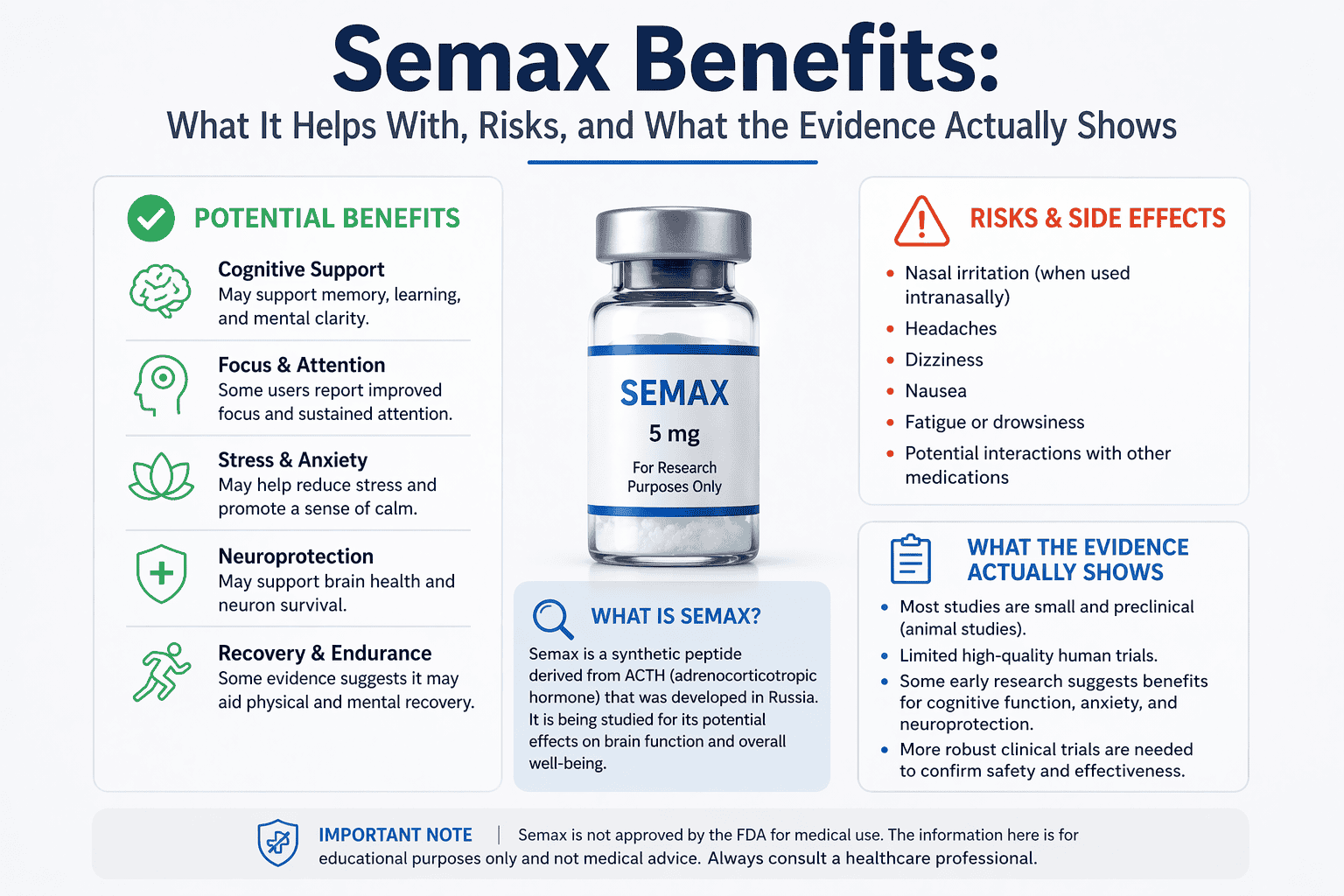
Semax is not a fake compound built from nothing. It is a synthetic heptapeptide analogue of ACTH(4–10) with a meaningful neuroprotection and neuroregulation story behind it. The problem is that the online version of Semax usually sounds much broader and much more proven than the actual human evidence supports.
The strongest human signal is not “limitless focus” or “brain upgrade” in healthy users. It is the older stroke and neurorecovery literature, plus a smaller set of human cognition or brain-network studies that are interesting but not close to modern gold-standard proof. In the U.S., the current regulatory story also is much less settled than the marketing usually implies.
This page is for the real Semax question: what it is, what it might actually help with, where the stronger evidence sits, and where the current safety and legal picture should make you slow down.
Key terms: Semax, ACTH(4–10) analogue, heptapeptide, intranasal Semax, cognition, stroke recovery, migraine, neuroprotection, nootropic
Quick Take
Semax makes the most sense as a neuroprotection and brain-recovery peptide with some smaller human signals around cognition and brain function. It makes much less sense as a proven “healthy-person nootropic” or routine Western wellness tool with a clean FDA-style safety and approval story.
TL;DR decision
Semax is more legitimate than many internet nootropic peptides, but less proven than many users assume. The strongest case is around stroke and neurorecovery-related use, while the healthy-cognition, focus, and broad brain-enhancement story is much thinner and more preliminary.
Evidence standard: human trials, dose ranges, guideline-level sources when available
Who this is for: people hearing about Semax for focus, cognition, stroke recovery, migraine, or “brain optimization” and wanting a cleaner evidence-based read
Who this is not for: anyone looking for gray-market sourcing, off-label dosing, or reassurance that online Semax is already medically settled
Reviewed by: VerifiedSupps Editorial Team
Last reviewed: April 20, 2026
Parent Hub
VerifiedSupps Articles
Use the broader article hub if you want a calmer framework before assuming every neuropeptide with a brain-health story is equally proven.
Quick decision table: what does Semax actually look strongest for?
This is the fastest way to separate plausible benefit from overextended nootropic marketing.
| If your real goal is… | Best current answer | Why | Best honest read |
|---|---|---|---|
| Stroke or neurorecovery support | Strongest lane | This is where most of the more serious human Semax discussion sits | Most credible use case |
| Healthy-person focus or cognition boost | Interesting but weak | Small human signals and brain-imaging data exist, but not a strong modern nootropic trial base | Preliminary, not settled |
| Migraine or trigeminal-neuralgia benefit | Unclear | FDA is reviewing these as proposed uses, but that is not the same as strong approval-grade proof | Watchful, not confident |
| Routine U.S. medical use | No | FDA says compounded Semax may pose immunogenicity risk and lacks sufficient safety information for proposed routes | Still a caution story |
Best next step (today): If you are evaluating Semax honestly, separate the stroke-recovery literature from the healthy-user nootropic story. Those are not equally strong evidence lanes.
Does Semax actually help focus, memory, or cognition?
Maybe, but this is the part of the Semax story that gets overstated fastest. There are small human signals and a plausible neurobiological story, but not the kind of large, modern, replicated trial base that would justify treating Semax like a proven mainstream cognition enhancer.
A commonly cited review says Semax has been found to stimulate memory and attention in rodents and humans after intranasal use. But that same broader evidence picture is still thin enough that secondary sources reviewing cognitive-aging evidence note there is little evidence for cognitive improvement in healthy patients and no good evidence for dementia or Alzheimer’s disease treatment or prevention.
Mechanism
- Semax is a synthetic ACTH(4–10)-related heptapeptide usually discussed for neuroprotective, nootropic, and neuromodulatory effects.
- The mechanistic literature often links Semax to neurotrophic and neuroprotective pathways, especially BDNF-related signaling.
- Interesting biology is not the same thing as strong healthy-user outcome proof.
What would change my recommendation: stronger controlled human cognition trials in healthy or mildly impaired populations that measure more than acute biomarkers or small surrogate effects.
Does Semax work for stroke or brain recovery?
This is the strongest clinical lane in the whole Semax discussion. If Semax deserves serious attention anywhere, it is here.
Human studies from the Russian literature suggest benefit in ischemic-stroke settings. A 2018 study in 110 patients after ischemic stroke reported that Semax increased plasma BDNF and was associated with faster functional recovery and better motor performance. Older reports also describe efficacy in acute hemispheric ischemic stroke. The important caution is that a lot of this literature is older, not widely integrated into Western mainstream practice, and not the same thing as a large global phase 3 program.
That still makes stroke and neurorecovery the strongest Semax use case. It just does not make it globally settled the way a widely approved modern stroke drug would be.
Is Semax useful for anxiety, depression, migraine, or other conditions?
This is where the story gets much softer. Semax is often discussed online as a broad mood, focus, and stress peptide, but the strongest human discussion still centers much more on stroke and neurorecovery than on clean psychiatric or healthy-performance use.
There are some interesting human brain-network findings. In one resting-state fMRI study, healthy volunteers receiving intranasal Semax showed detectable changes in default-mode-network organization relative to placebo. That is interesting mechanistically, but it is not the same thing as proving meaningful clinical improvement in anxiety, depression, ADHD, or real-world productivity.
The current FDA compounding-review agenda is also informative here. For the July 2026 PCAC meeting, the uses FDA reviewed for Semax-related bulk substances were cerebral ischemia, migraine, and trigeminal neuralgia. That tells you where nominators are trying to position it clinically right now. It does not mean those uses are approved or already strongly validated.
How is Semax used and what forms are people talking about?
The Semax literature is dominated by intranasal use. That matters because people often talk about Semax online like it is just another injectable peptide, but a lot of the better-known human and mechanistic work is centered on the nasal route.
That does not make all intranasal use automatically safe or standardized. It simply means the route matters. A peptide with a mostly intranasal clinical story should not be casually turned into a generalized injectable-nootropic story without evidence to support that jump.
The cleanest practical summary is: if you are reading Semax literature, check the route first. A lot of the meaning changes right there.
Is Semax safe and legal right now?
In the U.S., this is not a comfortable or routine safety story. FDA says compounded drugs containing Semax may pose immunogenicity risk for certain routes because of aggregation and peptide-related impurities, and the agency says it has no or only limited safety-related information for proposed routes of administration.
The current regulatory picture also is active, not settled. FDA has scheduled Semax-related bulk drug substances for discussion at the July 24, 2026 Pharmacy Compounding Advisory Committee meeting, and the April 2026 503A category update says Semax would be removed from Category 2 after seven days because the nominations were withdrawn, while FDA still intends to consult PCAC about possible inclusion of Semax-related bulk substances on the 503A bulks list.
That means Semax is not sitting inside a normal, calm, well-established U.S. drug framework. The current U.S. story is better described as regulatory review plus safety uncertainty.
What should you do before trying Semax?
The safest move is to stop treating Semax like a generic “smart peptide.” It is better to ask what problem you think it is solving and whether the evidence for that exact problem is actually strong.
Common mistakes
- Using stroke-recovery literature to justify healthy-person nootropic claims.
- Assuming interesting brain-network findings automatically mean meaningful real-world cognitive benefit.
- Ignoring route of administration and treating every Semax product like it belongs to the same evidence lane.
- Treating uncertain regulatory status and product quality as minor details instead of central safety issues.
Clean test protocol
| Inputs | A clear target problem, a clear distinction between stroke/neurorecovery evidence and healthy-user nootropic claims, and a realistic understanding of current U.S. safety uncertainty |
|---|---|
| Duration | Reassess when stronger modern human outcome trials appear or when U.S. regulatory status becomes clearer |
| 3 metrics | Whether the claim is supported by human data, whether the route matches the evidence, and whether the use case is clinical neurorecovery or healthy-user enhancement |
| Stop conditions | Any gray-market product, any blurred explanation of approval status, or any decision based mainly on nootropic hype instead of clinical context and safety |
How to tell it’s working
Right now, the better test is whether your framework got cleaner. A good evidence-based read should leave you less impressed by vague “brain peptide” claims and more focused on which indications actually have something resembling real human support.
Red flags / seek care
Seek medical care for severe swelling, rash, trouble breathing, chest pain, fainting, or strong reactions after using any unverified peptide product. Treat uncertain source quality itself as a safety problem, not a technicality.
Selected Professional References
These are the most useful sources for understanding Semax’s identity, the strongest current human lanes, and the still-active U.S. safety and regulatory picture.
FDA Risk Language for Semax
The most important official source for why the current U.S. safety story is not relaxed or routine.
Used for: immunogenicity, aggregation, impurity concerns, and limited safety information
July 2026 PCAC Meeting on Semax-Related Substances
Useful because it shows which uses FDA reviewed in current compounding policy discussions.
Used for: cerebral ischemia, migraine, and trigeminal-neuralgia context
Semax, an Analogue of ACTH(4–10), Is a Neuroprotective and Nootropic Drug
One of the clearest sources for the baseline Semax identity and the broad neuroprotection / nootropic framing.
Used for: ACTH-analogue identity and cognition / neuroprotection framing
Semax in Patients at Different Stages of Ischemic Stroke
One of the better human references for why stroke recovery remains the strongest Semax lane.
Used for: BDNF, functional recovery, and motor-performance context
Effects of Semax on the Default Mode Network of the Brain
Useful because it shows why Semax gets healthy-cognition attention, while also showing how small and indirect that evidence still is.
Used for: small human brain-network signal, not full clinical proof
Cognitive Vitality: Semax
Helpful because it cleanly summarizes the gap between healthy-cognition hype and the still-limited human evidence base.
Used for: “little evidence in healthy patients” and “no dementia evidence” context
April 2026 503A Category Update
Useful for the current policy context around Semax-related substances and why the U.S. compounding story still is unsettled.
Used for: current review status and policy uncertainty
Final Takeaway
Semax is one of the more interesting neuropeptides in this whole category because there actually is a meaningful human lane behind it. But that lane is mostly stroke and neurorecovery, not broad healthy-person brain enhancement. The cleanest conclusion is “real compound, real neurobiology, real interest — but still a much more limited and less settled evidence story than the internet version suggests.”
FAQ
What is Semax?
Semax is a synthetic heptapeptide analogue of ACTH(4-10) discussed for neuroprotective and nootropic effects, with much of the better-known human discussion centered on stroke and neurorecovery.
Does Semax actually help focus or cognition?
Maybe, but the evidence is still limited. There are small human signals and plausible neurobiology, but not a strong modern trial base proving reliable mainstream nootropic benefit in healthy users.
Is Semax strongest for stroke or brain recovery?
Yes. Stroke and neurorecovery are the strongest Semax evidence lanes in humans.
Does Semax help anxiety or depression?
That is much less clearly established. The strongest Semax human literature is not primarily about psychiatric treatment.
Does Semax help migraine or trigeminal neuralgia?
These are uses FDA reviewed in its current Semax-related policy discussion, but that does not mean those uses are already approved or strongly proven.
Is Semax usually studied intranasally?
Yes. A lot of the better-known human and mechanistic Semax literature centers on intranasal use.
Is Semax safe and settled in the U.S.?
No. FDA says compounded Semax may pose immunogenicity risk for certain routes and that the agency has no or limited safety-related information for proposed routes.
Is Semax an FDA-approved routine drug in the U.S.?
The current U.S. story is better described as ongoing regulatory and compounding-policy review rather than a settled routine-use framework.
Why does Semax get overhyped online?
Because interesting neurobiology and older stroke literature are often stretched into broad healthy-user nootropic promises that the human evidence does not fully support.
What is the safest way to think about Semax right now?
Treat it as a real neuropeptide with meaningful but uneven evidence, strongest in stroke and neurorecovery contexts and much less settled as a general nootropic or wellness product.
VerifiedSupps Medical Disclaimer
This content is for educational purposes only and is not medical advice. Semax is not a routine FDA-approved U.S. wellness or nootropic therapy, and the current compounded-product safety and regulatory picture remains unsettled. Interesting neurobiology and older clinical signals should not be confused with a proven general brain-enhancement protocol. Do not use unverified peptide products as a substitute for evidence-based medical care. Seek urgent medical care for severe swelling, rash, trouble breathing, chest pain, fainting, or strong reactions after using any unverified peptide product.