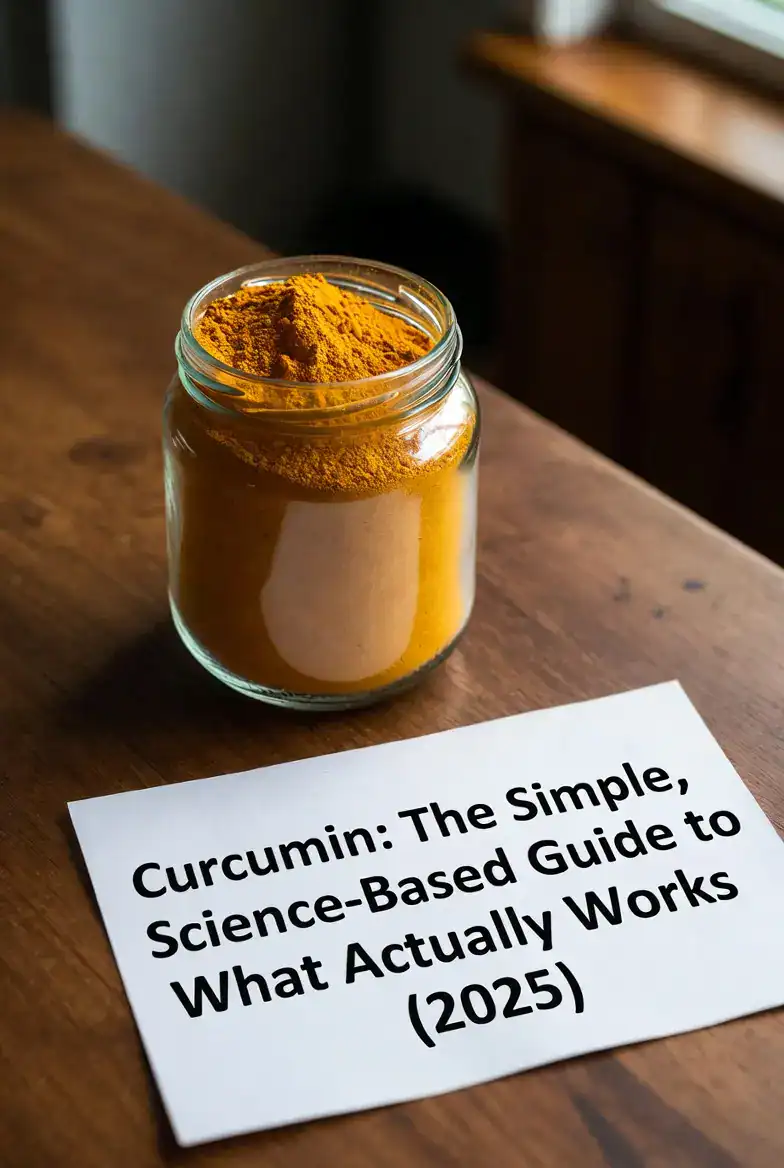
Curcumin: The Simple, Science-Based Guide to What Actually Works

download
Inflammation support · Joint comfort · Absorption matters · BCM-95 · Meriva · Longvida
Form Decoder

Curcumin: Which Forms Actually Absorb (BCM-95 vs Meriva vs Longvida)

Most curcumin “fails” are absorption fails. Generic turmeric powder (and many generic curcumin capsules) delivers so little usable curcumin that you can take it for weeks and feel nothing. If you want real odds of benefit, the decision is simple: pick a high-absorption delivery form and use it consistently with food.

Scope note (so we don’t cannibalize): this page is only about forms + absorption and how to choose between them. If you want the broader “what curcumin does” map, use the Curcumin Benefits hub.

Key terms: curcumin · turmeric · bioavailability · phytosome · BCM-95/Curcugreen · Meriva · Longvida · piperine
If this is you…
  • You tried turmeric/curcumin and got nothing.
  • You want a joint / tendon comfort lever that isn’t a stimulant.
  • You want a “quieter baseline” during heavy training or high-stress weeks.
Quick Take
  • Best overall default: BCM-95 / Curcugreen (whole-body comfort + recovery baseline).
  • Best joint-leaning pick: Meriva (phytosomal curcumin).
  • Brain + inflammation crossover: Longvida.
  • Most common reason “it does nothing”: wrong form or inconsistent dosing (especially empty-stomach dosing).
TL;DR decision: If you want a low-regret start, pick Meriva (joints) or BCM-95 (general). Take it with a fat-containing meal daily and judge the trend at 2–4 weeks.
🧭
Parent Hub: Curcumin Benefits
The full curcumin map (benefits, use-cases, dosing logic, safety). This page is strictly the “which form actually absorbs” decision guide.
Open the curcumin hub

Curcumin form chooser: pick the one that matches your goal

This is the fastest way to avoid the “took turmeric for months, nothing happened” loop.
Your pattern / goalBest first formTypical daily rangeWhen to judgeBest next step (today)
Joint stiffness, tendons, mobility “friction”Meriva~500–1,000 mg/day (product-dependent)2–4 weeksTake with a fat-containing meal; split AM/PM if needed
Whole-body recovery baseline, “less reactive” weeksBCM-95 / Curcugreen~500–1,000 mg/day (product-dependent)2–4 weeksPick one consistent meal and anchor dosing to it
Brain fog + inflammation crossover (niche)Longvida~400–800 mg/day (product-dependent)3–6 weeksDon’t “stack” new nootropics during the test window
Budget-constrained, still wants an absorption bumpCurcumin + piperine (check meds)Varies; start conservative2–4 weeksIf you take prescriptions, skip piperine until cleared
Best next step (today) if turmeric never worked: choose Meriva (joints) or BCM-95 (general), take it with a fat-containing meal daily, and judge the trend at day 14.

Which form of curcumin is best absorbed?

Cannibalization guardrail: if you’re comparing “curcumin benefits” broadly, this page is only about absorption forms and why they differ.
Mechanism (why absorption is the whole game)
  • Poor solubility: standard curcumin doesn’t dissolve well, so less gets absorbed.
  • Fast metabolism: what does absorb is often rapidly broken down.
  • Delivery fixes: phytosomes/turmeric oils/special matrices help curcumin survive long enough to matter.

In practice, the “best absorbed” forms are purpose-built systems like Meriva, BCM-95/Curcugreen, and Longvida—because they were designed to solve the absorption bottleneck.

BCM-95 vs Meriva vs Longvida: which should you choose?

Choose by your main problem. Don’t overthink the “best.” The best is the form you’ll actually take consistently at a meaningful dose.

BCM-95 / Curcugreen
Best “whole-body default” for comfort + recovery baseline.
Pick it if: you want one general curcumin form that actually absorbs.
Meriva (phytosome)
Most common “joints/tendons/mobility” pick.
Pick it if: stiffness and movement friction are your main complaint.
Longvida
Niche choice for “brain + inflammation crossover.”
Pick it if: your pattern feels cognition-driven and you can judge over weeks.

How much curcumin should I take for inflammation or joint pain?

People usually dose curcumin by the form (because delivery matters) and then keep it steady long enough to judge. A practical “real-world” range for high-absorption forms is often ~500–1,000 mg per day—but product standardization varies, so use the label’s standardized form guidance and start conservatively if you’re sensitive.

Dose rules that prevent mistakes
  • Start low → build: GI tolerance is the main limiter for many people.
  • Split dosing helps: AM/PM can feel smoother for joints.
  • Consistency beats timing: don’t “random dose” and expect a readable signal.

When should I take curcumin for best absorption?

Curcumin is fat-soluble and most people do best taking it with food—ideally a meal that contains some fat. If you’re using more than one capsule per day, splitting across meals can reduce GI issues and improve adherence.

Best default
Take with your most consistent meal (often dinner). Make it boringly repeatable.
If your stomach is sensitive
Start lower, take mid-meal, and split doses before you assume it “doesn’t agree with you.”

How long does curcumin take to work?

Curcumin is a “baseline” tool, not a stimulant. Many people judge early signals at 1–3 weeks (mobility, stiffness, recovery feel) and judge a more stable baseline at 4–8 weeks—especially for chronic patterns.

  • Week 1: sometimes subtle, sometimes nothing obvious (don’t overreact).
  • Weeks 2–3: easier to notice “less friction” in joints and warm-ups.
  • Weeks 4–8: best window to decide if it earns a permanent spot.

Should you take curcumin with black pepper (piperine)?

Piperine is sometimes used as a budget absorption boost. The trade-off is that piperine is also the ingredient most likely to raise “interaction questions” with certain medications. If you want a cleaner path, choose Meriva / BCM-95 / Longvida instead of leaning on piperine.

Practical rule: if you take prescriptions and you’re not sure about interactions, treat piperine as “check first.”

How to tell if curcumin is working

Don’t look for a “feeling.” Look for trend changes: warm-up quality, stiffness, recovery drag, and day-to-day comfort.

Clean test protocol
Inputs
  • 1 form (Meriva or BCM-95 or Longvida)
  • Take with a fat-containing meal
  • Keep training + sleep reasonably steady
Duration
21 days (minimum). If chronic pattern, extend to 6–8 weeks before final judgment.
Track 3 metrics
  • Morning stiffness (1–10)
  • Warm-up “unlock time” (minutes)
  • Next-day soreness drag (1–10)
Stop conditions
  • Significant GI pain that doesn’t settle with dose reduction
  • Any bleeding concern or pre-surgery instruction conflict
  • Allergic-type symptoms (hives, swelling, breathing issues)

Why curcumin isn’t working and what to do instead

  • You used turmeric powder / generic curcumin: switch to Meriva/BCM-95/Longvida.
  • You dosed inconsistently: anchor to one meal for 21 days.
  • You took it without food: add a fat-containing meal (often fixes “nothing happened”).
  • You changed 3 supplements at once: you made the result unmeasurable—run a clean test instead.
  • Your bottleneck isn’t inflammation: sleep debt, load management, or injury mechanics may be the real driver.
Red flags / seek care
  • New, severe, or worsening pain (especially swelling/redness/fever)
  • Bleeding concerns or you’re on anticoagulants/antiplatelets
  • Gallbladder disease symptoms or severe upper abdominal pain
  • Allergic reaction signs (hives, swelling, wheezing, trouble breathing)
Selected Professional References

External links (evidence + safety). Each tile includes what it was used for.

Frequently Asked Questions

Is turmeric the same as curcumin?
Turmeric is the whole spice; curcumin is one active compound within turmeric. Many “turmeric powders” contain relatively low curcumin and absorb poorly.
Does curcumin actually reduce inflammation?
Curcumin is studied for inflammatory signaling and comfort outcomes. Real-world results depend heavily on absorption form, consistency, and baseline diet/training stress.
Which curcumin form is best for joint pain?
Meriva (phytosome) is commonly chosen for joint/mobility patterns. BCM-95 is often chosen as the “whole-body default.”
How much curcumin should I take daily?
A common practical range for high-absorption forms is ~500–1,000 mg/day, but product standardization varies. Start lower if sensitive and judge trends over weeks.
Should I take curcumin with food?
Usually yes. Most people tolerate it better and absorb it more reliably when taken with a meal that includes some fat.
Does curcumin interact with blood thinners?
It can be a “check first” supplement in anticoagulant/antiplatelet contexts and around surgery. Use clinician guidance if you’re on prescriptions.
Why does curcumin upset my stomach?
Dose, empty-stomach dosing, and form choice are common reasons. Taking with food, starting lower, and splitting doses usually helps.
Is curcumin safe long term?
Many people use it long-term, but safety depends on dose, product quality, and medication context. If risk is higher (blood thinners, gallbladder disease, surgery), use clinician guidance.
Is curcumin safe if I have gallbladder issues?
Gallbladder/bile issues are a common “be cautious” category. If you have symptoms or diagnosed disease, discuss curcumin with a clinician before supplementing.
VerifiedSupps Medical Disclaimer
This content is for informational and educational purposes only and does not constitute medical advice. Supplements can affect individuals differently and may interact with medications and medical conditions. Consult a qualified healthcare professional before starting, stopping, or changing supplementation—especially if you are pregnant or breastfeeding, have gallbladder disease, take anticoagulants/antiplatelet medications, have upcoming surgery, or take prescription medications. Seek medical attention for severe, rapidly worsening, or concerning symptoms.

Related Articles

Health

MOTS-c Peptide: Why Biohackers Are Suddenly Talking About It

Mitochondrial peptide explainer Exercise-mimetic hype check By VerifiedSupps Editorial Team MOTS-c: Why Biohackers Are Suddenly Talking About It MOTS-c is getting attention because it hits a very specific biohacker nerve: it is a mitochondrial-derived peptide with animal data suggesting better insulin sensitivity, protection against diet-induced obesity, and exercise-mimetic effects. That combination makes it sound like

Read More »
Health

GHK-Cu for Skin and Hair: Benefits, Evidence, and Safety

Skin + hair evidence review Copper peptide reality check By VerifiedSupps Editorial Team GHK-Cu for Skin and Hair: Hype, Evidence, and Safety GHK-Cu is not pure hype, but it is also not as settled as the marketing often makes it sound. For skin, there is enough human signal to say topical copper peptide looks promising

Read More »
Health

Tesamorelin for Belly Fat: Does It Actually Reduce Visceral Fat?

Visceral fat reality check By VerifiedSupps Editorial Team Tesamorelin for Belly Fat: Does It Actually Reduce Visceral Fat? Yes, tesamorelin can reduce visceral abdominal fat in the right patients. But that answer is narrower than most people expect. The best-established use is not general obesity or cosmetic lower-belly fat. It is excess abdominal fat in

Read More »