CoQ10 Benefits: What It Does, Who It Helps Most, and How to Use It
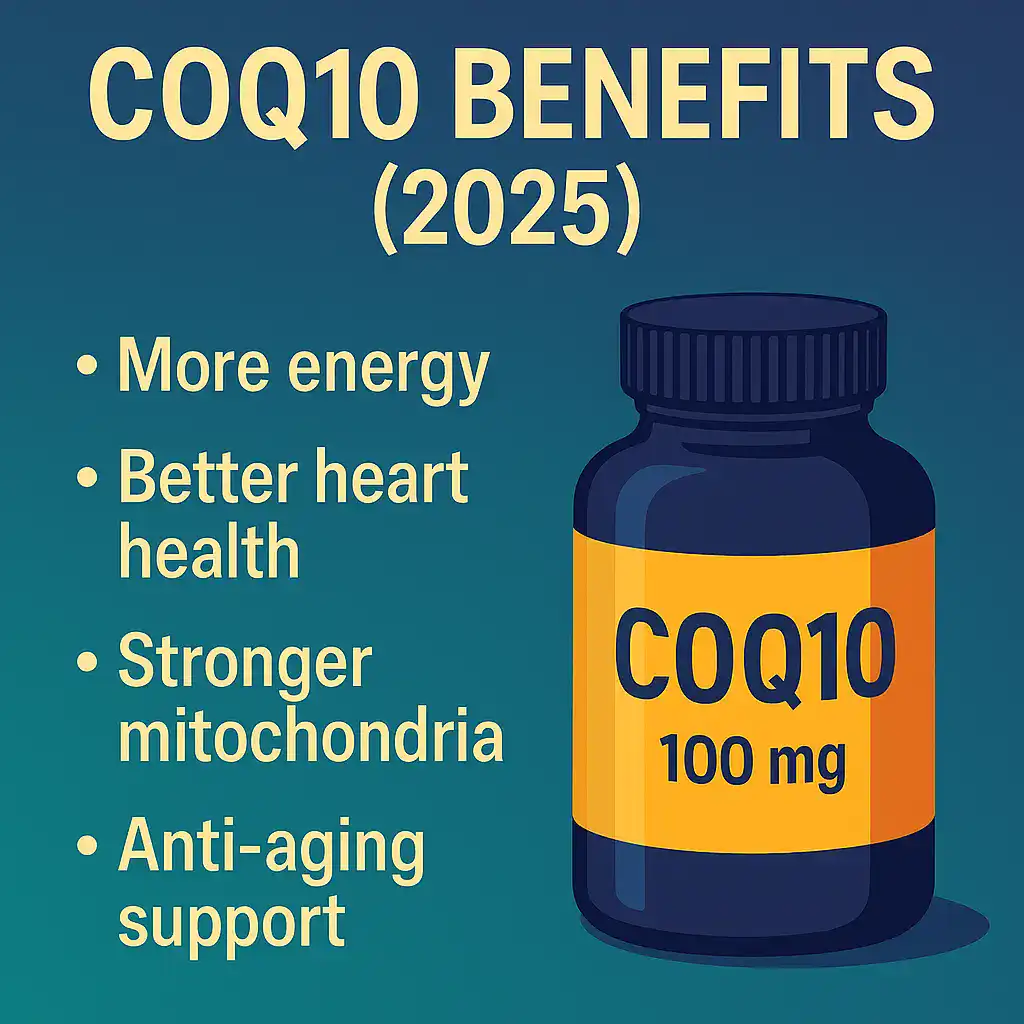
CoQ10 (coenzyme Q10) is a fat-soluble compound your cells use for energy production inside the mitochondria. Supplementing CoQ10 is most likely to help when your levels are lower (common with aging, statin use, or high energy demand). In healthy people with strong baseline energy, the effect can be subtle.
Quick Take: If you want a simple, evidence-aligned CoQ10 setup, start with 100–200 mg/day and take it with a meal that contains fat.
- Most noticeable for: low energy + statin users + older adults
- Form shortcut: ubiquinol is often chosen for older adults; ubiquinone can still work well
- Common reason it “does nothing”: inconsistent use or taking it without fat
Parent Hub: How to Choose Supplements Without Guesswork
A simple decision framework: what matters on labels, how to judge evidence, and how to build a clean baseline before you stack anything.
Open the supplement decision hub →
CoQ10 quick decoder: who it’s for, best form, and the simplest dose
CoQ10 is most worth taking when your cellular energy demand is high or your CoQ10 status is likely lower (aging, statin use, heavy training, chronic stress). If you already feel great, it can still be supportive—but it’s less likely to feel dramatic.
| If you are… | Most common reason to use CoQ10 | Practical starting setup | What you might notice |
|---|---|---|---|
| Low energy / fatigue-prone | Mitochondrial energy support | 100–200 mg/day with a fat-containing meal | Steadier energy (not a stimulant), better “baseline” |
| On statins | CoQ10 depletion concern + heart energy support | 100–200 mg/day; consider ubiquinol if older | Sometimes improved tolerance; results are mixed |
| Older adult | Natural decline in CoQ10 levels | Ubiquinol 100–200 mg/day with fat | Energy steadiness, exercise tolerance support |
| Training frequently | Recovery capacity + oxidative stress support | 100–200 mg/day with food; be consistent | Subtle: “less drained,” smoother output over weeks |
Most important absorption rule: CoQ10 is fat-soluble. Taking it without food (or without fat) is one of the biggest reasons people don’t notice it.
What is CoQ10 and what does it do in the body?
CoQ10 is a compound found in nearly all cells that helps drive ATP production inside mitochondria. You can think of it as one of the “working parts” that helps turn food energy into usable cellular energy.
Constraint: CoQ10 isn’t a stimulant. If it helps, it usually feels like a better baseline (less drag, steadier output) rather than a sudden surge.
- Energy role: supports mitochondrial electron transport and ATP production.
- Antioxidant role: helps protect lipids and cell membranes from oxidative stress.
- Why people supplement: levels may decline with age, and some medications (notably statins) are associated with lower CoQ10 status.
Does CoQ10 actually help with energy?
CoQ10 can help with energy most when mitochondrial output is a bottleneck—common in older adults, high-stress periods, high training load, or when CoQ10 status is reduced. For people already feeling excellent, the effect may be mild.
Constraint: if fatigue is driven by sleep debt, iron deficiency, thyroid issues, or low calories, CoQ10 won’t “override” those fundamentals.
- What people report: steadier energy, fewer afternoon crashes, better “get up and go.”
- What it should not feel like: caffeine, jitters, or a rush.
- Timeframe: many people evaluate it over 2–6 weeks of consistent use.
Is CoQ10 good for heart health?
CoQ10 is often discussed for heart support because the heart has extremely high energy demands. Clinical studies have explored CoQ10 as an adjunct in heart failure care and other cardiovascular contexts, with results that range from promising to mixed depending on the population and design.
Constraint: CoQ10 is not a substitute for medical treatment. If you have cardiovascular disease, supplementation decisions should be coordinated with a clinician.
- Why it’s plausible: mitochondrial energy support + antioxidant effects.
- Where evidence is discussed most: chronic heart failure adjunct research (including Q-SYMBIO).
- Practical approach: prioritize absorption (with fat) and consistency before judging results.
What’s the difference between ubiquinol and ubiquinone?
Ubiquinone is the “classic” form of CoQ10 and ubiquinol is the reduced form. Many people choose ubiquinol when absorption is a concern (often with older age), while ubiquinone can still work well—especially in good formulations taken with fat.
Constraint: “best form” is less important than (1) taking it with fat, (2) using a consistent dose, and (3) giving it a few weeks.
Simple decision rule
- Start with ubiquinol if you’re older, on statins, or want the “most conservative” absorption choice.
- Use ubiquinone if you tolerate it well, it fits your budget, and you’re consistent with fat-containing meals.
What is the best CoQ10 dosage and when should you take it?
A common practical range is 100–200 mg daily for general support, often taken with a meal that contains fat for absorption. Higher doses are sometimes used in clinical contexts, but dosing should match your goal and medical situation.
Constraint: if you’re on multiple medications or have cardiovascular conditions, discuss dosing with your clinician—especially at higher ranges.
- Best timing: with a meal that contains fat (breakfast or dinner—whatever is most consistent).
- If you feel “wired” late: move it earlier in the day (some people report mild alertness).
- If stomach is sensitive: split your dose (e.g., morning + evening with meals).
What are CoQ10 side effects and medication interactions?
CoQ10 is generally well tolerated, but it can cause mild GI symptoms in some people (nausea, stomach upset). The bigger issue is medication interaction risk—especially if you use blood thinners or blood pressure medications.
Constraint: “generally safe” does not mean “safe for everyone.” Your medications and diagnoses matter more than internet reassurance.
- Common side effects: stomach upset, nausea, appetite changes (often improved by taking with food).
- Blood pressure: CoQ10 may modestly affect blood pressure in some people—monitor if you run low.
- Anticoagulants/antiplatelets: discuss with a clinician (interaction concerns are commonly noted in clinical references).
- Statins: CoQ10 is frequently discussed as supportive, but evidence for statin-associated muscle symptoms is mixed.
Why am I not feeling CoQ10?
The most common reason people “feel nothing” from CoQ10 is simple: absorption and expectations. CoQ10 isn’t a stimulant—its effect is often gradual and baseline-driven.
- You’re taking it without fat: fix this first. Take it with a meal that contains fat.
- You didn’t give it time: evaluate over 2–6 weeks of consistent daily use.
- Your baseline is already strong: the better you already feel, the smaller the “noticeable delta” tends to be.
- Dose mismatch: if you’re at a very low dose, consider 100–200 mg/day as a practical starting range.
- Wrong target: if fatigue is driven by sleep, iron, thyroid, low calories, or stress overload, CoQ10 won’t fix the root cause.
- Too many changes at once: add CoQ10 alone first so you can actually attribute effects.
Simple test: Take 200 mg/day with a fat-containing meal for 30 days, track energy and training tolerance weekly (not daily), and reassess with a calm baseline comparison.
Selected Professional References
External links only. These cover mechanisms, safety considerations, and clinical research context.
- NIH NCCIH: Coenzyme Q10 — overview, uses studied, safety and interaction notes.
- Mayo Clinic: Coenzyme Q10 — practical summary of uses, safety, and common side effects.
- Q-SYMBIO trial (PubMed) — adjunct CoQ10 study in chronic heart failure context.
- CoQ10 for statin-associated muscle symptoms: meta-analysis (PubMed) — example of mixed results across trials.
- StatPearls (NCBI Bookshelf): Coenzyme Q10 — clinical overview including dosing ranges and interactions.
- National Cancer Institute: Coenzyme Q10 (PDQ) — safety/interactions emphasis and evidence limitations in certain claims.
Go Deeper (VerifiedSupps Guides)
If you want to dial in form choice, dosing, and foundational pairing, these are the most useful next reads.
Ubiquinol vs Ubiquinone
Which form fits your age, meds, and goals—without guesswork.
CoQ10 Dosage Guide
Goal-based dosing, timing, and what changes if you’re on statins.
NMN vs NR
A calm comparison of two common NAD+ pathways people ask about.
Omega-3: Is It Worth Taking?
Foundational support that pairs well with cardiovascular and recovery goals.
Final Takeaway
CoQ10 is not a hype supplement. It’s a cellular energy compound with real biological relevance—especially when levels are likely lower (aging, statin use, heavy demand).
If you want a clean, low-risk start: take 100–200 mg/day, take it with a fat-containing meal, and evaluate it over a few weeks based on energy steadiness and training tolerance.
If you’re on medications (especially blood thinners) or managing cardiovascular conditions, make CoQ10 a clinician-informed decision—not a guess.
Frequently Asked Questions
How long does CoQ10 take to work?
Many people evaluate it over 2–6 weeks of consistent daily use. It’s often a gradual baseline change rather than an immediate “kick.”
Should I take CoQ10 in the morning or at night?
Either can work. The most important factor is taking it with a meal that contains fat. If you feel mildly more alert from it, take it earlier in the day.
Is ubiquinol better than ubiquinone?
Ubiquinol is often chosen when absorption is a concern (commonly with older age). Ubiquinone can still be effective in good formulations. In practice, consistency and taking it with fat matter more than “perfect form.”
Does CoQ10 help with statin side effects?
CoQ10 is commonly used for this, but clinical evidence is mixed across trials. If you want to try it, do so with clinician awareness and track symptoms objectively rather than relying on day-to-day impressions.
What are the most common CoQ10 side effects?
Mild GI symptoms (nausea, stomach upset) are most common. Taking it with food often improves tolerability.
Can CoQ10 interact with medications?
Yes. CoQ10 is commonly flagged for potential interactions—especially with blood thinners and some blood pressure medications. If you take prescription medications, discuss CoQ10 with your clinician.
Do I need to cycle CoQ10?
Most people do not cycle it. If it helps, it’s typically used consistently. If you’re unsure, trial it for a defined period (e.g., 30–60 days), then reassess.
Should I take CoQ10 with food?
Yes—this matters. CoQ10 is fat-soluble, so taking it with a meal that contains fat improves absorption and is one of the biggest “make it work” steps.